
Spatial Intelligence Sensing Market Report 2026
Global Outlook – By Component (Hardware, Software, Services), By Technology (Computer Vision, Artificial Intelligence And Machine Learning, Three Dimensional Spatial Mapping, Sensor Fusion, Light Detection And Ranging And Depth Sensing), By Deployment Mode (On Premises, Cloud Based, Hybrid), By Application (Patient Positioning And Alignment, Patient Fall Detection And Prevention, Workflow And Asset Tracking, Operating Room Monitoring, Rehabilitation And Mobility Assessment, Other Applications), By End User (Hospitals, Diagnostic Imaging Centers, Ambulatory Surgical Centers, Rehabilitation Centers, Long Term Care Facilities, Other End Users) – Market Size, Trends, Strategies, and Forecast to 2030
Spatial Intelligence Sensing Market Report 2026 Market Overview
• Spatial Intelligence Sensing Market Report 2026 market size has reached to $1.8 billion in 2025 • Expected to grow to $4.09 billion in 2030 at a compound annual growth rate (CAGR) of 17.8% • Growth Driver: Increasing Demand For Patient Safety And Fall Prevention Fueling The Growth Of The Market Due To Rising Fall-Related Injuries Among The Aging Population • Market Trend: Increasing Adoption Of Advanced Sensing Technologies Accelerating Real-Time Spatial Awareness • North America was the largest region in 2025 and Asia-Pacific is the fastest growing region.What Is Covered Under Spatial Intelligence Sensing Market?
Spatial intelligence sensing refers to an integrated ecosystem of depth-sensing cameras, LiDAR sensors, and computer vision technologies that continuously capture and analyze spatial data within healthcare environments. By generating real-time three-dimensional insights into the movement and positioning of patients, healthcare personnel, and medical equipment, these systems enhance patient alignment, automate clinical workflow monitoring, optimize asset utilization, improve safety through fall detection, and support more efficient diagnostic and therapeutic procedures. The main components of spatial intelligence sensing include hardware, software, and services. Hardware refers to sensing devices, cameras, depth sensors, and edge computing equipment that capture and process spatial data to enable real-time environmental awareness and intelligent decision-making. These solutions utilize technologies such as computer vision, artificial intelligence and machine learning, three dimensional spatial mapping, sensor fusion, and light detection and ranging and depth sensing and are deployed through on premises, cloud based, and hybrid environments. They find application in patient positioning and alignment, patient fall detection and prevention, workflow and asset tracking, operating room monitoring, rehabilitation and mobility assessment, and others, serving end users including hospitals, diagnostic imaging centers, ambulatory surgical centers, rehabilitation centers, long term care facilities, and others.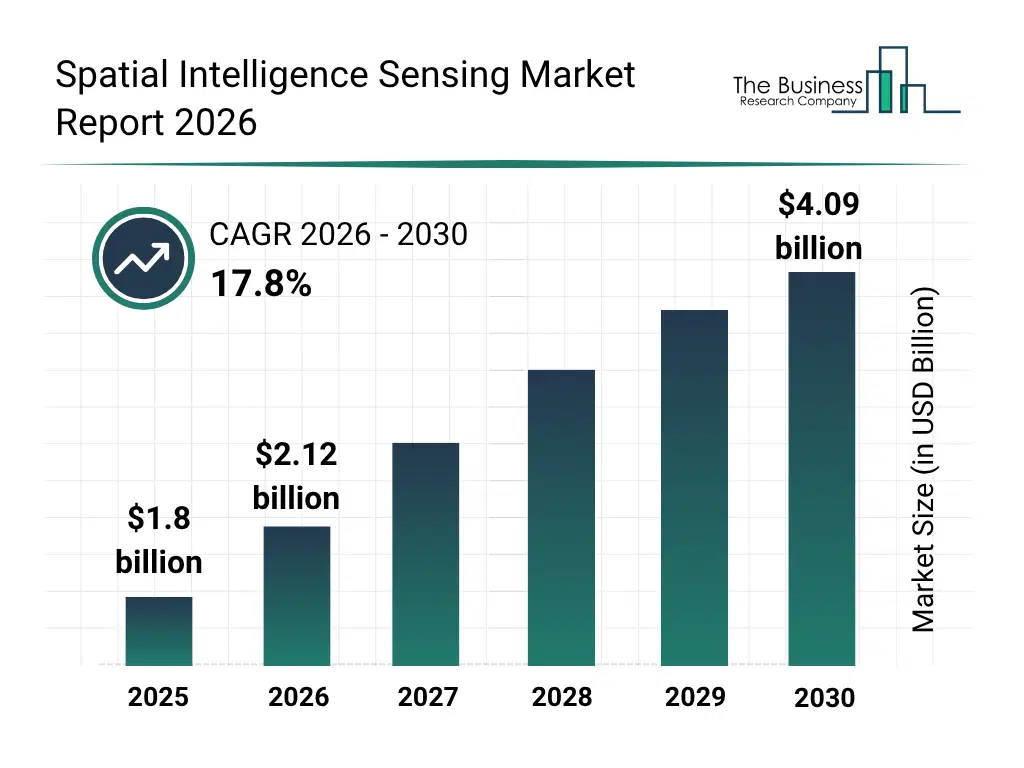
What Is The Spatial Intelligence Sensing Market Size and Share 2026?
The spatial intelligence sensing market size has grown rapidly in recent years. It will grow from $1.8 billion in 2025 to $2.12 billion in 2026 at a compound annual growth rate (CAGR) of 17.6%. The growth in the historic period can be attributed to growing adoption of digital healthcare infrastructure, increasing demand for patient safety solutions, rising investments in smart hospital technologies, expanding utilization of real-time asset tracking, increasing focus on clinical workflow optimization.What Is The Spatial Intelligence Sensing Market Growth Forecast?
The spatial intelligence sensing market size is expected to see rapid growth in the next few years. It will grow to $4.09 billion in 2030 at a compound annual growth rate (CAGR) of 17.8%. The growth in the forecast period can be attributed to growing demand for contactless patient monitoring, rising investments in intelligent healthcare infrastructure, increasing adoption of three-dimensional sensing technologies, expanding deployment of connected healthcare ecosystems, growing emphasis on operational efficiency in healthcare facilities. Major trends in the forecast period include increasing adoption of real-time patient monitoring systems, growing integration of contactless clinical workflow monitoring, rising demand for automated patient positioning solutions, expanding utilization of asset tracking across healthcare facilities, increasing focus on patient safety and fall prevention.
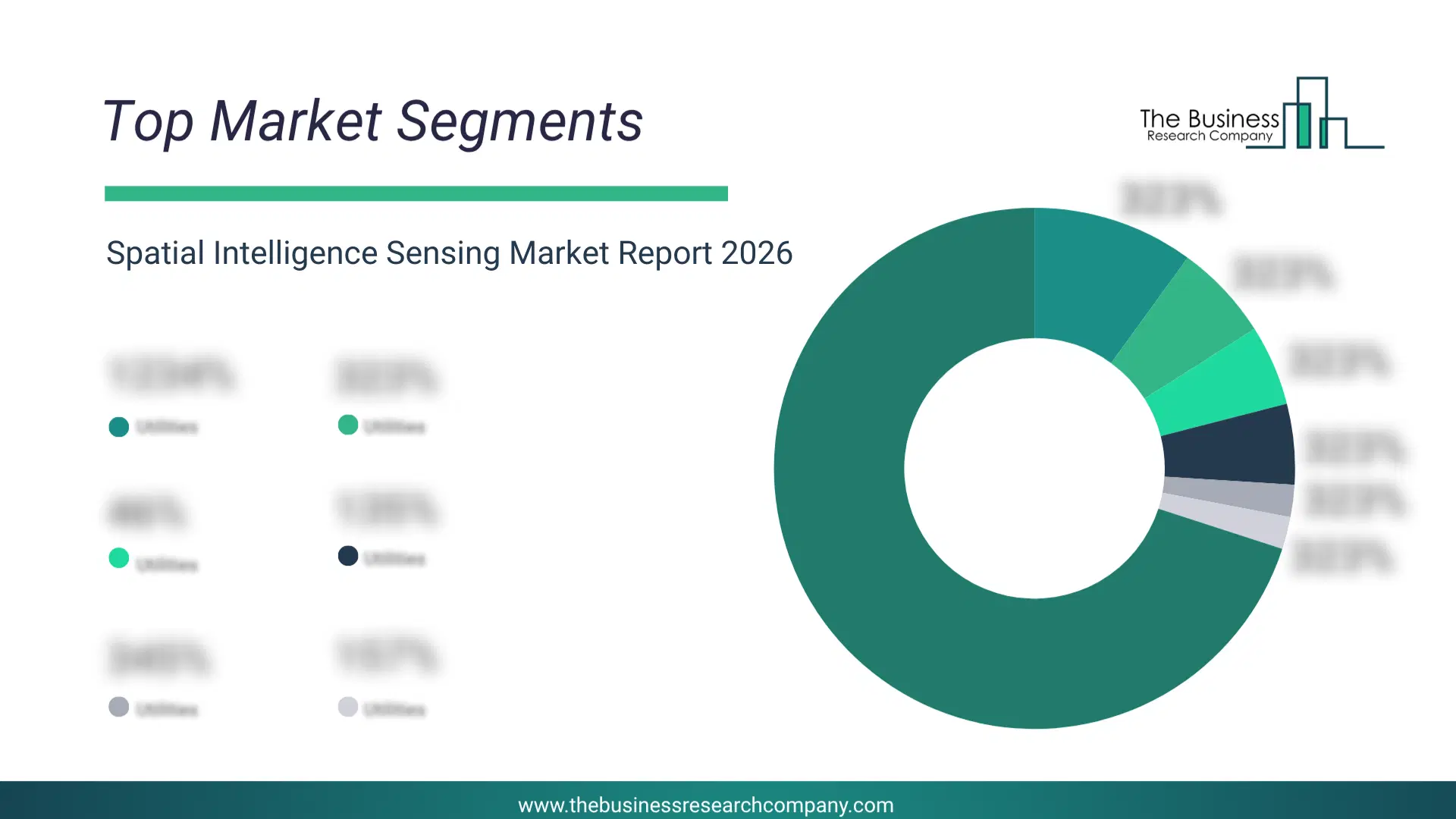
Global Spatial Intelligence Sensing Market Segmentation
1) By Component: Hardware, Software, Services 2) By Technology: Computer Vision, Artificial Intelligence And Machine Learning, Three Dimensional Spatial Mapping, Sensor Fusion, Light Detection And Ranging And Depth Sensing 3) By Deployment Mode: On Premises, Cloud Based, Hybrid 4) By Application: Patient Positioning And Alignment, Patient Fall Detection And Prevention, Workflow And Asset Tracking, Operating Room Monitoring, Rehabilitation And Mobility Assessment, Other Applications 5) By End User: Hospitals, Diagnostic Imaging Centers, Ambulatory Surgical Centers, Rehabilitation Centers, Long Term Care Facilities, Other End Users Subsegments: 1) By Hardware: Depth Sensing Cameras, Light Detection And Ranging Sensors, Time Of Flight Sensors, Stereo Vision Cameras, Edge Computing Devices, Processing Units 2) By Software: Computer Vision Software, Artificial Intelligence Analytics Platform, Three Dimensional Mapping Software, Sensor Fusion Software, Indoor Positioning Software, Data Visualization Software 3) By Services: System Integration Services, Consulting Services, Deployment Services, Maintenance And Support Services, Training Services, Managed ServicesWhat Is The Driver Of The Spatial Intelligence Sensing Market?
The increasing demand for patient safety and fall prevention is expected to propel the growth of the spatial intelligence sensing market going forward. Patient safety and fall prevention incorporate strategies, technologies, and clinical practices aimed at minimizing the risk of patient injuries, falls, and other adverse events across healthcare settings. The growing demand for patient safety and fall prevention is driven by the rising aging population, as older adults are at a significantly higher risk of falls, mobility impairments, and injury-related complications that require continuous monitoring and proactive preventive measures. Spatial intelligence sensing solutions help detect fall risks in real time, enabling timely intervention and reducing the likelihood of patient injuries. For instance, in June 2026, according to the Australian Institute of Health and Welfare (AIHW), an Australia-based government agency, Australians aged 65 years and over were almost 12 times more likely to be hospitalized due to a fall than adults aged 25–44 years in 2023–24, highlighting the substantial burden of fall-related injuries among older adults. Therefore, the increasing demand for patient safety and fall prevention is driving the growth of the spatial intelligence sensing industry.Key Players In The Global Spatial Intelligence Sensing Market
Major companies operating in the spatial intelligence sensing market report are Microsoft Corporation, Intel Corporation, Sony Semiconductor Solutions Corporation, Canon Inc., Zebra Technologies Corporation, Omron Corporation, Hesai Technology Co. Ltd., RoboSense Technology Co. Ltd., NEC Corporation, Aeva Technologies Inc., Ambarella Inc., Ouster Inc., Vayyar Imaging Ltd., Artisight Inc., Orbbec Inc., Stryker Corporation, VirtuSense Technologies, Kepler Vision Technologies, Ocuvera LLC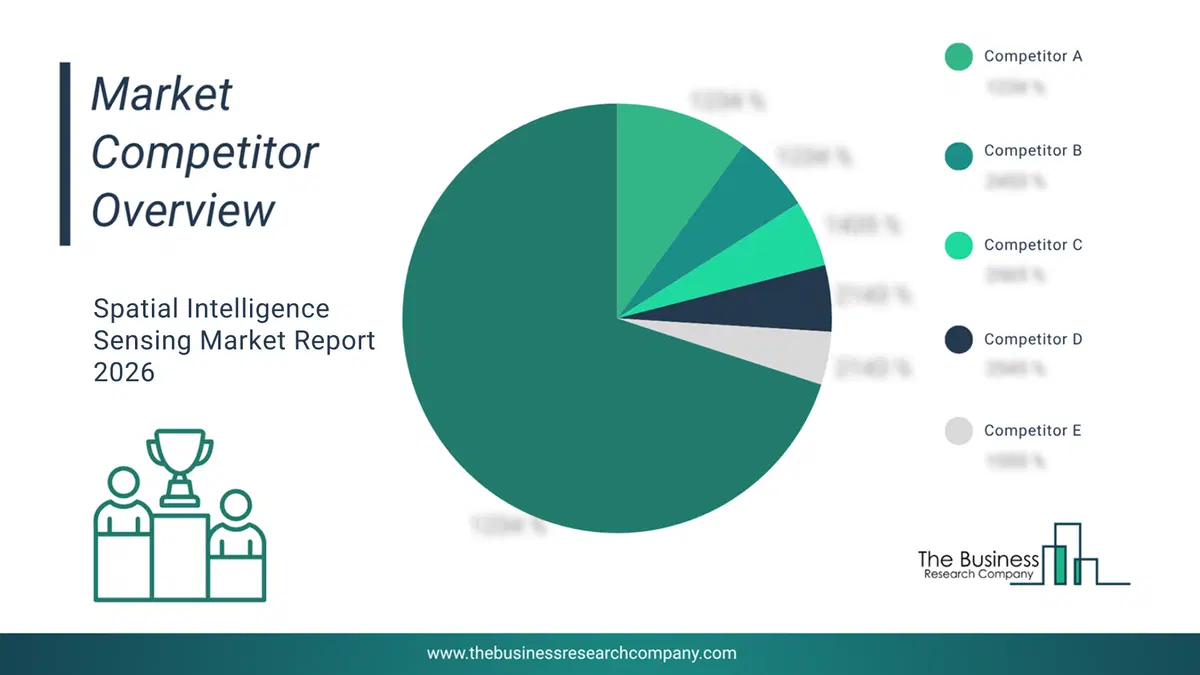
This chart is for illustrative purposes; the full report includes a detailed competitor analysis and comprehensive overview of the top 10 companies in the market.
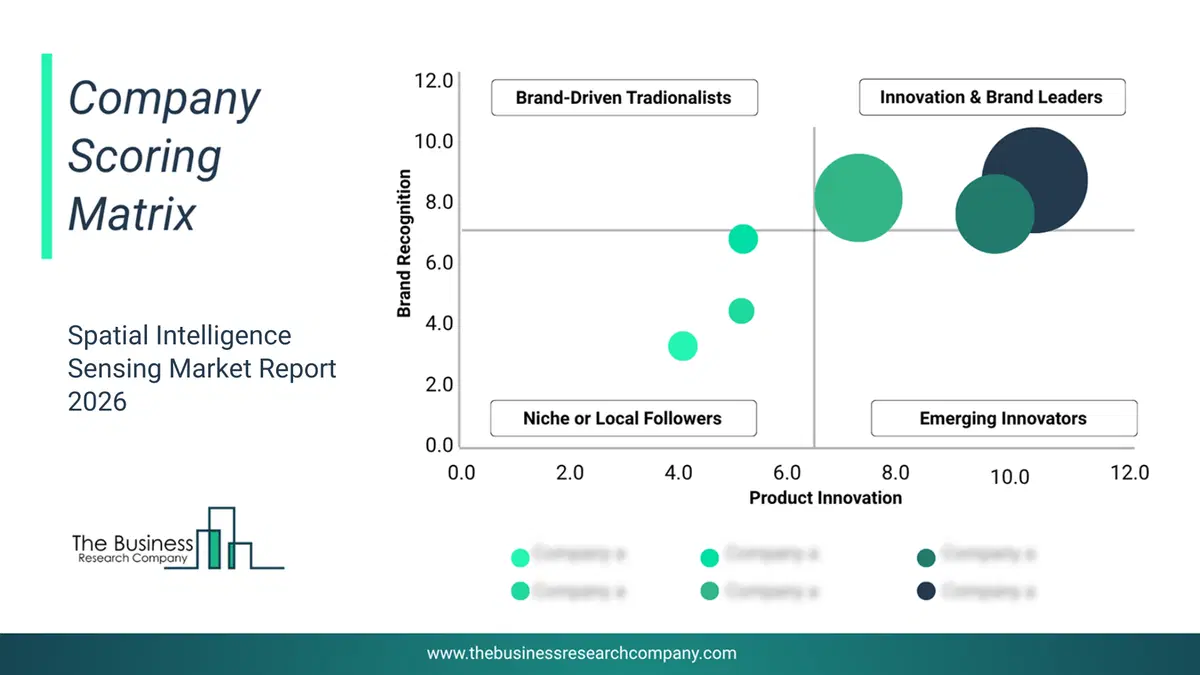
This chart maps companies by product innovation and brand strength, with bubble size indicating relative revenue, helping identify market leaders, challengers, and niche players. This is an illustrative chart; the full report provides a complete and accurate competitive analysis.
Global Spatial Intelligence Sensing Market Trends and Insights
Major companies operating in the spatial intelligence sensing market are focusing on developing advanced sensor-based spatial awareness solutions for real-time human monitoring, movement tracking, and safety enhancement. These solutions use sensors such as radar, LiDAR, depth cameras, and computer vision systems to capture and analyze spatial data on the position and movement of people and objects. For example, in September 2025, Asahi Kasei Microdevices Corporation (AKM), a Japan-based semiconductor and sensing technology company, launched the AK581xAIM Antenna-in-Module (AiM) millimeter-wave radar modules designed for high-precision sensing of human presence, position, posture, and fall detection. The camera-less sensing technology enables privacy-conscious real-time spatial monitoring, supporting healthcare applications such as patient safety, fall prevention, and remote monitoring.What Are Latest Mergers And Acquisitions In The Spatial Intelligence Sensing Market?
In July 2024, Onsemi, a US-based intelligent power and sensing technology company, completed the acquisition of SWIR Vision Systems for an undisclosed amount. Through this acquisition, Onsemi aims to strengthen its intelligent sensing portfolio by integrating SWIR Vision Systems' colloidal quantum dot (CQD)-based short-wave infrared (SWIR) imaging technology with its CMOS image sensors. The acquisition enhances Onsemi's capabilities in advanced spatial intelligence sensing, including depth perception, 3D imaging, machine vision, industrial automation, robotics, automotive, and defense applications. SWIR Vision Systems is a US-based imaging technology company specializing in short-wave infrared (SWIR) sensor solutions that enhance advanced sensing capabilities.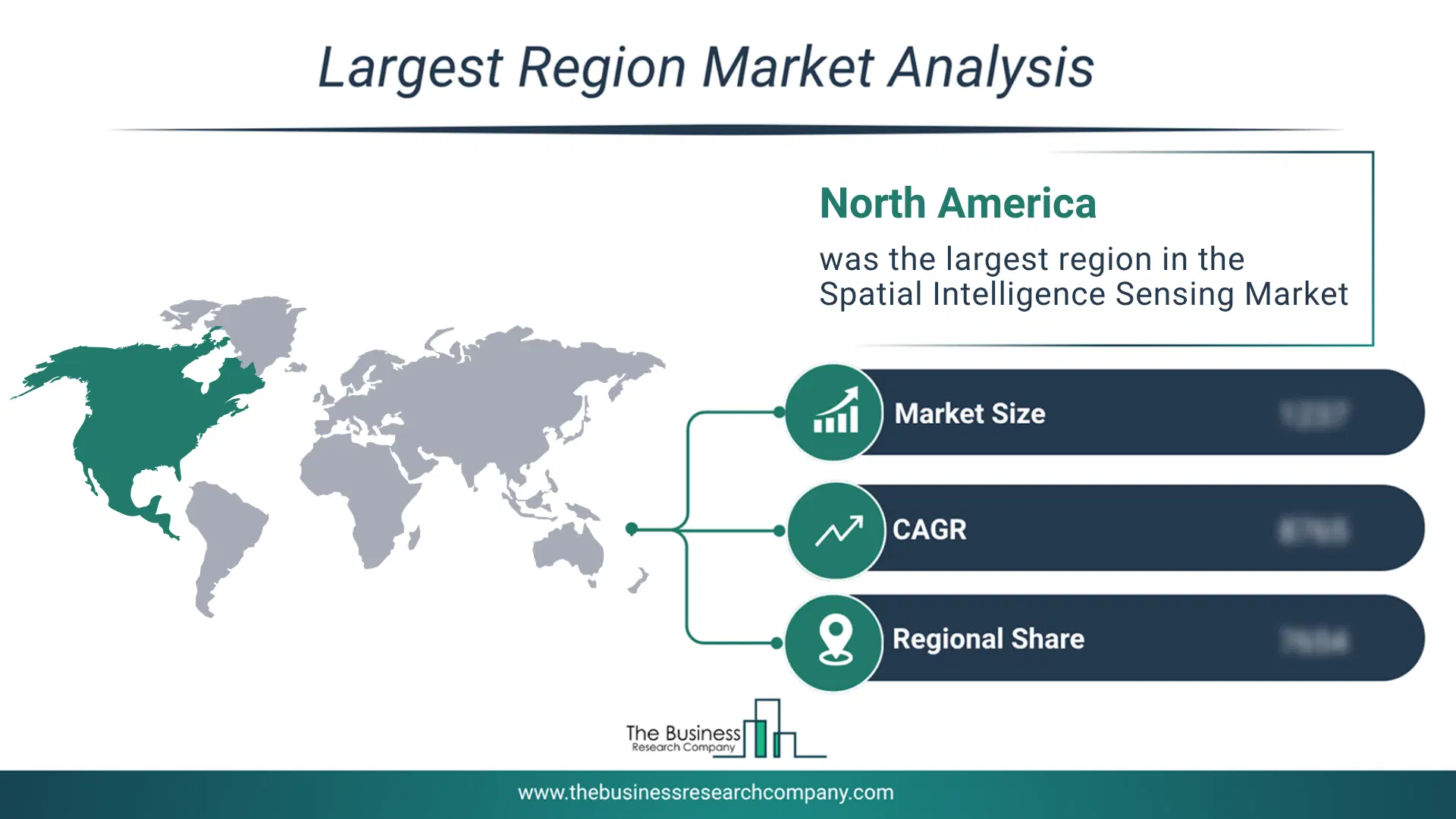
Regional Outlook
North America was the largest region in the spatial intelligence sensing market in 2025. Asia-Pacific is expected to be the fastest-growing region in the forecast period. The regions covered in this market report are Asia-Pacific, South East Asia, Western Europe, Eastern Europe, North America, South America, Middle East, Africa. The countries covered in this market report are Australia, Brazil, China, France, Germany, India, Indonesia, Japan, Taiwan, Russia, South Korea, UK, USA, Canada, Italy, Spain.What Defines the Spatial Intelligence Sensing Market?
The spatial intelligence sensing market consists of revenues earned by entities by providing services such as patient positioning, workflow monitoring, asset tracking, fall detection and occupancy analytics. The market value includes the value of related goods sold by the service provider or included within the service offering. The spatial intelligence sensing market also includes sales of infrared cameras, thermal imaging cameras, ultra-wideband (UWB) anchors and bluetooth low energy (BLE) beacons. Values in this market are ‘factory gate’ values, that is the value of goods sold by the manufacturers or creators of the goods, whether to other entities (including downstream manufacturers, wholesalers, distributors and retailers) or directly to end customers. The value of goods in this market includes related services sold by the creators of the goods.How is Market Value Defined and Measured?
The market value is defined as the revenues that enterprises gain from the sale of goods and/or services within the specified market and geography through sales, grants, or donations in terms of the currency (in USD unless otherwise specified). The revenues for a specified geography are consumption values that are revenues generated by organizations in the specified geography within the market, irrespective of where they are produced. It does not include revenues from resales along the supply chain, either further along the supply chain or as part of other products.
This chart presents market attractiveness based on a quantitative evaluation of growth, competition, strategic alignment, and risk, offering a clear view of opportunity areas for decision-making. This chart is for illustrative purposes; the full report contains the complete analysis.

This chart highlights the Total Addressable Market (TAM) by estimating the maximum revenue opportunity using an assumption-driven approach, supporting strategic planning and opportunity sizing across markets. The chart is illustrative; the full report provides a more comprehensive analysis.
What Key Data and Analysis Are Included in the Spatial Intelligence Sensing Market Report 2026?
The spatial intelligence sensing market research report is one of a series of new reports from The Business Research Company that provides market statistics, including industry global market size, regional shares, competitors with the market share, detailed market segments, market trends and opportunities, and any further data you may need to thrive in the spatial intelligence sensing industry. The market research report delivers a complete perspective of everything you need, with an in-depth analysis of the current and future state of the industry.Spatial Intelligence Sensing Market Report Forecast Analysis
| Report Attribute | Details |
|---|---|
| Market Size Value In 2026 | $2.12 billion |
| Revenue Forecast In 2030 | $4.09 billion |
| Growth Rate | CAGR of 17.8% from 2026 to 2030 |
| Base Year For Estimation | 2025 |
| Actual Estimates/Historical Data | 2020-2025 |
| Forecast Period | 2026 - 2030 |
| Market Representation | Revenue in USD Billion and CAGR from 2026 to 2030 |
| Segments Covered | Component, Technology, Deployment Mode, Application, End User |
| Regional Scope | Asia-Pacific, Western Europe, Eastern Europe, North America, South America, Middle East, Africa |
| Country Scope | The countries covered in the report are Australia, Brazil, China, France, Germany, India, Indonesia, Japan, Taiwan, Russia, South Korea, UK, USA, Canada, Italy, Spain. |
| Key Companies Profiled | Microsoft Corporation, Intel Corporation, Sony Semiconductor Solutions Corporation, Canon Inc., Zebra Technologies Corporation, Omron Corporation, Hesai Technology Co. Ltd., RoboSense Technology Co. Ltd., NEC Corporation, Aeva Technologies Inc., Ambarella Inc., Ouster Inc., Vayyar Imaging Ltd., Artisight Inc., Orbbec Inc., Stryker Corporation, VirtuSense Technologies, Kepler Vision Technologies, Ocuvera LLC |
| Customization Scope | Request for Customization |
| Pricing And Purchase Options | Explore Purchase Options |