
Spatial Light Modulator Market Report 2026
Global Outlook – By Product Type ( Optically Addressed, Electrically Addressed), By Component Type ( Hardware, Software, Services), By Technology ( Liquid Crystal Spatial Light Modulators, Digital Micromirror Devices, Liquid Crystal On Silicon, Microelectromechanical Systems), By Application ( Laser Beam Steering, Beam Shaping, Holographic Data Storage, Display Application, Optical Applications, Other Applications), By End Use ( Education, Healthcare, Telecommunications) – Market Size, Trends, Strategies, and Forecast to 2030
Spatial Light Modulator Market Overview
• Spatial Light Modulator market size has reached to $2.24 billion in 2025 • Expected to grow to $3.46 billion in 2030 at a compound annual growth rate (CAGR) of 9% • Growth Driver: Surge In Advanced Display Adoption Driving The Spatial Light Modulator Market Due To Enhanced Visual Performance Needs • Market Trend: High-Power LCOS Spatial Light Modulators Revolutionize Industrial Laser Processing • North America was the largest region in 2025 and Asia-Pacific is the fastest growing region.What Is Covered Under Spatial Light Modulator Market?
A spatial light modulator (SLM) is a device that controls light by altering properties such as amplitude, phase, or polarization across a two-dimensional plane. It operates by dynamically adjusting light interacts with its surface on an individual pixel level. This enables highly precise, real-time, and programmable modulation of optical wavefronts. The main product types of spatial light modulators are optically addressed and electrically addressed. An optically addressed spatial light modulator is a device that modulates the intensity, phase, or polarization of light across its surface in response to an optical input rather than an electrical signal. The component types in these are hardware, software, and services, using various technologies including liquid crystal spatial light modulators, digital micromirror devices, liquid crystal on silicon, and microelectromechanical systems, used in applications such as laser beam steering, beam shaping, holographic data storage, display applications, optical applications, and others. These are used by various end users including education, entertainment, healthcare, and telecommunications.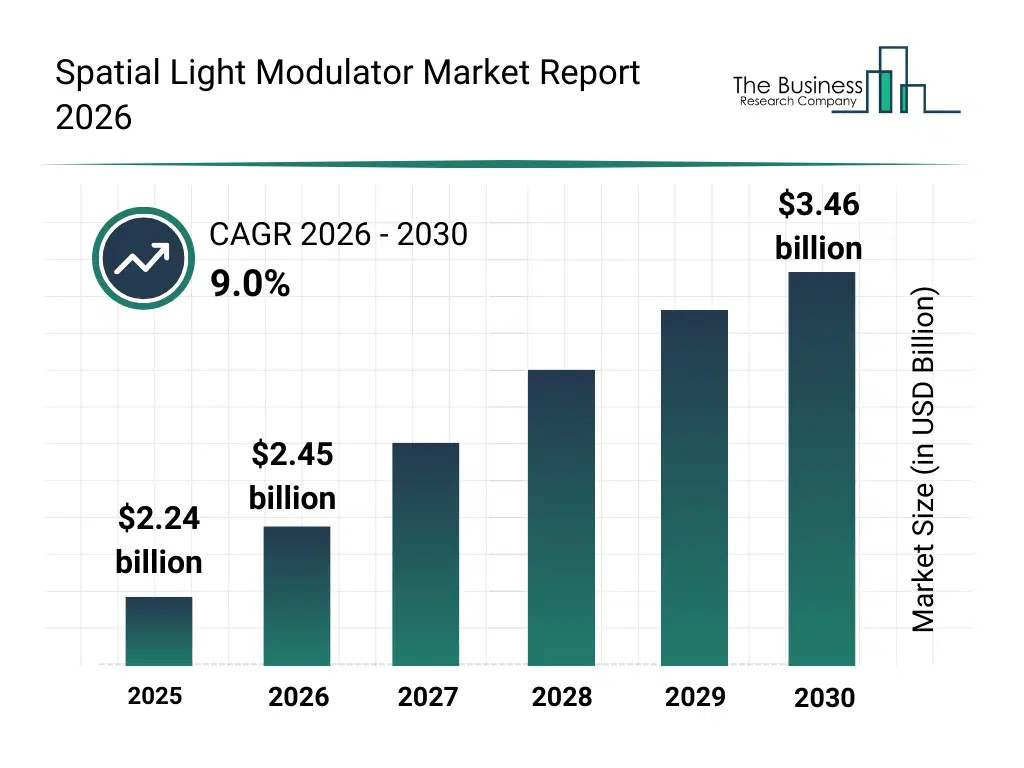
What Is The Spatial Light Modulator Market Size 2026 And Growth Rate?
The spatial light modulator market size has grown strongly in recent years. It will grow from $2.24 billion in 2025 to $2.45 billion in 2026 at a compound annual growth rate (CAGR) of 9.4%. The growth in the historic period can be attributed to growth in optical research and academic laboratories, rising adoption of holography and beam shaping systems, increasing use of slms in projection and display systems, advancements in liquid crystal materials, demand for precision optical instrumentation.What Is The Spatial Light Modulator Market Growth Forecast?
The spatial light modulator market size is expected to see strong growth in the next few years. It will grow to $3.46 billion in 2030 at a compound annual growth rate (CAGR) of 9.0%. The growth in the forecast period can be attributed to expansion of laser-based manufacturing systems, increasing deployment in AR and VR optical engines, rising demand for adaptive optics in healthcare imaging, wider adoption in autonomous sensing and lidar, continuous improvements in MEMS and LCoS technologies. Major trends in the forecast period include higher resolution and pixel density enhancement, multi-wavelength and broadband light modulation, miniaturization and compact slm module design, improved phase-only modulation accuracy, cost optimization and yield improvement in slm manufacturing.
Global Spatial Light Modulator Market Segmentation
1) By Product Type: Optically Addressed, Electrically Addressed 2) By Component Type: Hardware, Software, Services 3) By Technology: Liquid Crystal Spatial Light Modulators, Digital Micromirror Devices, Liquid Crystal On Silicon, Microelectromechanical Systems 4) By Application: Laser Beam Steering, Beam Shaping, Holographic Data Storage, Display Application, Optical Applications, Other Applications 5) By End Use: Education, Healthcare, Telecommunications Subsegments: 1) By Optically Addressed: Liquid Crystal Light Valves, Photorefractive Crystal Light Modulators 2) By Electrically Addressed: Ferroelectric Liquid Crystal Light Modulators, Twisted Nematic Liquid Crystal Light Modulators’ Silicon-Based Light ModulatorsWhat Is The Driver Of The Spatial Light Modulator Market?
The rising demand for advanced display technology is expected to propel the growth of the spatial light modulator market going forward. Advanced display technology refers to a class of innovative visual systems and components that enhance image quality, color accuracy, brightness, contrast, and viewing angles beyond the capabilities of conventional display solutions, enabling superior visual performance across diverse applications such as consumer electronics, automotive interfaces, medical imaging, and immersive environments. The rising demand for advanced display technology is primarily driven by the increasing emphasis on immersive and interactive user experiences, as organizations across industries seek to differentiate their products and services by providing more lifelike visuals and seamless digital interactions, thereby elevating customer engagement and satisfaction. Spatial light modulators support the rising demand for advanced display technology by enabling precise control of light phase and amplitude, allowing for higher resolution, improved image quality, and enhanced visual effects in next-generation displays. For instance, in June 2025, according to GOSTUDENT LTD, an Austria-based online tutoring platform, in UK classrooms, VR lesson plans boosted engagement by 30% in 2023, while 44% of SEN parents viewed VR as essential for personalized learning, 59% of teachers reported that combining human instruction with AI and VR yields the best outcomes. Additionally, VR adoption in schools increased by 35% in 2024 due to more affordable headsets, and 93% of teachers believed VR enhances teaching quality and student engagement. Therefore, the rising demand for advanced display technology is driving the growth of the spatial light modulator industry.Key Players In The Global Spatial Light Modulator Market
Major companies operating in the spatial light modulator market are Hamamatsu Photonics K.K., HOLOEYE Photonics AG, Meadowlark Optics, Inc., Texas Instruments Incorporated, Jenoptik AG, Santec Corporation, Thorlabs, Inc., Forth Dimension Displays, Jasper Display Corporation, Silicon Light Machines, Boston Micromachines Corporation, ViALUX GmbH, PerkinElmer, CAS-Microstar, Changchun New Industries (CNI), Beijing Rofea Optoelectronics Co., Ltd., Laser 2000, Kopin Corporation, Holographix, UPOLabs, CamOptics, Sintec Optronics, Elliot Scientific
This chart is for illustrative purposes; the full report includes a detailed competitor analysis and comprehensive overview of the top 10 companies in the market.
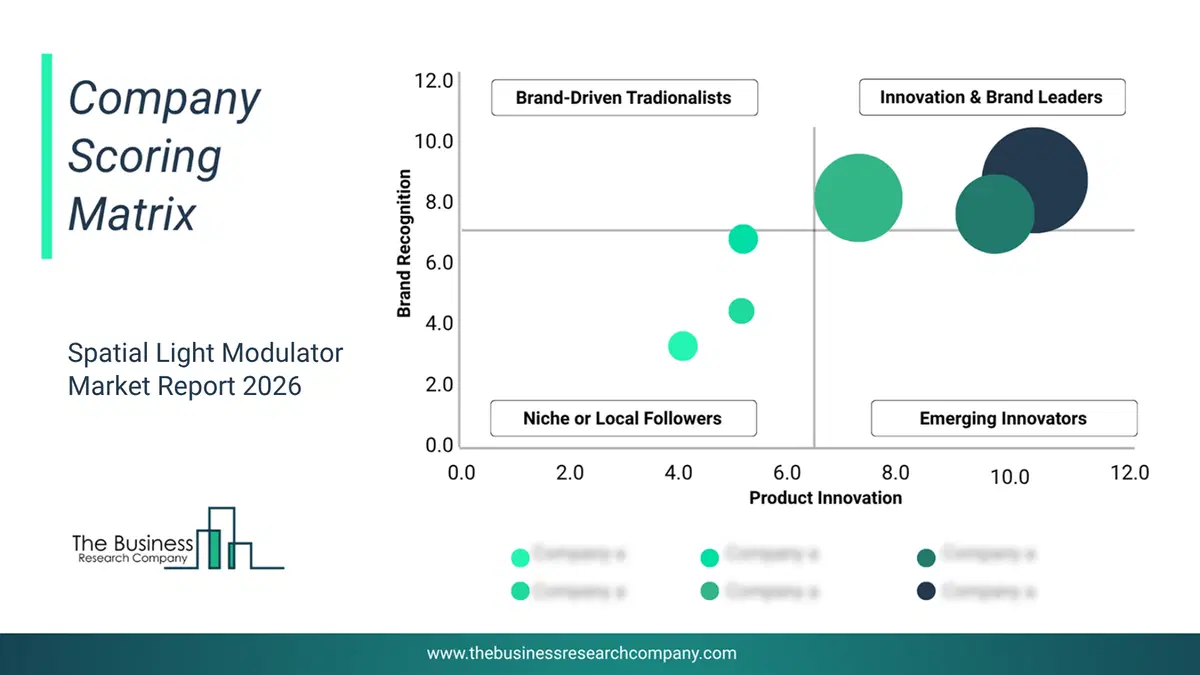
This chart maps companies by product innovation and brand strength, with bubble size indicating relative revenue, helping identify market leaders, challengers, and niche players. This is an illustrative chart; the full report provides a complete and accurate competitive analysis.
Global Spatial Light Modulator Market Trends and Insights
Major companies operating in the spatial light modulator market are focusing on developing technological advancements such as high-power liquid crystal on silicon designs to enable precise beam control, improve performance, and expand capabilities. High-power liquid crystal on silicon designs refers to advanced SLM architectures engineered to handle intense laser power while maintaining precise phase modulation, thermal stability, and optical efficiency for demanding industrial, scientific, and defense applications. For instance, in 2025, Santec AOC Corporation, a Japan-based optical technology company, unveiled the SLM-310, an LCOS-based spatial light modulator engineered to withstand 1kW-class laser power in the near-infrared spectrum. This is designed for advanced industrial applications such as metal 3D printing and precision laser processing, the SLM-310 integrates newly developed liquid crystal materials with a water-cooling system, enabling exceptional light resistance, precise phase control, beam shaping, and multi-point laser irradiation beyond the capabilities of traditional galvanometer scanner technology.What Are Latest Mergers And Acquisitions In The Spatial Light Modulator Market?
In November 2024, HOLOEYE Photonics AG, a Germany-based optical and electronic element and device company, collaborated with Fraunhofer Institute for Photonic Microsystems (IPMS) to advance high-performance microdisplay and light modulation technologies through combined expertise. This deal aims to leverage Fraunhofer IPMS’s research and development strengths together with HOLOEYE’s commercialization capabilities to speed up the creation and market deployment of next-generation compact LCOS microdisplays and spatial light modulation solutions for high-performance applications. Fraunhofer Institute for Photonic Microsystems (IPMS) is a Germany-based research institute focusing on electronic and photonic microsystems in the fields of Smart Industrial Solutions.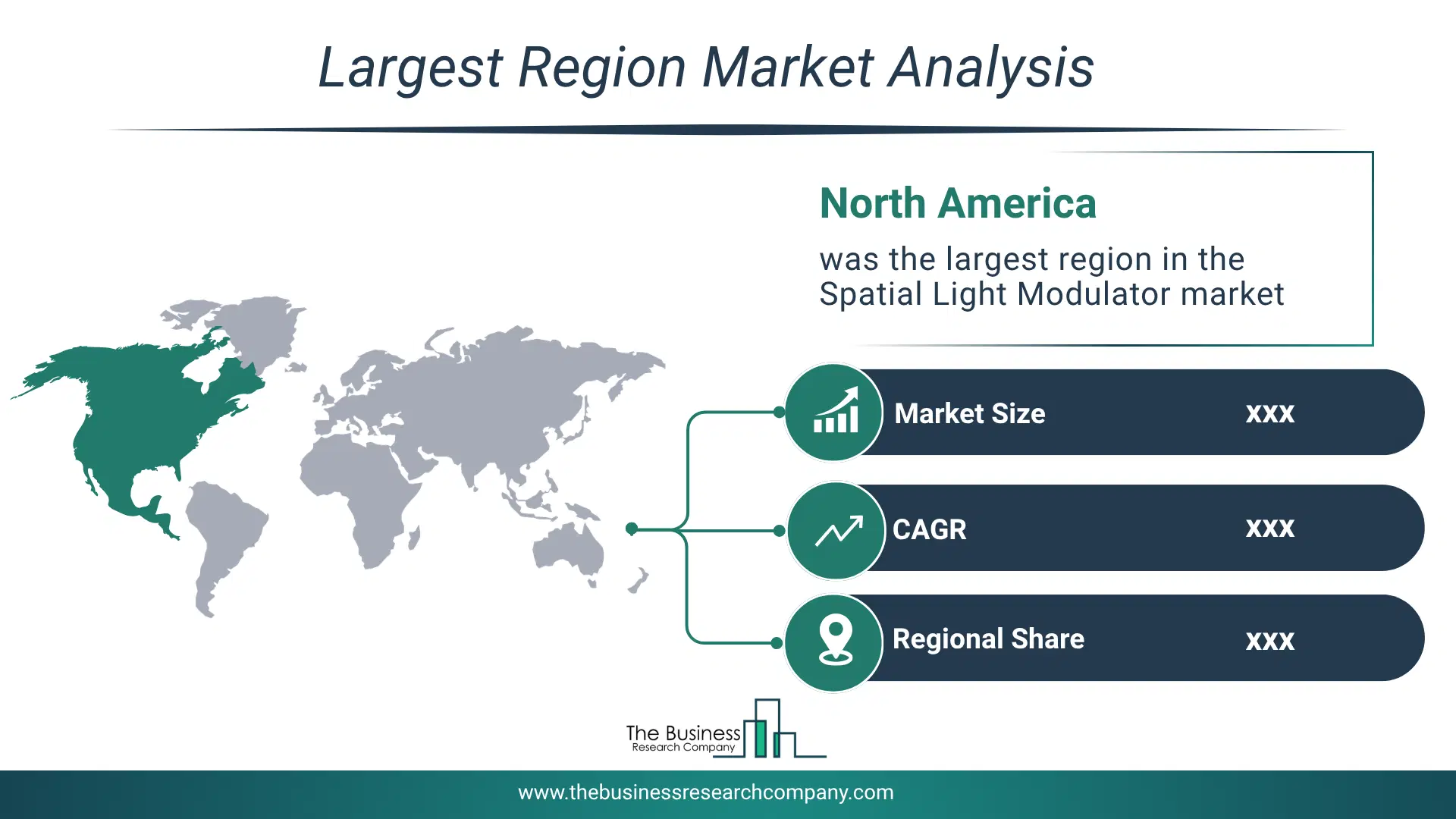
Regional Outlook
North America was the largest region in the spatial light modulator market in 2025. Asia-Pacific is expected to be the fastest-growing region in the forecast period. The regions covered in this market report are Asia-Pacific, South East Asia, Western Europe, Eastern Europe, North America, South America, Middle East, Africa. The countries covered in this market report are Australia, Brazil, China, France, Germany, India, Indonesia, Japan, Taiwan, Russia, South Korea, UK, USA, Canada, Italy, Spain.What Defines the Spatial Light Modulator Market?
The spatial light modulator market consists of revenues earned by entities by providing services such as system integration and customization services, calibration and alignment services, maintenance and repair services, technical consulting and design support services, and training and operational support services. The market value includes the value of related goods sold by the service provider or included within the service offering. The spatial light modulator market also includes sales of products such as programmable diffraction gratings, phase-only spatial light modulators, amplitude-only spatial light modulators, transmissive spatial light modulators, reflective spatial light modulators, and polarization control spatial light modulators. Values in this market are ‘factory gate’ values, that is, the value of goods sold by the manufacturers or creators of the goods, whether to other entities (including downstream manufacturers, wholesalers, distributors, and retailers) or directly to end customers. The value of goods in this market includes related services sold by the creators of the goods.How is Market Value Defined and Measured?
The market value is defined as the revenues that enterprises gain from the sale of goods and/or services within the specified market and geography through sales, grants, or donations in terms of the currency (in USD unless otherwise specified). The revenues for a specified geography are consumption values that are revenues generated by organizations in the specified geography within the market, irrespective of where they are produced. It does not include revenues from resales along the supply chain, either further along the supply chain or as part of other products.
This chart presents market attractiveness based on a quantitative evaluation of growth, competition, strategic alignment, and risk, offering a clear view of opportunity areas for decision-making. This chart is for illustrative purposes; the full report contains the complete analysis.

This chart highlights the Total Addressable Market (TAM) by estimating the maximum revenue opportunity using an assumption-driven approach, supporting strategic planning and opportunity sizing across markets. The chart is illustrative; the full report provides a more comprehensive analysis.
What Key Data and Analysis Are Included in the Spatial Light Modulator Market Report 2026?
The spatial light modulator market research report is one of a series of new reports from The Business Research Company that provides market statistics, including industry global market size, regional shares, competitors with the market share, detailed market segments, market trends and opportunities, and any further data you may need to thrive in the spatial light modulator industry. The market research report delivers a complete perspective of everything you need, with an in-depth analysis of the current and future state of the industry.Spatial Light Modulator Market Report Forecast Analysis
| Report Attribute | Details |
|---|---|
| Market Size Value In 2026 | $2.45 billion |
| Revenue Forecast In 2030 | $3.46 billion |
| Growth Rate | CAGR of 9% from 2026 to 2030 |
| Base Year For Estimation | 2025 |
| Actual Estimates/Historical Data | 2020-2025 |
| Forecast Period | 2026 - 2030 |
| Market Representation | Revenue in USD Billion and CAGR from 2026 to 2030 |
| Segments Covered | Product Type, Component Type, Technology, Application, End Use |
| Regional Scope | Asia-Pacific, Western Europe, Eastern Europe, North America, South America, Middle East, Africa |
| Country Scope | The countries covered in the report are Australia, Brazil, China, France, Germany, India, Indonesia, Japan, Taiwan, Russia, South Korea, UK, USA, Canada, Italy, Spain. |
| Key Companies Profiled | Hamamatsu Photonics K.K., HOLOEYE Photonics AG, Meadowlark Optics, Inc., Texas Instruments Incorporated, Jenoptik AG, Santec Corporation, Thorlabs, Inc., Forth Dimension Displays, Jasper Display Corporation, Silicon Light Machines, Boston Micromachines Corporation, ViALUX GmbH, PerkinElmer, CAS-Microstar, Changchun New Industries (CNI), Beijing Rofea Optoelectronics Co., Ltd., Laser 2000, Kopin Corporation, Holographix, UPOLabs, CamOptics, Sintec Optronics, Elliot Scientific |
| Customization Scope | Request for Customization |
| Pricing And Purchase Options | Explore Purchase Options |