

SRv6 Service Chaining Market Report 2026
Global Outlook – By Component (Hardware, Software, Services), By Deployment Mode (On-Premises, Cloud-Based), By Application (Telecommunications, Data Centers, Cloud Service Providers, Enterprises, Other Applications), By End-User (Service Providers, Enterprises, Government, Other End-Users) – Market Size, Trends, Strategies, and Forecast to 2030
SRv6 Service Chaining Market Overview
• SRv6 Service Chaining market size has reached to $2.46 billion in 2025 • Expected to grow to $6.75 billion in 2030 at a compound annual growth rate (CAGR) of 22.3% • Growth Driver: Expansion Of Cloud-Native And Hybrid Cloud Deployments Fueling The Growth Of The Market Due To Increasing Demand For Network Agility And Scalable Traffic Management • Market Trend: Programmable SRv6 Service Chaining Optimizes Network Traffic Flow • North America was the largest region in 2025 and Asia-Pacific is the fastest growing region.What Is Covered Under SRv6 Service Chaining Market?
SRv6 service chaining is a network architecture that uses segment routing over internet protocol version 6 to encode ordered sequences of network functions or forwarding instructions as segments inside packet headers, allowing packets to follow a predetermined chain of virtual or physical services. Its purpose is to enable scalable, programmable and efficient traffic steering so operators can orchestrate and deliver service functions in a specific order without maintaining per-flow state in the network, improving automation, agility and service-level control. The main components of the SRv6 service chaining include hardware, software, and services. Hardware consists of physical network devices such as routers, switches, servers, and network interface cards that facilitate the chaining, routing, and management of SRv6 services across networks. The various deployment modes include on-premises and cloud-based solutions, providing organizations with flexibility to meet operational, scalability, and performance requirements. The key applications of include telecommunications, data centers, cloud service providers, enterprises, and others. These solutions are used by several end-users such as service providers, enterprises, government organizations, and others.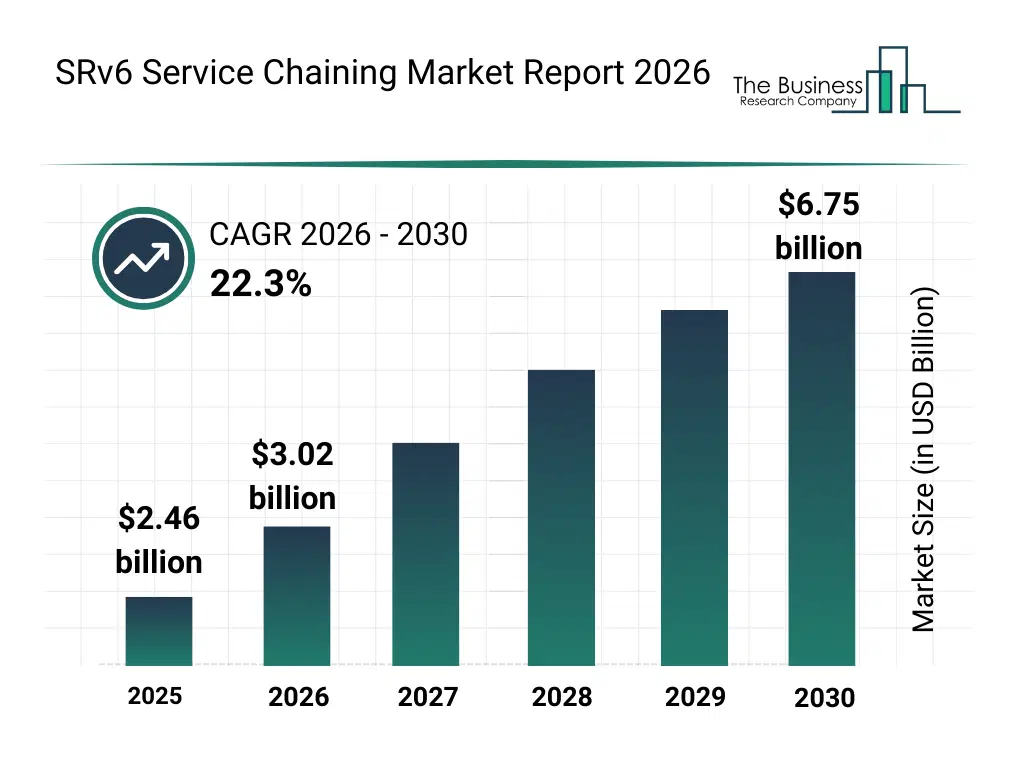
What Is The SRv6 Service Chaining Market Size and Share 2026?
The SRv6 service chaining market size has grown exponentially in recent years. It will grow from $2.46 billion in 2025 to $3.02 billion in 2026 at a compound annual growth rate (CAGR) of 22.6%. The growth in the historic period can be attributed to increasing demand for programmable networking, growing adoption of network function virtualization, rising need for scalable service architectures, increasing migration toward IPv6 infrastructure, and expansion of cloud and telecom network deployments.What Is The SRv6 Service Chaining Market Growth Forecast?
The SRv6 service chaining market size is expected to see exponential growth in the next few years. It will grow to $6.75 billion in 2030 at a compound annual growth rate (CAGR) of 22.3%. The growth in the forecast period can be attributed to the growing requirement for automated service chaining, increasing adoption of 5G and edge computing, rising demand for low-latency network services, increasing focus on network simplification and modernization, and growing need for efficient multi-cloud connectivity. Major trends in the forecast period include technology advancements in micro-segment identifiers, innovation in stateless service function chaining, development of high-performance SRv6 data planes, advancement in automated orchestration using artificial intelligence (AI) and machine learning (ML), and research and development in SRv6 interoperability and standardization.
Global SRv6 Service Chaining Market Segmentation
1) By Component: Hardware, Software, Services 2) By Deployment Mode: On-Premises, Cloud-Based 3) By Application: Telecommunications, Data Centers, Cloud Service Providers, Enterprises, Other Applications 4) By End-User: Service Providers, Enterprises, Government, Other End-Users Subsegments: 1) By Hardware: Network Routers, Switches, Gateways, Network Interface Cards, Traffic Controllers 2) By Software: Orchestration Platforms, Traffic Management Software, Analytics and Monitoring Tools, Security and Policy Software, Network Automation Software 3) By Services: Consulting Services, Implementation Services, Managed Services, Support and Maintenance ServicesWhat Is The Driver Of The SRv6 Service Chaining Market?
The expansion of cloud-native and hybrid cloud deployments is expected to propel the growth of the SRv6 service chaining market going forward. Cloud-native and hybrid cloud deployments refer to running applications either fully optimized for the cloud or across a combination of on-premises and cloud environments (hybrid cloud) to achieve scalability, flexibility, and operational efficiency. The expansion of cloud-native and hybrid cloud deployments is driven by the growing need for real-time, high-performance data processing and application scalability. SRv6 service chaining supports cloud-native and hybrid cloud deployments by enabling flexible, programmable traffic steering across distributed network functions. It improves network agility and scalability by simplifying service integration, optimizing performance, and supporting dynamic, software-defined infrastructures. For instance, in October 2025, according to the Cloud Native Computing Foundation, a US-based cloud native foundation, 56% of backend developers were identified as cloud native in the third quarter of 2025, up from 49% in the first quarter of 2025, marking a significant rise over the past five years. Therefore, the expansion of cloud-native and hybrid cloud deployments drives the growth of the SRv6 service chaining industry.Key Players In The Global SRv6 Service Chaining Market
Major companies operating in the srv6 service chaining market are Samsung Electronics Co. Ltd., Huawei Technologies Co. Ltd., Dell Technologies Inc., Telefonaktiebolaget LM Ericsson, Cisco Systems Inc., Intel Corporation, Broadcom Inc., Fujitsu Limited, NEC Corporation, ZTE Corporation, Arista Networks Inc., Marvell Technology Inc., Ciena Corporation, Mavenir Inc., Ribbon Communications Inc., ADVA Optical Networking SE, Ekinops S.A., IP Infusion Inc., H3C Technologies Co. Ltd., Nokia Corporation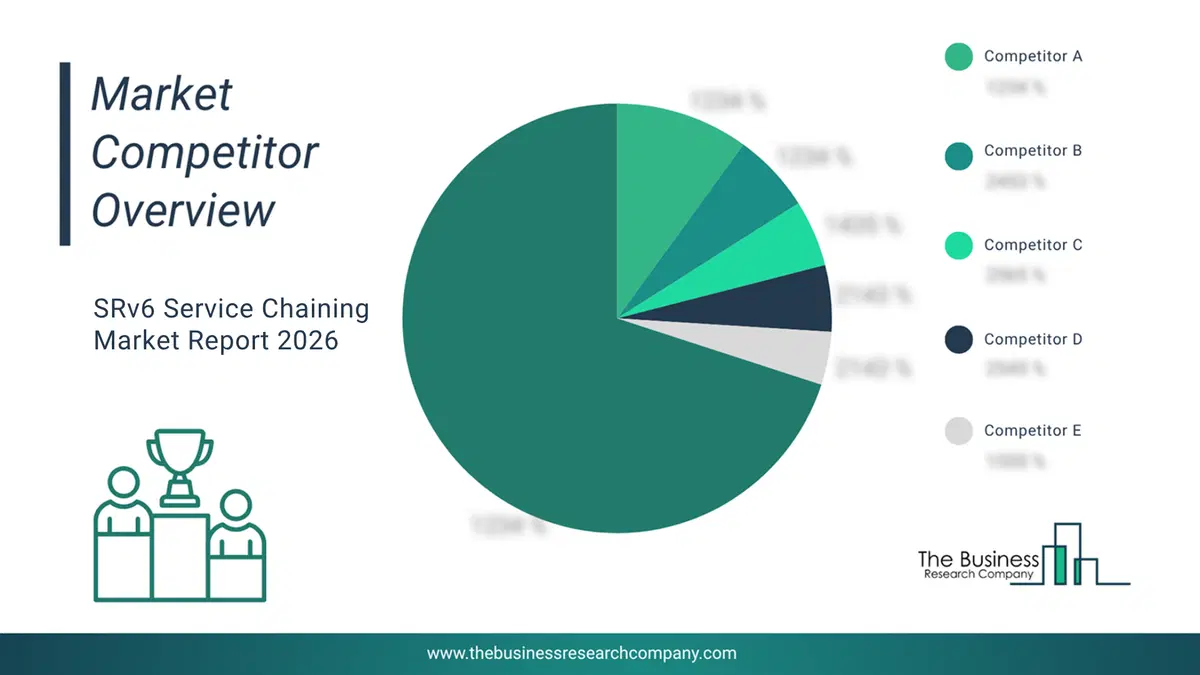
This chart is for illustrative purposes; the full report includes a detailed competitor analysis and comprehensive overview of the top 10 companies in the market.
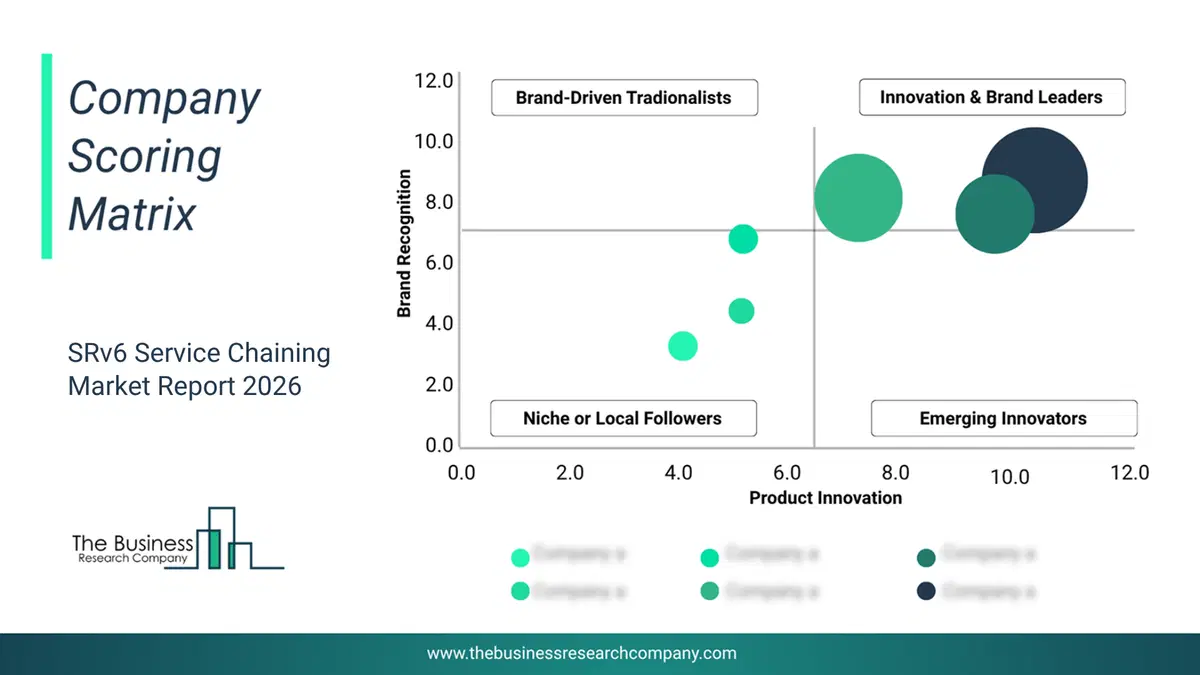
This chart maps companies by product innovation and brand strength, with bubble size indicating relative revenue, helping identify market leaders, challengers, and niche players. This is an illustrative chart; the full report provides a complete and accurate competitive analysis.
Global SRv6 Service Chaining Market Trends and Insights
Major companies operating in the SRv6 service chaining market are focusing on developing advanced network routing solutions, such as programmable service chaining platforms, to optimize traffic flow, reduce latency, and enhance operational efficiency. Programmable service chaining platforms are technologies that enable network traffic to be directed through a sequence of virtual or physical network functions, such as firewalls, load balancers, and deep packet inspection systems, in a predefined order using IPv6-based instructions. For instance, in May 2024, Time dotCom, a Malaysia-based telecommunications operator, launched its segment routing IPv6 (SRv6) service chaining platform. This solution features native IPv6 service steering, dynamic traffic engineering to maintain consistent bandwidth, and programmable service paths that enforce service-level agreements (SLAs) for enterprise and mission-critical applications. The launch represents a significant advancement in network function automation by integrating flexible, IPv6-native routing and service chaining, enabling operators to manage complex traffic flows efficiently while supporting scalable enterprise and carrier-grade deployments. It offers a robust, scalable, and programmable approach for managing modern IP networks and service orchestration.What Are Latest Mergers And Acquisitions In The SRv6 Service Chaining Market?
In October 2024, E.C.I. Networks Ltd., an Israel-based company specializing in networking and telecommunications solutions, acquired NoviFlow Inc. for an undisclosed amount. With this acquisition,E.C.I. Networks aims to strengthen its software-defined networking (SDN) and SRv6 service chaining capabilities, enhancing its portfolio of high-performance, programmable network solutions for service providers and telecom operators. NoviFlow Inc. is a Canada-based SDN company specializing in SRv6 service chaining.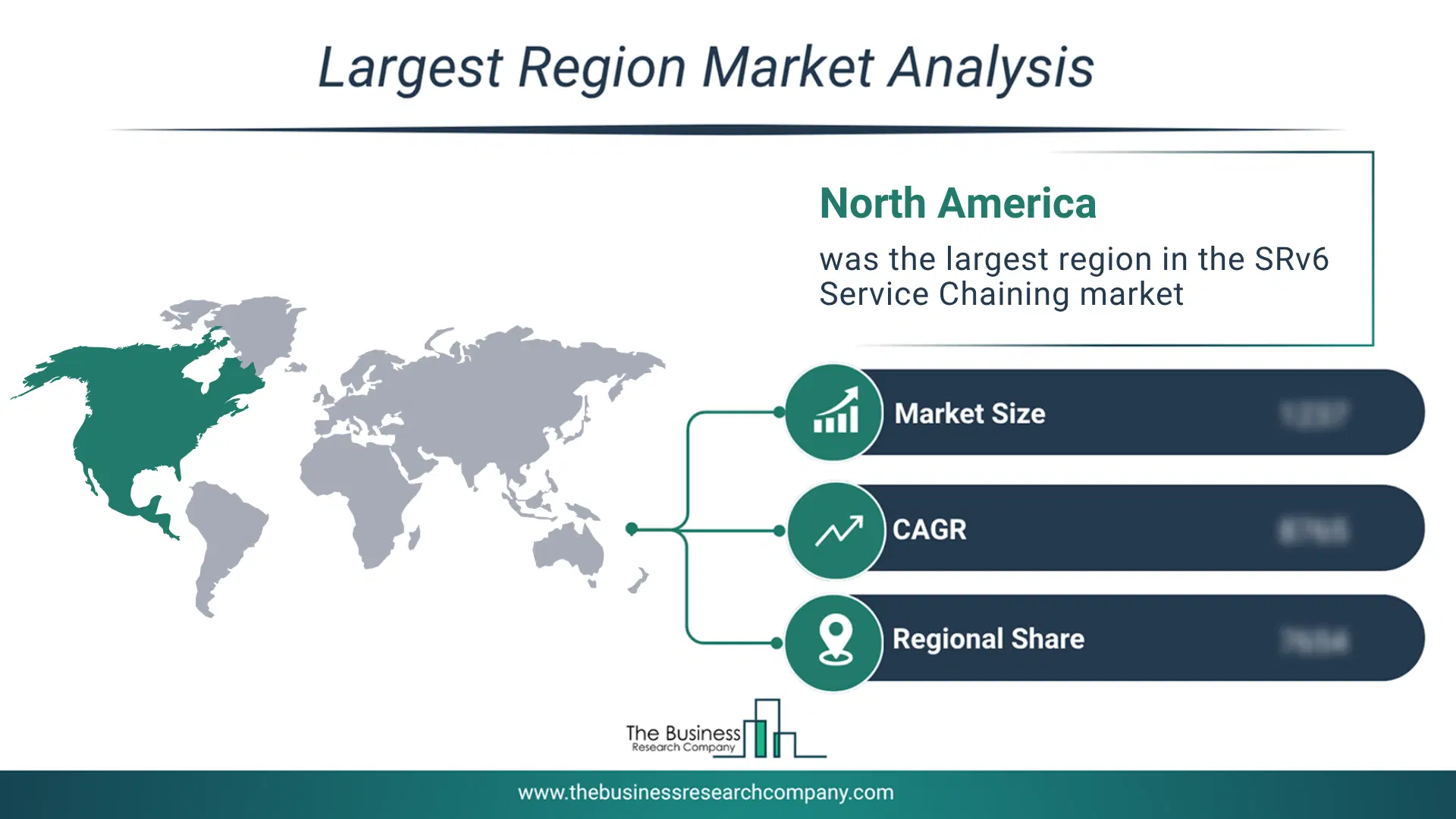
Regional Insights
North America was the largest region in the SRv6 service chaining market in 2025. Asia-Pacific is expected to be the fastest-growing region in the forecast period. The regions covered in this market report are Asia-Pacific, South East Asia, Western Europe, Eastern Europe, North America, South America, Middle East, Africa. The countries covered in this market report are Australia, Brazil, China, France, Germany, India, Indonesia, Japan, Taiwan, Russia, South Korea, UK, USA, Canada, Italy, Spain.What Defines the SRv6 Service Chaining Market?
The SRv6 service chaining market consists of revenues earned by entities by providing services such as network design and consulting, deployment and integration of service chains, managed network services and orchestration, professional services and systems integration, and training and technical support. The market value includes the value of related goods sold by the service provider or included within the service offering. The SRv6 service chaining market also includes sales of segment routing enabled routers and switches, network operating system software, network orchestration and automation platforms, virtual network functions (for example virtual firewalls and virtual load balancers), and analytics and monitoring tools. Values in this market are ‘factory gate’ values, that is, the value of goods sold by the manufacturers or creators of the goods, whether to other entities (including downstream manufacturers, wholesalers, distributors, and retailers) or directly to end customers. The value of goods in this market includes related services sold by the creators of the goods.How is Market Value Defined and Measured?
The market value is defined as the revenues that enterprises gain from the sale of goods and/or services within the specified market and geography through sales, grants, or donations in terms of the currency (in USD unless otherwise specified). The revenues for a specified geography are consumption values that are revenues generated by organizations in the specified geography within the market, irrespective of where they are produced. It does not include revenues from resales along the supply chain, either further along the supply chain or as part of other products.
This chart presents market attractiveness based on a quantitative evaluation of growth, competition, strategic alignment, and risk, offering a clear view of opportunity areas for decision-making. This chart is for illustrative purposes; the full report contains the complete analysis.

This chart highlights the Total Addressable Market (TAM) by estimating the maximum revenue opportunity using an assumption-driven approach, supporting strategic planning and opportunity sizing across markets. The chart is illustrative; the full report provides a more comprehensive analysis.
What Key Data and Analysis Are Included in the SRv6 Service Chaining Market Report 2026?
The srv6 service chaining market research report is one of a series of new reports from The Business Research Company that provides market statistics, including industry global market size, regional shares, competitors with the market share, detailed market segments, market trends and opportunities, and any further data you may need to thrive in the srv6 service chaining industry. The market research report delivers a complete perspective of everything you need, with an in-depth analysis of the current and future state of the industry.SRv6 Service Chaining Market Report Forecast Analysis
| Report Attribute | Details |
|---|---|
| Market Size Value In 2026 | $3.02 billion |
| Revenue Forecast In 2030 | $6.75 billion |
| Growth Rate | CAGR of 22.3% from 2026 to 2030 |
| Base Year For Estimation | 2025 |
| Actual Estimates/Historical Data | 2020-2025 |
| Forecast Period | 2026 - 2030 |
| Market Representation | Revenue in USD Billion and CAGR from 2026 to 2030 |
| Segments Covered | Component, Deployment Mode, Application, End-User |
| Regional Scope | Asia-Pacific, Western Europe, Eastern Europe, North America, South America, Middle East, Africa |
| Country Scope | The Countries Covered In This Market Report Are Australia, Brazil, China, France, Germany, India, Indonesia, Japan, Taiwan, Russia, South Korea, Uk, Usa, Canada, Italy, Spain. |
| Key Companies Profiled | Samsung Electronics Co. Ltd., Huawei Technologies Co. Ltd., Dell Technologies Inc., Telefonaktiebolaget LM Ericsson, Cisco Systems Inc., Intel Corporation, Broadcom Inc., Fujitsu Limited, NEC Corporation, ZTE Corporation, Arista Networks Inc., Marvell Technology Inc., Ciena Corporation, Mavenir Inc., Ribbon Communications Inc., ADVA Optical Networking SE, Ekinops S.A., IP Infusion Inc., H3C Technologies Co. Ltd., Nokia Corporation |
| Customization Scope | Request for Customization |
| Pricing And Purchase Options | Explore Purchase Options |