

Starch-Based Bioplastics Packaging Market Report 2026
Global Outlook – By Product Type (Thermoplastic Starch, Blended Starch Bioplastics, Native Starch Based, Modified Starch Bioplastics), By Technology (Blow Molding, Extrusion, Injection Molding), By Form (Films, Sheets, Coatings, Moulded Products), By End Use Industry (Food And Beverage, Retail And Electronic Commerce, Agriculture, Healthcare, Personal Care And Cosmetics, Industrial Goods) – Market Size, Trends, Strategies, and Forecast to 2030
Starch-Based Bioplastics Packaging Market Overview
• Starch-Based Bioplastics Packaging market size has reached to $8.83 billion in 2025 • Expected to grow to $15.4 billion in 2030 at a compound annual growth rate (CAGR) of 11.7% • Growth Driver: Surge In Sustainable And Eco-friendly Packaging Fueling The Growth Of The Market Due To Rising Environmental Awareness And Plastic Waste Reduction Efforts • Market Trend: Advancements In Corn-starch-Based Compostable Polymer Platforms Drive Sustainable Packaging Innovation • Asia-Pacific was the largest region and fastest growing region.What Is Covered Under Starch-Based Bioplastics Packaging Market?
Starch-based bioplastics packaging refers to packaging materials produced using starch derived from renewable sources such as corn, potato, or cassava. These materials are designed to replace conventional petroleum-based plastics by offering improved biodegradability and reduced environmental impact. Starch-based bioplastics packaging is widely used in various packaging applications due to its compostable nature, lightweight properties, and ability to reduce plastic waste accumulation. The main product types of starch-based bioplastics packaging include thermoplastic starch, blended starch bioplastics, native starch based, and modified starch bioplastics. Thermoplastic starch refers to biodegradable plastic material produced by processing starch with plasticizers to create flexible and moldable packaging solutions with reduced environmental impact. These products are manufactured using technologies such as blow molding, extrusion, and injection molding. They are available in forms including films, sheets, coatings, and moulded products and are utilized by end use industries including food and beverage, retail and electronic commerce, agriculture, healthcare, personal care and cosmetics, and industrial goods.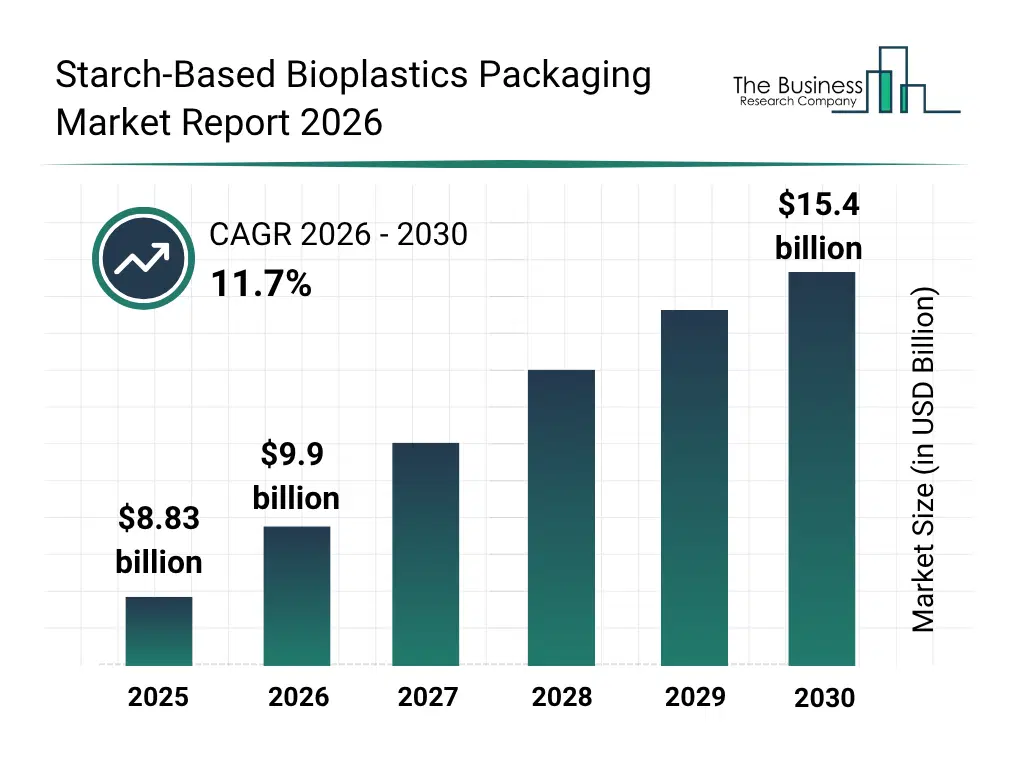
What Is The Starch-Based Bioplastics Packaging Market Size and Share 2026?
The starch-based bioplastics packaging market size has grown rapidly in recent years. It will grow from $8.83 billion in 2025 to $9.9 billion in 2026 at a compound annual growth rate (CAGR) of 12.1%. The growth in the historic period can be attributed to increasing environmental concerns regarding plastic waste accumulation, growth of sustainable packaging adoption across industries, rising government initiatives promoting biodegradable materials, expanding demand for renewable raw material based packaging solutions, growing consumer preference for eco friendly packaging products.What Is The Starch-Based Bioplastics Packaging Market Growth Forecast?
The starch-based bioplastics packaging market size is expected to see rapid growth in the next few years. It will grow to $15.4 billion in 2030 at a compound annual growth rate (CAGR) of 11.7%.The growth in the forecast period can be attributed to increasing adoption of advanced starch modification technologies, rising demand for compostable packaging solutions across emerging markets, growing development of improved strength and moisture resistant starch bioplastics, expanding applications of biodegradable packaging in food and healthcare sectors, increasing investments in sustainable packaging manufacturing capabilities. Major trends in the forecast period include increasing adoption of compostable starch based packaging solutions, growing development of high performance starch bioplastic materials, rising demand for renewable and biodegradable packaging alternatives, increasing focus on improved barrier properties in starch packaging films, growing utilization of starch based packaging across food and consumer goods applications.
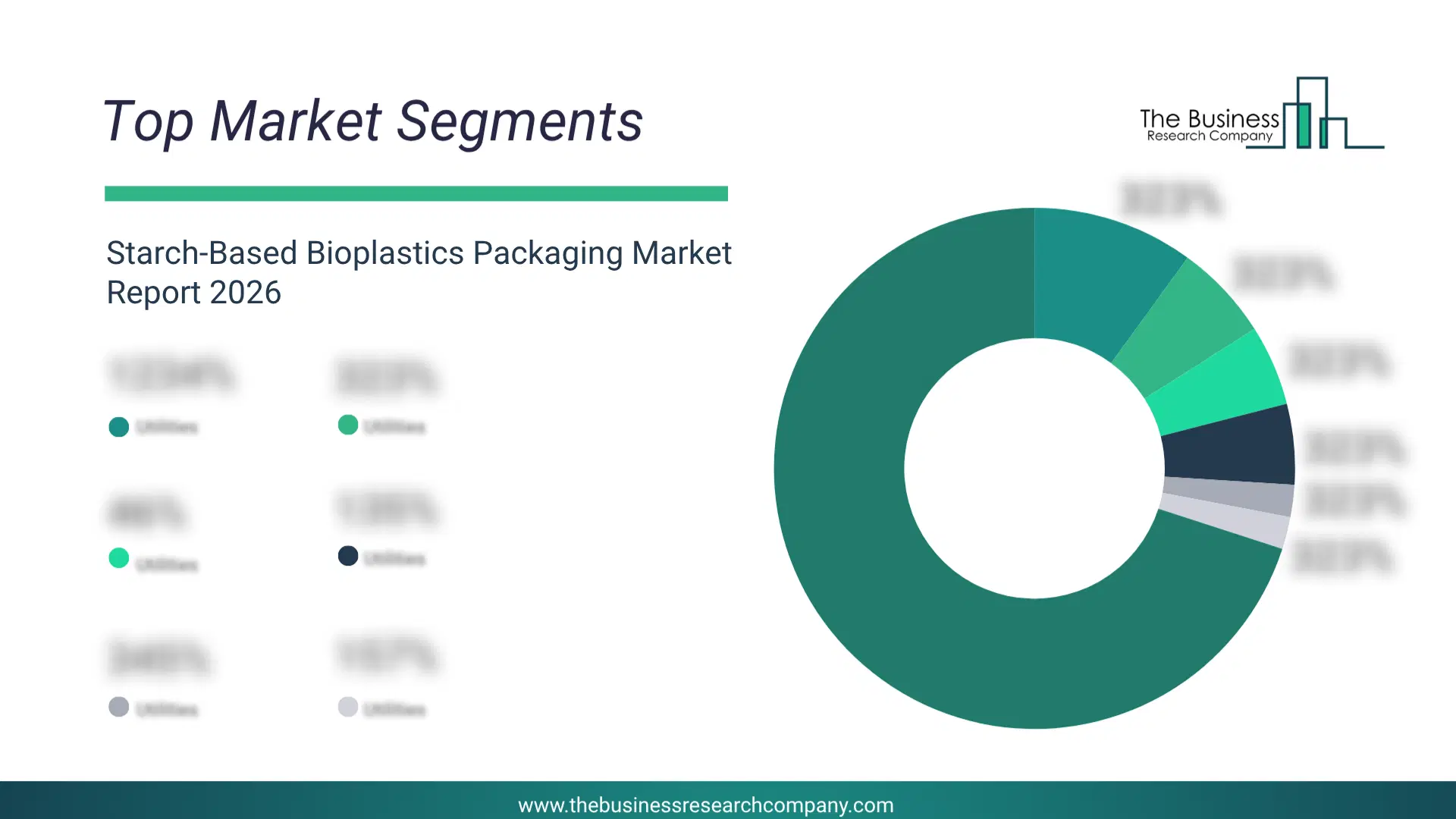
Global Starch-Based Bioplastics Packaging Market Segmentation
2) By Technology: Blow Molding, Extrusion, Injection Molding 3) By Form: Films, Sheets, Coatings, Moulded Products 4) By End Use Industry: Food And Beverage, Retail And Electronic Commerce, Agriculture, Healthcare, Personal Care And Cosmetics, Industrial Goods Subsegments: 1) By Thermoplastic Starch: Thermoplastic Starch Injection Molded Packaging, Thermoplastic Starch Foam Packaging, Thermoplastic Starch Extruded Sheets, Thermoplastic Starch Blow Molded Packaging 2) By Blended Starch Bioplastics: Blended Barrier Films, Blended Flexible Packaging, Blended Rigid Packaging, Blended Coated Packaging 3) By Native Starch Based: Cast Starch Films, Blown Starch Films, Laminated Starch Films, Surface Treated Starch Films 4) By Modified Starch Bioplastics: Crosslinked Starch Bioplastics, Plasticized Starch Bioplastics, Grafted Starch Bioplastics, Chemically Modified Starch BioplasticsWhat Is The Driver Of The Starch-Based Bioplastics Packaging Market?
The rising demand for sustainable and eco-friendly packaging is expected to propel the growth of the starch-based bioplastics packaging market going forward. Sustainable and eco-friendly packaging refers to packaging materials and systems designed to minimize environmental impact through reduced waste, recyclability, and the use of renewable or biodegradable resources. The rising demand for sustainable and eco-friendly packaging is driven by increasing environmental awareness, as consumers and industries seek to reduce plastic waste and lower overall ecological impact. Starch-based bioplastic packaging supports sustainable and eco-friendly packaging by offering biodegradable and renewable alternatives to conventional plastics, thereby reducing dependence on fossil fuels and lowering environmental pollution. For instance, in April 2023, according to a report published by Trivium Packaging, a US-based company that produces sustainable metal packaging, consumers are showing a rising readiness to spend extra on products with sustainable packaging, with 82% indicating they would pay a premium, an increase of four percentage points compared to 2022. Therefore, the rising demand for sustainable and eco-friendly packaging is driving the growth of the starch-based bioplastics packaging industry.Key Players In The Global Starch-Based Bioplastics Packaging Market
Major companies operating in the starch-based bioplastics packaging market are Arkema S.A., BASF SE, Biome Bioplastics Ltd, Braskem S.A., Cargill Incorporated, Corbion N.V., Danimer Scientific Inc., FKuR Kunststoff GmbH, Green Dot Bioplastics, Ingredion Incorporated, Kuraray Co. Ltd., Mitsubishi Chemical Group Corporation, NatureWorks LLC, PTT MCC Biochem Co. Ltd., Rodenburg Biopolymers, Roquette Frères S.A., SABIC, Sulzer Ltd, Toray Industries Inc., TotalEnergies Corbion, Amcor, Mondi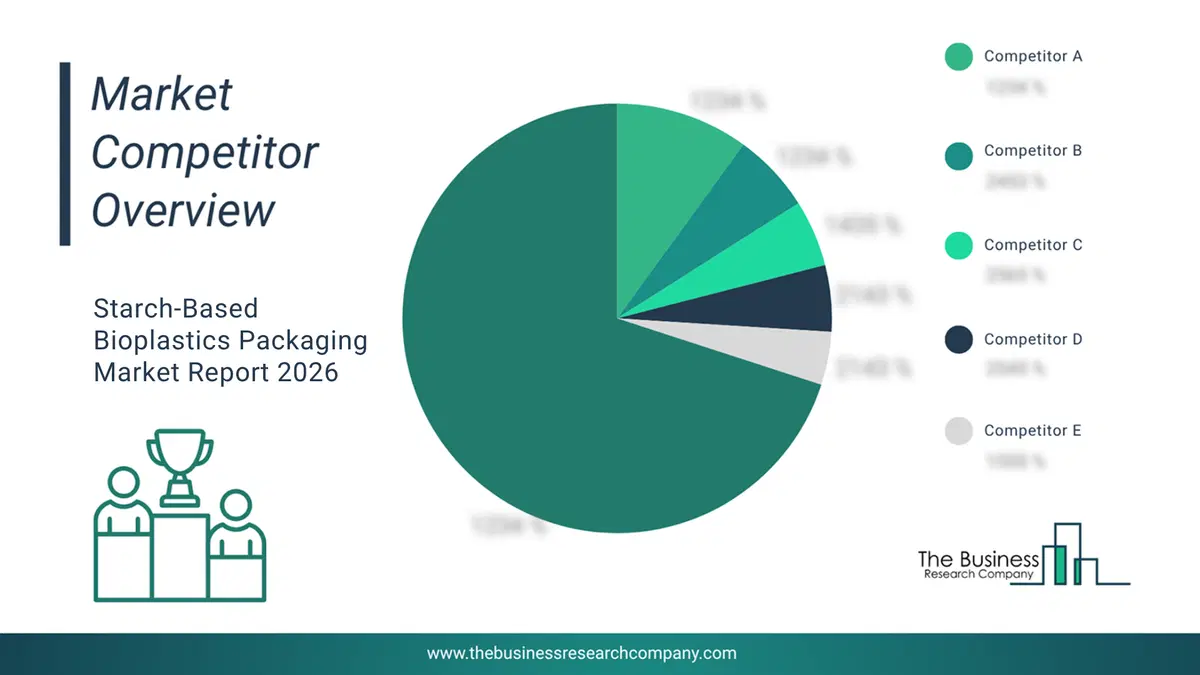
This chart is for illustrative purposes; the full report includes a detailed competitor analysis and comprehensive overview of the top 10 companies in the market.
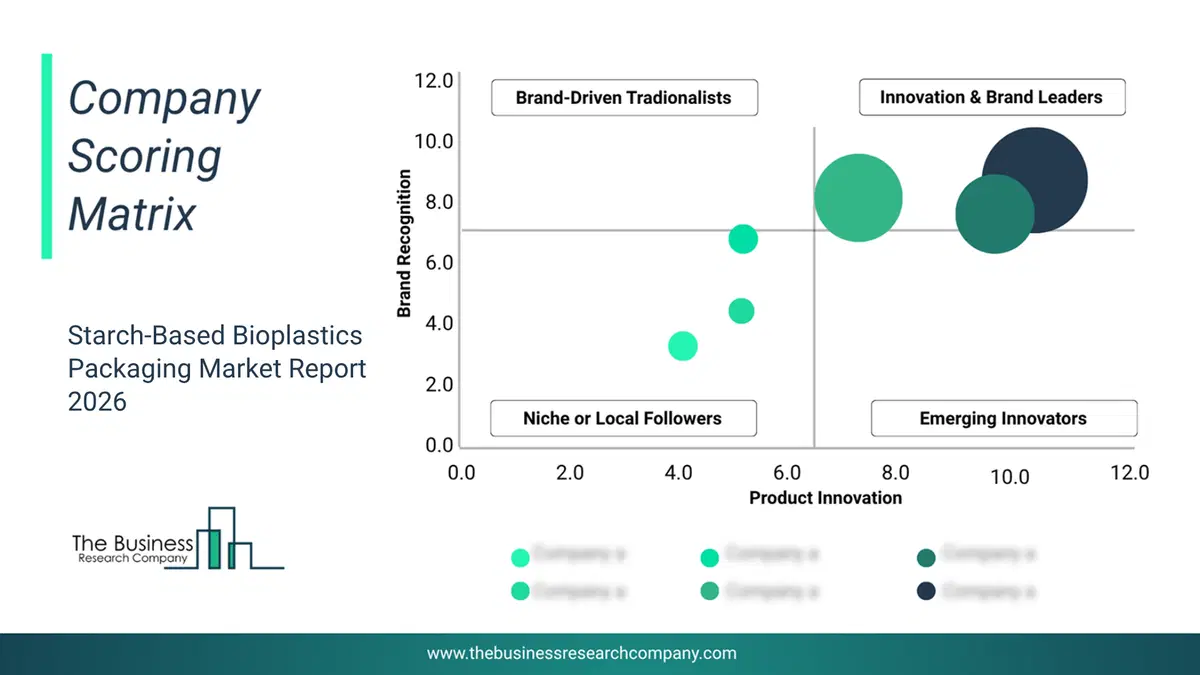
This chart maps companies by product innovation and brand strength, with bubble size indicating relative revenue, helping identify market leaders, challengers, and niche players. This is an illustrative chart; the full report provides a complete and accurate competitive analysis.
Global Starch-Based Bioplastics Packaging Market Trends and Insights
Major companies operating in the starch-based bioplastics packaging market are focusing on developing advanced bio-based materials and sustainable packaging solutions to enhance environmental sustainability, reduce dependence on fossil-fuel-based plastics, and deliver optimized packaging performance across food, consumer goods, and industrial packaging applications. Bio-based materials and sustainable packaging solutions are packaging products made from renewable biological resources that reduce environmental impact through improved recyclability, biodegradability, and resource efficiency. For instance, in April 2026, Dr. Bio, an India-based sustainable materials company, developed a corn-starch-based compostable polymer platform designed to reduce reliance on fossil-fuel-derived plastics amid global supply chain disruptions. It is designed to support improved packaging sustainability and enhanced material independence. The solution enables compostable packaging alternatives, reduced environmental plastic waste, and greater resilience against crude oil price volatility, strengthening advanced starch-based bioplastic packaging applications across global sustainable packaging markets.What Are Latest Mergers And Acquisitions In The Starch-Based Bioplastics Packaging Market?
In October 2023, Versalis, an Italy-based chemicals company, acquired Novamont S.p.A. for an undisclosed amount. Through this acquisition, Versalis, a subsidiary of Eni, strengthened its position in the bio-based and biodegradable plastics market by integrating Novamont’s starch-based bioplastics technologies to accelerate the development and commercialization of sustainable packaging solutions and reduce reliance on fossil-based plastics. Novamont S.p.A., an Italy-based company that is a provider of starch-based bioplastics used in packaging applications through its MATER-BI product family.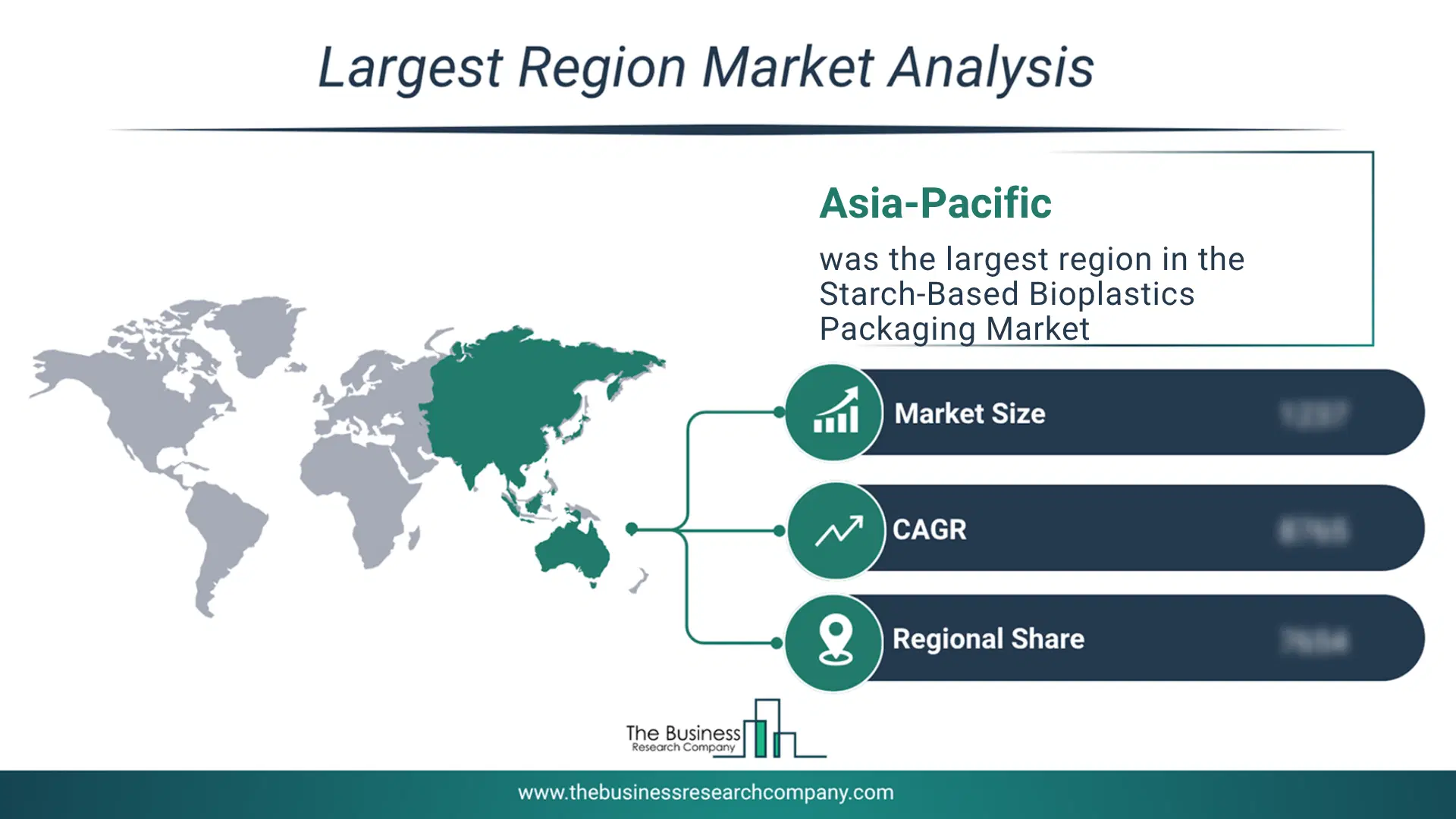
Regional Outlook/Insights
Asia-Pacific was the largest region in the starch-based bioplastics packaging market in 2025. Asia-Pacific is expected to be the fastest-growing region in the forecast period. The regions covered in this market report are Asia-Pacific, South East Asia, Western Europe, Eastern Europe, North America, South America, Middle East, Africa. The countries covered in this market report are Australia, Brazil, China, France, Germany, India, Indonesia, Japan, Taiwan, Russia, South Korea, UK, USA, Canada, Italy, Spain.What Defines the Starch-Based Bioplastics Packaging Market?
The starch-based bioplastics packaging market consists of sales of starch-based mulch films, bioplastic bottles, compostable lids, and biodegradable cups. Values in this market are ‘factory gate’ values, that is, the value of goods sold by the manufacturers or creators of the goods, whether to other entities (including downstream manufacturers, wholesalers, distributors, and retailers) or directly to end customers. The value of goods in this market includes related services sold by the creators of the goods.How is Market Value Defined and Measured?
The market value is defined as the revenues that enterprises gain from the sale of goods and/or services within the specified market and geography through sales, grants, or donations in terms of the currency (in USD unless otherwise specified). The revenues for a specified geography are consumption values that are revenues generated by organizations in the specified geography within the market, irrespective of where they are produced. It does not include revenues from resales along the supply chain, either further along the supply chain or as part of other products.
This chart presents market attractiveness based on a quantitative evaluation of growth, competition, strategic alignment, and risk, offering a clear view of opportunity areas for decision-making. This chart is for illustrative purposes; the full report contains the complete analysis.

This chart highlights the Total Addressable Market (TAM) by estimating the maximum revenue opportunity using an assumption-driven approach, supporting strategic planning and opportunity sizing across markets. The chart is illustrative; the full report provides a more comprehensive analysis.
What Key Data and Analysis Are Included in the Starch-Based Bioplastics Packaging Market Report 2026?
The starch-based bioplastics packaging market research report is one of a series of new reports from The Business Research Company that provides starch-based bioplastics packaging market statistics, including starch-based bioplastics packaging industry global market size, regional shares, competitors with a starch-based bioplastics packaging market share, detailed starch-based bioplastics packaging market segments, market trends and opportunities, and any further data you may need to thrive in the starch-based bioplastics packaging industry. This starch-based bioplastics packaging market research report delivers a complete perspective of everything you need, with an in-depth analysis of the current and future scenario of the industry.Starch-Based Bioplastics Packaging Market Report Forecast Analysis
| Report Attribute | Details |
|---|---|
| Market Size Value In 2026 | $9.9 billion |
| Revenue Forecast In 2030 | $15.4 billion |
| Growth Rate | CAGR of 11.7% from 2026 to 2030 |
| Base Year For Estimation | 2025 |
| Actual Estimates/Historical Data | 2020-2025 |
| Forecast Period | 2026 - 2030 |
| Market Representation | Revenue in USD Billion and CAGR from 2026 to 2030 |
| Segments Covered | Product Type, Technology, Form, End Use Industry |
| Regional Scope | Asia-Pacific, Western Europe, Eastern Europe, North America, South America, Middle East, Africa |
| Country Scope | The countries covered in the report are Australia, Brazil, China, France, Germany, India, Indonesia, Japan, Taiwan, Russia, South Korea, UK, USA, Canada, Italy, Spain. |
| Key Companies Profiled | Arkema S.A., BASF SE, Biome Bioplastics Ltd, Braskem S.A., Cargill Incorporated, Corbion N.V., Danimer Scientific Inc., FKuR Kunststoff GmbH, Green Dot Bioplastics, Ingredion Incorporated, Kuraray Co. Ltd., Mitsubishi Chemical Group Corporation, NatureWorks LLC, PTT MCC Biochem Co. Ltd., Rodenburg Biopolymers, Roquette Frères S.A., SABIC, Sulzer Ltd, Toray Industries Inc., TotalEnergies Corbion, Amcor, Mondi |
| Customization Scope | Request for Customization |
| Pricing And Purchase Options | Explore Purchase Options |