
Static Synchronous Compensator (STATCOM) Market Report 2026
Global Outlook – By Type (Low Voltage Static Synchronous Compensator (STATCOM), High Voltage Static Synchronous Compensator (STATCOM)), By Component (Power Electronics, Control Systems, Transformers, Filters, Protection Equipment), By Technology Type (Voltage Source Converter (VSC) Static Synchronous Compensator, Current Source Converter (CSC) Static Synchronous Compensator, Hybrid Static Synchronous Compensator), By Distribution Channel (Original Equipment Manufacturer (OEM), Aftermarket), By End-User (Utility Providers, Industrial Sector, Renewable Energy Developers, Transportation Sector, Commercial Establishments) – Market Size, Trends, Strategies, and Forecast to 2030
Static Synchronous Compensator (STATCOM) Market Overview
• Static Synchronous Compensator (STATCOM) market size has reached to $1.18 billion in 2025 • Expected to grow to $1.81 billion in 2030 at a compound annual growth rate (CAGR) of 8.8% • Growth Driver: Growing Renewable Energy Demand Is Fueling The Market Growth Due To Enhance Grid Stability And Power Quality Needs • Market Trend: Advancements In STATCOM Solutions For Improved Grid Stability And Renewable Energy Support • Asia-Pacific was the largest region in 2025.What Is Covered Under Static Synchronous Compensator (STATCOM) Market?
A Static synchronous compensator (STATCOM) is a power electronic device used in electrical power systems to regulate voltage and improve stability by rapidly injecting or absorbing reactive power. It connects in shunt with the power system and uses voltage-source converters to generate a controllable AC voltage, which helps maintain the desired voltage level, improve power factor, and enhance overall system reliability. STATCOMs respond quickly and efficiently to changes in the grid, making them essential for modern power quality and voltage control. The main types of static synchronous compensator (STATCOM) are low voltage static synchronous compensator (STATCOM) and high voltage static synchronous compensator (STATCOM). A low voltage static synchronous compensator (STATCOM) is a device used to regulate voltage and manage reactive power in low-voltage electrical systems, enhancing power quality and stability. Key components include power electronics, control systems, transformers, filters, and protection equipment. The various technology types include voltage source converter (VSC) static synchronous compensator (STATCOM), current source converter (CSC) static synchronous compensator (STATCOM), and hybrid static synchronous compensator (STATCOM). These systems are distributed through various channels such as original equipment manufacturers (OEMs) and the aftermarket. They are used by various end-users, including utility providers, the industrial sector, renewable energy developers, the transportation sector, and commercial establishments.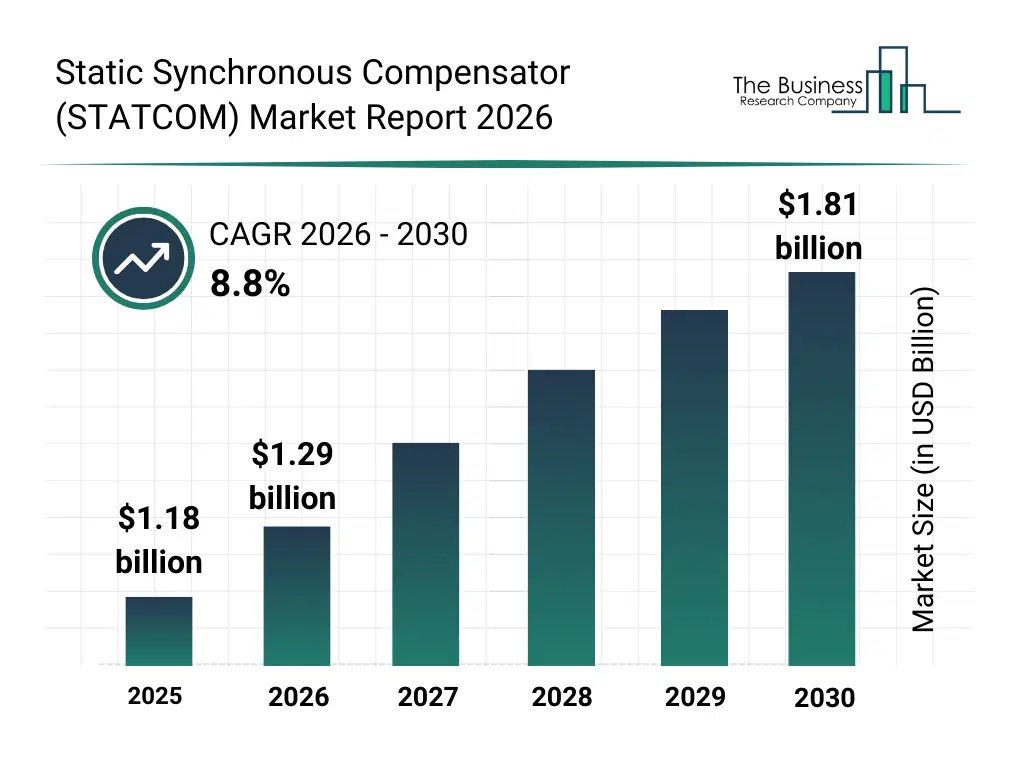
What Is The Static Synchronous Compensator (STATCOM) Market Size and Share 2026?
The static synchronous compensator (statcom) market size has grown strongly in recent years. It will grow from $1.18 billion in 2025 to $1.29 billion in 2026 at a compound annual growth rate (CAGR) of 9.1%. The growth in the historic period can be attributed to expansion of power transmission networks, increasing grid instability issues, early adoption of power electronic compensation devices, growth of utility-scale renewable projects, demand for improved power quality.What Is The Static Synchronous Compensator (STATCOM) Market Growth Forecast?
The static synchronous compensator (statcom) market size is expected to see strong growth in the next few years. It will grow to $1.81 billion in 2030 at a compound annual growth rate (CAGR) of 8.8%. The growth in the forecast period can be attributed to increasing renewable energy penetration, rising investments in smart grid infrastructure, growing demand for dynamic reactive power support, expansion of electric vehicle charging networks, increasing focus on grid resilience and reliability. Major trends in the forecast period include increasing deployment of grid-stabilization solutions, rising integration with renewable energy systems, growing adoption of modular statcom designs, expansion of high-voltage compensation installations, enhanced focus on fast-response voltage control.
Global Static Synchronous Compensator (STATCOM) Market Segmentation
1) By Type: Low Voltage Static Synchronous Compensator (STATCOM), High Voltage Static Synchronous Compensator (STATCOM) 2) By Component: Power Electronics, Control Systems, Transformers, Filters, Protection Equipment 3) By Technology Type: Voltage Source Converter (VSC) Static Synchronous Compensator, Current Source Converter (CSC) Static Synchronous Compensator, Hybrid Static Synchronous Compensator 4) By Distribution Channel: Original Equipment Manufacturer (OEM), Aftermarket 5) By End-User: Utility Providers, Industrial Sector, Renewable Energy Developers, Transportation Sector, Commercial Establishments Subsegments: 1) By Low Voltage Static Synchronous Compensator (STATCOM): Industrial Power Systems, Commercial Power Systems, Renewable Energy Integration, Data Centers, Urban Distribution Networks 2) By High Voltage Static Synchronous Compensator (STATCOM): Utility Transmission Grids, Renewable Energy Plants (Wind, Solar), Industrial Bulk Power Consumers, Smart Grid Infrastructure, Cross-Border InterconnectionsWhat Is The Driver Of The Static Synchronous Compensator (STATCOM) Market?
The growing demand for renewable energy is expected to propel the growth of the static synchronous compensator (STATCOM) market going forward. Renewable energy refers to energy that is generated from natural sources or processes that are constantly replenished and cannot be depleted. The growing demand for renewable energy is primarily due to increasing concerns about climate change, as governments, businesses, and consumers seek cleaner energy sources to reduce greenhouse gas emissions and mitigate global warming. Static synchronous compensator (STATCOM) enhances renewable energy integration by providing fast and dynamic voltage support, improving grid stability and power quality amid the variability of renewable sources. For instance, in December 2024, according to Eurostat, a Luxembourg-based government agency, the proportion of energy derived from renewable sources in the European Union’s transport sector increased to 10.8% in 2023, rising from 9.6% in 2022. Therefore, the growing demand for renewable energy is driving the growth of the static synchronous compensator (STATCOM) industry.Key Players In The Global Static Synchronous Compensator (STATCOM) Market
Major companies operating in the static synchronous compensator (statcom) market are Mitsubishi Electric Corporation, Hitachi Energy Ltd., Siemens AG, General Electric Company, ABB Ltd., Toshiba Corporation, Eaton Corporation plc, Bharat Heavy Electricals Limited BHEL, Hyosung Heavy Industries Corporation, Sieyuan Electric Co. Ltd., CG Power and Industrial Solutions Limited, American Superconductor Corporation, LS Electric Co. Ltd., JEMA Energy S.A., Merus Power Plc, NR Electric Co. Ltd., Comsys AB, ZDDQ Electric Co. Ltd., Hyundai Electric Co. Ltd., Alstom Grid
This chart is for illustrative purposes; the full report includes a detailed competitor analysis and comprehensive overview of the top 10 companies in the market.
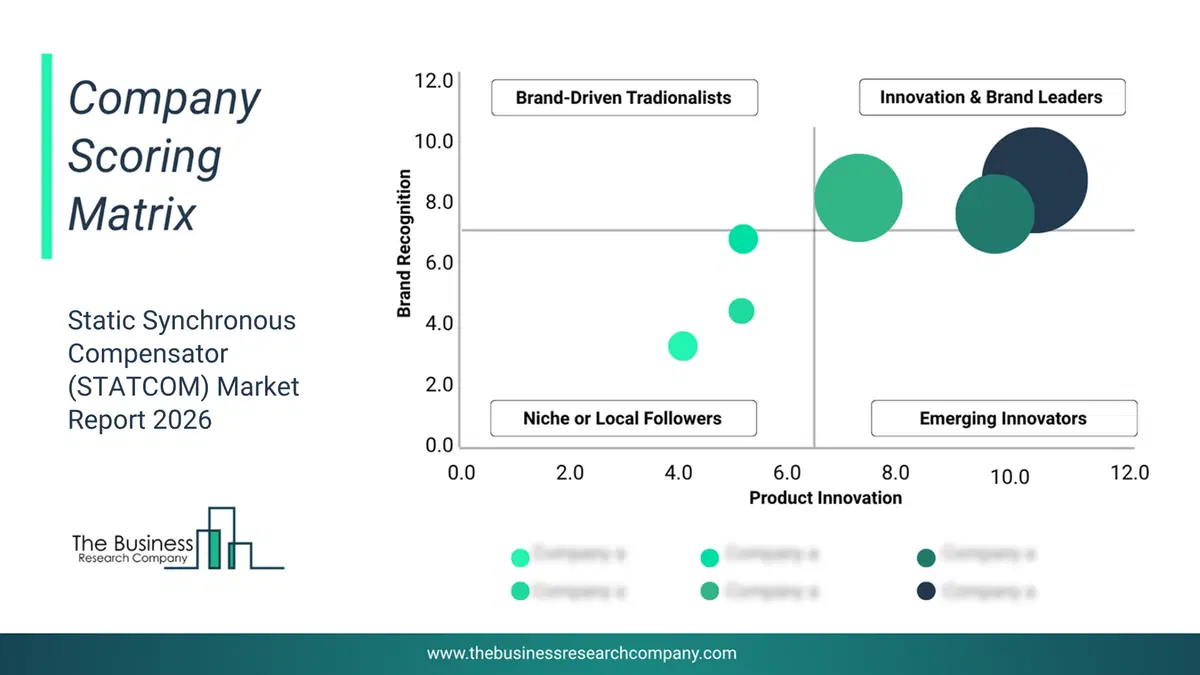
This chart maps companies by product innovation and brand strength, with bubble size indicating relative revenue, helping identify market leaders, challengers, and niche players. This is an illustrative chart; the full report provides a complete and accurate competitive analysis.
Global Static Synchronous Compensator (STATCOM) Market Trends and Insights
Major companies operating in the static synchronous compensator (STATCOM) market are focusing on developing innovative solutions, such as alternating current transmission systems, to enhance grid stability and power quality. An alternating current (AC) transmission system, which transmits electricity using alternating current over long distances, helps a static synchronous compensator (STATCOM) by providing a stable grid where the STATCOM can regulate voltage and improve power quality through rapid reactive power compensation. For instance, in August 2024, GE Vernova Inc., a US-based energy equipment manufacturing and services company, launched the FACTSFLEX GFMe, an advanced STATCOM solution that integrates supercapacitor-based energy storage to enhance grid stability and support the integration of renewable energy. The solution addresses the increasing challenges of voltage fluctuations and frequency disturbances caused by the intermittent nature of solar and wind energy. By providing virtual inertia and grid-forming capabilities, FACTSFLEX GFMe ensures reliable and efficient grid operations, particularly in regions with weaker infrastructure or high renewable penetration.What Are Latest Mergers And Acquisitions In The Static Synchronous Compensator (STATCOM) Market?
In March 2024, Renewable Energy Systems, a UK-based renewable energy company, acquired Ingeteam’s renewable service division for an undisclosed amount. Throughthis acquisition, RES aims to create the world’s largest independent, technology-agnostic renewable energy services provider by expanding its operations, enhancing service capabilities across multiple renewable technologies, and accelerating the transition to a zero-carbon energy future. Ingeteam Power Technology, S.A. is a Spain-based electrical control equipment manufacturing company that provides static synchronous compensators.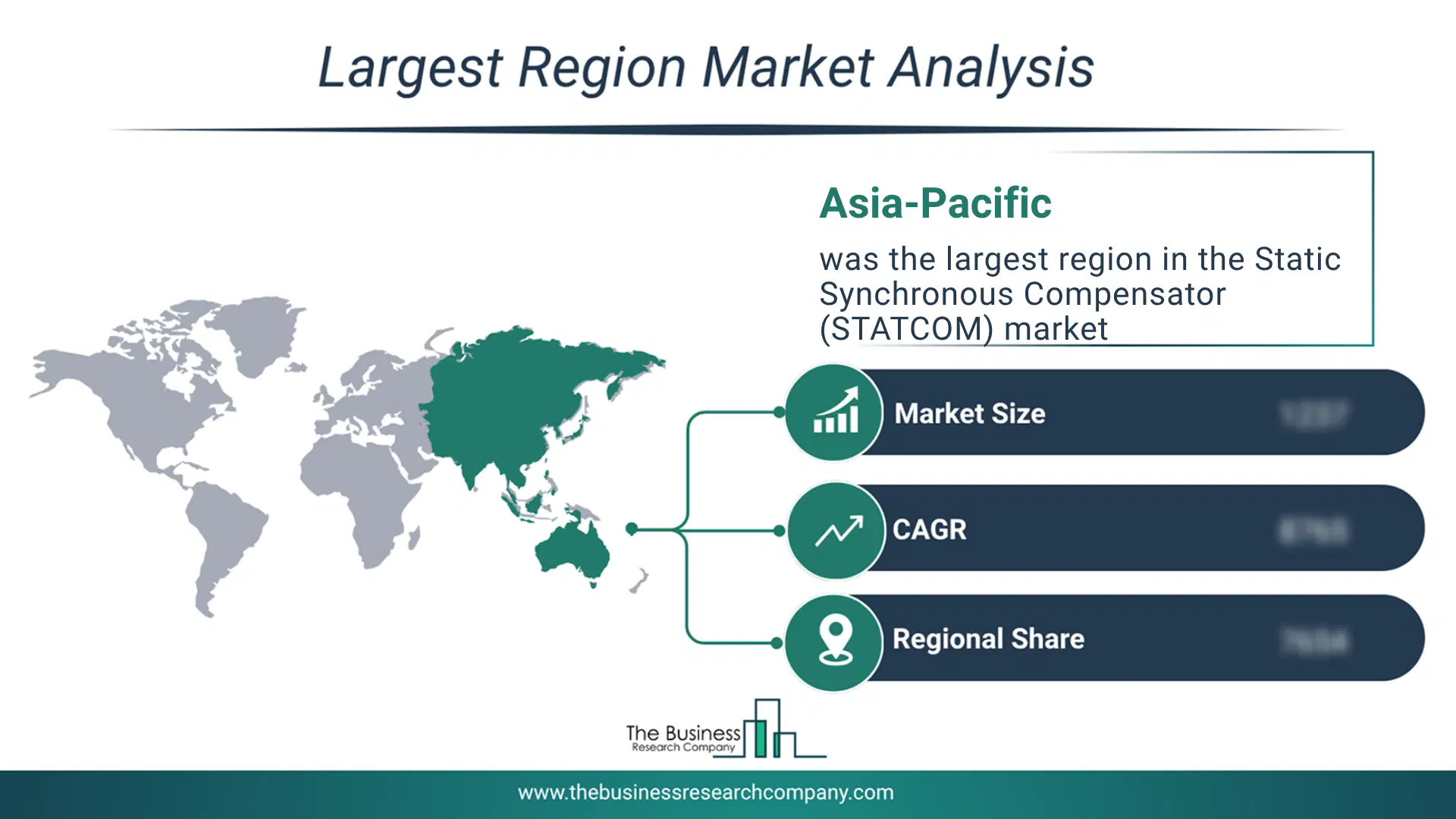
Regional Outlook
Asia-Pacific was the largest region in the static synchronous compensator (STATCOM) market in 2025. The regions covered in this market report are Asia-Pacific, South East Asia, Western Europe, Eastern Europe, North America, South America, Middle East, Africa. The countries covered in this market report are Australia, Brazil, China, France, Germany, India, Indonesia, Japan, Taiwan, Russia, South Korea, UK, USA, Canada, Italy, SpainWhat Defines the Static Synchronous Compensator (STATCOM) Market?
The static synchronous compensator (STATCOM) market consists of revenues earned by entities by providing services such as reactive power compensation, voltage regulation, grid stability support, harmonic filtering, renewable energy integration support, transmission and distribution support, industrial power quality improvement, system design and engineering, installation and commissioning, and monitoring and maintenance. The market value includes the value of related goods sold by the service provider or included within the service offering. The static synchronous compensator (STATCOM) market also includes sales of voltage source converters, control systems, digital controllers, transformers, harmonic filters, and spare parts. Values in this market are ‘factory gate’ values, that is the value of goods sold by the manufacturers or creators of the goods, whether to other entities (including downstream manufacturers, wholesalers, distributors and retailers) or directly to end customers. The value of goods in this market includes related services sold by the creators of the goods.How is Market Value Defined and Measured?
The market value is defined as the revenues that enterprises gain from the sale of goods and/or services within the specified market and geography through sales, grants, or donations in terms of the currency (in USD unless otherwise specified). The revenues for a specified geography are consumption values that are revenues generated by organizations in the specified geography within the market, irrespective of where they are produced. It does not include revenues from resales along the supply chain, either further along the supply chain or as part of other products.
This chart presents market attractiveness based on a quantitative evaluation of growth, competition, strategic alignment, and risk, offering a clear view of opportunity areas for decision-making. This chart is for illustrative purposes; the full report contains the complete analysis.

This chart highlights the Total Addressable Market (TAM) by estimating the maximum revenue opportunity using an assumption-driven approach, supporting strategic planning and opportunity sizing across markets. The chart is illustrative; the full report provides a more comprehensive analysis.
What Key Data and Analysis Are Included in the Static Synchronous Compensator (STATCOM) Market Report 2026?
The static synchronous compensator (statcom) market research report is one of a series of new reports from The Business Research Company that provides market statistics, including Market Report 2026?global market size, regional shares, competitors with the market share, detailed market segments, market trends and opportunities, and any further data you may need to thrive in the static synchronous compensator (statcom) Market Report 2026? The market research report delivers a complete perspective of everything you need, with an in-depth analysis of the current and future state of the Market Report 2026?Static Synchronous Compensator (STATCOM) Market Report Forecast Analysis
| Report Attribute | Details |
|---|---|
| Market Size Value In 2026 | $1.29 billion |
| Revenue Forecast In 2030 | $1.81 billion |
| Growth Rate | CAGR of 9.1% from 2026 to 2030 |
| Base Year For Estimation | 2025 |
| Actual Estimates/Historical Data | 2020-2025 |
| Forecast Period | 2026 - 2030 - 2030 |
| Market Representation | Revenue in USD Billion and CAGR from 2026 to 2030 |
| Segments Covered | Type, Component, Technology Type, Distribution Channel, End-User |
| Regional Scope | Asia-Pacific, Western Europe, Eastern Europe, North America, South America, Middle East, Africa |
| Country Scope | The countries covered in the report are Australia, Brazil, China, France, Germany, India, Indonesia, Japan, Taiwan, Russia, South Korea, UK, USA, Canada, Italy, Spain. |
| Key Companies Profiled | Mitsubishi Electric Corporation, Hitachi Energy Ltd., Siemens AG, General Electric Company, ABB Ltd., Toshiba Corporation, Eaton Corporation plc, Bharat Heavy Electricals Limited BHEL, Hyosung Heavy Industries Corporation, Sieyuan Electric Co. Ltd., CG Power and Industrial Solutions Limited, American Superconductor Corporation, LS Electric Co. Ltd., JEMA Energy S.A., Merus Power Plc, NR Electric Co. Ltd., Comsys AB, ZDDQ Electric Co. Ltd., Hyundai Electric Co. Ltd., Alstom Grid |
| Customization Scope | Request for Customization |
| Pricing And Purchase Options | Explore Purchase Options |