
Station Ventilation Energy Optimization Market Report 2026
Global Outlook – By Component (Software, Hardware, Services), By Technology (Internet Of Things Enabled Systems, Artificial Intelligence And Machine Learning Based Optimization, Cloud Based Energy Management Systems, Building Management Systems Integration), By Deployment Mode (On-Premises, Cloud), By Application (Subway Stations, Railway Stations, Bus Terminals, Airports, Other Applications), By End-User (Transportation Authorities, Facility Management Companies, Infrastructure Developers, Other End-Users) – Market Size, Trends, Strategies, and Forecast to 2035
Station Ventilation Energy Optimization Market Overview
• Station Ventilation Energy Optimization market size has reached to $1.7 billion in 2025 • Expected to grow to $2.87 billion in 2030 at a compound annual growth rate (CAGR) of 11.1% • Growth Driver: Expansion Of Metro And Railway Infrastructure Fueling The Growth Of The Market Due To Rising Urban Mobility Demand • Market Trend: Advanced Airflow Control System Modernizes Underground Station Environment Management • North America was the largest region in 2025 and Asia-Pacific is the fastest growing region.What Is Covered Under Station Ventilation Energy Optimization Market?
Station ventilation energy optimization refers to the systematic application of advanced control strategies, real-time monitoring, and data-driven modeling to regulate airflow, temperature, and pressure within transit stations in a manner that minimizes energy consumption while maintaining required environmental and safety standards. It involves the dynamic adjustment of ventilation parameters based on factors such as passenger density, external weather conditions, and air quality metrics, enabling efficient operation of ventilation infrastructure. The main components of station ventilation energy optimization include software, hardware, and services. Software refers to intelligent control and optimization platforms designed to reduce energy consumption in station ventilation systems while maintaining air quality and safety standards. These systems are based on technologies such as internet of things enabled systems, artificial intelligence and machine learning based optimization, cloud based energy management systems, and building management systems integration and are deployed in modes including on-premises and cloud. They are used in applications such as subway stations, railway stations, bus terminals, airports, and others, while the end-use includes transportation authorities, facility management companies, infrastructure developers, and others.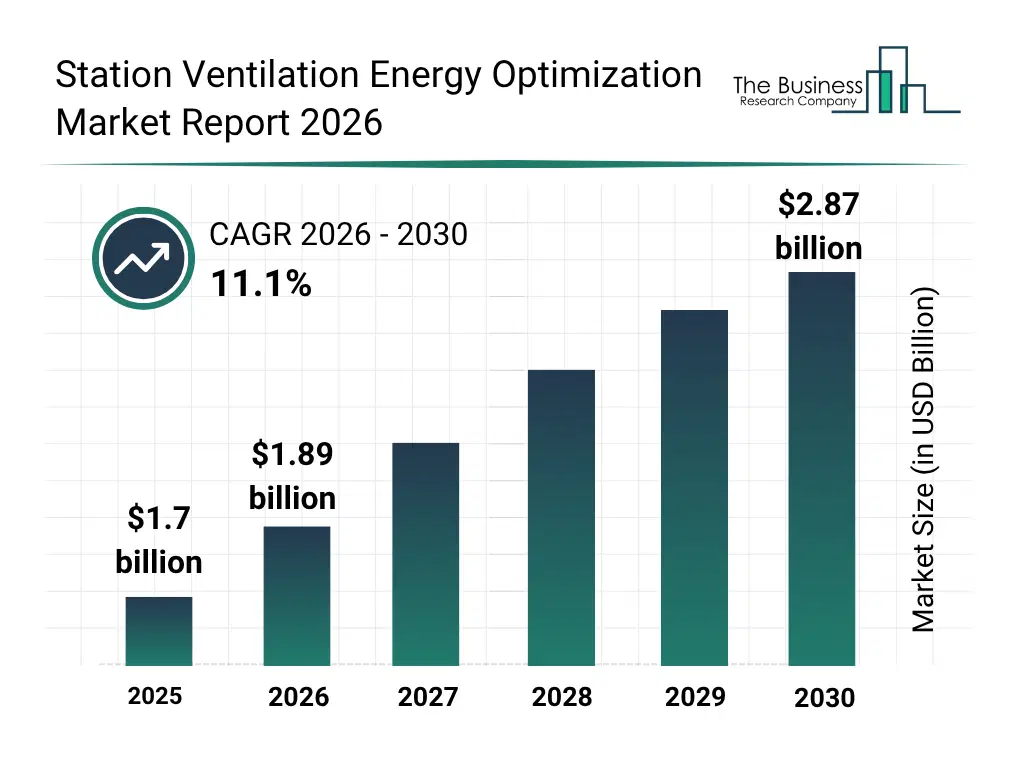
What Is The Station Ventilation Energy Optimization Market Size and Share 2026?
The station ventilation energy optimization market size has grown rapidly in recent years. It will grow from $1.7 billion in 2025 to $1.89 billion in 2026 at a compound annual growth rate (CAGR) of 10.8%. The growth in the historic period can be attributed to rising urbanization and commuter growth, basic mechanical ventilation adoption in transit stations, expansion of metro rail infrastructure, manual hvac control systems, early air quality monitoring regulations.What Is The Station Ventilation Energy Optimization Market Growth Forecast?
The station ventilation energy optimization market size is expected to see rapid growth in the next few years. It will grow to $2.87 billion in 2030 at a compound annual growth rate (CAGR) of 11.1%. The growth in the forecast period can be attributed to integration of predictive maintenance in HVAC systems, increasing electrification of transit infrastructure, adoption of dynamic airflow optimization strategies, growth in smart city transit investments, stricter carbon emission and sustainability targets. Major trends in the forecast period include increasing energy price volatility impacting transit ventilation operations, aging metro and railway infrastructure requiring ventilation system retrofits, rising passenger congestion in urban transit hubs driving airflow demand variability, strict indoor air quality and safety compliance mandates in public transport stations, expansion of metro, subway, and rail networks in emerging economies.
Global Station Ventilation Energy Optimization Market Segmentation
1) By Component: Software, Hardware, Services 2) By Technology: Internet Of Things Enabled Systems, Artificial Intelligence And Machine Learning Based Optimization, Cloud Based Energy Management Systems, Building Management Systems Integration 3) By Deployment Mode: On-Premises, Cloud 4) By Application: Subway Stations, Railway Stations, Bus Terminals, Airports, Other Applications 5) By End-User: Transportation Authorities, Facility Management Companies, Infrastructure Developers, Other End-Users Subsegments: 1) By Software: Real Time Monitoring Software, Predictive Analytics Software, Energy Management Software, Airflow Simulation Software, Control And Automation Software 2) By Hardware: Air Quality Sensors, Temperature And Humidity Sensors, Ventilation Fans And Blowers, Variable Speed Drives, Control Panels And Controllers 3) By Services: System Integration Services, Consulting And Advisory Services, Maintenance And Support Services, Installation And Commissioning Services, Performance Optimization ServicesWhat Is The Driver Of The Station Ventilation Energy Optimization Market?
The expansion of metro and railway infrastructure is expected to propel the growth of the station ventilation energy optimization market going forward. Metro and railway infrastructure refers to the integrated network of tracks, stations, tunnels, signaling systems, and support facilities designed to enable efficient, safe, and high-capacity rail-based transportation of passengers and goods. Expansion of metro and railway infrastructure is increasing due to rising urban population density, growing daily passenger traffic, increasing demand for efficient and reliable public transportation, expansion of smart city initiatives, and higher government investments in sustainable mobility solutions. Station ventilation energy optimization supports the expansion of metro and railway infrastructure by enabling efficient airflow management, reducing energy consumption, and maintaining safe air quality standards in newly constructed and expanded transit stations. For instance, in January 2025, according to the Department for Transport, a UK-based government department, the UK government provided $30.0 billion (£22.3 billion) in support to the rail system during 2023–2024. Therefore, the expansion of metro and railway infrastructure is driving the growth of the station ventilation energy optimization industry.Key Players In The Global Station Ventilation Energy Optimization Market
Major companies operating in the station ventilation energy optimization market are Siemens AG, Schneider Electric SE, Honeywell International Inc., ABB Ltd., Daikin Industries Ltd., Johnson Controls International plc, Carrier Global Corporation, Trane Technologies plc, Delta Electronics Inc., Howden Group Ltd., Systemair AB, Belimo Holding AG, Ziehl-Abegg SE, FläktGroup Holding GmbH, Swegon Group AB, Carel Industries S.p.A., TROX GmbH, Distech Controls Inc., NOVENCO Building & Industry A/S, TLT-Turbo GmbH, SODECA S.L.U., ebm-papst Group, Sauter AGGlobal Station Ventilation Energy Optimization Market Trends and Insights
Major companies operating in the station ventilation energy optimization market are focusing on the integration of artificial intelligence-driven ventilation optimization, such as machine learning-based airflow control systems, to dynamically adjust airflow, temperature, and pressure in real time, thereby improving energy efficiency, reducing operational costs, and enhancing passenger comfort and safety in underground transit systems. Machine learning-based airflow control systems are systems that use AI algorithms to automatically optimize ventilation airflow in real time. For instance, in February 2026, Metro Railway Kolkata, an India-based urban transportation organization, introduced an upgraded intelligent tunnel ventilation system. This system integrates automated control of axial flow fans, real-time temperature and air quality monitoring, and energy-efficient air-cooled chillers to optimize airflow and reduce power usage in underground stations. The project covers 15 underground stations and aims to improve energy efficiency, passenger comfort, and sustainability.What Are Latest Mergers And Acquisitions In The Station Ventilation Energy Optimization Market?
In January 2025, Trane Technologies plc, an Ireland-based company specializing in HVAC systems, building management solutions, and energy-efficient climate technologies, acquired BrainBox AI for an undisclosed amount. With this acquisition, Trane Technologies aims to strengthen its digital building and HVAC optimization capabilities by integrating BrainBox AI’s artificial intelligence–driven autonomous HVAC control platform, which optimizes energy consumption, reduces greenhouse gas emissions by up to 40%, and supports smart, self-learning building operations across commercial facilities such as airports, hotels, offices, and retail spaces. BrainBox AI Inc. is a Canada-based provider of AI-driven HVAC optimization software that autonomously controls and optimizes ventilation and HVAC systems using real-time data.Regional Outlook/Insights
North America was the largest region in the station ventilation energy optimization market in 2025. Asia-Pacific is expected to be the fastest-growing region in the forecast period. The regions covered in this market report are Asia-Pacific, South East Asia, Western Europe, Eastern Europe, North America, South America, Middle East, Africa. The countries covered in this market report are Australia, Brazil, China, France, Germany, India, Indonesia, Japan, Taiwan, Russia, South Korea, UK, USA, Canada, Italy, Spain.What Defines the Station Ventilation Energy Optimization Market?
The station ventilation energy optimization market consists of revenues earned by entities by providing services such as airflow modelling, real-time ventilation monitoring, AI-driven airflow and pressure optimization, nergy consumption benchmarking, and fault detection services. The market value includes the value of related goods sold by the service provider or included within the service offering. The station ventilation energy optimization market also includes sales of airflow sensors, air velocity meters, differential pressure sensors, particulate matter sensors, and humidity sensors. Values in this market are ‘factory gate’ values, that is the value of goods sold by the manufacturers or creators of the goods, whether to other entities (including downstream manufacturers, wholesalers, distributors and retailers) or directly to end customers. The value of goods in this market includes related services sold by the creators of the goods.How is Market Value Defined and Measured?
The market value is defined as the revenues that enterprises gain from the sale of goods and/or services within the specified market and geography through sales, grants, or donations in terms of the currency (in USD unless otherwise specified). The revenues for a specified geography are consumption values that are revenues generated by organizations in the specified geography within the market, irrespective of where they are produced. It does not include revenues from resales along the supply chain, either further along the supply chain or as part of other products.What Key Data and Analysis Are Included in the Station Ventilation Energy Optimization Market Report 2026?
The station ventilation energy optimization market research report is one of a series of new reports from The Business Research Company that provides market statistics, including industry global market size, regional shares, competitors with the market share, detailed market segments, market trends and opportunities, and any further data you may need to thrive in the station ventilation energy optimization industry. The market research report delivers a complete perspective of everything you need, with an in-depth analysis of the current and future state of the industry.Station Ventilation Energy Optimization Market Report Forecast Analysis
| Report Attribute | Details |
|---|---|
| Market Size Value In 2026 | $1.89 billion |
| Revenue Forecast In 2035 | $2.87 billion |
| Growth Rate | CAGR of 11.1% from 2026 to 2035 |
| Base Year For Estimation | 2025 |
| Actual Estimates/Historical Data | 2020-2025 |
| Forecast Period | 2026 - 2030 - 2035 |
| Market Representation | Revenue in USD Billion and CAGR from 2026 to 2035 |
| Segments Covered | Component, Technology, Deployment Mode, Application, End-User |
| Regional Scope | Asia-Pacific, Western Europe, Eastern Europe, North America, South America, Middle East, Africa |
| Country Scope | The countries covered in the report are Australia, Brazil, China, France, Germany, India, Indonesia, Japan, Taiwan, Russia, South Korea, UK, USA, Canada, Italy, Spain. |
| Key Companies Profiled | Siemens AG, Schneider Electric SE, Honeywell International Inc., ABB Ltd., Daikin Industries Ltd., Johnson Controls International plc, Carrier Global Corporation, Trane Technologies plc, Delta Electronics Inc., Howden Group Ltd., Systemair AB, Belimo Holding AG, Ziehl-Abegg SE, FläktGroup Holding GmbH, Swegon Group AB, Carel Industries S.p.A., TROX GmbH, Distech Controls Inc., NOVENCO Building & Industry A/S, TLT-Turbo GmbH, SODECA S.L.U., ebm-papst Group, Sauter AG |
| Customization Scope | Request for Customization |
| Pricing And Purchase Options | Explore Purchase Options |