
Stationary Catalytic Systems Market Report 2026
Global Outlook – By Technology ( Selective Catalytic Reduction, Oxidation Catalyst), By Pollutant Type ( Nox (Nitrogen Oxides), CO (Carbon Monoxide) Hydrocarbons, HAP (Hazardous Air Pollutants), DPM (Diesel Particulate Matter), NH3 (Ammonia)), By End-Use Industry ( Chemical, Oil And Natural Gas, Power Plant, Metal And Mining, Cement, Other End-Use Industries) – Market Size, Trends, Strategies, and Forecast to 2030
Stationary Catalytic Systems Market Overview
• Stationary Catalytic Systems market size has reached to $5.37 billion in 2025 • Expected to grow to $7.36 billion in 2030 at a compound annual growth rate (CAGR) of 6.7% • Growth Driver: Hydrogen Fuel Cells Demand Driving Force Behind The Stationary Catalytic Systems • Market Trend: Innovations In High-Efficiency Catalysts For Industrial Chemical Processes • Asia-Pacific was the largest region in 2025.What Is Covered Under Stationary Catalytic Systems Market?
Stationary catalytic systems refer to pollution control devices that use a catalyst to convert one or more chemical species into other chemical species. It is technology that is used to control emissions from stationary sources such as power plants, refineries, and industrial facilities. These systems are used to reduce the emission of harmful substances such as chlorofluorocarbons, sulfur oxides, and other pollutants in various industrial applications. The main types of technologies included in stationary catalytic systems are selective catalytic reduction and oxidation catalysts. Selective Catalytic Reduction is an advanced emission control technology used in various industries, particularly in the automotive and power generation sectors, to reduce the levels of nitrogen oxide emissions in exhaust gases. The various types of pollutants include NOX (nitrogen oxides), CO (carbon monoxide) hydrocarbons, HAP (hazardous air pollutants), DPM (diesel particulate matter), and NH3 (ammonia), that are used by several end-use industries, including chemical, oil and natural gas, power plants, metal and mining, cement, and others.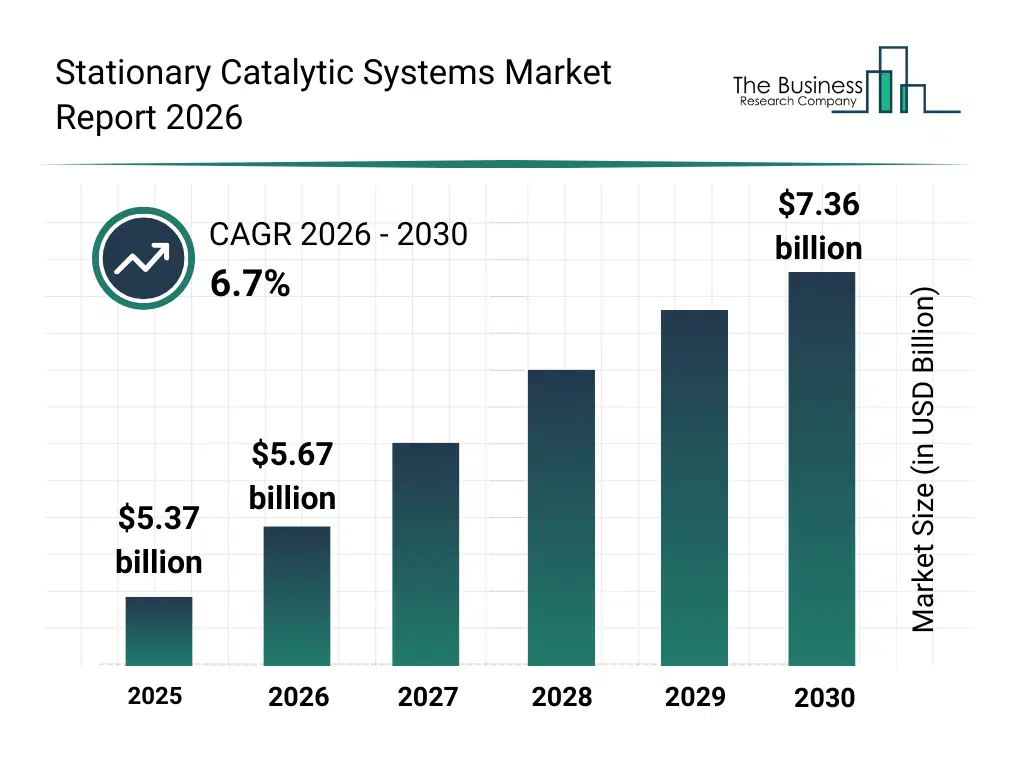
What Is The Stationary Catalytic Systems Market Size 2026 And Growth Rate?
The stationary catalytic systems market size has grown strongly in recent years. It will grow from $5.37 billion in 2025 to $5.67 billion in 2026 at a compound annual growth rate (CAGR) of 5.5%. The growth in the historic period can be attributed to tightening industrial emission regulations, rising pollution levels from stationary industrial sources, early adoption of scr and oxidation catalyst technologies, increasing use of platinum and palladium catalysts, growing industrialization driving pollutant control demand.What Is The Stationary Catalytic Systems Market Growth Forecast?
The stationary catalytic systems market size is expected to see strong growth in the next few years. It will grow to $7.36 billion in 2030 at a compound annual growth rate (CAGR) of 6.7%. The growth in the forecast period can be attributed to expansion of clean energy policies, rising focus on decarbonization in heavy industries, technological advancements in catalyst regeneration, growing demand for cost effective multi pollutant control systems, increasing investments in emission control modernization. Major trends in the forecast period include rising adoption of high efficiency catalyst formulations, increasing deployment of low temperature catalytic systems, growing integration of catalyst monitoring and diagnostic solutions, expansion of modular catalytic units for industrial retrofits, increasing shift toward ultra low emission industrial operations.
Global Stationary Catalytic Systems Market Segmentation
1) By Technology: Selective Catalytic Reduction, Oxidation Catalyst 2) By Pollutant Type: Nox (Nitrogen Oxides), CO (Carbon Monoxide) Hydrocarbons, HAP (Hazardous Air Pollutants), DPM (Diesel Particulate Matter), NH3 (Ammonia) 3) By End-Use Industry: Chemical, Oil And Natural Gas, Power Plant, Metal And Mining, Cement, Other End-Use Industries Subsegments: 1) By Selective Catalytic Reduction (SCR): Ammonia-Based SCR Systems, Urea-Based SCR Systems 2) By Oxidation Catalyst: Platinum-Based Catalysts, Palladium-Based CatalystsWhat Is The Driver Of The Stationary Catalytic Systems Market?
The rising demand for hydrogen fuel cells is expected to propel the growth of the stationary catalytic systems market in the coming years. A hydrogen fuel cell is an electrochemical cell that turns hydrogen's chemical energy into electricity via redox mechanisms. It is a sustainable energy, having just electricity, heat, and water as products and byproducts. Hydrogen fuel cells can be utilized in stationary catalytic systems for battery backup, uninterrupted electricity supply (UPS), and remote energy production. For instance, in September 2023, according to the Global Hydrogen Review 2023 published by the International Energy Agency (IEA), a France-based intergovernmental organization, hydrogen use in road transport rose by 45% in 2022, with fuel cell vehicle stock surpassing 58,000 by year-end an almost 40% increase reaching approximately 63,000 by mid-2023. Therefore, the rising demand for hydrogen fuel cells drives the stationary catalytic systems industry.Key Players In The Global Stationary Catalytic Systems Market
Major companies operating in the stationary catalytic systems market are Shell plc, BASF SE, Honeywell International inc., Bharat Heavy Electricals Limited, Yara International, Tenneco Inc., Johnson Matthey, Hitachi Zosen Corporation, Corning Incorporated, DuPont de Nemours Inc, Clariant AG, Durr Group, Umicore N.V., NIPPON SHOKUBAI CO. LTD, CECO Environmental, Babcock and Wilcox Enterprises Inc., Dinex Group, Ducon Infratechnologies Ltd., Kwangsung Corporation Ltd, Nett Technologies, Unifrax Holding Co., Air Clean Energy, DCL International, Catalytic Products International Inc., APC Technologies Inc., Advanced Catalyst Systems LLC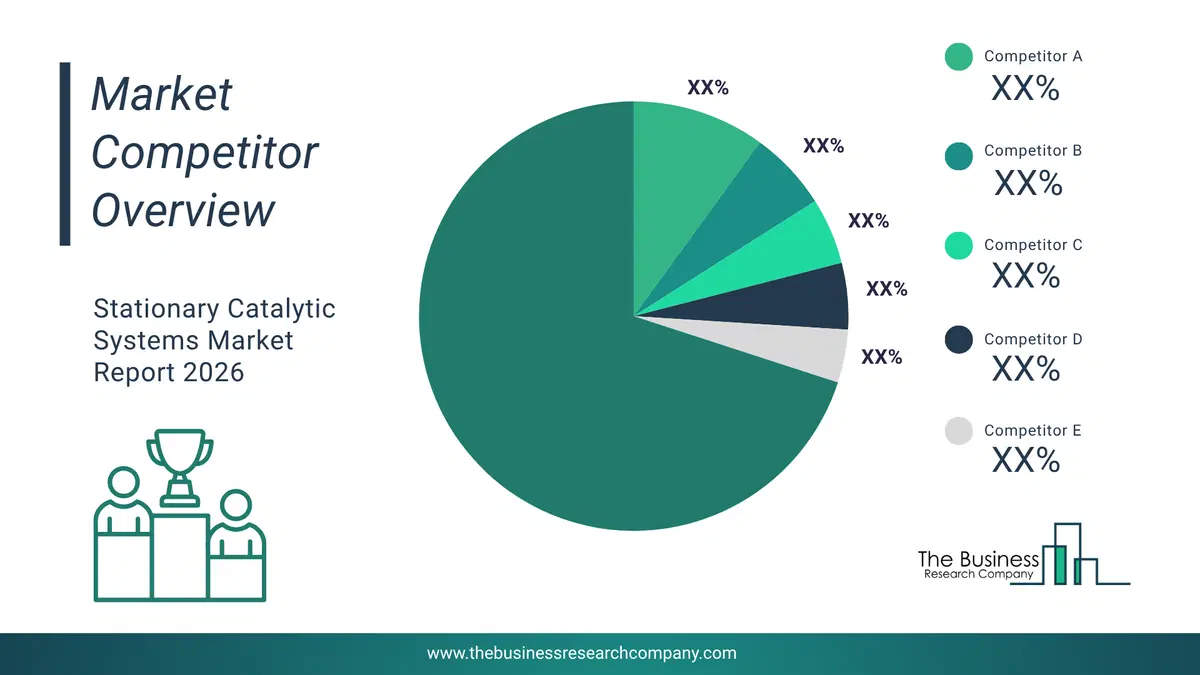
This chart is for illustrative purposes; the full report includes a detailed competitor analysis and comprehensive overview of the top 10 companies in the market.
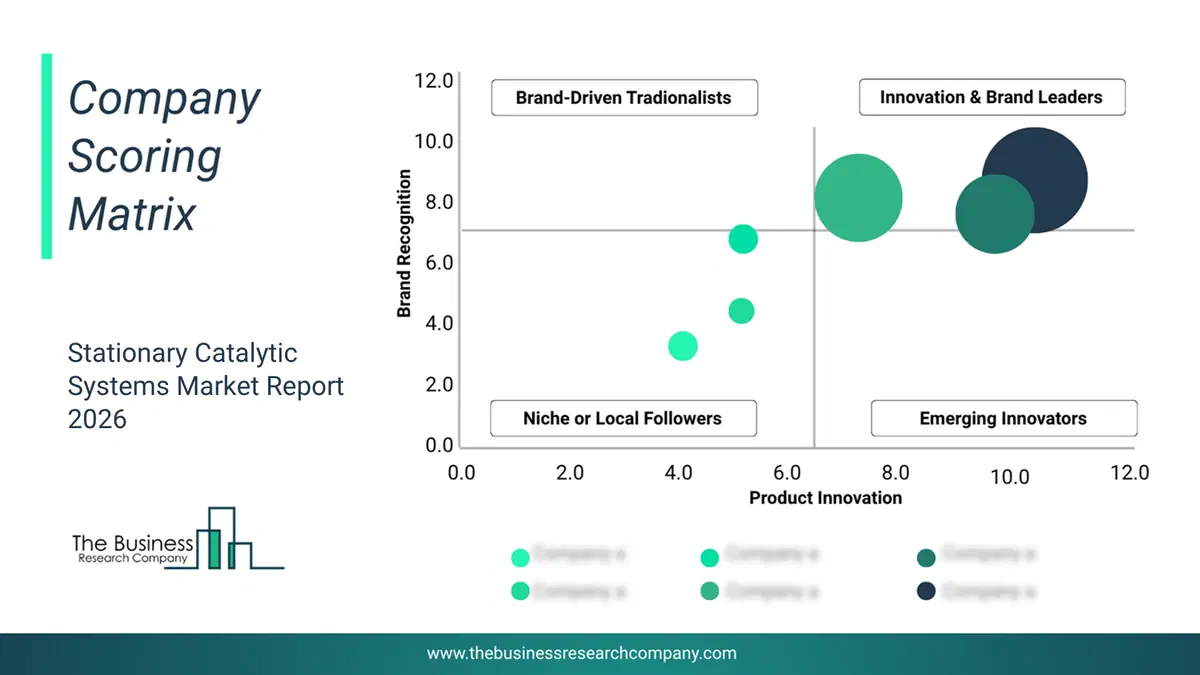
This chart maps companies by product innovation and brand strength, with bubble size indicating relative revenue, helping identify market leaders, challengers, and niche players. This is an illustrative chart; the full report provides a complete and accurate competitive analysis.
Global Stationary Catalytic Systems Market Trends and Insights
Major companies operating in the stationary catalytic systems market are focusing on developing innovative solutions such as high-efficiency catalyst formulations to enhance reaction rates, reduce energy consumption, and improve the longevity of industrial chemical processes. High-efficiency catalyst formulations refer to advanced chemical compounds engineered to accelerate specific reactions while minimizing degradation and operational costs. For instance, in September 2023, MIRATECH, a US-based industrial chemical company, unveiled Apex, a new industry-best catalyst product line. Apex is designed to optimize reaction efficiency, extend catalyst lifespan, and reduce operational downtime in large-scale chemical manufacturing, enabling companies to achieve higher productivity and lower energy consumption.What Are Latest Mergers And Acquisitions In The Stationary Catalytic Systems Market?
In September 2024, TPG Rise Climate, a US-based dedicated climate investing strategy of TPG’s global impact investing platform, acquired MIRATECH Corp. for an undisclosed amount. The purpose of TPG Rise Climate's acquisition of MIRATECH Corp. is to expand MIRATECH’s market leadership and support emissions reduction efforts in response to increasing energy demand and stricter global air quality regulations. MIRATECH Corp. is a US-based company specializing in aftermarket emissions and noise reduction technology for stationary industrial engines, including catalyst solutions.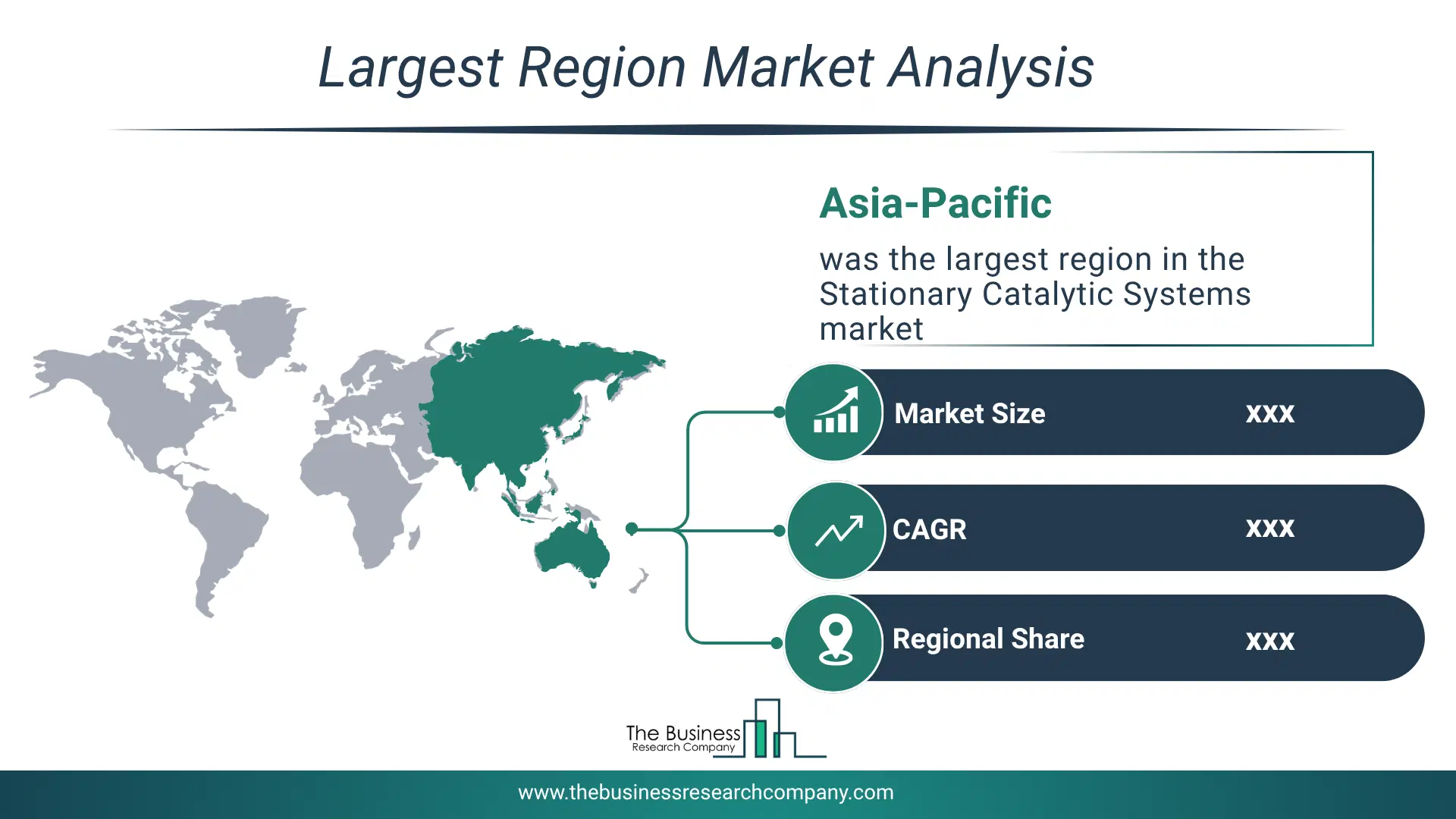
Regional Outlook
Asia-Pacific was the largest region in the stationary catalytic systems market in 2025. The regions covered in this market report are Asia-Pacific, South East Asia, Western Europe, Eastern Europe, North America, South America, Middle East, Africa. The countries covered in this market report are Australia, Brazil, China, France, Germany, India, Indonesia, Japan, Taiwan, Russia, South Korea, UK, USA, Canada, Italy, Spain.What Defines the Stationary Catalytic Systems Market?
The stationary catalytic systems market consists of sales of catalytic converters, heat exchangers, particulate filters, monitoring, and reporting systems. Values in this market are ‘factory gate’ values, that is, the value of goods sold by the manufacturers or creators of the goods, whether to other entities (including downstream manufacturers, wholesalers, distributors, and retailers) or directly to end customers. The value of goods in this market includes related services sold by the creators of the goods.How is Market Value Defined and Measured?
The market value is defined as the revenues that enterprises gain from the sale of goods and/or services within the specified market and geography through sales, grants, or donations in terms of the currency (in USD unless otherwise specified). The revenues for a specified geography are consumption values that are revenues generated by organizations in the specified geography within the market, irrespective of where they are produced. It does not include revenues from resales along the supply chain, either further along the supply chain or as part of other products.
This chart presents market attractiveness based on a quantitative evaluation of growth, competition, strategic alignment, and risk, offering a clear view of opportunity areas for decision-making. This chart is for illustrative purposes; the full report contains the complete analysis.

This chart highlights the Total Addressable Market (TAM) by estimating the maximum revenue opportunity using an assumption-driven approach, supporting strategic planning and opportunity sizing across markets. The chart is illustrative; the full report provides a more comprehensive analysis.
What Key Data and Analysis Are Included in the Stationary Catalytic Systems Market Report 2026?
The stationary catalytic systems market research report is one of a series of new reports from The Business Research Company that provides market statistics, including industry global market size, regional shares, competitors with the market share, detailed market segments, market trends and opportunities, and any further data you may need to thrive in the stationary catalytic systems industry. The market research report delivers a complete perspective of everything you need, with an in-depth analysis of the current and future state of the industry.Stationary Catalytic Systems Market Report Forecast Analysis
| Report Attribute | Details |
|---|---|
| Market Size Value In 2026 | $5.67 billion |
| Revenue Forecast In 2030 | $7.36 billion |
| Growth Rate | CAGR of 6.7% from 2026 to 2030 |
| Base Year For Estimation | 2025 |
| Actual Estimates/Historical Data | 2020-2025 |
| Forecast Period | 2026 - 2030 |
| Market Representation | Revenue in USD Billion and CAGR from 2026 to 2030 |
| Segments Covered | Technology, Pollutant Type, End-Use Industry |
| Regional Scope | Asia-Pacific, Western Europe, Eastern Europe, North America, South America, Middle East, Africa |
| Country Scope | The countries covered in the report are Australia, Brazil, China, France, Germany, India, Indonesia, Japan, Taiwan, Russia, South Korea, UK, USA, Canada, Italy, Spain. |
| Key Companies Profiled | Shell plc, BASF SE, Honeywell International inc., Bharat Heavy Electricals Limited, Yara International, Tenneco Inc., Johnson Matthey, Hitachi Zosen Corporation, Corning Incorporated, DuPont de Nemours Inc, Clariant AG, Durr Group, Umicore N.V., NIPPON SHOKUBAI CO. LTD, CECO Environmental, Babcock and Wilcox Enterprises Inc., Dinex Group, Ducon Infratechnologies Ltd., Kwangsung Corporation Ltd, Nett Technologies, Unifrax Holding Co., Air Clean Energy, DCL International, Catalytic Products International Inc., APC Technologies Inc., Advanced Catalyst Systems LLC |
| Customization Scope | Request for Customization |
| Pricing And Purchase Options | Explore Purchase Options |