
Stearic Acid Market Report 2026
Global Outlook – By Feedstock (Animal-Based Raw Materials, Vegetable-Based Raw Materials), By Sales Channel (Direct Sales, Indirect Sales), By End-Use Industry (Automotive, Textiles, Healthcare, Personal Care, Other End-Use Industries) – Market Size, Trends, Strategies, and Forecast to 2030
Stearic Acid Market Overview
• Stearic Acid market size has reached to $38.17 billion in 2025 • Expected to grow to $54.63 billion in 2030 at a compound annual growth rate (CAGR) of 7.3% • Growth Driver: The Impact of Personal Care Product Demand on the Stearic Acid Market • Market Trend: Innovative Applications Of Non-Ionic Surfactants Derived From Stearic Acid In Cosmetics And Personal Care • Asia-Pacific was the largest region and fastest growing region.What Is Covered Under Stearic Acid Market?
Stearic acid refers to a saturated monobasic acid with an 18-carbon chain length. It is synthesized through the hydrolysis of animal fat or the hydrogenation of cottonseed or vegetable oil. Commercially available stearic acid is usually a mixture of palmitic and myristic acid. Stearic acid finds extensive application in the production of candles, as a softening agent in rubber, and as an additive in manufacturing lubricants. The main feedstock of stearic acid includes animal-based raw materials and vegetable-based raw materials. Animal-based raw materials for stearic acid are derived from animal fat and commonly sourced from beef or pork. The sales channels are direct and indirect, used for automotive, textiles, healthcare, food and beverages, personal care, and other end-use industries.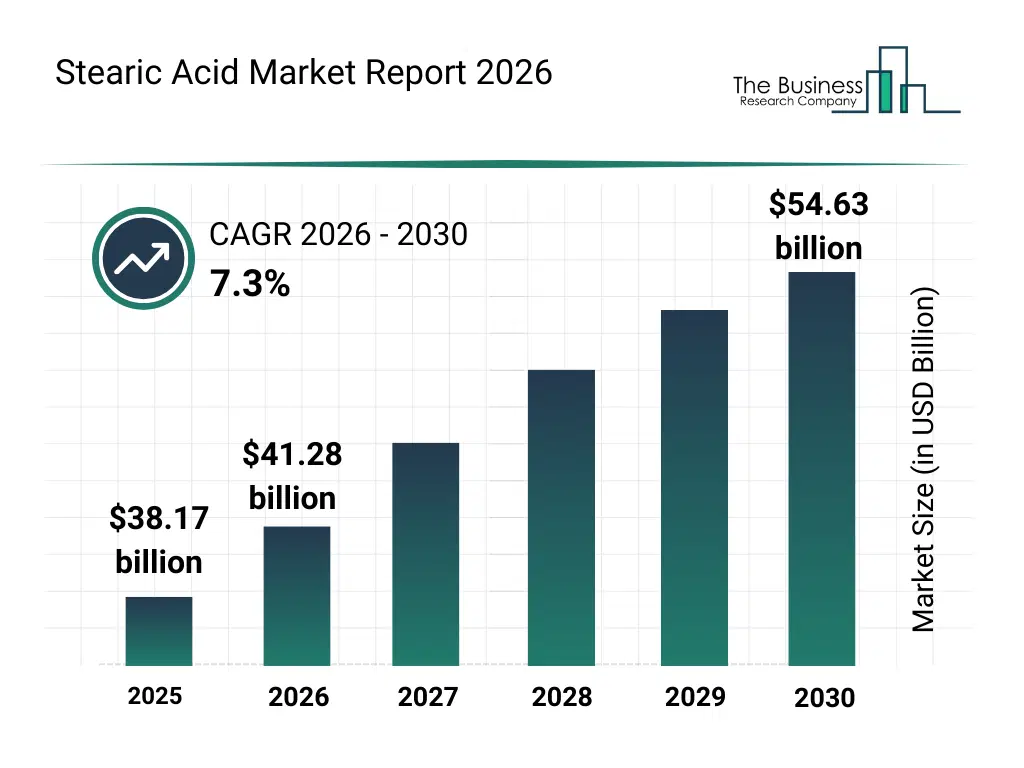
What Is The Stearic Acid Market Size and Share 2026?
The stearic acid market size has grown strongly in recent years. It will grow from $38.17 billion in 2025 to $41.28 billion in 2026 at a compound annual growth rate (CAGR) of 8.1%. The growth in the historic period can be attributed to growth of rubber processing industry, expansion of candle manufacturing, demand from personal care sector, availability of animal based feedstocks, early adoption in lubricant production.What Is The Stearic Acid Market Growth Forecast?
The stearic acid market size is expected to see strong growth in the next few years. It will grow to $54.63 billion in 2030 at a compound annual growth rate (CAGR) of 7.3%. The growth in the forecast period can be attributed to rising demand for plant based chemicals, growth of personal care industry, expansion of automotive production, increasing use in sustainable lubricants, advancements in oleochemical processing. Major trends in the forecast period include growing use in rubber and tire manufacturing, rising demand from personal care products, increasing adoption in lubricant formulations, expansion of candle manufacturing applications, higher focus on vegetable based feedstocks.
Global Stearic Acid Market Segmentation
1) By Feedstock: Animal-Based Raw Materials, Vegetable-Based Raw Materials 2) By Sales Channel: Direct Sales, Indirect Sales 3) By End-Use Industry: Automotive, Textiles, Healthcare, Personal Care, Other End-Use Industries Subsegments: 1) By Animal-Based Raw Materials: Tallow, Lard 2) By Vegetable-Based Raw Materials: Palm Oil, Coconut Oil, Soybean Oil, Sunflower Oil, Canola OilWhat Is The Driver Of The Stearic Acid Market?
The increasing need for personal care products is expected to propel the growth of the stearic acid market going forward. Personal care products encompass items used for hygiene, grooming, and beautification, including skincare, haircare, oral care, and cosmetics. The increasing need for personal care products is attributed to rising consumer awareness about personal hygiene and grooming, growing disposable incomes, urbanization, and the influence of social media and beauty trends. Stearic acid plays a crucial role in cosmetics by enhancing product stability, texture, and performance. Its emulsifying, thickening, and conditioning properties make it valuable in various skincare, haircare, and personal care products. For instance, in September 2024, according to the Bureau of Labor Statistics (BLS), a US-based federal government agency, in 2023, U.S. household spending on personal care products and services grew by 9.7% over 2022. Therefore, the increasing need for personal care products drives the stearic acid industry.Key Players In The Global Stearic Acid Market
Major companies operating in the stearic acid market are Cargill Incorporated, BASF SE, Wilmar International Ltd., Evonik Industries AG, Musim Mas Group, Stepan Company, Croda International Plc, KLK Oleo, Sinarmas Cepsa Pte. Ltd., Vantage Specialty Chemicals, Godrej Industries Limited, Oleon NV, Emery Oleochemicals, Stearinerie Dubois, Lascaray S.A., IOI Oleochemical, Ruixing Chemical Co. Ltd, Paras Polymer and Chemicals, Nimir Industrial Chemicals Ltd, 3F Industries Ltd, Pacific Oleochemicals Sdn Bhd, Kwantas Corporation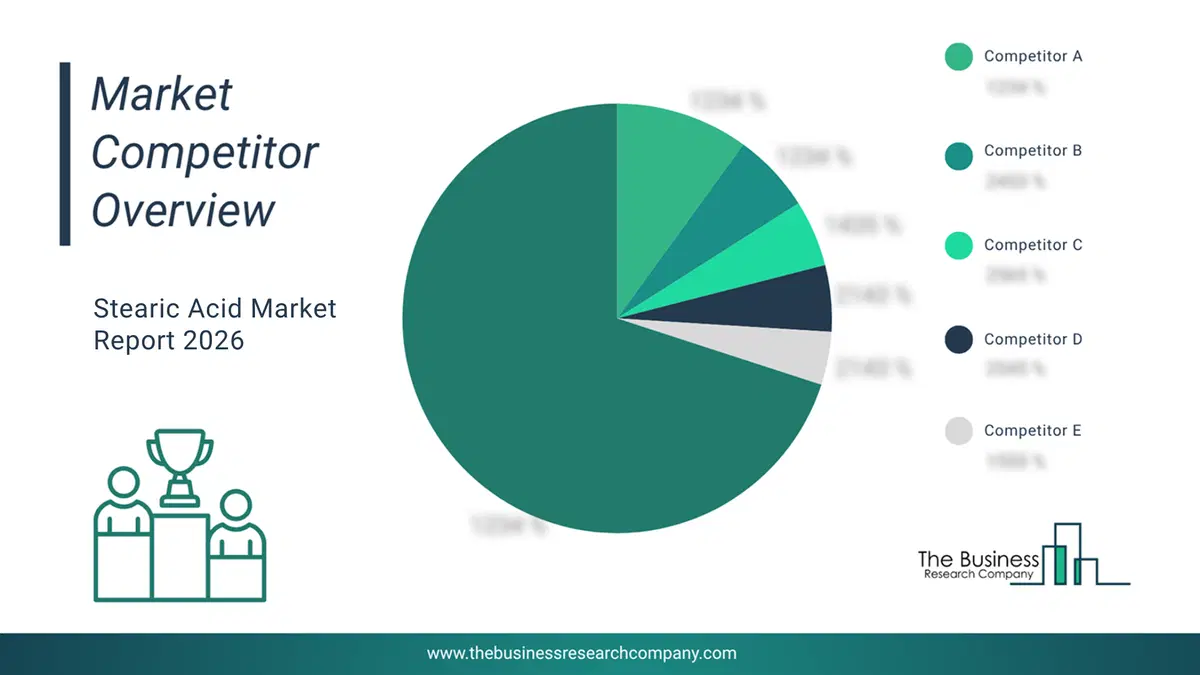
This chart is for illustrative purposes; the full report includes a detailed competitor analysis and comprehensive overview of the top 10 companies in the market.
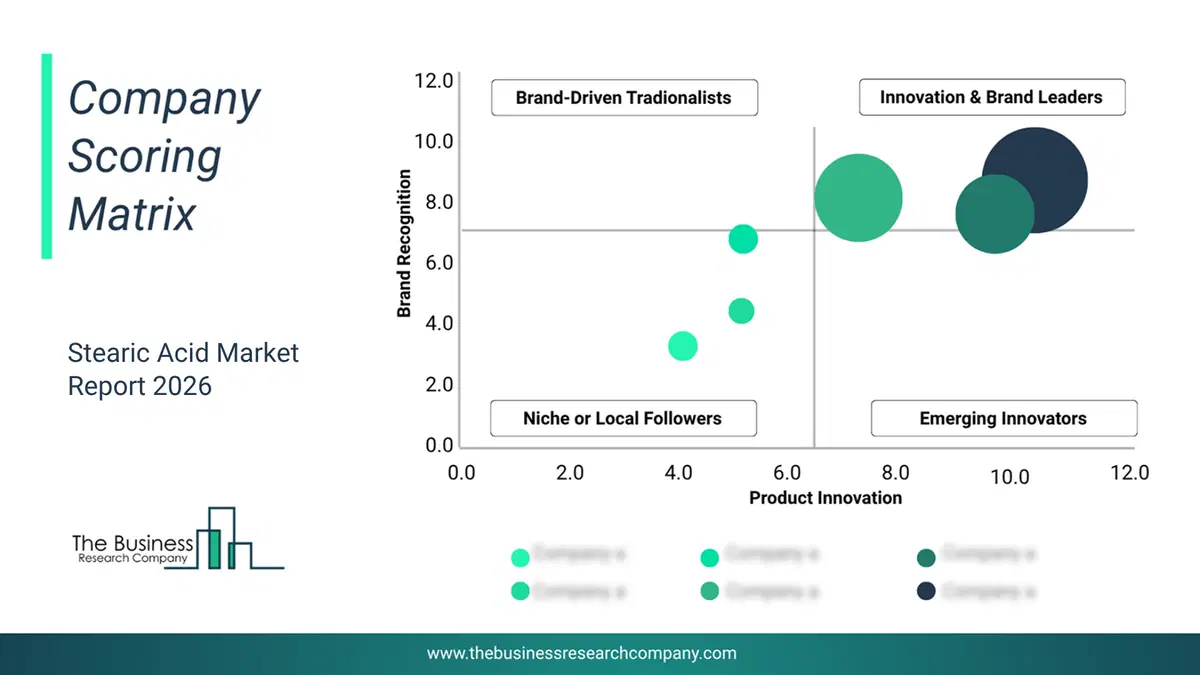
This chart maps companies by product innovation and brand strength, with bubble size indicating relative revenue, helping identify market leaders, challengers, and niche players. This is an illustrative chart; the full report provides a complete and accurate competitive analysis.
Global Stearic Acid Market Trends and Insights
Major companies operating in the stearic acid market are focused on developing innovative products, such as non-ionic surfactants, to enhance the performance of personal care and cleaning products. Non-ionic surfactants derived from stearic acid offer excellent emulsifying, foaming, and cleansing properties, making them ideal for use in formulations of shampoos, soaps, detergents, and cosmetics. For instance, in January 2024, Ataman Kimya, a Turkey-based chemical manufacturing company, launched PEG-20 Stearate, a non-ionic surfactant used in cosmetics and personal care products for its emulsifying and solubilizing properties. It enhances the texture and stability of formulations, providing a smooth and consistent feel. PEG-20 Stearate is a reliable emulsifier that stabilizes water and oil blends in cosmetic formulations. Its utility extends notably to hand and body lotions and creams, and it is also featured in select cleansing products designed to cleanse the skin of impurities. PEG-20 Stearate finds application across a spectrum of cosmetic and personal care items, including moisturizing creams, lotions, sunscreens, and various skincare preparations.What Are Latest Mergers And Acquisitions In The Stearic Acid Market?
In October 2024, OLEON NV, a Belgium-based provider of natural-based oleochemicals and fatty acid derivatives, acquired A. Azevedo Industria e Comercio de Oleos Ltda. for an undisclosed amount. With this acquisition, Oleon aimed to strengthen its global footprint and expand its production capacity and raw material sourcing for fatty acids and related products, including stearic acid, to serve growing demand across personal care, plastics, and industrial markets. A. Azevedo Industria e Comercio de Oleos Ltda. is a Brazil-based oleochemical company specializing in castor bean and vegetable oil-derived fatty acids, including stearic acid and other oleochemicals used in lubricants, cosmetics, and industrial applications.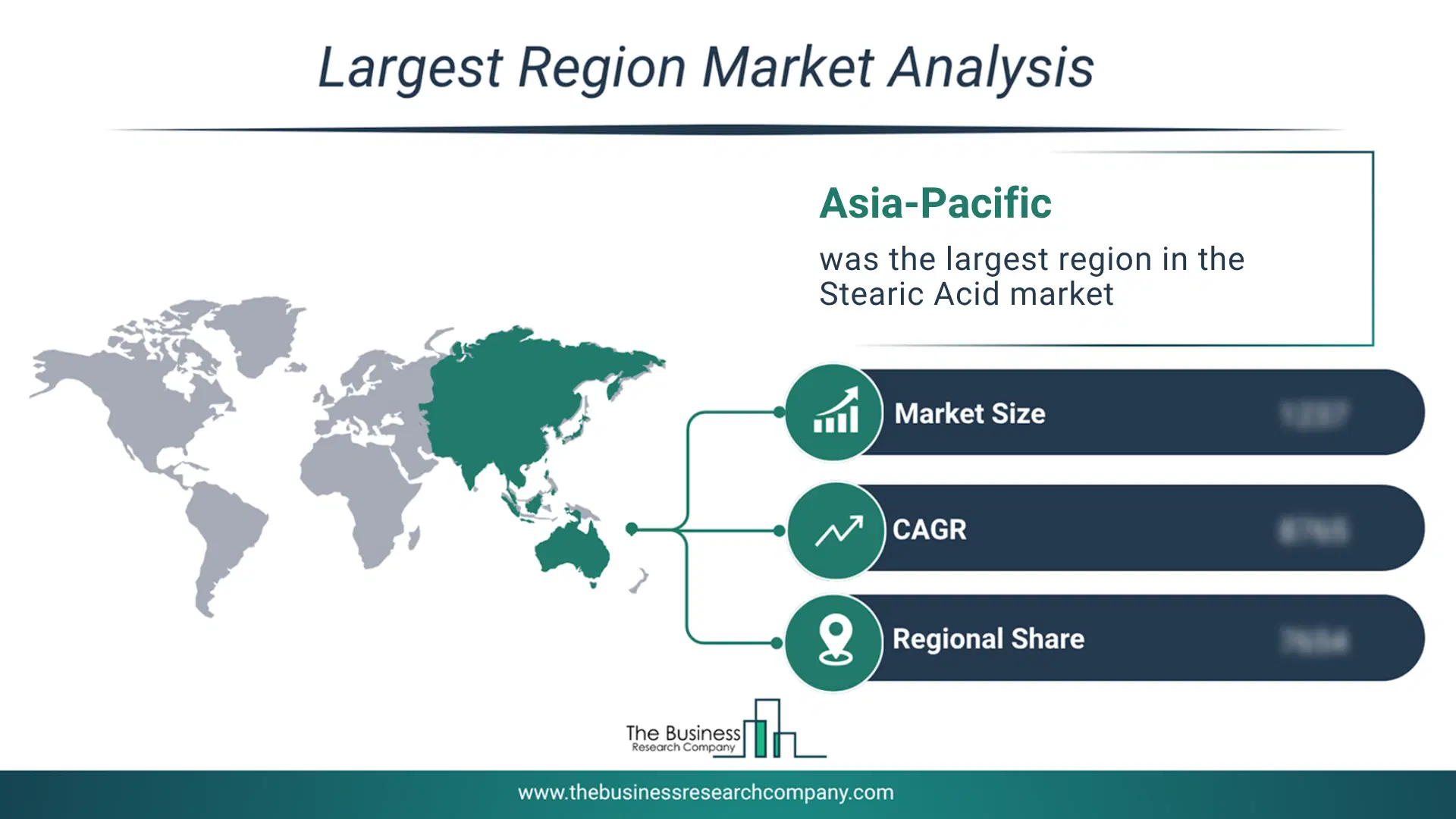
Regional Insights
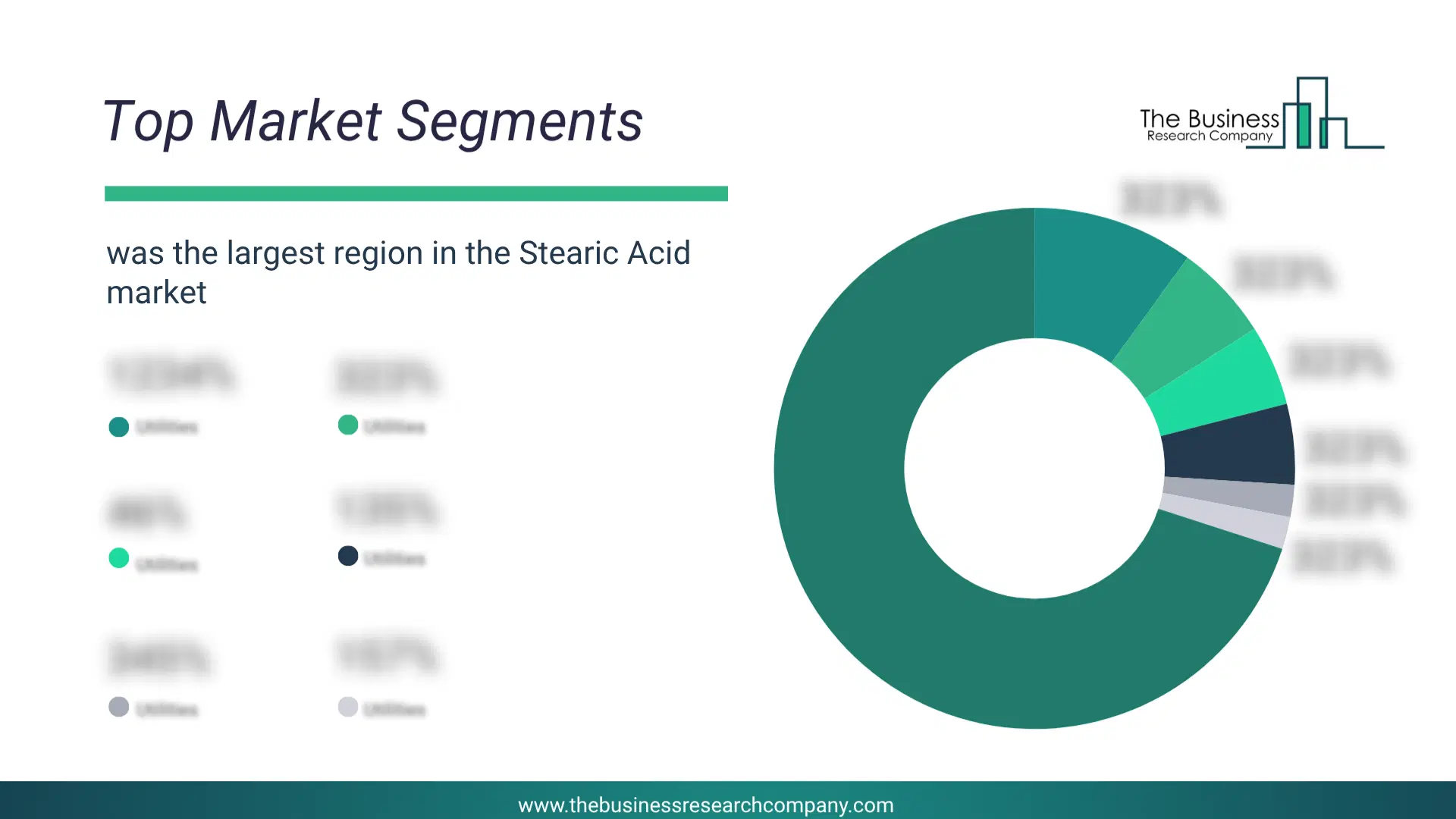
Asia-Pacific was the largest region in the stearic acid market in 2025. Asia-Pacific is expected to be the fastest-growing region in the forecast period. The regions covered in this market report are Asia-Pacific, South East Asia, Western Europe, Eastern Europe, North America, South America, Middle East, Africa The countries covered in this market report are Australia, Brazil, China, France, Germany, India, Indonesia, Japan, Taiwan, Russia, South Korea, UK, USA, Canada, Italy, SpainWhat Defines the Stearic Acid Market?
The stearic acid market consists of sales of natural stearic acid, synthetic stearic acid. Values in this market are ‘factory gate’ values, that is the value of goods sold by the manufacturers or creators of the goods, whether to other entities (including downstream manufacturers, wholesalers, distributors and retailers) or directly to end customers. The value of goods in this market includes related services sold by the creators of the goods.How is Market Value Defined and Measured?
The market value is defined as the revenues that enterprises gain from the sale of goods and/or services within the specified market and geography through sales, grants, or donations in terms of the currency (in USD unless otherwise specified). The revenues for a specified geography are consumption values that are revenues generated by organizations in the specified geography within the market, irrespective of where they are produced. It does not include revenues from resales along the supply chain, either further along the supply chain or as part of other products.
This chart presents market attractiveness based on a quantitative evaluation of growth, competition, strategic alignment, and risk, offering a clear view of opportunity areas for decision-making. This chart is for illustrative purposes; the full report contains the complete analysis.

This chart highlights the Total Addressable Market (TAM) by estimating the maximum revenue opportunity using an assumption-driven approach, supporting strategic planning and opportunity sizing across markets. The chart is illustrative; the full report provides a more comprehensive analysis.
What Key Data and Analysis Are Included in the Stearic Acid Market Report 2026?
The stearic acid market research report is one of a series of new reports from The Business Research Company that provides market statistics, including industry global market size, regional shares, competitors with the market share, detailed market segments, market trends and opportunities, and any further data you may need to thrive in the stearic acid industry. The market research report delivers a complete perspective of everything you need, with an in-depth analysis of the current and future state of the industry.Stearic Acid Market Report Forecast Analysis
| Report Attribute | Details |
|---|---|
| Market Size Value In 2026 | $41.28 billion |
| Revenue Forecast In 2030 | $54.63 billion |
| Growth Rate | CAGR of 8.1% from 2026 to 2030 |
| Base Year For Estimation | 2025 |
| Actual Estimates/Historical Data | 2020-2025 |
| Forecast Period | 2026 - 2030 |
| Market Representation | Revenue in USD Billion and CAGR from 2026 to 2030 |
| Segments Covered | Feedstock, Sales Channel, End-Use Industry |
| Regional Scope | Asia-Pacific, Western Europe, Eastern Europe, North America, South America, Middle East, Africa |
| Country Scope | The countries covered in this market report are Australia, Brazil, China, France, Germany, India, Indonesia, Japan, Taiwan, Russia, South Korea, UK, USA, Canada, Italy, Spain |
| Key Companies Profiled | Cargill Incorporated, BASF SE, Wilmar International Ltd., Evonik Industries AG, Musim Mas Group, Stepan Company, Croda International Plc, KLK Oleo, Sinarmas Cepsa Pte. Ltd., Vantage Specialty Chemicals, Godrej Industries Limited, Oleon NV, Emery Oleochemicals, Stearinerie Dubois, Lascaray S.A., IOI Oleochemical, Ruixing Chemical Co. Ltd, Paras Polymer and Chemicals, Nimir Industrial Chemicals Ltd, 3F Industries Ltd, Pacific Oleochemicals Sdn Bhd, Kwantas Corporation |
| Customization Scope | Request for Customization |
| Pricing And Purchase Options | Explore Purchase Options |