
Steel Wire Global Market Opportunities And Strategies To 2035
By Type (Carbon Steel, Alloy Steel, Stainless Steel), By Thickness (0.01 Mm To 0.8 Mm, 0.8 Mm To 1.6 Mm, 1.6 Mm To 4 Mm, 4 Mm And Above), By Form (Non-Rope, Rope), By End-Use (Construction, Automotive, Energy, Industrial, Other End-Use Industries), And By Region, Opportunities And Strategies – Global Forecast To 2035
Steel Wire Market Definition
Steel wire refers to metallic wire products manufactured by drawing steel rods through a series of dies to reduce their diameter and achieve specific mechanical and physical properties. Steel wire is widely used across industrial, commercial and infrastructure applications because of its high tensile strength, durability, flexibility and resistance to wear and deformation. Steel wire is produced in various grades, diameters and configurations to meet the requirements of construction, automotive, industrial manufacturing, energy transmission and other sectors. The steel wire market consist of sales by entities (organizations, sole traders and partnerships) that manufacture and supply steel wire products used for reinforcement, fastening, lifting, transmission, fencing, spring production and mechanical applications.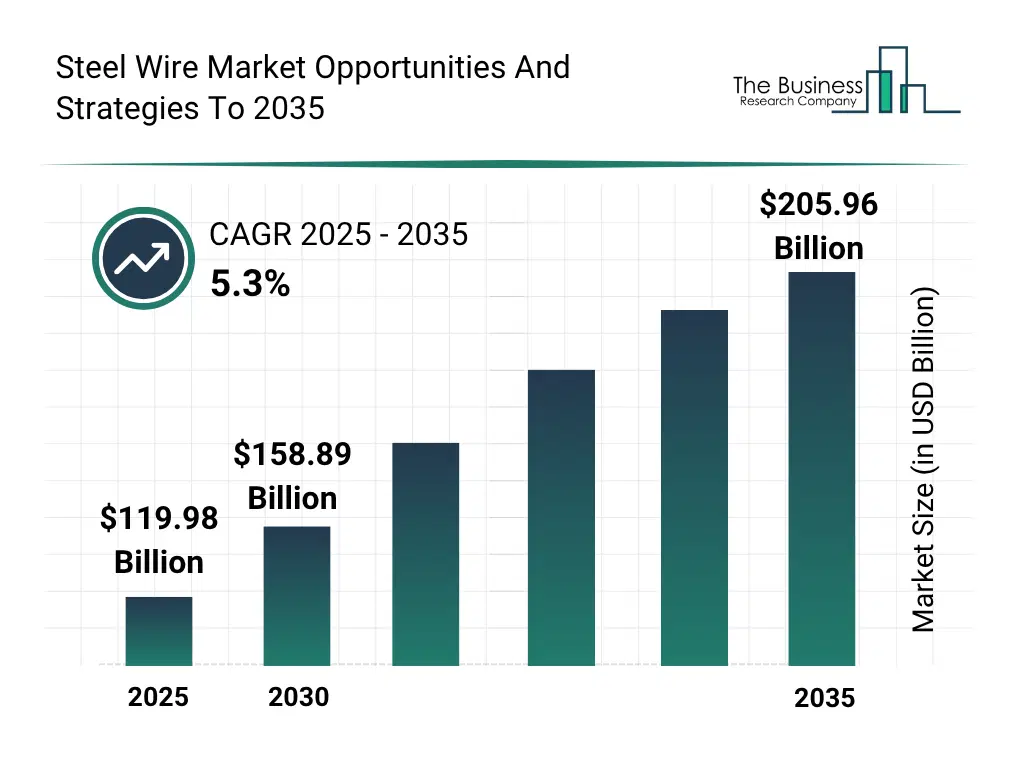
Steel Wire Market Size
The global steel wire market reached a value of nearly $119,980.4 million in 2025, having grown at a compound annual growth rate (CAGR) of 8.3% since 2020. The market is expected to grow from $119,980.4 million in 2025 to $158,889.2 million in 2030 at a rate of 5.8%. The market is then expected to grow at a CAGR of 5.3% from 2030 and reach $205,958.8 million in 2035. Growth in the historic period resulted from growing demand for high-rise buildings, growth in the automotive industry, expansion of renewable energy infrastructure and growth in railway infrastructure and metro rail projects. Factors that negatively affected growth in the historic period were volatility in raw material prices and fluctuations in energy and electricity costs affecting manufacturing operations. Going forward, increasing investments in smart cities, growth in manufacturing of heavy machinery and industrial equipment, expansion of telecommunications and 5G infrastructure and growing demand from the elevator and escalator industry will drive the growth. Factors that could hinder the growth of the steel wire market in the future include intense competition from alternative materials, stringent environmental regulations and impact of trade wars and tariffs.
Steel Wire Market Segmentation
The steel wire market is segmented by type, by thickness, by form and by end-use.By Type –
The steel wire market is segmented by type into:
- a) Carbon Steel
- b) Alloy Steel
- c) Stainless Steel Zinc
By Thickness –
The steel wire market is segmented by thickness into:
- a) 0.01 MM TO 0.8 MM
- b) 0.8 MM TO 1.6 MM
- c) 1.6 MM TO 4 MM
- d) 4 mm and above
By Form –
The steel wire market is segmented by form into:
- a) Non-Rope
- b) Rope
By End-Use –
The steel wire market is segmented by end-use into:
- a) Construction
- b) Automotive
- c) Energy
- d) Industrial
- e) Other End-Use Industries
By Geography - The steel wire market is segmented by geography into:
- China
- India
- Japan
- Australia
- Taiwan
- South Korea
- Indonesia
- USA
- Canada
- Brazil
- France
- Germany
- UK
- Italy
- Spain
- Russia
-
o Asia Pacific
o Africa