
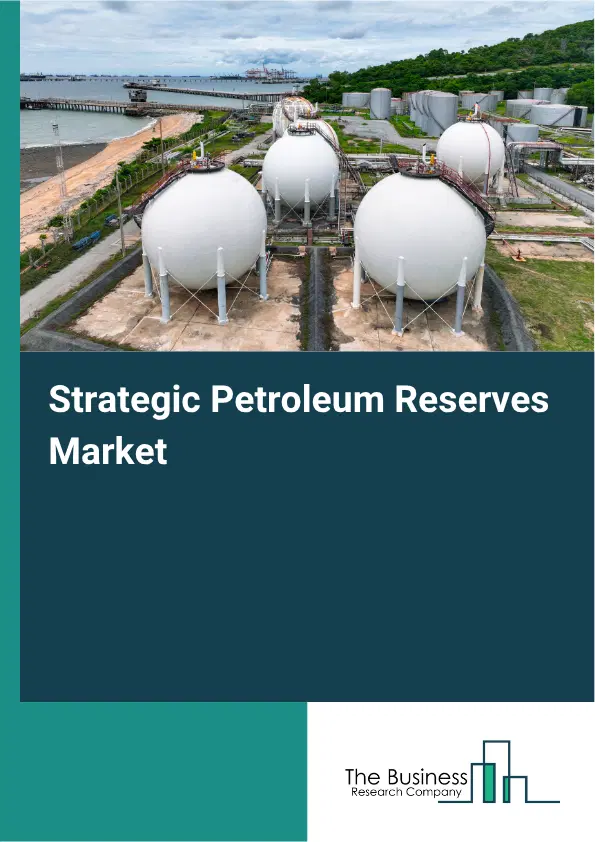
Strategic Petroleum Reserves Market Report 2026
Global Outlook – By Storage Type (Underground Caverns, Aboveground Tanks, Salt Domes, Depleted Oil Fields), By Petroleum Product (Crude Oil, Refined Products, Gasoline, Diesel, Jet Fuel, Biofuels And Alternative Fuels), By Storage Purpose (Energy Security And Emergency Supply, Price Stabilization And Market Intervention, Industrial And Commercial Usage, Strategic Trade And Export Management), By Storage Capacity (Below 10 Million Barrels, 10–50 Million Barrels, 50–100 Million Barrels, Above 100 Million Barrels), By End User (Government And National Energy Agencies, Oil And Gas Companies, Military And Defense Organizations, International Energy Organizations) – Market Size, Trends, Strategies, and Forecast to 2030
Strategic Petroleum Reserves Market Overview
• Strategic Petroleum Reserves market size has reached to $9.2 billion in 2025 • Expected to grow to $12.58 billion in 2030 at a compound annual growth rate (CAGR) of 6.3% • Growth Driver: The Growing Oil Import Fueling The Growth Of The Market Due To Increasing Energy Demand And Import Dependence • Market Trend: Strategic Petroleum Reserve Replenishment Initiatives Strengthen Energy Security And Supply Stability • North America was the largest region in 2025 and Asia-Pacific is the fastest growing region.What Is Covered Under Strategic Petroleum Reserves Market?
Strategic petroleum reserves are stockpiles of crude oil or petroleum products that governments maintain to ensure energy security during emergencies, supply disruptions, or geopolitical crises. They involve storing, managing, and releasing petroleum reserves through dedicated storage facilities and coordinated distribution systems. Essentially, strategic petroleum reserves provide a reliable emergency energy supply to stabilize fuel availability and support economic and national security. The main storage types in the strategic petroleum reserves market include underground caverns, aboveground tanks, salt domes, and depleted oil fields. Underground caverns refer to subsurface storage facilities, typically created in suitable geological formations, that provide secure and large-scale storage of petroleum products. These facilities store crude oil, refined products, gasoline, diesel, jet fuel, biofuels, and alternative fuels and used for energy security and emergency supply, price stabilization and market intervention, industrial and commercial usage, and strategic trade and export management. Storage facilities are categorized by capacities below 10 million barrels, 10–50 million barrels, 50–100 million barrels, and above 100 million barrels and serve government and national energy agencies, oil and gas companies, military and defense organizations, and international energy organizations.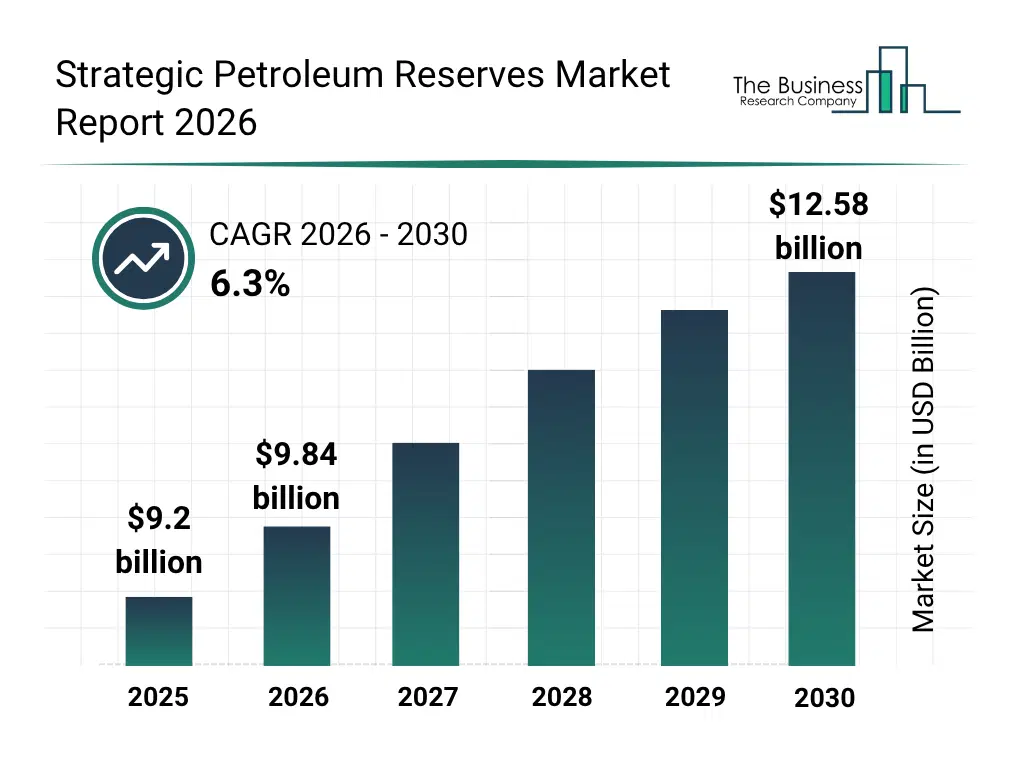
What Is The Strategic Petroleum Reserves Market Size and Share 2026?
The strategic petroleum reserves market size has grown strongly in recent years. It will grow from $9.2 billion in 2025 to $9.84 billion in 2026 at a compound annual growth rate (CAGR) of 6.9%. The growth in the historic period can be attributed to rising energy security concerns, geopolitical supply disruptions, increasing crude oil supply volatility, government focus on emergency fuel preparedness, growth in national petroleum stockpiling programs.What Is The Strategic Petroleum Reserves Market Growth Forecast?
The strategic petroleum reserves market size is expected to see strong growth in the next few years. It will grow to $12.58 billion in 2030 at a compound annual growth rate (CAGR) of 6.3%. The growth in the forecast period can be attributed to increasing geopolitical uncertainty, rising demand for energy supply resilience, expansion of strategic reserve capacities, growing investment in advanced petroleum storage infrastructure, increasing government focus on fuel supply continuity. Major trends in the forecast period include expansion of underground crude oil storage facilities, modernization of petroleum reserve infrastructure, adoption of advanced crude oil storage technologies, diversification of strategic petroleum product inventories, increasing integration of emergency fuel distribution systems.Tariff Impact On Strategic Petroleum Reserves Market
Tariffs are impacting the strategic petroleum reserves market by increasing the cost of imported storage equipment, steel tanks, pumping systems, monitoring technologies, and specialized infrastructure required for petroleum reserve development and maintenance. This is raising project costs and creating procurement challenges, particularly in regions dependent on imported energy infrastructure equipment such as Asia-Pacific, Europe, and emerging markets. Infrastructure-intensive segments such as aboveground tanks, underground caverns, and large-capacity storage facilities are most affected due to their reliance on specialized equipment and construction materials. However, tariffs are also encouraging domestic equipment manufacturing, regional supplier diversification, and increased investment in local petroleum storage infrastructure, supporting greater long-term energy supply resilience.
Global Strategic Petroleum Reserves Market Segmentation
1) By Storage Type: Underground Caverns, Aboveground Tanks, Salt Domes, Depleted Oil Fields 2) By Petroleum Product: Crude Oil, Refined Products, Gasoline, Diesel, Jet Fuel, Biofuels And Alternative Fuels 3) By Storage Purpose: Energy Security And Emergency Supply, Price Stabilization And Market Intervention, Industrial And Commercial Usage, Strategic Trade And Export Management 4) By Storage Capacity: Below 10 Million Barrels, 10–50 Million Barrels, 50–100 Million Barrels, Above 100 Million Barrels 5) By End User: Government And National Energy Agencies, Oil And Gas Companies, Military And Defense Organizations, International Energy Organizations Subsegments: 1) By Underground Caverns: Salt Caverns, Rock Caverns, Mined Caverns 2) By Aboveground Tanks: Fixed Roof Tanks, Floating Roof Tanks, Spherical Tanks 3) By Salt Domes: Bedded Salt Domes, Bedded Salt Formations 4) By Depleted Oil Fields: Depleted Onshore Oil Fields, Depleted Offshore Oil Fields, Partially Depleted Oil FieldsWhat Is The Driver Of The Strategic Petroleum Reserves Market?
The growing oil import is expected to propel the growth of the strategic petroleum reserves market going forward. Oil import is the purchase of crude oil and petroleum products from foreign countries to meet domestic energy demand when local production is insufficient. The growing oil import is primarily due to insufficient domestic production to meet rising energy demand, forcing countries to rely on imports to bridge the supply gap. Oil imports help strategic petroleum reserves by providing the necessary crude supply to build and maintain stockpiles for energy security during supply disruptions or emergencies. For instance, in July 2026, according to the Department for Transport, a UK-based government department responsible for overseeing transport policies and infrastructure, oil product throughput at UK ports rose by 1.6 million tonnes (2%) to reach 72 million tonnes in 2025, supported by a 9% increase in imports amounting to 3.9 million tonnes. Therefore, the growing oil import is driving the growth of the strategic petroleum reserves industry.Key Players In The Global Strategic Petroleum Reserves Market
Major companies operating in the strategic petroleum reserves market are Enbridge Inc., Kinder Morgan Inc., Energy Transfer LP, Royal Vopak N.V., Exolum, Buckeye Partners L.P., Oiltanking GmbH, Koole Terminals B.V., VTTI B.V., HES International B.V., Evos Group, Odfjell SE, Intercontinental Terminals Company LLC, Zenith Energy Terminals Holdings LLC, Global Energy Storage Group, Korea National Oil Corporation, Indian Strategic Petroleum Reserves Limited, Strategic Storage Partners LLC, Saudi Arabian Oil Company, China National Petroleum Corporation, China Petrochemical Corporation, Enterprise Products Partners L.P., Japan Organization for Metals and Energy Security
This chart is for illustrative purposes; the full report includes a detailed competitor analysis and comprehensive overview of the top 10 companies in the market.
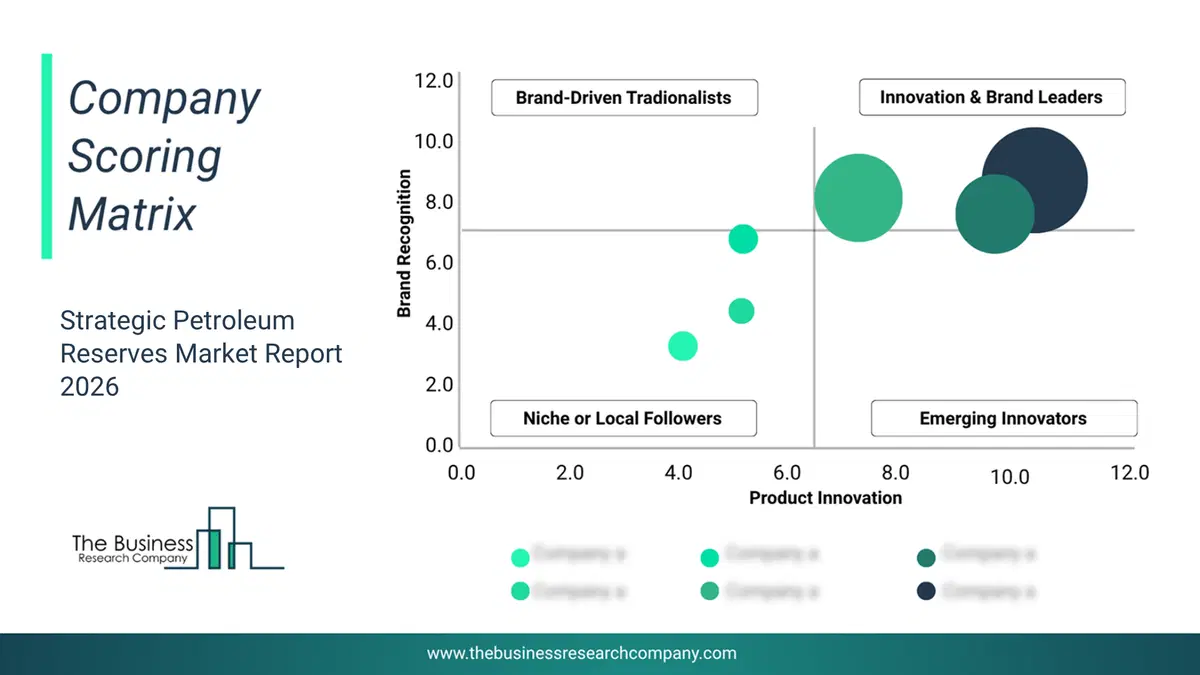
This chart maps companies by product innovation and brand strength, with bubble size indicating relative revenue, helping identify market leaders, challengers, and niche players. This is an illustrative chart; the full report provides a complete and accurate competitive analysis.
Global Strategic Petroleum Reserves Market Trends and Insights
Major companies operating in the strategic petroleum reserves market are focusing on strategic petroleum reserve replenishment initiatives, such as crude oil procurement programs, to restore reserve levels, enhance energy security, and ensure supply stability during disruptions. Strategic petroleum reserve replenishment programs refer to government-led initiatives that involve the purchase and storage of crude oil to maintain adequate emergency reserves and support long-term energy resilience. For instance, in November 2025, the Department of Energy, a US-based government department, awarded contracts to purchase approximately 1 million barrels of crude oil to begin refilling the strategic petroleum reserve. The initiative includes scheduled deliveries to the Bryan Mound storage site between December 2025 and January 2026 and is aimed at restoring reserve levels following prior emergency drawdowns while strengthening national energy security and supply preparedness.What Are Latest Mergers And Acquisitions In The Strategic Petroleum Reserves Market?
In May 2026, Indian Strategic Petroleum Reserves Limited (ISPRL), an India-based strategic oil storage company, partnered with Abu Dhabi National Oil Company (ADNOC) to expand crude oil storage under India’s strategic petroleum reserves program. The aim of the partnership is to strengthen energy security by enabling shared storage, enhancing supply flexibility, and supporting the expansion of strategic crude oil reserves infrastructure. Abu Dhabi National Oil Company (ADNOC) is a UAE-based national oil company specializing in oil and gas production and global energy supply.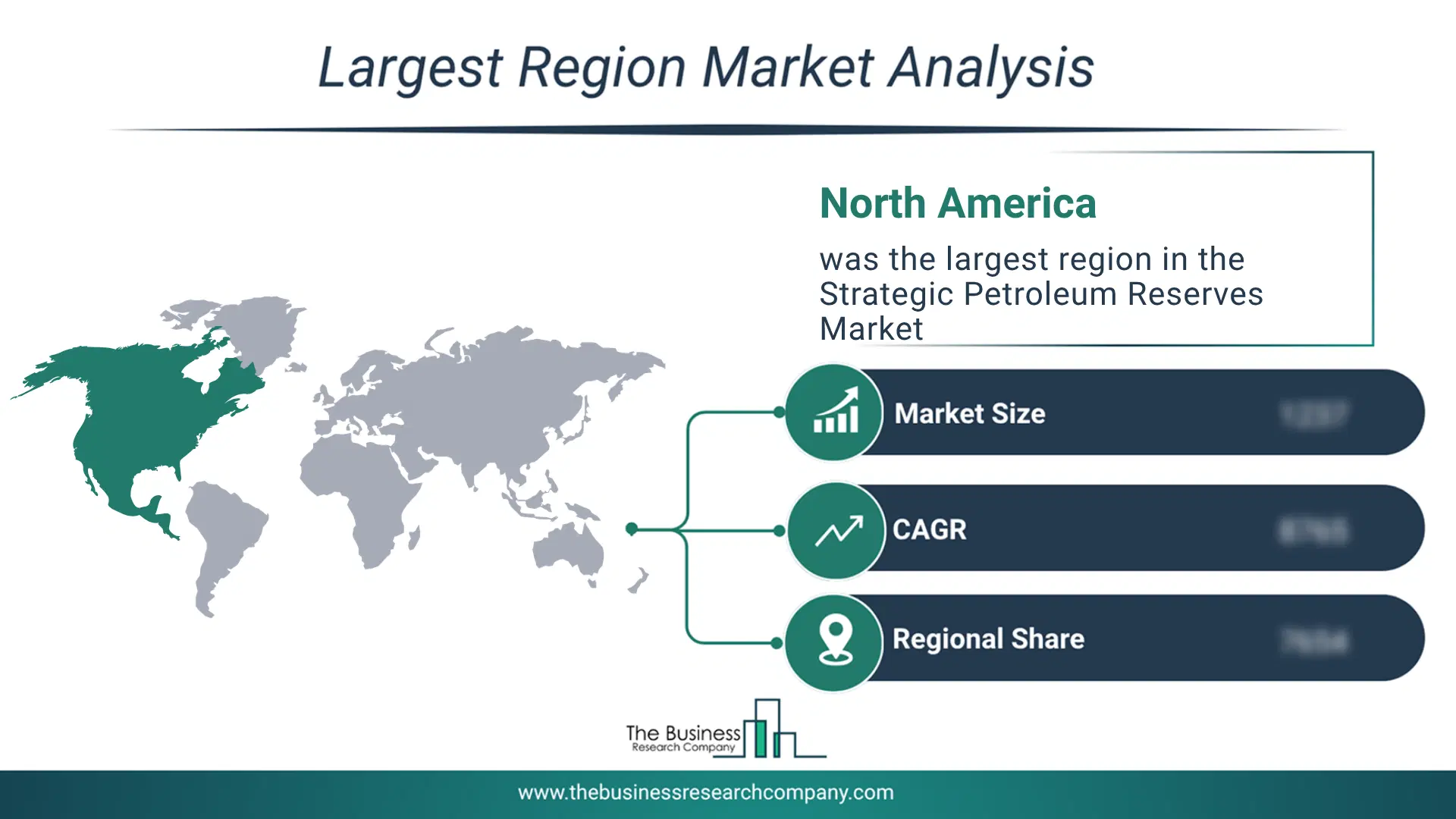
Regional Outlook
North America was the largest region in the strategic petroleum reserves market in 2025. Asia-Pacific is expected to be the fastest-growing region in the forecast period. The regions covered in this market report are Asia-Pacific, South East Asia, Western Europe, Eastern Europe, North America, South America, Middle East, Africa. The countries covered in this market report are Australia, Brazil, China, France, Germany, India, Indonesia, Japan, Taiwan, Russia, South Korea, UK, USA, Canada, Italy, Spain.What Defines the Strategic Petroleum Reserves Market?
The strategic petroleum reserves market includes revenues earned by entities by providing services such as crude oil and petroleum product storage, reserve management, inventory monitoring, facility operation and maintenance, logistics and transportation, emergency stock release, and infrastructure management. The market value includes the value of related goods sold by the service provider or included within the service offering. Only goods and services traded between entities or sold to end consumers are included.How is Market Value Defined and Measured?
The market value is defined as the revenues that enterprises gain from the sale of goods and/or services within the specified market and geography through sales, grants, or donations in terms of the currency (in USD unless otherwise specified). The revenues for a specified geography are consumption values that are revenues generated by organizations in the specified geography within the market, irrespective of where they are produced. It does not include revenues from resales along the supply chain, either further along the supply chain or as part of other products.
This chart presents market attractiveness based on a quantitative evaluation of growth, competition, strategic alignment, and risk, offering a clear view of opportunity areas for decision-making. This chart is for illustrative purposes; the full report contains the complete analysis.

This chart highlights the Total Addressable Market (TAM) by estimating the maximum revenue opportunity using an assumption-driven approach, supporting strategic planning and opportunity sizing across markets. The chart is illustrative; the full report provides a more comprehensive analysis.
What Key Data and Analysis Are Included in the Strategic Petroleum Reserves Market Report 2026?
The strategic petroleum reserves market research report is one of a series of new reports from The Business Research Company that provides market statistics, including industry global market size, regional shares, competitors with the market share, detailed market segments, market trends and opportunities, and any further data you may need to thrive in the strategic petroleum reserves industry. The market research report delivers a complete perspective of everything you need, with an in-depth analysis of the current and future state of the industry.Strategic Petroleum Reserves Market Report Forecast Analysis
| Report Attribute | Details |
|---|---|
| Market Size Value In 2026 | $9.84 billion |
| Revenue Forecast In 2030 | $12.58 billion |
| Growth Rate | CAGR of 6.3% from 2026 to 2030 |
| Base Year For Estimation | 2025 |
| Actual Estimates/Historical Data | 2020-2025 |
| Forecast Period | 2026 - 2030 |
| Market Representation | Revenue in USD Billion and CAGR from 2026 to 2030 |
| Segments Covered | Storage Type, Petroleum Product, Storage Purpose, Storage Capacity, End User |
| Regional Scope | Asia-Pacific, Western Europe, Eastern Europe, North America, South America, Middle East, Africa |
| Country Scope | The countries covered in the report are Australia, Brazil, China, France, Germany, India, Indonesia, Japan, Taiwan, Russia, South Korea, UK, USA, Canada, Italy, Spain. |
| Key Companies Profiled | Enbridge Inc., Kinder Morgan Inc., Energy Transfer LP, Royal Vopak N.V., Exolum, Buckeye Partners L.P., Oiltanking GmbH, Koole Terminals B.V., VTTI B.V., HES International B.V., Evos Group, Odfjell SE, Intercontinental Terminals Company LLC, Zenith Energy Terminals Holdings LLC, Global Energy Storage Group, Korea National Oil Corporation, Indian Strategic Petroleum Reserves Limited, Strategic Storage Partners LLC, Saudi Arabian Oil Company, China National Petroleum Corporation, China Petrochemical Corporation, Enterprise Products Partners L.P., Japan Organization for Metals and Energy Security |
| Customization Scope | Request for Customization |
| Pricing And Purchase Options | Explore Purchase Options |