

Structural Health Monitoring Market Report 2026
Global Outlook – By Component ( Hardware, Software, Services ), By Connectivity ( Wired, Wireless ), By Application ( Bridges And Dams, Buildings And Stadiums, Vessels And Platforms, Airframes And Wind Turbines, Large Machinery And Equipment), By End User ( Civil, Aerospace, Defense, Energy, Mining, Other End Users) – Market Size, Trends, Strategies, and Forecast to 2030
Structural Health Monitoring Market Overview
• Structural Health Monitoring market size has reached to $3.44 billion in 2025 • Expected to grow to $6.93 billion in 2030 at a compound annual growth rate (CAGR) of 15% • Growth Driver: Frequent Natural Calamities Propel Growth In Structural Health Monitoring Market • Market Trend: Strategic Partnerships Transforming The Structural Health MonitoringMarket • Asia-Pacific was the largest region in 2025.Market Gains By 2030 – Top Opportunities By Segment
Market Gain identifies the most promising market opportunities by highlighting the segments or products expected to generate the highest incremental revenue growth over the next five years.
What Is Covered Under Structural Health Monitoring Market?
Structural health monitoring (SHM) refers to the practice of applying damage detection and characterization tools to vital structures, including bridges, wind turbines and tunnels. It is used to assure structural integrity and safety, track the progression of damage and evaluate how well civil infrastructures are performing. The major components of structural health monitoring are hardware, software and services. Hardware refers to the physical parts of the computer or its delivery mechanisms that allow the software's written instructions to be stored and executed. By connectivity, wired and wireless monitoring is involved. It is involved in several applications, such as bridges and dams, buildings and stadiums, vessels and platforms, airframes and wind turbines and large machinery and equipment that are used by several end-users, such as civil, aerospace, defense, energy, mining and others.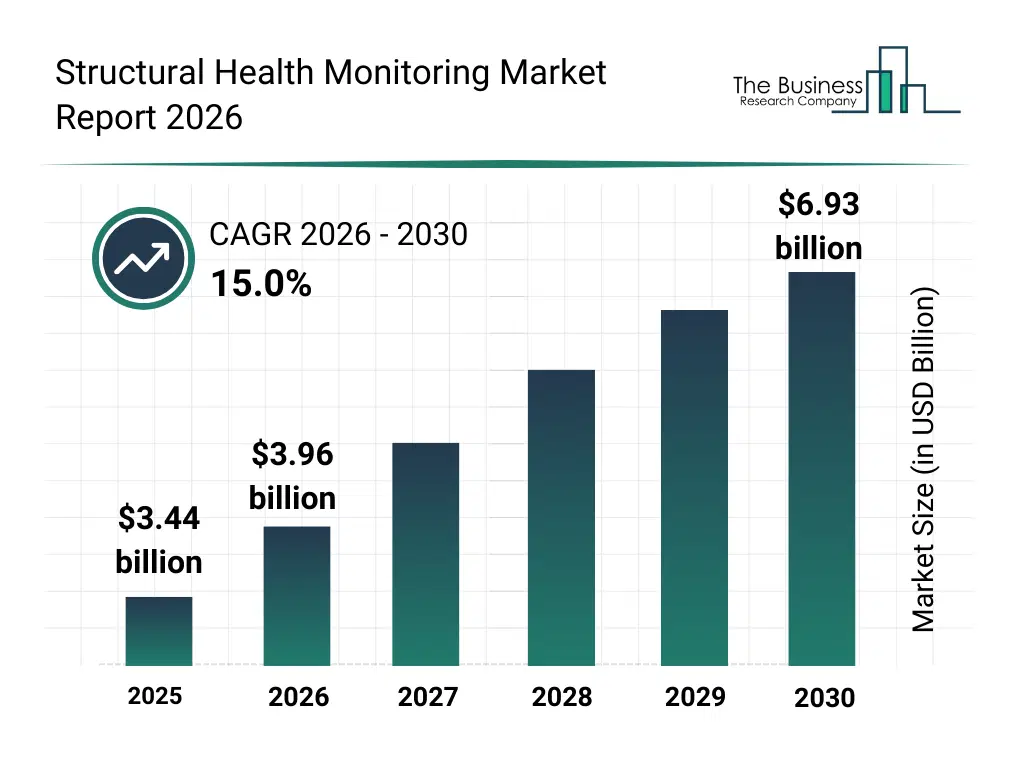
What Is The Structural Health Monitoring Market Size 2026 And Growth Rate?
The structural health monitoring market size has grown rapidly in recent years. It will grow from $3.44 billion in 2025 to $3.96 billion in 2026 at a compound annual growth rate (CAGR) of 15.1%. The growth in the historic period can be attributed to structural monitoring of bridges and dams, adoption in large civil infrastructures, early deployment of wired sensor systems, usage in industrial machinery maintenance, incorporation in wind turbine monitoring.What Is The Structural Health Monitoring Market Growth Forecast?
The structural health monitoring market size is expected to see rapid growth in the next few years. It will grow to $6.93 billion in 2030 at a compound annual growth rate (CAGR) of 15.0%. The growth in the forecast period can be attributed to expansion of wireless sensor networks, rising investment in predictive maintenance, increasing adoption of real-time monitoring technologies, growth in digital infrastructure management, advancement in structural visualization tools. Major trends in the forecast period include integration of AI-based damage detection tools, deployment of IoT-connected monitoring networks, advancement of automated structural diagnostic systems, adoption of sustainable infrastructure monitoring solutions, expansion of cloud-powered structural data platforms.
Global Structural Health Monitoring Market Segmentation
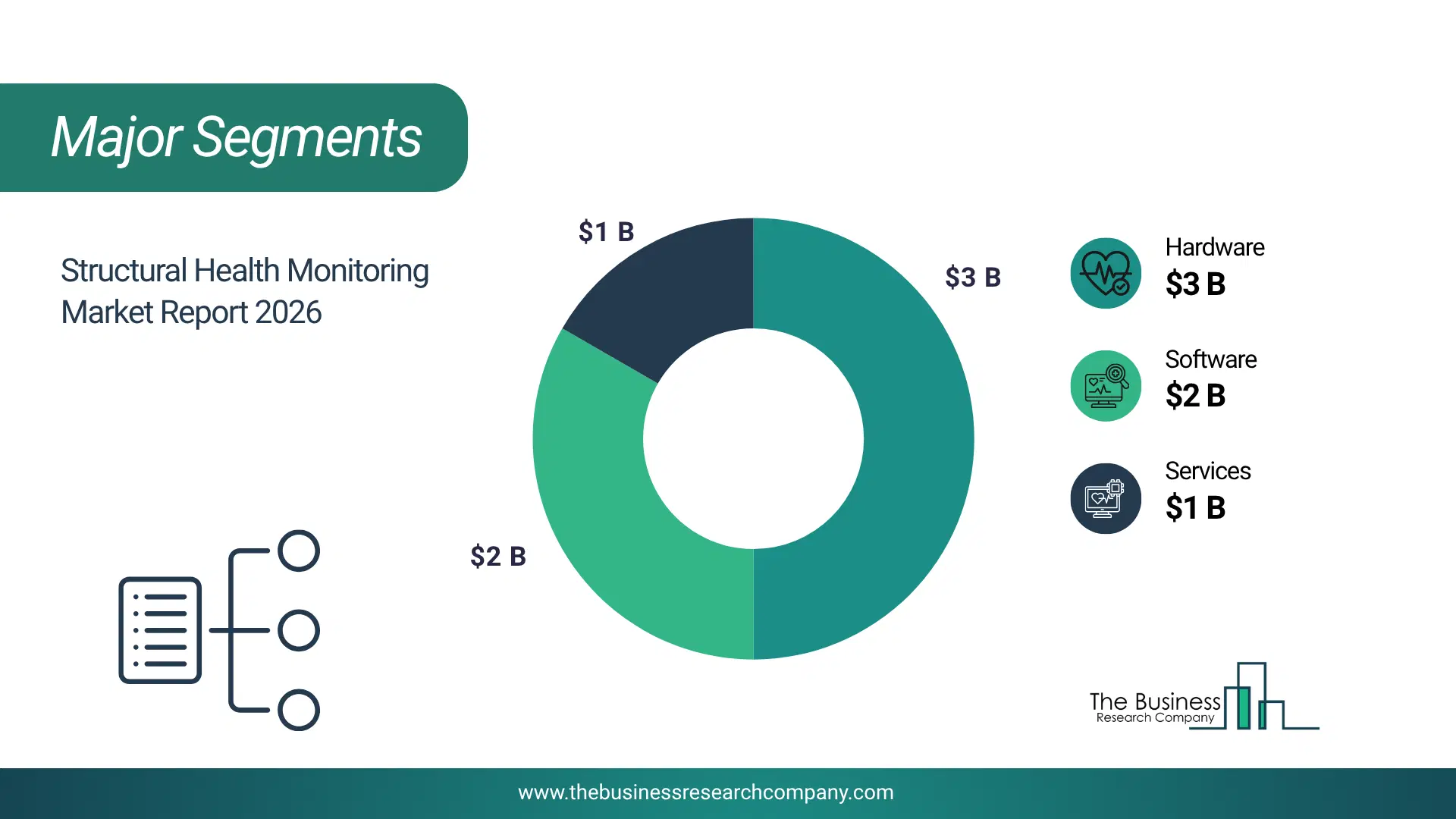
1) By Component: Hardware, Software, Services 2) By Connectivity: Wired, Wireless 3) By Application: Bridges And Dams, Buildings And Stadiums, Vessels And Platforms, Airframes And Wind Turbines, Large Machinery And Equipment 4) By End User: Civil, Aerospace, Defense, Energy, Mining, Other End Users Subsegments: 1) By Hardware: Sensors, Data Acquisition Systems, Communication Devices, Structural Health Monitoring Systems 2) By Software: Data Analysis Software, Monitoring And Management Software, Visualization Tools 3) By Services: Installation And Integration, Maintenance And Support, Consulting And Advisory Services, Training And Education The top segments in the structural health monitoring market will be: • Hardware will reach $3.28 Billion by 2030. • Software will reach $2.33 Billion by 2030. • Services will reach $1.27 Billion by 2030.What Is The Driver Of The Structural Health Monitoring Market?
The frequent occurrences of natural calamities are expected to boost the growth of the structural health monitoring market going forward. Natural calamities are catastrophic occurrences that arise as a result of any natural phenomenon on Earth. Structural health monitoring is very helpful to prevent water and flood damage brought on by collapsed dams, dykes, pipelines and other similar infrastructure as a result of natural disasters, hence, frequent occurrences of natural calamities are expected to boost the structural health monitoring market. For instance, in January 2024, according to the report published by the National Centers for Environmental Information (NCEI) a US-based government agency, in 2023, the U.S. faced 28 distinct weather and climate-related disasters, each causing at least $1 billion in damages. This sets a new record for the highest number of billion-dollar disasters in a single year. Therefore, the frequent occurrences of natural calamities are driving the growth of the structural health monitoring industry.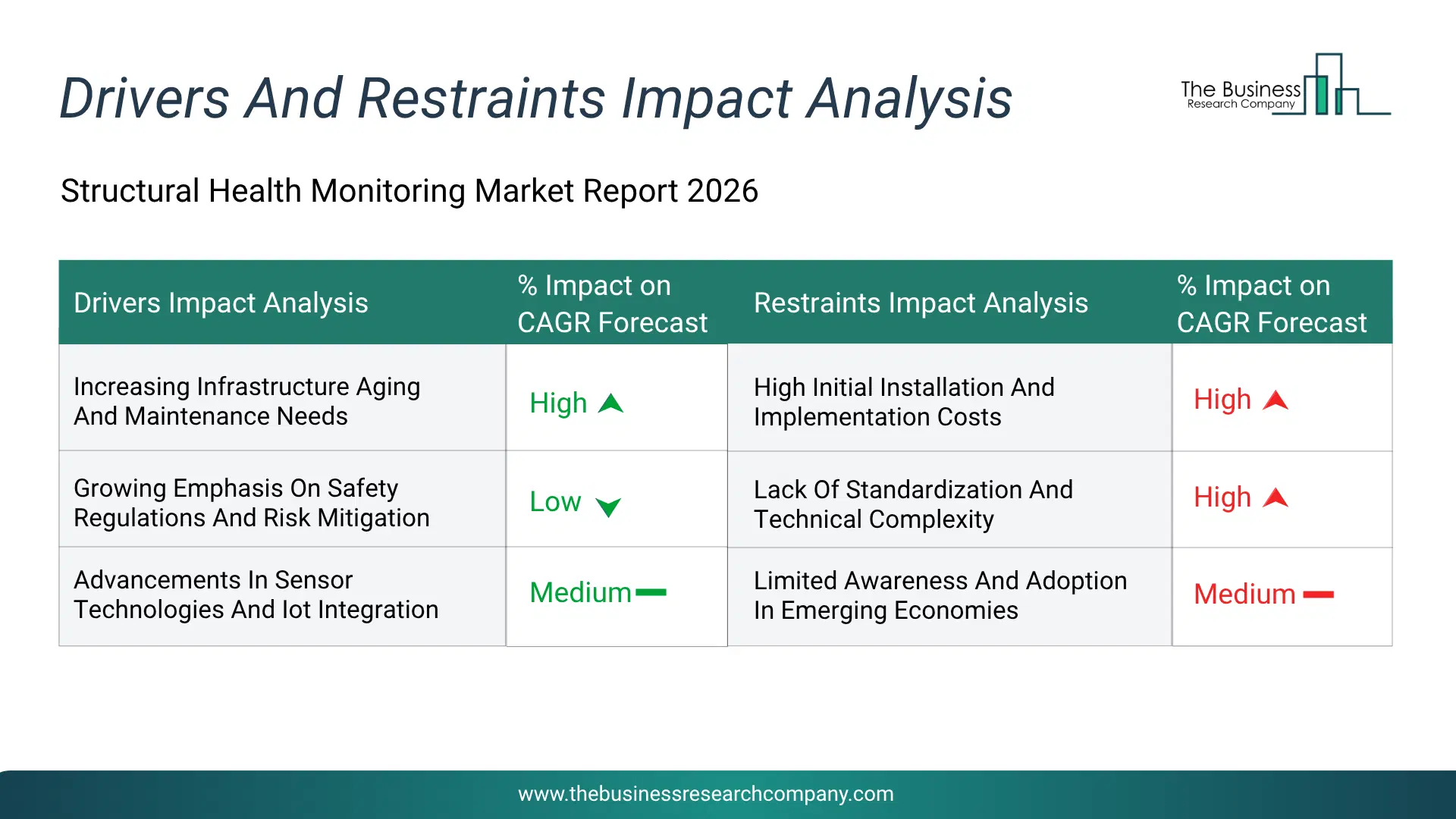
Infographic Chart Showing Key Market Drivers Analysis And Restraints For Structural Health Monitoring Market
The chart presents an impact analysis of key drivers and restraints, quantifying their relative influence on the market's growth rate and helping assess the balance between growth enablers and limiting factors. This chart offers a high-level perspective; the full report contains more detailed insights.
How Will The Drivers Impact Growth In The Global Structural Health Monitoring Market?
• Increasing Infrastructure Aging And Maintenance Needs (High) – During the forecast period, the increasing infrastructure aging and maintenance needs is expected to become a key growth driver for the structural health monitoring market by 2030. A large share of global infrastructure such as bridges, tunnels, and industrial assets is aging and requires continuous monitoring to ensure safety and performance. Structural deterioration over time increases the risk of failures, making proactive monitoring essential. SHM systems provide real-time data on structural conditions, helping detect issues like cracks, corrosion, and stress. This enables predictive maintenance, reducing repair costs and extending asset life. Governments and private operators are increasingly investing in rehabilitation and modernization projects, further driving demand. Additionally, aging infrastructure in developed economies accelerates adoption of advanced monitoring solutions. • Growing Emphasis On Safety Regulations And Risk Mitigation (Low) – During the forecast period, the growing emphasis on safety regulations and risk mitigation is expected to emerge as a major factor driving the expansion of the structural health monitoring market by 2030. Governments and regulatory bodies are implementing stricter safety standards to prevent structural failures and associated risks. SHM systems help organizations comply with these regulations by providing continuous monitoring and early warning systems. This reduces the likelihood of catastrophic events, protecting lives and minimizing financial losses. Industries such as transportation, construction, and energy are increasingly adopting SHM technologies to enhance safety compliance. Insurance providers also encourage the use of monitoring systems to lower risk exposure. The ability to generate reliable, data-driven insights further strengthens decision-making and risk management. • Advancements In Sensor Technologies And Iot Integration (Medium) – During the forecast period, the advancements in sensor technologies and IoT integration is expected to act as a key growth catalyst for the structural health monitoring market by 2030. Rapid advancements in sensor technologies and IoT integration are significantly enhancing SHM capabilities. Modern systems utilize fiber optic sensors, wireless networks, and cloud-based platforms for efficient data collection and analysis. These technologies enable real-time monitoring, remote access, and improved accuracy in detecting structural issues. Integration with advanced analytics and machine learning allows predictive insights and automated alerts. The decreasing cost of sensors and improved scalability make SHM solutions more accessible. These technological improvements are accelerating adoption across various infrastructure sectors.How Will The Restraints Impact Growth In The Global Structural Health Monitoring Market?
• High Initial Installation And Implementation Costs (High) – During the forecast period, high initial installation and implementation costs are significantly restricting the growth of the structural health monitoring market. The substantial investment required for advanced sensors, data acquisition systems, connectivity infrastructure, and skilled workforce deployment is limiting adoption, particularly in cost-sensitive infrastructure projects. • Lack Of Standardization And Technical Complexity (Low) – During the forecast period, lack of standardization and technical complexity are significantly restricting the growth of the structural health monitoring market. The absence of unified protocols, interoperability issues among systems, and complex data interpretation requirements are creating barriers to large-scale deployment and increasing integration challenges. • Limited Awareness And Adoption In Emerging Economies (Medium) – During the forecast period, limited awareness and adoption in emerging economies are restricting the growth of the structural health monitoring market. Insufficient technical knowledge, budget constraints, and lower prioritization of advanced monitoring systems in developing regions are slowing market penetration and widespread utilization.Key Players In The Global Structural Health Monitoring Market
Major companies operating in the structural health monitoring market are Geokon, Campbell Scientific Inc., COWI A/S, Geocomp Corporation, Acellent Technologies Inc., Sixense, Structural Monitoring Systems Plc, Digitexx Data Systems Inc., Kinemetrics, National Instruments Corporation, Hottinger Baldwin Messtechnik GmbH, SGS Société Générale de Surveillance SA, James Fisher Strainstall, Strainstall Limited, Pure Technologies, RST Instruments Ltd., Smart Structures Inc., Hexagon AB, Hottinger Bruel & Kjaer (HBK) Test and Measurement, General Electric (GE) Sensing & Inspection Technologies, Dynastar SAS, B&K Vibro, ASI Technologies, Applied Acoustic Systems, Agilent Technologies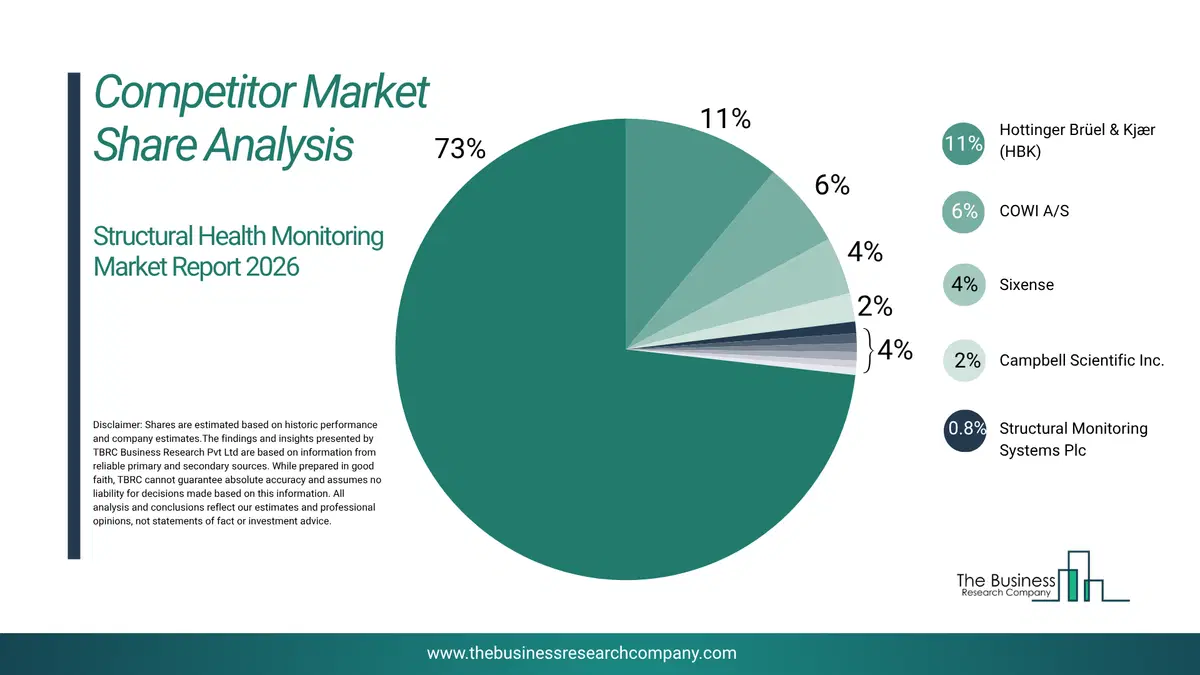
This chart is for illustrative purposes; the full report includes a detailed competitor analysis and comprehensive overview of the top 10 companies in the market.
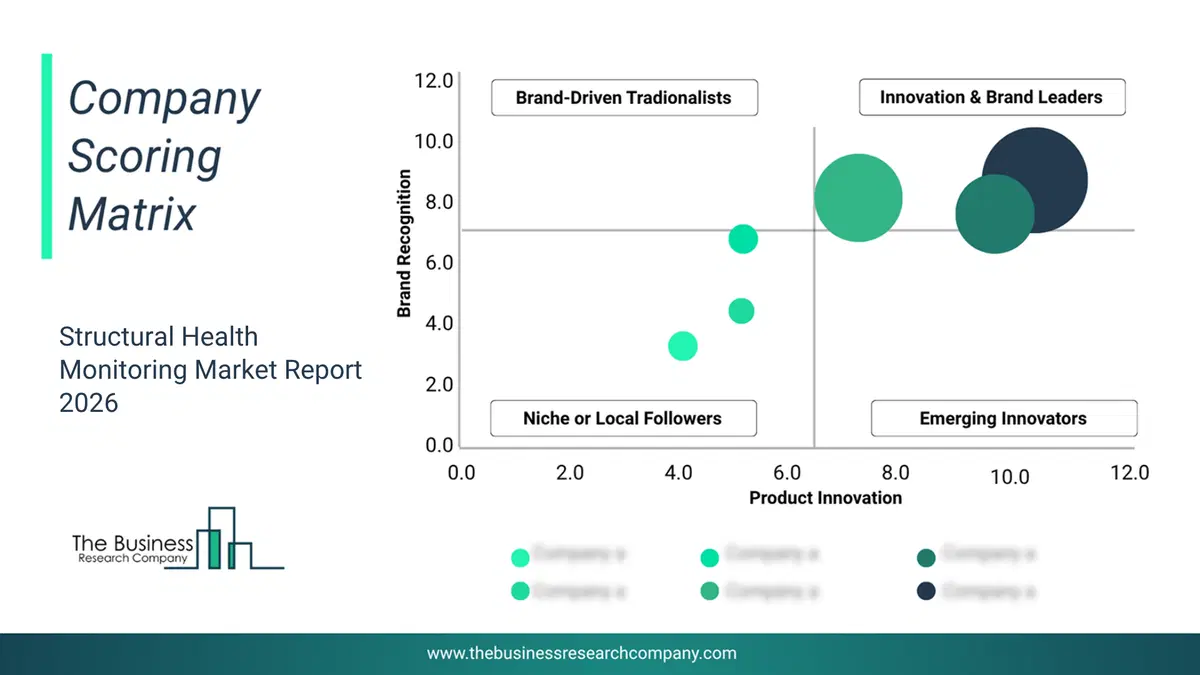
This chart maps companies by product innovation and brand strength, with bubble size indicating relative revenue, helping identify market leaders, challengers, and niche players. This is an illustrative chart; the full report provides a complete and accurate competitive analysis.
Global Structural Health Monitoring Market Trends and Insights
Major companies operating in the structural health monitoring market are forming partnerships to develop new products and strengthen their positions in the market. Strategic partnerships refer to a process in which companies leverage each other's strengths and resources to achieve mutual benefits and success. For instance, in November 2023, American Bureau of Shipping (ABS), a US-based non-profit organization, partnered with Seatrium Limited, a Singapore-based shipbuilding and repairing company, to advance structural health monitoring (SHM) technologies in offshore structures. The partnership involves assigning a Structural Health Monitoring Notation to the world's first self-elevating drilling unit (SEDU), ADMARINE 686, recognizing its capability to monitor and analyze key structural elements. Seatrium Offshore Technology, in collaboration with the Technology Centre for Offshore and Marine, Singapore, is developing a structural digital twin for the SEDU using sensor data, enabling advanced structural health monitoring. This effort aligns with the companies' broader agenda of integrating smart technologies into maritime assets, with previous recognitions for deploying smart technologies and developing smart LNG bunkering vessels.What Are Latest Mergers And Acquisitions In The Structural Health Monitoring Market?
In June 2025, TransDigm Group Incorporated, a US-based provider of highly engineered aerospace components and proprietary systems for commercial and defense markets, acquired Simmonds Precision Products, Inc. for approximately US $765 million in cash. With this acquisition, TransDigm aims to enhance its portfolio of structural health monitoring and sensing solutions, expand its aerospace market presence, and strengthen aftermarket revenue streams. Simmonds Precision Products, Inc. is a US-based provider of fuel and proximity sensing solutions as well as structural health monitoring systems for aerospace and defense applications.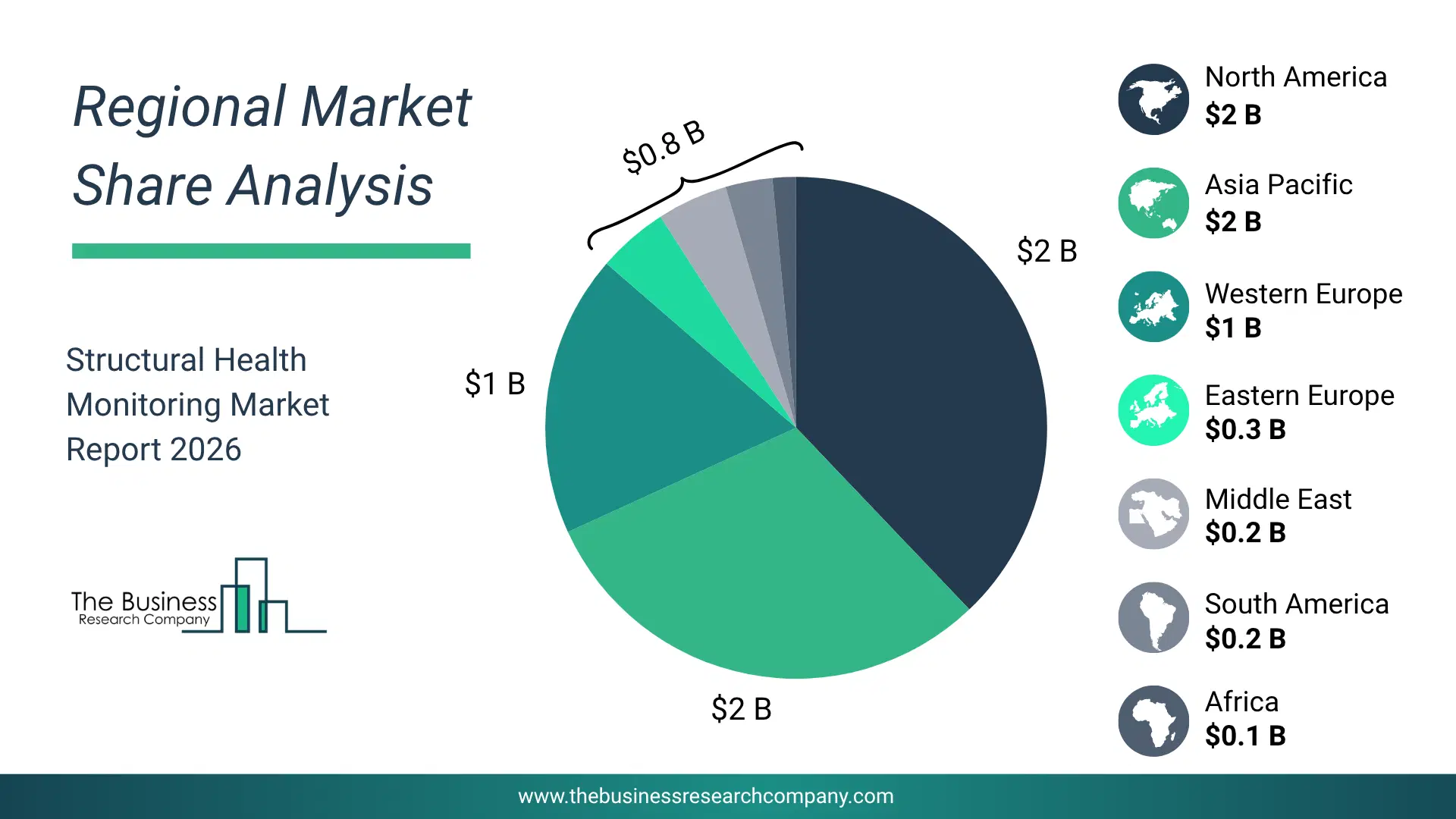
Regional Outlook
Asia-Pacific was the largest region in the structural health monitoring market in 2025. The regions covered in this market report are Asia-Pacific, South East Asia, Western Europe, Eastern Europe, North America, South America, Middle East, Africa. The countries covered in this market report are Australia, Brazil, China, France, Germany, India, Indonesia, Japan, Taiwan, Russia, South Korea, UK, USA, Canada, Italy, Spain.What Defines the Structural Health Monitoring Market?
The structural health monitoring market consists of revenues earned by entities by providing quantitative and reliable data on the real conditions of a bridge and observing its evolution and detecting the visual of degradations. The market value includes the value of related goods sold by the service provider or included within the service offering. The structural health monitoring market also includes sales of fiber optic sensors, accelerometers and vibrating wire transducers which are used in providing structural health monitoring services. Values in this market are ‘factory gate’ values, that is the value of goods sold by the manufacturers or creators of the goods, whether to other entities (including downstream manufacturers, wholesalers, distributors and retailers) or directly to end customers. The value of goods in this market includes related services sold by the creators of the goods.How is Market Value Defined and Measured?
The market value is defined as the revenues that enterprises gain from the sale of goods and/or services within the specified market and geography through sales, grants, or donations in terms of the currency (in USD unless otherwise specified). The revenues for a specified geography are consumption values that are revenues generated by organizations in the specified geography within the market, irrespective of where they are produced. It does not include revenues from resales along the supply chain, either further along the supply chain or as part of other products.
This chart presents market attractiveness based on a quantitative evaluation of growth, competition, strategic alignment, and risk, offering a clear view of opportunity areas for decision-making. This chart is for illustrative purposes; the full report contains the complete analysis.

This chart highlights the Total Addressable Market (TAM) by estimating the maximum revenue opportunity using an assumption-driven approach, supporting strategic planning and opportunity sizing across markets. The chart is illustrative; the full report provides a more comprehensive analysis.
What Key Data and Analysis Are Included in the Structural Health Monitoring Market Report 2026?
The structural health monitoring market research report is one of a series of new reports from The Business Research Company that provides market statistics, including industry global market size, regional shares, competitors with the market share, detailed market segments, market trends and opportunities, and any further data you may need to thrive in the structural health monitoring industry. The market research report delivers a complete perspective of everything you need, with an in-depth analysis of the current and future state of the industry.Structural Health Monitoring Market Report Forecast Analysis Market Report Forecast Analysis
| Report Attribute | Details |
|---|---|
| Market Size Value In 2026 | $3.96 billion |
| Revenue Forecast In 2030 | $6.93 billion |
| Growth Rate | CAGR of 15.1% from 2026 to 2030 |
| Base Year For Estimation | 2025 |
| Actual Estimates/Historical Data | 2020-2025 |
| Forecast Period | 2026 - 2030 |
| Market Representation | Revenue in USD Billion and CAGR from 2026 to 2030 |
| Segments Covered | Component, Connectivity, Application, End User |
| Regional Scope | Asia-Pacific, Western Europe, Eastern Europe, North America, South America, Middle East, Africa |
| Country Scope | The countries covered in the report are Australia, Brazil, China, France, Germany, India, Indonesia, Japan, Taiwan, Russia, South Korea, UK, USA, Canada, Italy, Spain. |
| Key Companies Profiled | Geokon, Campbell Scientific Inc., COWI A/S, Geocomp Corporation, Acellent Technologies Inc., Sixense, Structural Monitoring Systems Plc, Digitexx Data Systems Inc., Kinemetrics, National Instruments Corporation, Hottinger Baldwin Messtechnik GmbH, SGS Société Générale de Surveillance SA, James Fisher Strainstall, Strainstall Limited, Pure Technologies, RST Instruments Ltd., Smart Structures Inc., Hexagon AB, Hottinger Bruel & Kjaer (HBK) Test and Measurement, General Electric (GE) Sensing & Inspection Technologies, Dynastar SAS, B&K Vibro, ASI Technologies, Applied Acoustic Systems, Agilent Technologies |
| Customization Scope | Request for Customization |
| Pricing And Purchase Options | Explore Purchase Options |