
Structural Steel Fabrication Market Report 2026
Global Outlook – By Service (Metal Welding, Machining, Metal Forming, Metal Cutting, Metal Shearing, Metal Folding, Metal Rolling, Metal Punching, Metal Stamping ), By Product (Carbon Steel, Alloy Steel, Stainless Steel, Tool Steel ), By End-Users (Aerospace, Automotive, Construction, Defense And Aerospace, Electronics, Energy And Power, Manufacturing, Mining, Other End-Users ) – Market Size, Trends, Strategies, and Forecast to 2030
Structural Steel Fabrication Market Overview
• Structural Steel Fabrication market size has reached to $179.04 billion in 2025 • Expected to grow to $273.64 billion in 2030 at a compound annual growth rate (CAGR) of 8.8% • Growth Driver: The Role Of The Booming Construction Industry In Driving Structural Steel Fabrication Market Growth • Market Trend: Precise Innovation With CNC Plasma Cutting Machines In Structural Steel Fabrication • Asia-Pacific was the largest region and fastest growing region.Market Gains By 2030 – Top Opportunities By Segment
Market Gain identifies the most promising market opportunities by highlighting the segments or products expected to generate the highest incremental revenue growth over the next five years.
What Is Covered Under Structural Steel Fabrication Market?
The structural steel fabrication refer to a set of activities conducted to convert raw materials into different shapes by steel fabricators. Structural steel fabrication is the process of cutting, bending, shaping, and assembling steel into various structures with predetermined sizes and shapes designed for assembly into buildings, industrial equipment, tools, and various other final products. The main types of services in structural steel fabrication are metal welding, machining, metal forming, metal cutting, metal shearing, metal folding, metal rolling, metal punching, and metal stamping. Metal shearing is a fabrication process used to trim or remove unwanted material from the metal, primarily used for cutting the metal into smaller sizes and different shapes. The various products include carbon steel, alloy steel, stainless steel, tool steel, and others and are used by aerospace, automotive, construction, defense, electronics, energy and power, manufacturing, mining, and others.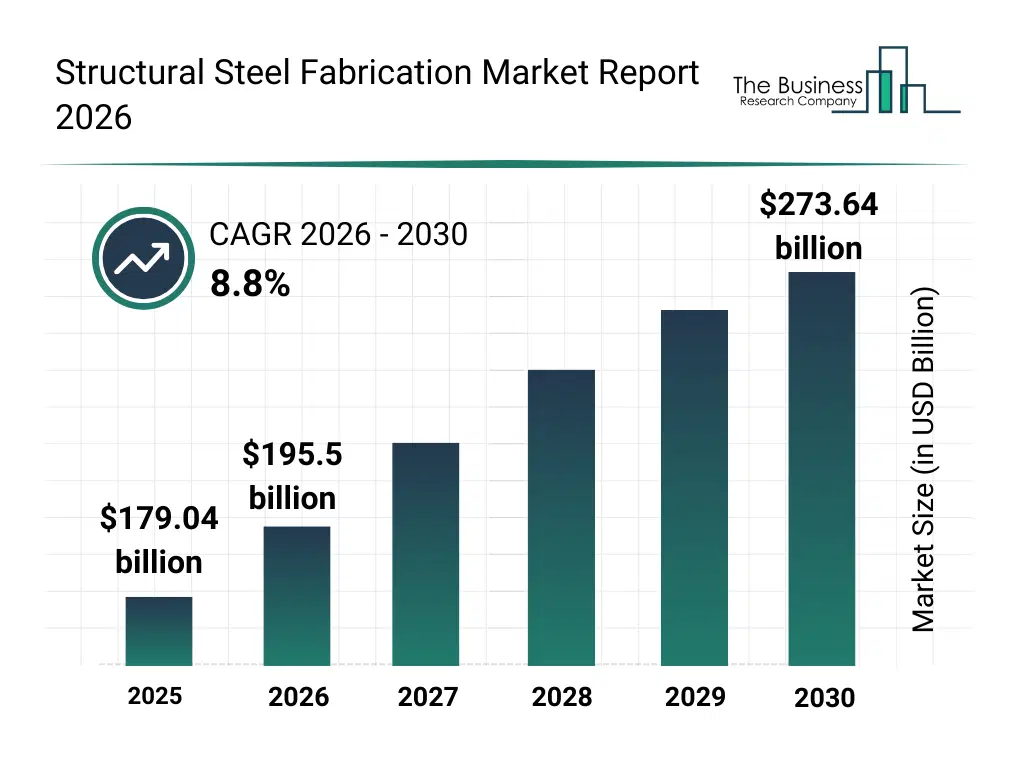
What Is The Structural Steel Fabrication Market Size and Share 2026?
The structural steel fabrication market size has grown strongly in recent years. It will grow from $179.04 billion in 2025 to $195.5 billion in 2026 at a compound annual growth rate (CAGR) of 9.2%. The growth in the historic period can be attributed to increasing use of steel fabrication in construction and industrial applications, reliance on manual welding and machining processes, steady demand from automotive and aerospace sectors, availability of competitively priced steel materials, expansion of infrastructure development projects.What Is The Structural Steel Fabrication Market Growth Forecast?
The structural steel fabrication market size is expected to see strong growth in the next few years. It will grow to $273.64 billion in 2030 at a compound annual growth rate (CAGR) of 8.8%. The growth in the forecast period can be attributed to rising adoption of robotics and automation in fabrication, growing demand for high-precision custom steel components, increasing investment in renewable energy and industrial facilities, shift toward prefabricated modular steel structures, advancements in digitally integrated fabrication technologies. Major trends in the forecast period include rising adoption of automated and cnc-based fabrication, increasing integration of robotics in welding and forming processes, growth in high-precision and custom steel fabrication demand, expansion of modular and prefabricated steel structures, rising use of advanced coatings and durable fabrication materials.
Global Structural Steel Fabrication Market Segmentation
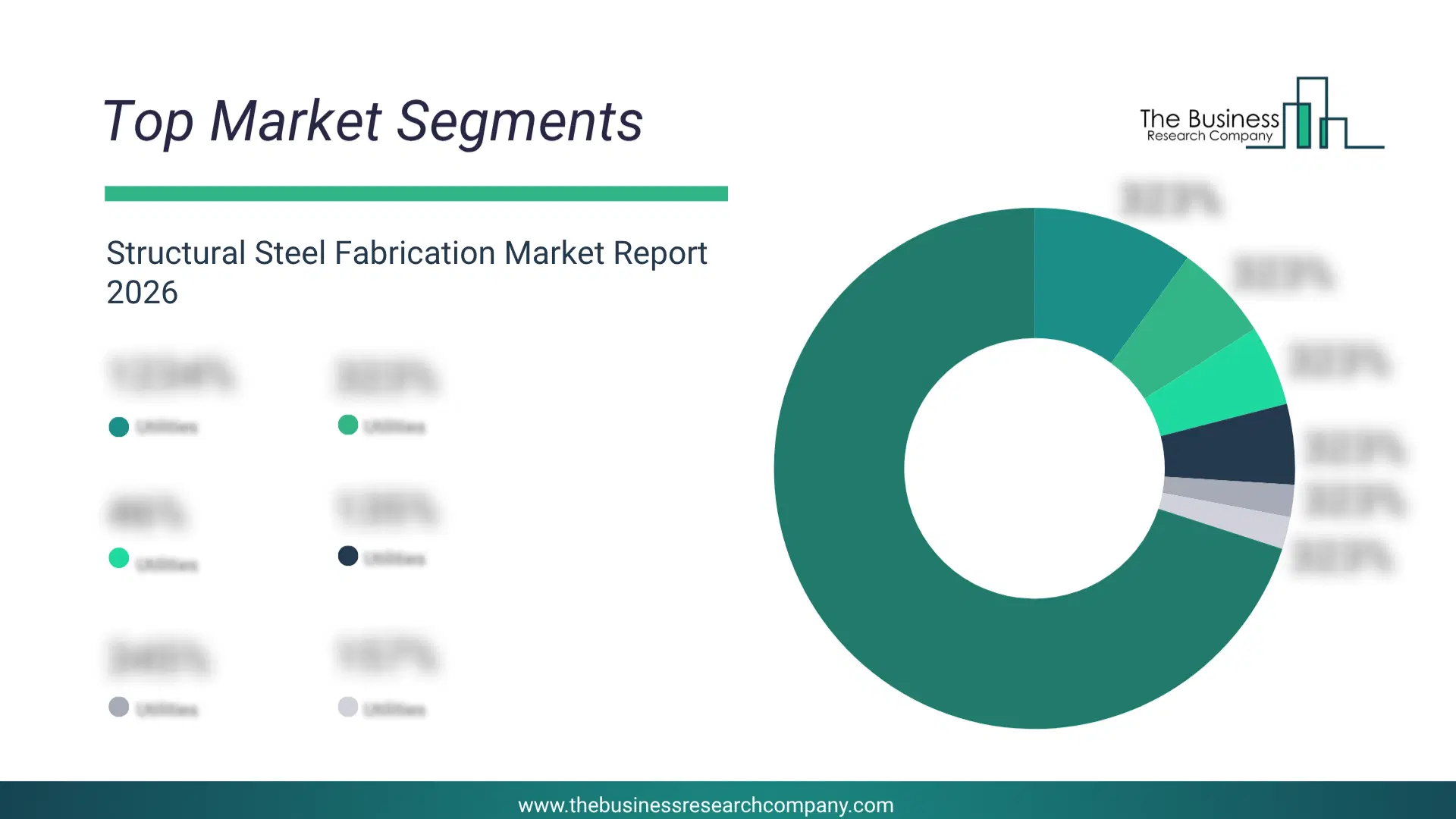
1) By Service: Metal Welding, Machining, Metal Forming, Metal Cutting, Metal Shearing, Metal Folding, Metal Rolling, Metal Punching, Metal Stamping 2) By Product: Carbon Steel, Alloy Steel, Stainless Steel, Tool Steel 3) By End-Users: Aerospace, Automotive, Construction, Defense And Aerospace, Electronics, Energy And Power, Manufacturing, Mining, Other End-Users Subsegments: 1) By Metal Welding: MIG Welding, TIG Welding, Stick Welding, Spot Welding 2) By Machining: CNC Machining, Manual Machining, Grinding 3) By Metal Forming: Bending, Stretch Forming, Hydroforming 4) By Metal Cutting: Laser Cutting, Plasma Cutting, Waterjet Cutting 5) By Metal Shearing: Guillotine Shearing, Power Shearing 6) By Metal Folding: Brake Press Folding, Manual Folding 7) By Metal Rolling: Plate Rolling, Section Rolling 8) By Metal Punching: Punch Press, CNC Punching 9) By Metal Stamping: Progressive Stamping, Deep Drawing Stamping The top segments in the structural steel fabrication market will be: • Carbon Steel will reach $146921.7 Million by 2030. • Construction will reach $97220.8 Million by 2030. • Metal Welding will reach $75651.63 Million by 2030. • Alloy Steel will reach $47513.41 Million by 2030. • Metal Forming will reach $43397.63 Million by 2030.What Is The Driver Of The Structural Steel Fabrication Market?
The growing construction industry is expected to propel the growth of the structural steel fabrication market going forward. The construction industry is rising as a result of ongoing urbanization, impending infrastructural projects, and a growing population base. The construction sector uses structural steel for a variety of products due to its strength, durability, tensile strength, and low cost. It is the ideal option for designing and fabricating high-rise buildings, residential buildings, bridges, and other structures. For instance, in February 2024, according to the Office for National Statistics, a UK-based statistical agency, total annual construction output increased by 2.0% in 2023 compared to 2022, representing the third year in a row of growth. Hence, the growing construction industry will drive the growth of the structural steel fabrication industry.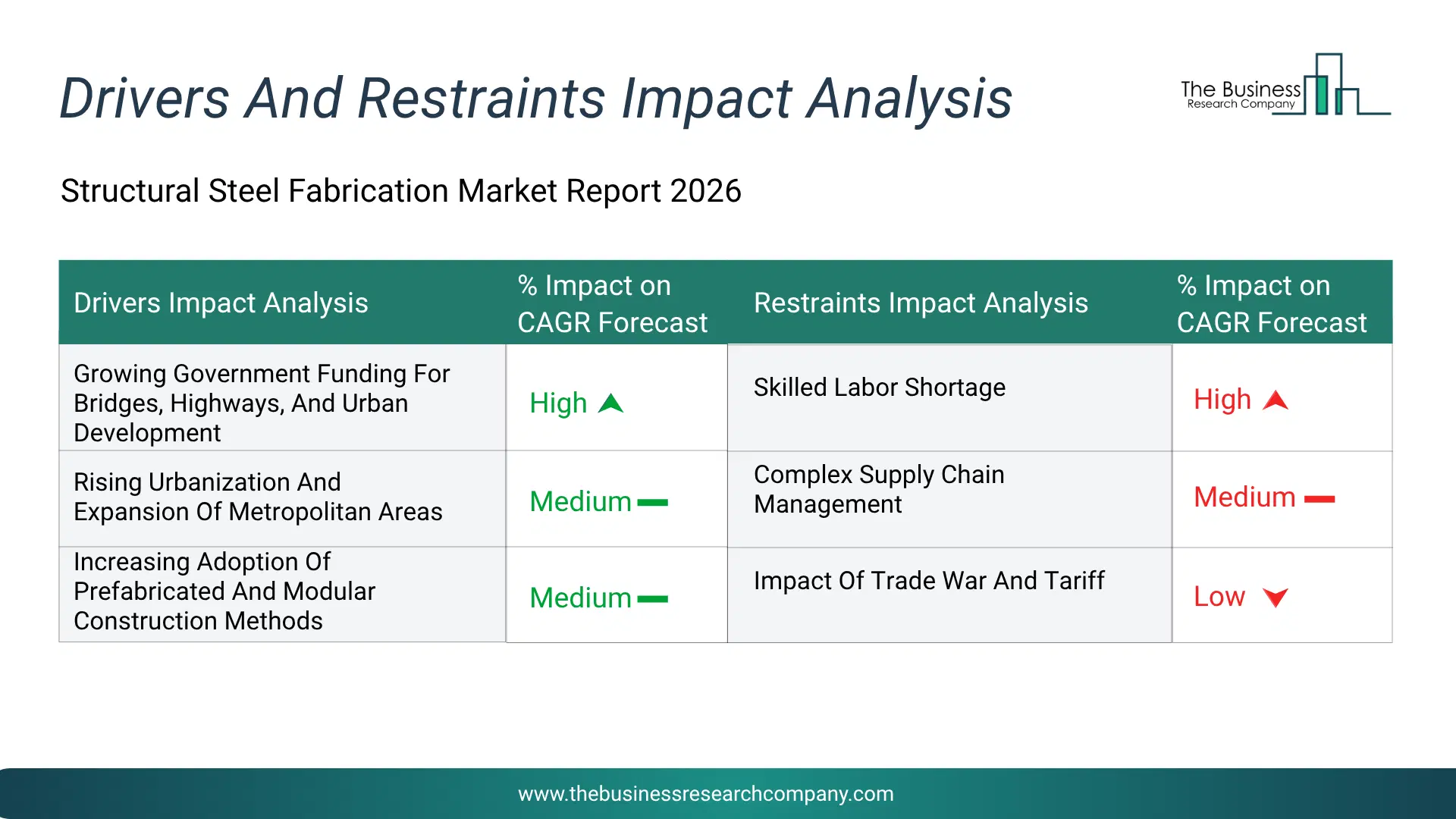
Infographic Chart Showing Key Market Drivers Analysis And Restraints For Structural Steel Fabrication Market
The chart presents an impact analysis of key drivers and restraints, quantifying their relative influence on the market's growth rate and helping assess the balance between growth enablers and limiting factors. This chart offers a high-level perspective; the full report contains more detailed insights.
How Will The Drivers Impact Growth In The Global Structural Steel Fabrication Market?
• Growing Government Funding For Bridges, Highways, And Urban Development (High) – During the forecast period, the growing government funding for bridges, highways, and urban development is expected to be a key driver propelling expansion in the structural steel fabrication market. Governments are allocating substantial resources to infrastructure projects such as bridges, highways, and urban redevelopment, which demand robust and durable frameworks. Structural steel is preferred for its strength, longevity, and ability to withstand heavy loads, making it essential for large-scale constructions. Accelerated project timelines and the need for standardized, high-quality components further drive its integration. As public works expand, steel fabrication becomes a core component in delivering resilient infrastructure efficiently. The growing government funding for bridges, highways, and urban development growth contribution during the forecast period in 2025 is 2.0%. • Rising Urbanization And Expansion Of Metropolitan Areas (Medium) – During the forecast period, the rising urbanization and expansion of metropolitan areas is expected to be a key driver propelling expansion in the structural steel fabrication market. Rapid urban growth and the spread of metropolitan areas increase the need for residential, commercial, and mixed-use structures. High-rise buildings, transit hubs, and complex urban facilities rely on steel frameworks for structural integrity and design flexibility. Population density pressures also necessitate faster construction cycles, where prefabricated steel components allow quicker assembly. This urban expansion directly translates into greater utilization of steel fabrication services. The rising urbanization and expansion of metropolitan areas growth contribution during the forecast period in 2025 is 1.5%. • Increasing Adoption Of Prefabricated And Modular Construction Methods (Medium) – During the forecast period, the increasing adoption of prefabricated and modular construction methods is expected to be a key driver propelling expansion in the structural steel fabrication market. Prefabricated and modular construction methods emphasize off-site assembly and standardized components to reduce construction time and costs. Structural steel’s versatility and precision make it ideal for these techniques, enabling quality control and minimizing on-site labor requirements. Manufacturers can produce modular steel sections tailored to specific designs, which accelerates project delivery. This shift toward pre-engineered solutions enhances reliance on steel fabrication processes. The increasing adoption of prefabricated and modular construction methods growth contribution during the forecast period in 2025 is 1.0%. • Increasing Demand From Renewable Energy Projects (Low) – During the forecast period, the increasing demand from renewable energy projects is expected to be a key driver propelling expansion in the structural steel fabrication market. Renewable energy installations, including wind farms, solar power structures, and hydroelectric facilities, require specialized support frameworks capable of handling environmental stresses. Steel offers high strength-to-weight ratios and durability, making it suitable for towers, supports, and mounting systems. Growing investments in clean energy infrastructure lead to increased demand for fabricated steel components to ensure reliability and safety in energy projects. These projects also stimulate innovation in steel design and manufacturing techniques. The increasing demand from renewable energy projects growth contribution during the forecast period in 2025 is 0.5%.How Will The Restraints Impact Growth In The Global Structural Steel Fabrication Market?
• Skilled Labor Shortage (High) – During the forecast period, skilled labor shortage are restricting the growth of the structural steel fabrication market. A limited availability of trained personnel slows production and affects quality in steel fabrication, as skilled welders, fitters, and engineers are essential for precise structural assembly. Companies may face higher labor costs or delays in completing projects, which can constrain overall output. This shortage often prompts investments in automation and training programs, but the gap between demand and qualified workers remains a critical operational challenge. Growth affected by the skilled labor shortage during the forecast period in 2025 is -2.0%. • Complex Supply Chain Management (Medium) – During the forecast period, complex supply chain management the growth of the structural steel fabrication market. Managing multiple suppliers for raw steel, coatings, and components increases logistical complexity, especially when sourcing globally. Delays, miscommunications, or quality inconsistencies in the supply chain can disrupt fabrication schedules and inflate costs. Coordinating just-in-time deliveries while maintaining production efficiency requires advanced planning and robust vendor networks, making supply chain reliability a key determinant of operational performance. Growth affected by the complex supply chain management during the forecast period in 2025 is -1.3%. • Impact Of Trade War And Tariff (Medium) – During the forecast period, the impact of trade wars and tariffs is restricting the growth of the structural steel fabrication market. Tariffs, trade restrictions, and geopolitical tensions raise the cost of imported steel and related materials, affecting budgeting and project feasibility. Fabricators must navigate fluctuating prices and regulatory requirements, which can lead to delayed orders or sourcing from alternative suppliers. These uncertainties complicate planning and may push companies to seek local materials or adjust production strategies, impacting overall efficiency. Growth affected by the impact of trade wars and tariffs during the forecast period in 2025 is -0.3%.Key Players In The Global Structural Steel Fabrication Market
Major companies operating in the structural steel fabrication market are Mayville Engineering Company Inc., BTD Manufacturing Inc., O'Neal Manufacturing Services Inc., Defiance Metal Products LLC, Ironform Inc., Richard L. Sensenig Company, Lenex Steel LLC, EVS Metal Inc., Watson Engineering Company Inc., LancerFab Tech Pvt Ltd., Zamil Steel Buildings India Private Limited, Apex Buildsys Limited, STI Group, Structural Steelworks Inc., Structural Fabrications Ltd., Steel LLC, Fabspeed Engineering, Banker Steel Company, Metal Sales Manufacturing Corporation, Schuff Steel Company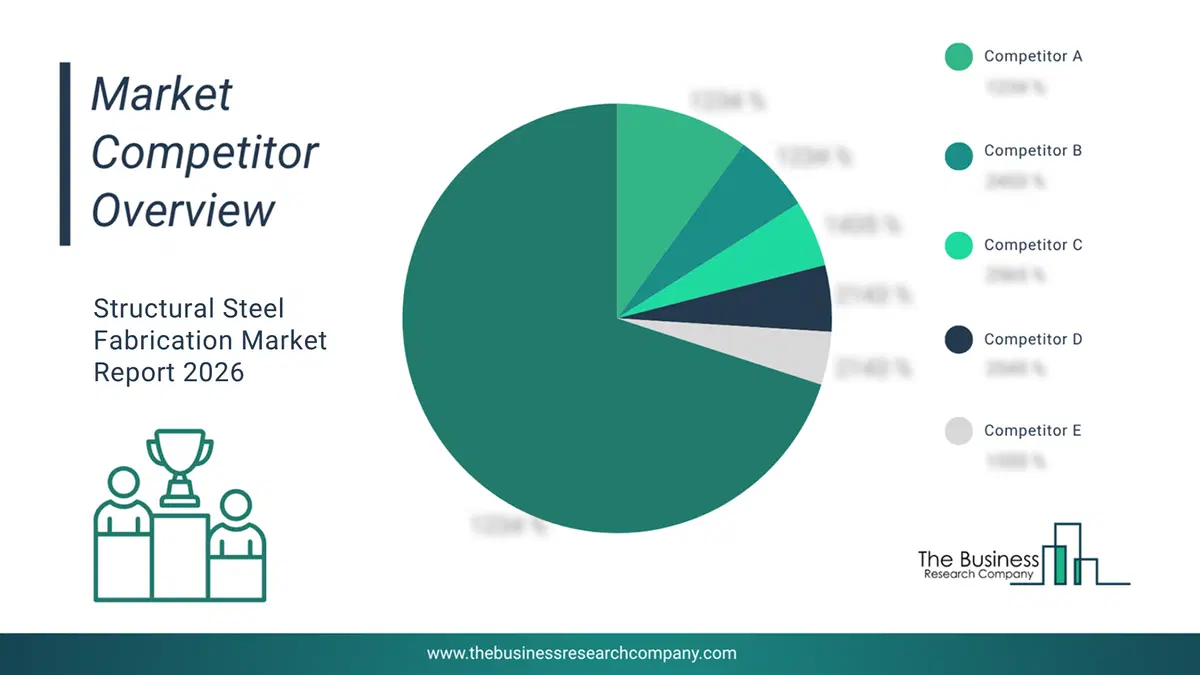
This chart is for illustrative purposes; the full report includes a detailed competitor analysis and comprehensive overview of the top 10 companies in the market.
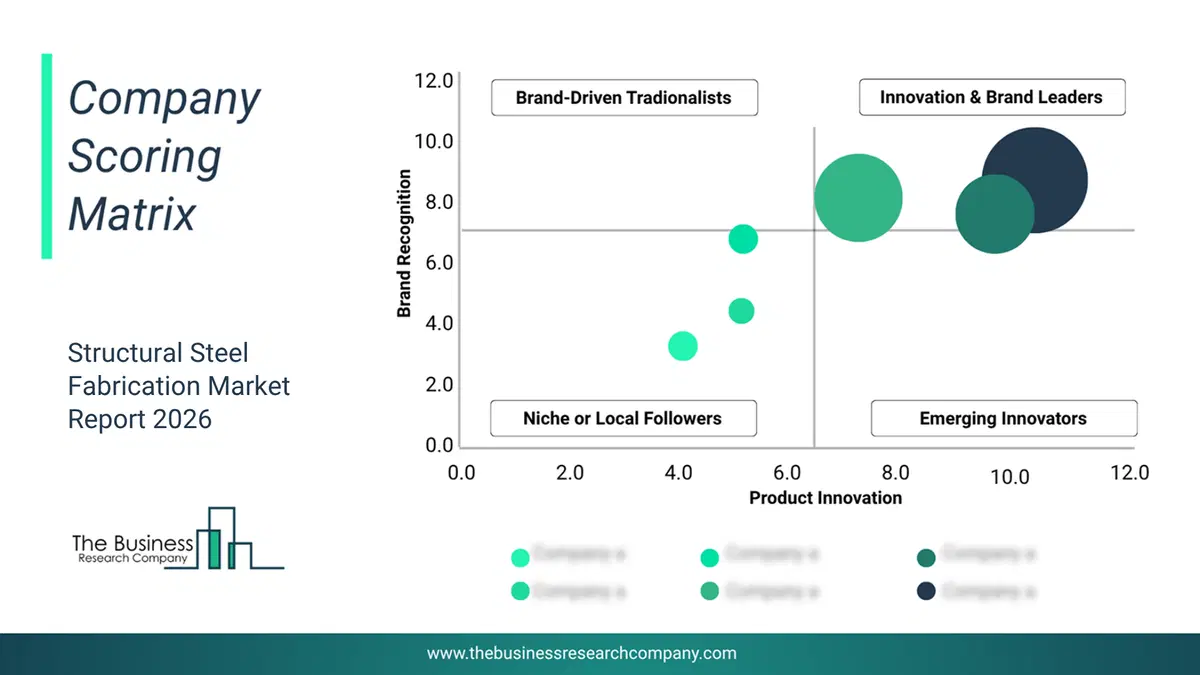
This chart maps companies by product innovation and brand strength, with bubble size indicating relative revenue, helping identify market leaders, challengers, and niche players. This is an illustrative chart; the full report provides a complete and accurate competitive analysis.
Global Structural Steel Fabrication Market Trends and Insights
Major companies operating in the structural steel fabrication market are focusing on leveraging innovative solutions such as advanced plasma cutting systems to increase cutting precision, reduce production time, and improve overall fabrication efficiency. Advanced plasma cutting systems use a high-velocity jet of ionized gas to cut through electrically conductive materials like steel, offering greater accuracy, cleaner edges, and faster processing compared to traditional oxy-fuel cutting or mechanical methods. For instance, in May 2024, Hypertherm Associates, a US-based industrial manufacturing company, launched the Powermax45 SYNC, which specializes in delivering efficient and versatile cutting solutions for metalworkers. It caters to various applications, including gouging, cutting, and marking, making it ideal for multiple industries. This system incorporates a patented single-piece cartridge that extends consumable life up to five times longer than competing products, thereby reducing operating costs significantly. With advanced torch communication and straightforward setup for mechanized use, the Powermax45 SYNC provides high-quality cuts while minimizing operator error.What Are Latest Mergers And Acquisitions In The Structural Steel Fabrication Market?
In May 2024, Lainco Canada Inc., a Canada based structural project management and manufacturing company, acquired Sofab Structural Steel Inc. for an undisclosed amount. With this acquisition, Lainco aims to strengthen its manufacturing and fabrication capabilities and consolidate its market position in the structural steel sector. Sofab Structural Steel Inc. is a Canada based provider of structural steel fabrication and installation services for commercial and industrial construction projects.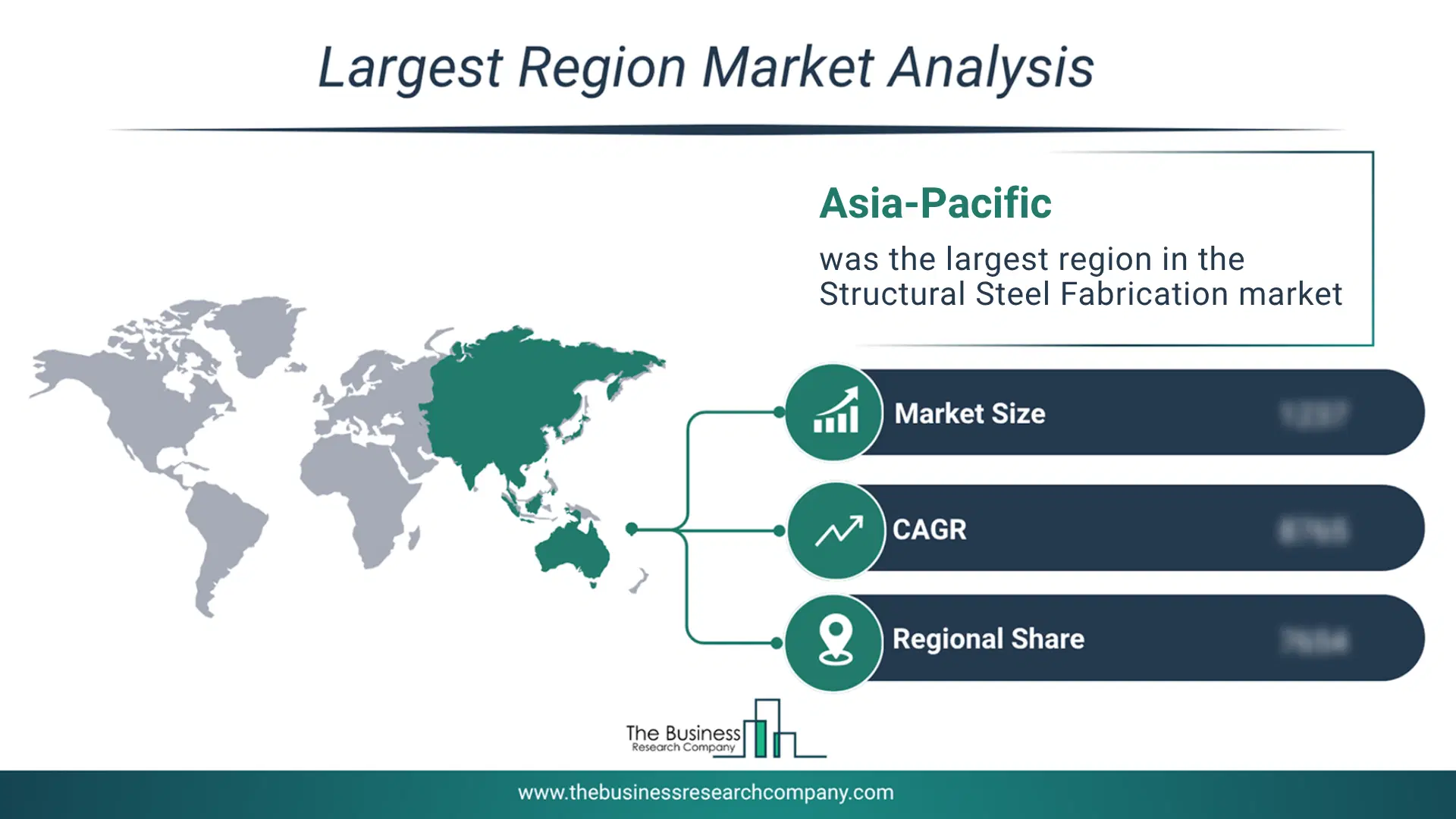
Regional Insights
Asia-Pacific was the largest region in the structural steel fabrication market share in 2025. The regions covered in this market report are Asia-Pacific, South East Asia, Western Europe, Eastern Europe, North America, South America, Middle East, Africa. The countries covered in this market report are Australia, Brazil, China, France, Germany, India, Indonesia, Japan, Taiwan, Russia, South Korea, UK, USA, Canada, Italy, Spain.What Defines the Structural Steel Fabrication Market?
The structural steel fabrication market includes revenues earned by entities by providing fabrication services and related products. The market value includes the value of related goods sold by the service provider or included within the service offering. Only goods and services traded between entities or sold to end consumers are included.How is Market Value Defined and Measured?
The market value is defined as the revenues that enterprises gain from the sale of goods and/or services within the specified market and geography through sales, grants, or donations in terms of the currency (in USD unless otherwise specified). The revenues for a specified geography are consumption values that are revenues generated by organizations in the specified geography within the market, irrespective of where they are produced. It does not include revenues from resales along the supply chain, either further along the supply chain or as part of other products.
This chart presents market attractiveness based on a quantitative evaluation of growth, competition, strategic alignment, and risk, offering a clear view of opportunity areas for decision-making. This chart is for illustrative purposes; the full report contains the complete analysis.

This chart highlights the Total Addressable Market (TAM) by estimating the maximum revenue opportunity using an assumption-driven approach, supporting strategic planning and opportunity sizing across markets. The chart is illustrative; the full report provides a more comprehensive analysis.
What Key Data and Analysis Are Included in theStructural Steel Fabrication Market Report 2026?
The structural steel fabrication market research report is one of a series of new reports from The Business Research Company that provides market statistics, including industry global market size, regional shares, competitors with the market share, detailed market segments, market trends and opportunities, and any further data you may need to thrive in the structural steel fabrication industry. The market research report delivers a complete perspective of everything you need, with an in-depth analysis of the current and future state of the industry.Structural Steel Fabrication Market Report Forecast Analysis
| Report Attribute | Details |
|---|---|
| Market Size Value In 2026 | $195.5 billion |
| Revenue Forecast In 2030 | $273.64 billion |
| Growth Rate | CAGR of 9.2% from 2026 to 2030 |
| Base Year For Estimation | 2025 |
| Actual Estimates/Historical Data | 2020-2025 |
| Forecast Period | 2026 - 2030 - 2035 |
| Market Representation | Revenue in USD Billion and CAGR from 2026 to 2030 |
| Segments Covered | Service, Product, End-Users |
| Regional Scope | Asia-Pacific, Western Europe, Eastern Europe, North America, South America, Middle East, Africa |
| Country Scope | The countries covered in the report are Australia, Brazil, China, France, Germany, India, Indonesia, Japan, Taiwan, Russia, South Korea, UK, USA, Canada, Italy, Spain. |
| Key Companies Profiled | Mayville Engineering Company Inc., BTD Manufacturing Inc., O'Neal Manufacturing Services Inc., Defiance Metal Products LLC, Ironform Inc., Richard L. Sensenig Company, Lenex Steel LLC, EVS Metal Inc., Watson Engineering Company Inc., LancerFab Tech Pvt Ltd., Zamil Steel Buildings India Private Limited, Apex Buildsys Limited, STI Group, Structural Steelworks Inc., Structural Fabrications Ltd., Steel LLC, Fabspeed Engineering, Banker Steel Company, Metal Sales Manufacturing Corporation, Schuff Steel Company |
| Customization Scope | Request for Customization |
| Pricing And Purchase Options | Explore Purchase Options |