
Structural Steel Market Report 2026
Global Outlook – By Type (Structural Sections, Plates, Hollow Structural Sections (HSS), Structural Reinforcement Steel, Other Types), By Manufacturing Process (Hot-Rolled Structural Steel, Fabricated Structural Steel), By Application (Residential, Commercial, Industrial) – Market Size, Trends, Strategies, and Forecast to 2030
Structural Steel Market Overview
• Structural steel market size has reached to $115.82 billion in 2025 • Expected to grow to $154.05 billion in 2030 at a compound annual growth rate (CAGR) of 5.8% • Growth Driver: Rising Construction Demand Boosts The Structural Steel Market • Market Trend: Revolutionizing Sustainable Steel Manufacturing Through Zero Fossil-Carbon Technology • Asia-Pacific was the largest region and fastest growing region.What Is Covered Under Structural Steel Market?
Structural steel refers to a category of steel used in construction to support and shape buildings and infrastructure. It includes various shapes and sizes, such as beams, columns, and plates, engineered to handle specific loads and stresses. Its strength, durability, and versatility make it a key material in structural engineering and construction. The main types of structural steel are hot-rolled steel and cold-rolled steel. Hot-rolled steel refers to steel that is processed at high temperatures, typically above its recrystallization point, to achieve desired shapes and properties. This process results in a material with enhanced strength and durability. The products include heavy sectional steel, light sectional steel, and rebar and are applied in both residential and non-residential.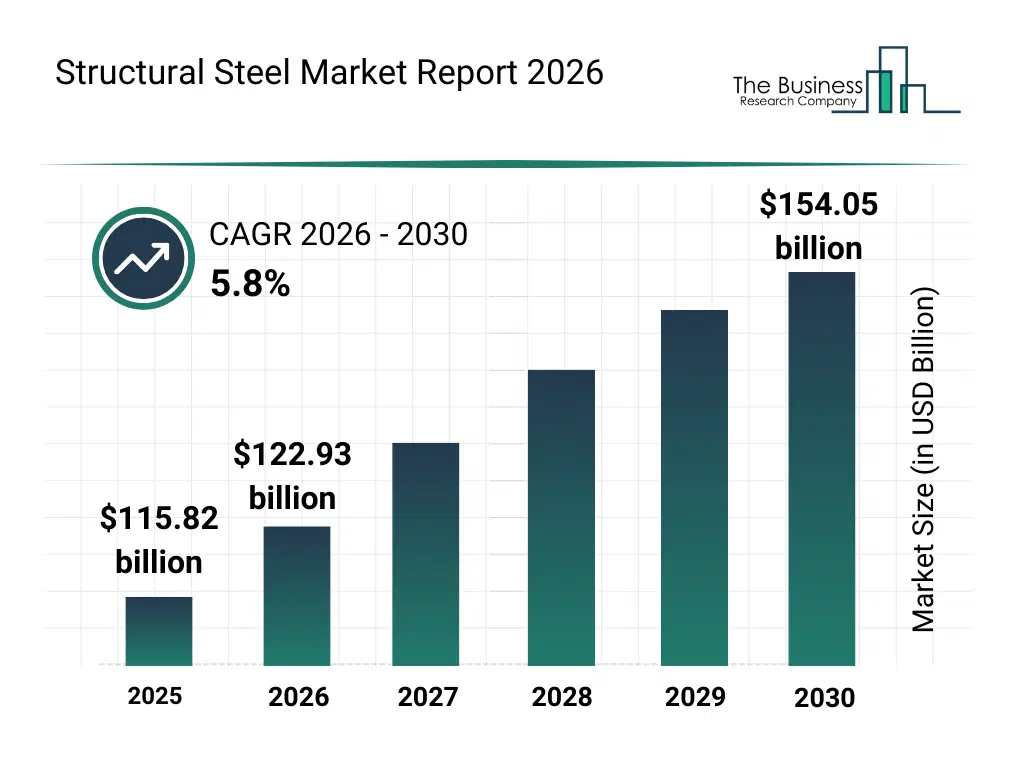
What Is The Structural Steel Market Size and Share 2026?
The structural steel market size has grown strongly in recent years. It will grow from $115.82 billion in 2025 to $122.93 billion in 2026 at a compound annual growth rate (CAGR) of 6.1%. The growth in the historic period can be attributed to urbanization growth, expansion of industrial buildings, availability of iron ore, government infrastructure spending, demand for durable construction materials.What Is The Structural Steel Market Growth Forecast?
The structural steel market size is expected to see strong growth in the next few years. It will grow to $154.05 billion in 2030 at a compound annual growth rate (CAGR) of 5.8%. The growth in the forecast period can be attributed to smart city projects, green building initiatives, growth in modular construction, technological advances in steel processing, increased private sector investments. Major trends in the forecast period include rising demand from infrastructure development, growing use of prefabricated steel structures, expansion of high strength steel applications, increasing adoption in commercial construction, focus on sustainable steel production.
Global Structural Steel Market Segmentation
1) By Type: Structural Sections, Plates, Hollow Structural Sections (HSS), Structural Reinforcement Steel, Other Types 2) By Manufacturing Process: Hot-Rolled Structural Steel, Fabricated Structural Steel 3) By Application: Residential, Commercial, Industrial Subsegments: 1) By Structural Sections: I-Beams, H-Beams And Universal Beams, Columns, Channels, Angles, Tee Sections 2) By Plates: Structural Steel Plates, Heavy Plates, Quenched And Tempered Structural Plates, High-Strength Structural Plates 3) By Hollow Structural Sections (HSS): Circular Hollow Sections (CHS), Square Hollow Sections (SHS), Rectangular Hollow Sections (RHS) 4) By Structural Reinforcement Steel: Reinforcing Bars (Rebar), Deformed Bars, Welded Wire Reinforcement (WWR And Mesh) 5) By Other Types: Girders, Trusses, Built-Up And Fabricated Structural Sections, Lattice StructuresWhat Is The Driver Of The Structural Steel Market?
The growing construction of residential and commercial infrastructure is expected to propel the growth of the structural steel market going forward. Residential and commercial infrastructure refers to the physical structures and facilities that support housing and business activities, including homes, apartments, offices, retail spaces, and other buildings essential for living and commerce. The increase in residential and commercial infrastructure is driven by smart city initiatives, strategic infrastructure planning, affordable housing projects, and sustainability efforts led by government agencies. Structural steel is used in residential and commercial infrastructure for its strength and versatility, providing essential support and stability for building frameworks and large-scale construction projects. For instance, in August 2024, according to a report published by the US Census Bureau, a US-based government agency, the value of construction operations for residential projects in the US rose from $875.5 billion in June 2023 to $939.8 billion in June 2024, reflecting a 7.3% increase. Meanwhile, the value of construction operations for non-residential projects grew from $1.15 trillion in June 2023 to $1.21 trillion in June 2024, marking a 5.3% increase. Therefore, the growing construction of residential and commercial infrastructure is driving the growth of the structural steel industry.Key Players In The Global Structural Steel Market
Major companies operating in the structural steel market are Severstal, ArcelorMittal, POSCO, China Baowu, Nippon Steel, Thyssenkrupp, Nucor, JFE Steel, Tata Steel, U.S. Steel, JSW Steel, HBIS, Hyundai Steel, Ansteel, Voestalpine, Jiangsu Shagang, Gerdau, Evraz, SAIL, SSAB, British Steel
This chart is for illustrative purposes; the full report includes a detailed competitor analysis and comprehensive overview of the top 10 companies in the market.
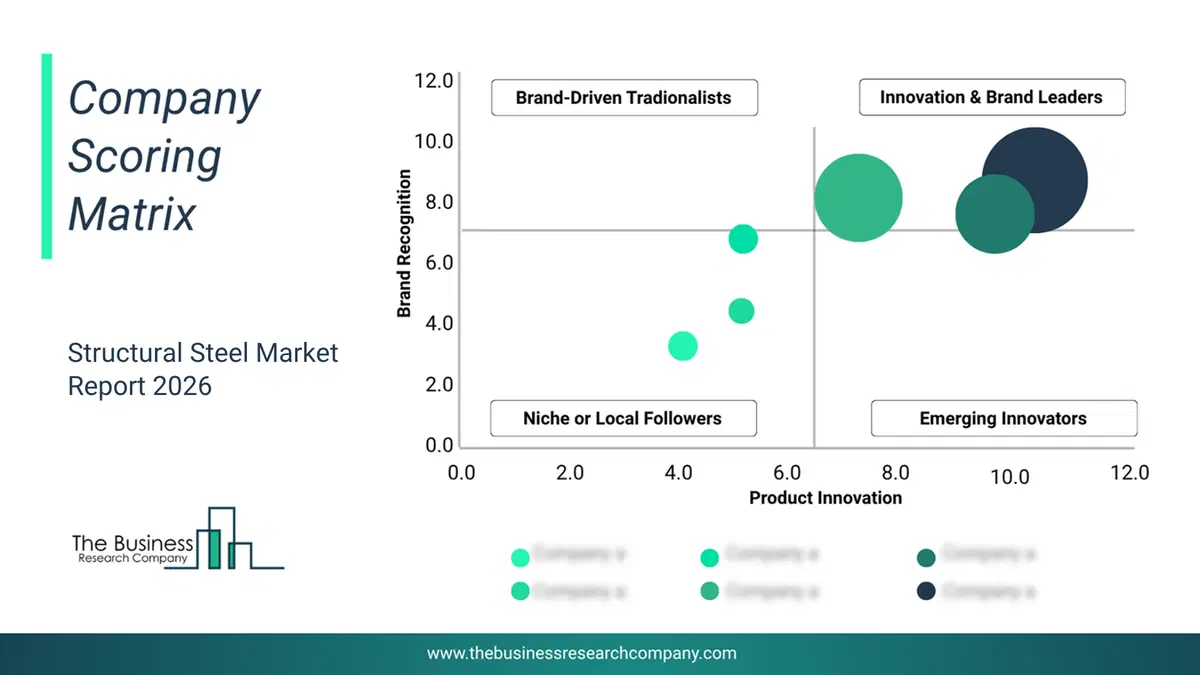
This chart maps companies by product innovation and brand strength, with bubble size indicating relative revenue, helping identify market leaders, challengers, and niche players. This is an illustrative chart; the full report provides a complete and accurate competitive analysis.
Global Structural Steel Market Trends and Insights
Major companies operating in the structural steel market are focusing on innovation in sustainable steel production, such as zero fossil-carbon emission solutions to reduce environmental impact and support climate-neutral construction. Zero fossil-carbon emissions refer to producing steel without generating fossil-derived operational carbon dioxide, typically by using recycled steel and fossil-free energy sources. For instance, in March 2023, SSAB AB, a Sweden-based steel manufacturer, launched SSAB Zero, a fossil-carbon-emission-free steel produced from recycled steel and fossil-free electricity without relying on carbon offsets. This innovative product delivers high-quality steel with mechanical performance equal to conventional SSAB steels while significantly reducing operational emissions, representing a major advancement in sustainable steel technology.What Are Latest Mergers And Acquisitions In The Structural Steel Market?
In May 2024, Lainco Inc., a Canada-based structural project management company, acquired Charpentes D'Acier Sofab Inc. for an undisclosed amount. The acquisition is intended to position Lainco for ongoing success and growth in the structural steel sector, improving its capacity to provide innovative solutions and uphold high service standards for a broader customer base. Charpentes D'Acier Sofab Inc. is a Canada-based structural steel manufacturing company.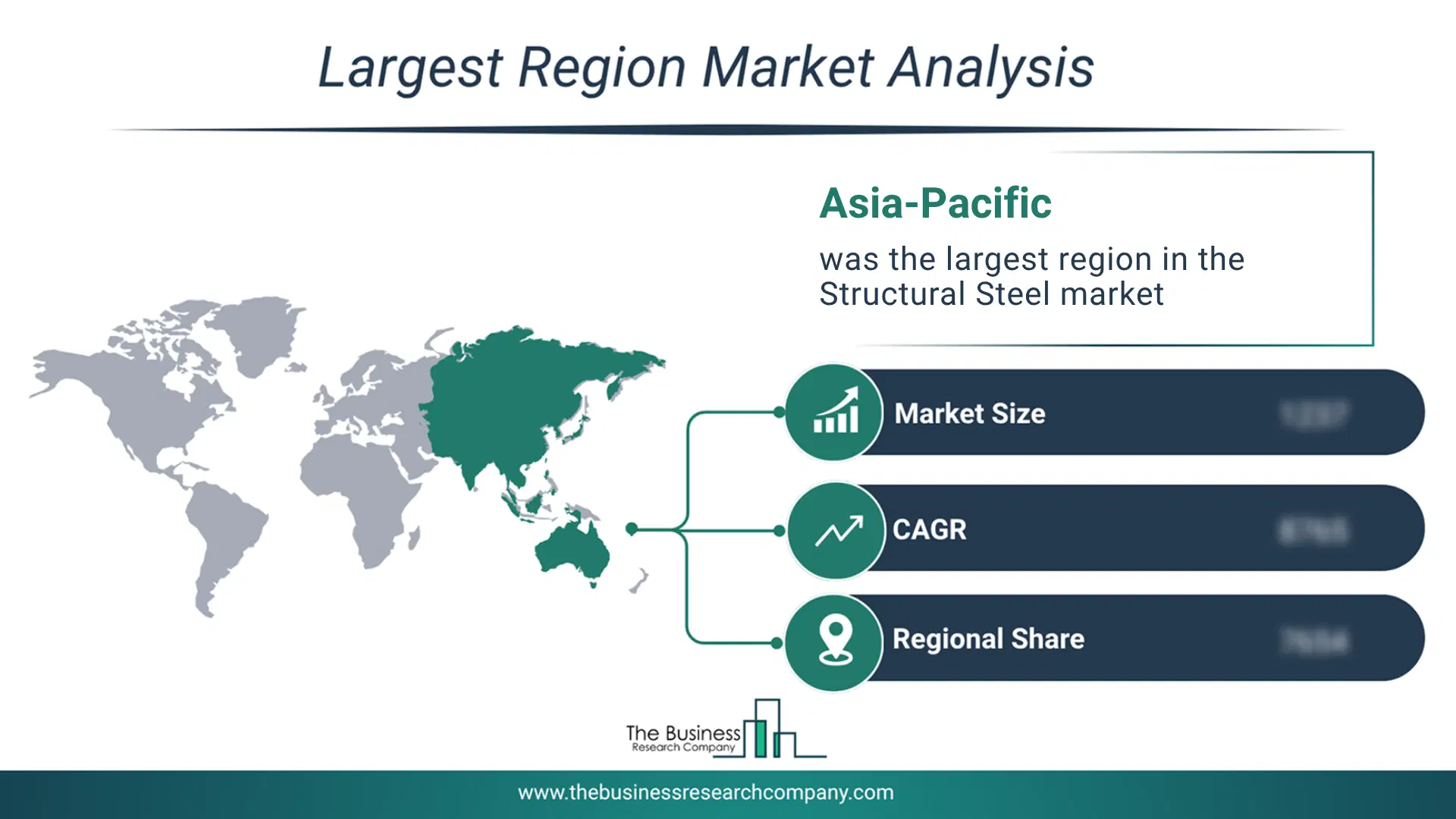
Regional Insights
Asia-Pacific was the largest region in the structural steel market in 2025. North America is expected to be the fastest-growing region in the forecast period. The regions covered in this market report are Asia-Pacific, South East Asia, Western Europe, Eastern Europe, North America, South America, Middle East, Africa The countries covered in this market report are Australia, Brazil, China, France, Germany, India, Indonesia, Japan, Taiwan, Russia, South Korea, UK, USA, Canada, Italy, SpainWhat Defines the Structural Steel Market?
The structural steel market consists of sales of carbon steel, high-strength carbon steel, weathering steel, and fire-resistant steel. Values in this market are ‘factory gate’ values, that is the value of goods sold by the manufacturers or creators of the goods, whether to other entities (including downstream manufacturers, wholesalers, distributors, and retailers) or directly to end customers. The value of goods in this market includes related services sold by the creators of the goods.How is Market Value Defined and Measured?
The market value is defined as the revenues that enterprises gain from the sale of goods and/or services within the specified market and geography through sales, grants, or donations in terms of the currency (in USD unless otherwise specified). The revenues for a specified geography are consumption values that are revenues generated by organizations in the specified geography within the market, irrespective of where they are produced. It does not include revenues from resales along the supply chain, either further along the supply chain or as part of other products.
This chart presents market attractiveness based on a quantitative evaluation of growth, competition, strategic alignment, and risk, offering a clear view of opportunity areas for decision-making. This chart is for illustrative purposes; the full report contains the complete analysis.

This chart highlights the Total Addressable Market (TAM) by estimating the maximum revenue opportunity using an assumption-driven approach, supporting strategic planning and opportunity sizing across markets. The chart is illustrative; the full report provides a more comprehensive analysis.
What Key Data and Analysis Are Included in the Structural Steel Market Report 2026?
The structural steel market research report is one of a series of new reports from The Business Research Company that provides market statistics, including industry global market size, regional shares, competitors with the market share, detailed market segments, market trends and opportunities, and any further data you may need to thrive in the structural steel industry. The market research report delivers a complete perspective of everything you need, with an in-depth analysis of the current and future state of the industry.Structural Steel Market Report Forecast Analysis
| Report Attribute | Details |
|---|---|
| Market Size Value In 2026 | $122.93 billion |
| Revenue Forecast In 2030 | $154.05 billion |
| Growth Rate | CAGR of 6.1% from 2026 to 2030 |
| Base Year For Estimation | 2025 |
| Actual Estimates/Historical Data | 2020-2025 |
| Forecast Period | 2026 - 2030 |
| Market Representation | Revenue in USD Billion and CAGR from 2026 to 2030 |
| Segments Covered | Type, Manufacturing Process, Application |
| Regional Scope | Asia-Pacific, Western Europe, Eastern Europe, North America, South America, Middle East, Africa |
| Country Scope | The countries covered in this market report are Australia, Brazil, China, France, Germany, India, Indonesia, Japan, Taiwan, Russia, South Korea, UK, USA, Canada, Italy, Spain |
| Key Companies Profiled | Severstal, ArcelorMittal, POSCO, China Baowu, Nippon Steel, Thyssenkrupp, Nucor, JFE Steel, Tata Steel, U.S. Steel, JSW Steel, HBIS, Hyundai Steel, Ansteel, Voestalpine, Jiangsu Shagang, Gerdau, Evraz, SAIL, SSAB, British Steel |
| Customization Scope | Request for Customization |
| Pricing And Purchase Options | Explore Purchase Options |