
Subcutaneous Drug Delivery Devices Market Report 2026
Global Outlook – By Product Type (Insulin Pens, Pen Needles, Injector Pens, Auto-Injectors, Implantable Pumps), By Application (Diabetes, Fertility, Oncology), By End-User (Hospitals And Clinics, Homecare Settings, Ambulatory Surgical Centers) – Market Size, Trends, Strategies, and Forecast to 2030
Subcutaneous Drug Delivery Devices Market Overview
• Subcutaneous Drug Delivery Devices market size has reached to $29.77 billion in 2025 • Expected to grow to $42.42 billion in 2030 at a compound annual growth rate (CAGR) of 7.3% • Growth Driver: Rising Prevalence Of Diabetes And Cardiovascular Diseases Boosts Growth In Subcutaneous Drug Delivery Device Market • Market Trend: Innovations In Subcutaneous Drug Delivery Enhance Safety And Precision • North America was the largest region in 2025 and Asia-Pacific is the fastest growing region.Market Gains By 2030 – Top Opportunities By Segment
Market Gain identifies the most promising market opportunities by highlighting the segments or products expected to generate the highest incremental revenue growth over the next five years.
What Is Covered Under Subcutaneous Drug Delivery Devices Market?
Subcutaneous drug delivery devices are medical devices designed to administer medications directly into the subcutaneous tissue, the layer of fat and connective tissue just beneath the skin. These devices are used for the delivery of various drugs, including insulin, hormones, and biologics, providing a convenient and minimally invasive method of drug administration. The main product types of subcutaneous drug delivery devices are insulin pens, pen needles, injector pens, auto-injectors, and implantable pumps. Insulin pens are handheld devices used for the precise and convenient administration of insulin in diabetes management, allowing users to easily measure and inject insulin doses. Subcutaneous drug delivery devices are utilized across various applications, such as diabetes, fertility, and oncology, and are employed by different end-users, such as hospitals and clinics, homecare settings, and ambulatory surgical centers.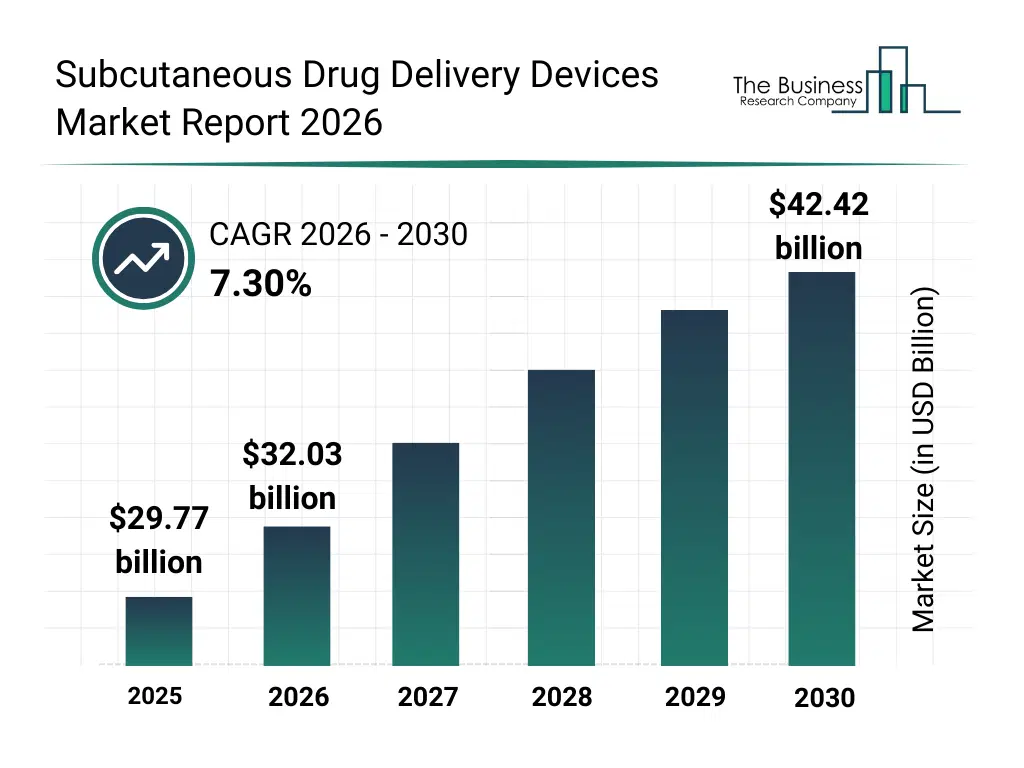
What Is The Subcutaneous Drug Delivery Devices Market Size and Share 2026?
The subcutaneous drug delivery devices market size has grown strongly in recent years. It will grow from $29.77 billion in 2025 to $32.03 billion in 2026 at a compound annual growth rate (CAGR) of 7.6%. The growth in the historic period can be attributed to rising prevalence of diabetes and chronic diseases, increasing use of insulin pens and pen needles, growing hospital and clinic infrastructure, limited availability of advanced delivery technologies, increasing awareness of subcutaneous drug administration.What Is The Subcutaneous Drug Delivery Devices Market Growth Forecast?
The subcutaneous drug delivery devices market size is expected to see strong growth in the next few years. It will grow to $42.42 billion in 2030 at a compound annual growth rate (CAGR) of 7.3%. The growth in the forecast period can be attributed to growth in biologics and oncology therapies, increasing adoption of smart auto-injectors, expansion of homecare settings, technological advancements in implantable pumps, rising demand for patient-centric drug delivery solutions. Major trends in the forecast period include rising adoption of auto-injectors and smart injection devices, growing preference for home-based and self-administration therapies, increasing demand for minimally invasive drug delivery methods, expansion of biologic and biosimilar drug delivery applications, improved patient compliance through user-friendly device designs.

Global Subcutaneous Drug Delivery Devices Market Segmentation
1) By Product Type: Insulin Pens, Pen Needles, Injector Pens, Auto-Injectors, Implantable Pumps 2) By Application: Diabetes, Fertility, Oncology 3) By End-User: Hospitals And Clinics, Homecare Settings, Ambulatory Surgical Centers Subsegments: 1) By Insulin Pens: Disposable Insulin Pens, Reusable Insulin Pens 2) By Pen Needles: Standard Pen Needles, Safety Pen Needles 3) By Injector Pens: Disposable Injector Pens, Reusable Injector Pens 4) By Auto-Injectors: Manual Auto-Injectors, Smart Auto-Injectors 5) By Implantable Pumps: Insulin Pumps, Drug Infusion Pumps The top segments in the subcutaneous drug delivery devices market will be: • Insulin Pens will reach $16.9 billion by 2030. • Pen Needles will reach $13.78 billion by 2030. • Injector Pens will reach $8.44 billion by 2030. • Auto-Injectors will reach $6.84 billion by 2030. • Implantable Pumps will reach $3.83 billion by 2030.What Is The Driver Of The Subcutaneous Drug Delivery Devices Market?
The increasing prevalence of diabetes and cardiovascular diseases (CVD) is expected to propel the growth of the subcutaneous drug delivery devices market going forward. The rising prevalence of diabetes and cardiovascular diseases is driven by aging populations, unhealthy diets, sedentary lifestyles, obesity, socioeconomic inequalities, stress, environmental factors, and limited access to preventive healthcare. Subcutaneous drug delivery devices are used in diabetes to administer insulin and other medications for glycemic control and in cardiovascular diseases to provide drugs such as anticoagulants or lipid-lowering agents, offering a convenient and controlled method for managing these chronic conditions. For instance, October 2024, according to the Centers for Disease Control and Prevention, a US-based federal agency, in 2023, 919,032 people died from cardiovascular disease. That's the equivalent of 1 in every 3 deaths. Therefore, the increasing prevalence of diabetes and cardiovascular diseases (CVD) is driving growth in the subcutaneous drug delivery devices industry.
Infographic Chart Showing Key Market Drivers Analysis And Restraints For Subcutaneous Drug Delivery Devices Market
The chart presents an impact analysis of key drivers and restraints, quantifying their relative influence on the market's growth rate and helping assess the balance between growth enablers and limiting factors. This chart offers a high-level perspective; the full report contains more detailed insights.
How Will The Drivers Impact Growth In The Global Subcutaneous Drug Delivery Devices Market?
• Growth In The Biologics And Biosimilars (High) – During the forecast period, the growth in biologics and biosimilars is expected to become a key driver for the subcutaneous drug delivery devices market by 2030. The increasing use of biologics in the treatment of chronic conditions such as diabetes, cancer, and autoimmune diseases is driving demand for efficient and patient -friendly delivery systems. Subcutaneous administration is preferred for many biologics due to its convenience, reduced need for hospital visits, and improved patient compliance. Additionally, the rising availability of cost -effective biosimilars is expanding patient access to advanced therapies, further increasing device demand. Pharmaceutical companies are also focusing on developing formulations compatible with self -injection devices. • Rising Adoption Of Wearable Drug Delivery Systems (High) – During the forecast period, the rising adoption of wearable drug delivery systems is expected to emerge as a major factor driving the expansion of the subcutaneous drug delivery devices market by 2030. Wearable injectors and on-body delivery systems enable continuous or large-volume drug administration with minimal patient intervention, improving treatment adherence and convenience. These systems are particularly beneficial for chronic disease management and biologic therapies requiring precise and sustained dosing. Technological advancements such as connectivity, real-time monitoring, and integration with digital health platforms are further enhancing their adoption. • Improving Healthcare Reimbursement Policies (Medium) – During the forecast period, improving healthcare reimbursement policies are expected to act as a key growth catalyst for the subcutaneous drug delivery devices market by 2030. Favorable reimbursement frameworks across developed healthcare systems are encouraging the adoption of advanced drug delivery devices by reducing out-of-pocket costs for patients. Insurance coverage for self-injection devices and home-based therapies is supporting the shift away from hospital-administered treatments. Additionally, reimbursement support for innovative biologics and combination products is driving investments in advanced delivery technologies. As reimbursement policies continue to evolve, accessibility and affordability of these devices are expected to improve significantly.How Will The Restraints Impact Growth In The Global Subcutaneous Drug Delivery Devices Market?
• High Cost Of Advanced Delivery Systems (High) – During the forecast period, the the high cost of advanced subcutaneous drug delivery systems acts as a significant restraint for market growth. Many modern delivery devices include sophisticated components such as precision needles, specialized cartridges, and integrated reservoirs that ensure safe and accurate drug administration. These advanced devices often require complex manufacturing processes and strict regulatory compliance, which increases production costs. As a result, the final price of these devices becomes higher for healthcare providers and patients. In many cases, hospitals and clinics may hesitate to adopt newer delivery technologies due to budget limitations. Patients who require long-term treatment, such as insulin therapy or biologic drug administration, may also find these devices expensive for regular use. This cost barrier can limit accessibility, particularly in regions with lower healthcare spending. In addition, healthcare systems in some countries may prioritize more affordable treatment methods rather than investing in advanced drug delivery technologies. Consequently, the high cost of advanced delivery systems can slow the widespread adoption of subcutaneous drug delivery devices. • Lack Of Awareness In Developing Countries (Medium) – During the forecast period, the limited awareness about subcutaneous drug delivery devices in developing countries also restrains market expansion. In many emerging economies, healthcare professionals and patients may not be fully familiar with the benefits of these devices, such as convenience, improved drug absorption, and reduced need for hospital visits. Traditional methods of drug administration are often preferred because they are more widely understood and readily available. Additionally, limited healthcare infrastructure and training opportunities can reduce the exposure of medical staff to modern drug delivery technologies. Patients may also lack sufficient information about self-administration devices, which can discourage their usage. In rural or underserved areas, healthcare education programs and technology access may be limited, further reducing awareness. Without proper understanding of the advantages of subcutaneous delivery systems, both healthcare providers and patients may continue to rely on conventional treatment approaches. This lack of awareness ultimately slows the adoption rate of these devices in developing regions. • Competition From Alternative Drug Delivery Systems (Medium) – During the forecast period, the competition from alternative drug delivery systems presents another challenge for the subcutaneous drug delivery devices market. Various other methods of drug administration, such as oral medications, intravenous injections, transdermal patches, and inhalation therapies, are widely used in medical treatment. These alternatives may offer advantages such as ease of use, non-invasive administration, or faster drug delivery depending on the therapy required. For example, oral drugs are often preferred by patients because they do not involve needles or injections. In some cases, healthcare providers may recommend alternative delivery methods if they are more convenient or cost-effective for specific treatments. Pharmaceutical companies are also continuously developing innovative drug delivery technologies that compete with traditional injection-based systems. As a result, healthcare providers may have multiple options available for administering medications. This competition can reduce the demand for subcutaneous drug delivery devices in certain therapeutic areas. Consequently, the availability of alternative drug delivery systems can limit the growth potential of this market.Key Players In The Global Subcutaneous Drug Delivery Devices Market
Major companies operating in the subcutaneous drug delivery devices market are Pfizer Inc., Sanofi S.A., Roche Holdings Inc., Medtronic plc, Eli Lilly and Company, Amgen Inc., Novo Nordisk A/S, Becton Dickinson and Company, West Pharmaceutical Services Inc., Gerresheimer AG, Insulet Corporation, SHL Medical AG, Tandem Diabetes Care Inc., Ypsomed Holding AG, Nemera, Elcam Medical Ltd., Owen Mumford Ltd., Haselmeier GmbH, Sensile Medical AG, Enable Injections Inc., Unilife Corporation, PharmaJet, Oval Medical Technologies Ltd.
This chart is for illustrative purposes; the full report includes a detailed competitor analysis and comprehensive overview of the top 10 companies in the market.

This chart maps companies by product innovation and brand strength, with bubble size indicating relative revenue, helping identify market leaders, challengers, and niche players. This is an illustrative chart; the full report provides a complete and accurate competitive analysis.
Global Subcutaneous Drug Delivery Devices Market Trends and Insights
Major companies operating in the subcutaneous drug delivery devices market are focusing on the development of innovative products, such as miniature digital liquid flow sensors, to enhance the safety and precision of subcutaneous drug delivery by providing accurate, customizable flow sensors for large-volume injectors. Miniature digital liquid flow sensors are compact devices that precisely measure the flow rate of liquids in small-scale applications, providing digital output for accurate monitoring and control. For instance, in May 2024, Sensirion AG, a Switzerland-based provider of environmental and flow sensors, launched the SLD3x series sensor platform. This sensor series features highly accurate digital liquid flow sensors with customizable solutions, offering precise flow measurement, occlusion detection, in-line air bubble identification, and liquid temperature monitoring. These miniature sensors are ideal for large-scale medical device manufacturing, ensuring optimal dosing and enhanced patient safety in subcutaneous drug delivery.What Are Latest Mergers And Acquisitions In The Subcutaneous Drug Delivery Devices Market?
In November 2025, Halozyme Therapeutics, a US-based biopharmaceutical company specializing in novel drug delivery technologies, completed the acquisition of Elektrofi for an undisclosed amount. Through this acquisition, Halozyme aims to expand its drug-delivery technology portfolio, enhance its ability to develop high-concentration, ready-to-use injectable biologics, and strengthen its position in the rapidly growing market for patient-friendly, subcutaneous delivery solutions. Elektrofi is a US-based biotechnology company that offers subcutaneous drug delivery devices.
Regional Insights
North America was the largest region in the subcutaneous drug delivery devices market in 2025. Asia-Pacific is expected to be the fastest-growing region in the market going forward. The regions covered in this market report are Asia-Pacific, South East Asia, Western Europe, Eastern Europe, North America, South America, Middle East, Africa. The countries covered in this market report are Australia, Brazil, China, France, Germany, India, Indonesia, Japan, Taiwan, Russia, South Korea, UK, USA, Canada, Italy, Spain.What Defines the Subcutaneous Drug Delivery Devices Market?
The subcutaneous drug delivery devices market consists of sales of needles, cartridges, and reservoirs. Values in this market are ‘factory gate’ values, that is the value of goods sold by the manufacturers or creators of the goods, whether to other entities (including downstream manufacturers, wholesalers, distributors and retailers) or directly to end customers. The value of goods in this market includes related services sold by the creators of the goods.How is Market Value Defined and Measured?
The market value is defined as the revenues that enterprises gain from the sale of goods and/or services within the specified market and geography through sales, grants, or donations in terms of the currency (in USD unless otherwise specified). The revenues for a specified geography are consumption values that are revenues generated by organizations in the specified geography within the market, irrespective of where they are produced. It does not include revenues from resales along the supply chain, either further along the supply chain or as part of other products.
This chart presents market attractiveness based on a quantitative evaluation of growth, competition, strategic alignment, and risk, offering a clear view of opportunity areas for decision-making. This chart is for illustrative purposes; the full report contains the complete analysis.

This chart highlights the Total Addressable Market (TAM) by estimating the maximum revenue opportunity using an assumption-driven approach, supporting strategic planning and opportunity sizing across markets. The chart is illustrative; the full report provides a more comprehensive analysis.
What Key Data and Analysis Are Included in the Subcutaneous Drug Delivery Devices Market Report 2026?
The subcutaneous drug delivery devices market research report is one of a series of new reports from The Business Research Company that provides market statistics, including industry global market size, regional shares, competitors with the market share, detailed market segments, market trends and opportunities, and any further data you may need to thrive in the subcutaneous drug delivery devices industry. The market research report delivers a complete perspective of everything you need, with an in-depth analysis of the current and future state of the industry.Subcutaneous Drug Delivery Devices Market Report Forecast Analysis
| Report Attribute | Details |
|---|---|
| Market Size Value In 2026 | $32.03 billion |
| Revenue Forecast In 2030 | $42.42 billion |
| Growth Rate | CAGR of 7.3% from 2026 to 2030 |
| Base Year For Estimation | 2025 |
| Actual Estimates/Historical Data | 2020-2025 |
| Forecast Period | 2026 - 2030 |
| Market Representation | Revenue in USD Billion and CAGR from 2026 to 2030 |
| Segments Covered | Product Type, Application, End-User |
| Regional Scope | Asia-Pacific, Western Europe, Eastern Europe, North America, South America, Middle East, Africa |
| Country Scope | The countries covered in the report are Australia, Brazil, China, France, Germany, India, ... |
| Key Companies Profiled | Pfizer Inc., Sanofi S.A., Roche Holdings Inc., Medtronic plc, Eli Lilly and Company, Amgen Inc., Novo Nordisk A/S, Becton Dickinson and Company, West Pharmaceutical Services Inc., Gerresheimer AG, Insulet Corporation, SHL Medical AG, Tandem Diabetes Care Inc., Ypsomed Holding AG, Nemera, Elcam Medical Ltd., Owen Mumford Ltd., Haselmeier GmbH, Sensile Medical AG, Enable Injections Inc., Unilife Corporation, PharmaJet, Oval Medical Technologies Ltd. |
| Customization Scope | Request for Customization |
| Pricing And Purchase Options | Explore Purchase Options |