
Submarine cable systems Market Report 2026
Global Outlook – By Component ( Wet Plant Products, Dry Plant Products), By Type ( Multicore, Single Core), By Voltage ( High Voltage, Medium Voltage), By Application ( Communication Cables, Power Cables), By End User ( Offshore Wind Power Generation, Inter-Country And Island Connection, Offshore Oil And Gas) – Market Size, Trends, Strategies, and Forecast to 2030
Submarine cable systems Market Overview
• Submarine cable systems market size has reached to $22.19 billion in 2025 • Expected to grow to $40.14 billion in 2030 at a compound annual growth rate (CAGR) of 12.6% • Growth Driver: Surge In Telecom And Internet Subscriptions Fuels Growth In The Submarine Cable System Market • Market Trend: Advancements In Submarine Cable Systems Driving Global Connectivity And Data Transmission Efficiency • Asia-Pacific was the largest region and fastest growing region.Market Gains By 2030 – Top Opportunities By Segment
Market Gain identifies the most promising market opportunities by highlighting the segments or products expected to generate the highest incremental revenue growth over the next five years.
What Is Covered Under Submarine cable systems Market?
Submarine cables also known as marine cables are assemblies of various conductors enclosed by an insulating sheath that are present on the oceanic bed connecting two or more points. They are used for interconnection between two or more regions. They mainly consist of landing terminating equipment, submarine optical fiber systems, and others. The main component of global submarine cable systems are wet plant products and dry plant products. Wet plant products refer to various items and services related to the management and maintenance of wet plant environments, such as underwater facilities, data centers, and submarine networks. It includes multicore and single core with voltage class of high voltage and medium voltage that are applied into Communication Cables, Power Cables and are used by Offshore Wind Power Generation, Inter-Country and Island Connection, Offshore Oil and Gas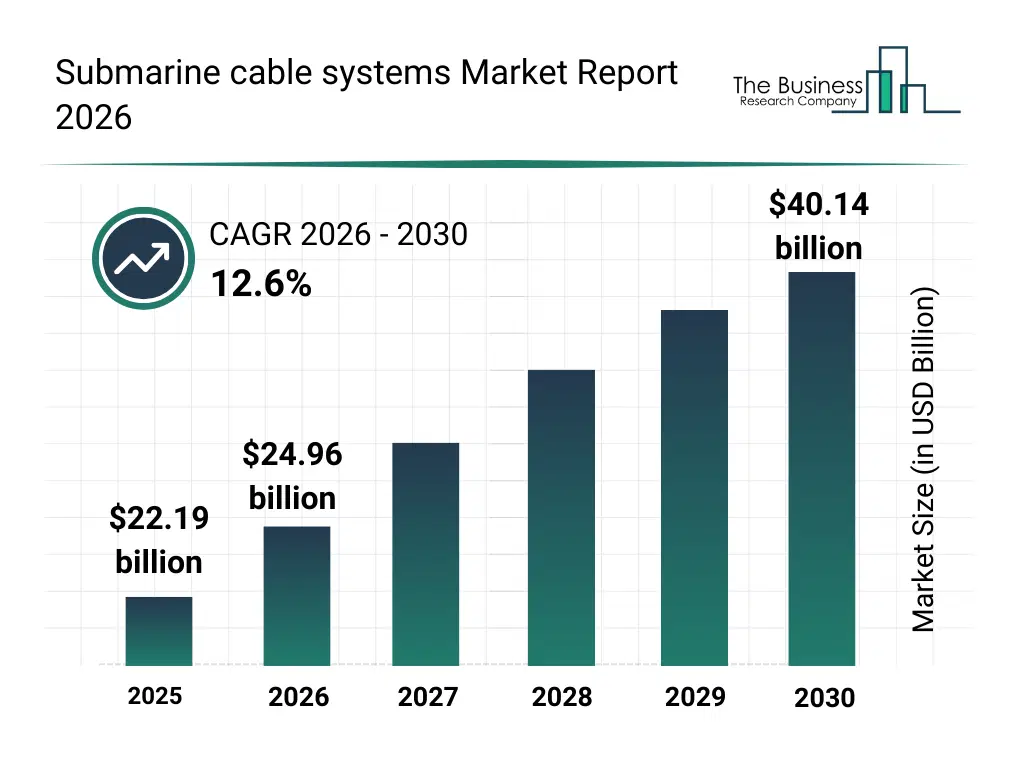
What Is The Submarine cable systems Market Size 2026 And Growth Rate?
The submarine cable systems market size has grown rapidly in recent years. It will grow from $22.19 billion in 2025 to $24.96 billion in 2026 at a compound annual growth rate (CAGR) of 12.5%. The growth in the historic period can be attributed to growth in international telecommunications, rising internet penetration, early expansion of intercontinental cable routes, demand for reliable data connectivity, development of fiber optic technologies.What Is The Submarine cable systems Market Growth Forecast?
The submarine cable systems market size is expected to see rapid growth in the next few years. It will grow to $40.14 billion in 2030 at a compound annual growth rate (CAGR) of 12.6%. The growth in the forecast period can be attributed to surge in data center interconnections, rising offshore wind projects, growth in hyperscale cloud providers, increasing need for resilient communication networks, expansion of digital trade. Major trends in the forecast period include expansion of global data transmission capacity, rising deployment of subsea cables for cloud connectivity, growing demand for cross border high bandwidth infrastructure, increased offshore energy integration requiring power cables, advancements in long distance deep sea cable technologies.
Global Submarine cable systems Market Segmentation
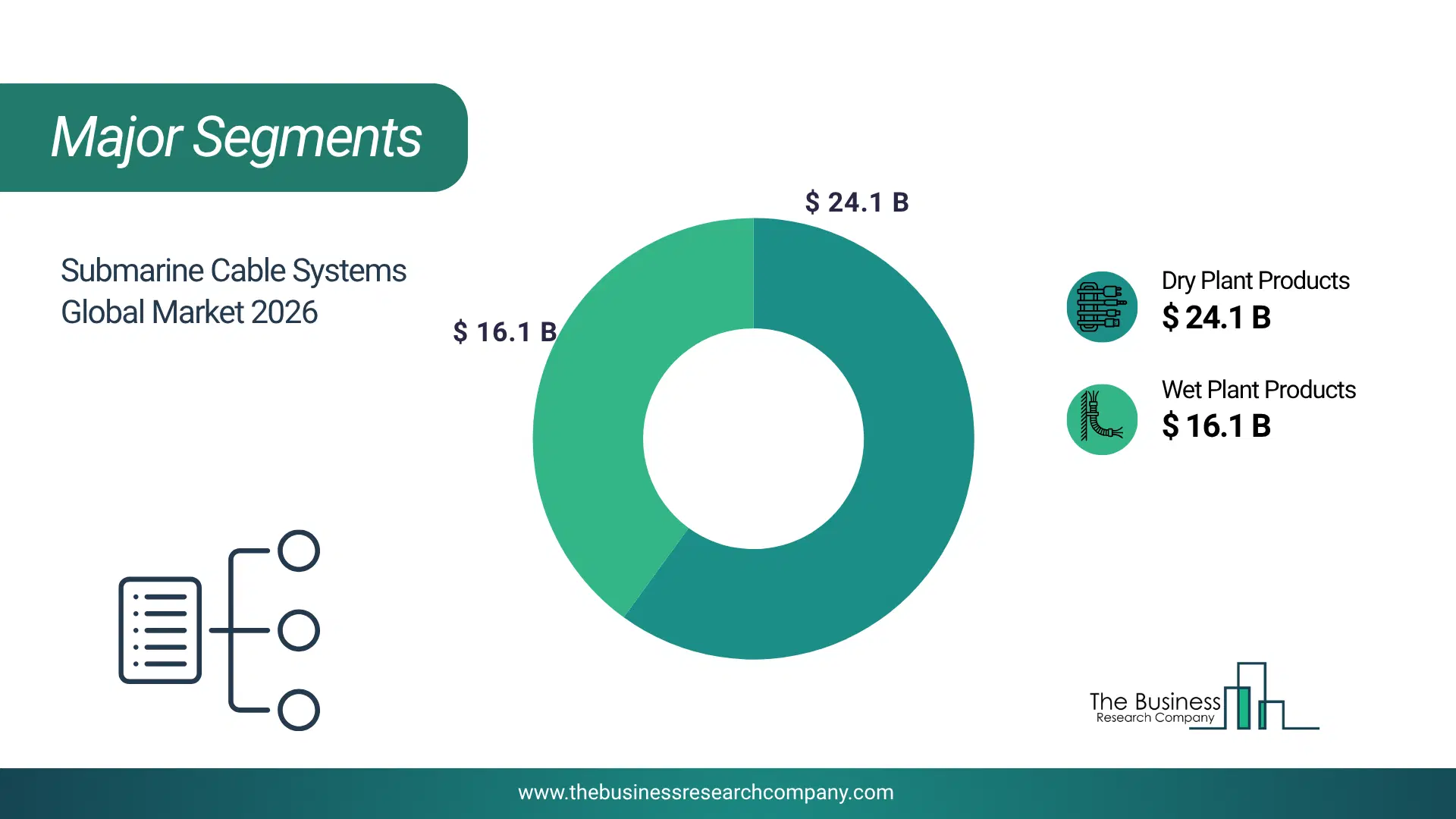
1) By Component: Wet Plant Products, Dry Plant Products 2) By Type: Multicore, Single Core 3) By Voltage: High Voltage, Medium Voltage 4) By Application: Communication Cables, Power Cables 5) By End User: Offshore Wind Power Generation, Inter-Country And Island Connection, Offshore Oil And Gas Subsegments: 1) By Wet Plant Products: Submarine Cables, Repeaters, Cable Joints 2) By Dry Plant Products: Cable Landing Stations, Terminal Equipment, Power Feed Equipment The top segments in the submarine cable systems market will be: • Dry Plant Products will reach $24.06 billion by 2030. • Wet Plant Products will reach $16.08 billion by 2030.What Is The Driver Of The Submarine cable systems Market?
The rising number of telecom and internet subscriptions is significantly contributing to the growth of the submarine cable system market. A submarine cable system that is laid on the seabed helps in carrying the telecommunication signals across various places by using optical fiber technology. There is rapid growth in the telecom and internet subscriptions industries as the utility of smartphones compared to normal desktops has increased rapidly, this drives the telecom and internet subscriptions. For instance, in November 2024, according to a report published by the International Telecommunication Union (ITU), a Switzerland-based specialized UN agency, in 2024 fully 5.5 billion people are online. That represents 68 per cent of the world population, compared with 65 per cent in 2023. The year-on-year growth rate is itself increasing, from 2.7 just one year ago to 3.4 per cent this year. Therefore, the rise in the number of telecom and internet subscriptions is driving the telecom and internet subscriptions market.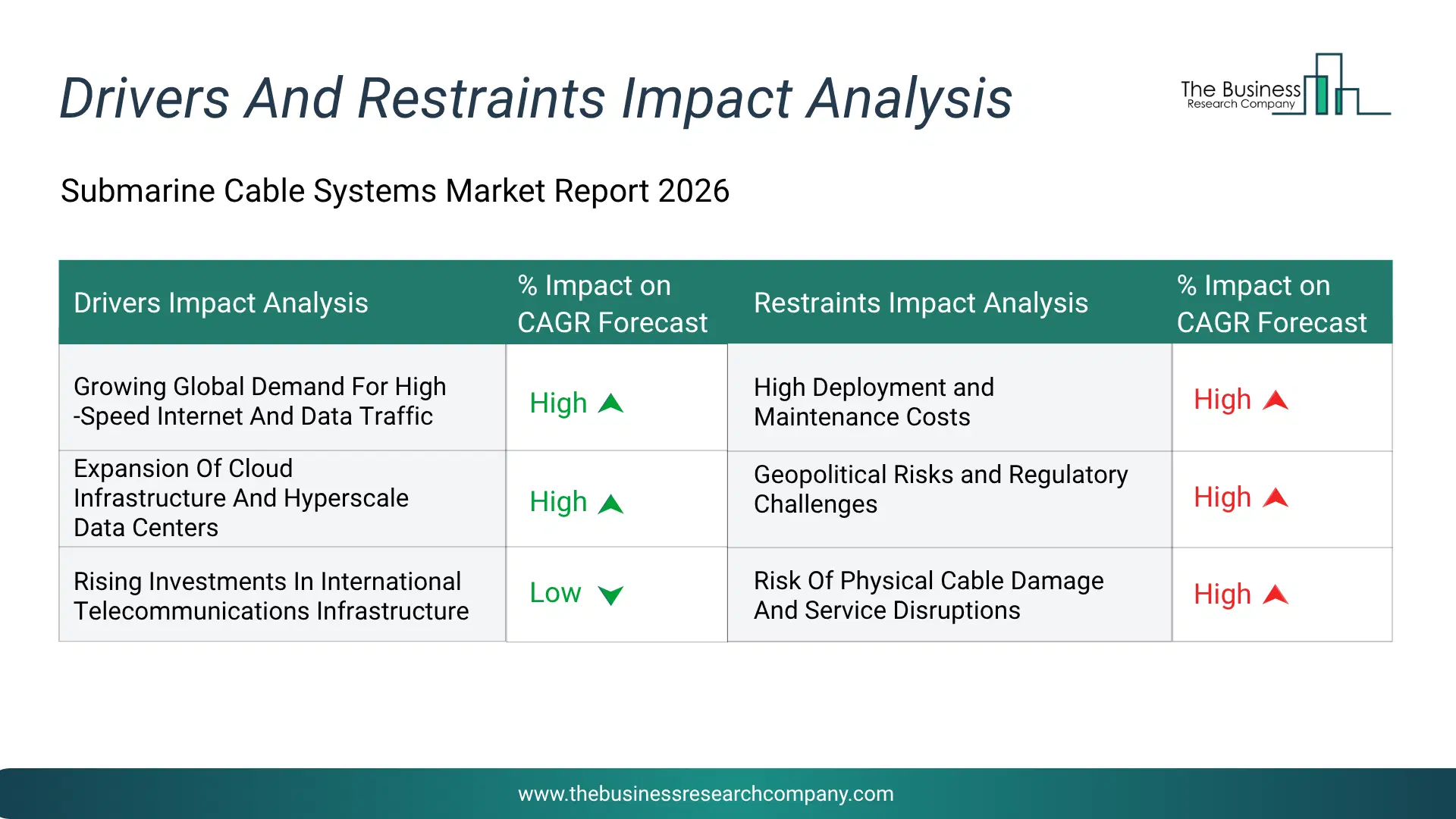
Infographic Chart Showing Key Market Drivers Analysis And Restraints For Submarine Cable Systems Market
The chart presents an impact analysis of key drivers and restraints, quantifying their relative influence on the market's growth rate and helping assess the balance between growth enablers and limiting factors. This chart offers a high-level perspective; the full report contains more detailed insights.
How Will The Drivers Impact Growth In The Global Submarine Cable Systems Market?
• Growing Global Demand For High -Speed Internet And Data Traffic (High) – During the forecast period, the growing global demand for high -speed internet and data traffic is expected to become a key growth driver for the submarine cable systems market by 2030. The rapid growth in global internet usage, cloud computing, video streaming, and digital communication services is significantly increasing demand for high -capacity submarine cable systems. These networks carry more than 95% of international internet traffic, serving as the backbone of global data transmission. As digital economies expand and connectivity needs rise, telecommunications providers and technology companies are investing in advanced fiber -optic submarine cables with higher bandwidth and lower latency, driving market growth. • Expansion Of Cloud Infrastructure And Hyperscale Data Centers (High) – During the forecast period, the expansion of cloud infrastructure and hyperscale data centers is expected to emerge as a major factor driving the expansion of the submarine cable systems market by 2030. Cloud providers require reliable, high-capacity global networks to ensure seamless connectivity between international data centers. As digital services such as artificial intelligence, iot platforms, and enterprise cloud applications expand, many technology companies are investing directly in submarine cable systems to handle rising data traffic and reduce latency. This growing need for intercontinental data connectivity is driving strong demand for submarine cable infrastructure. • Rising Investments In International Telecommunications Infrastructure (Low) – During the forecast period, the rising investments in international telecommunications infrastructure are expected to act as a key growth catalyst for the submarine cable systems market by 2030. Governments and private telecommunications companies are increasing investments in international submarine cable networks to strengthen global connectivity and digital infrastructure. Many countries are prioritizing cross-border communication systems to support economic development, digital transformation, and regional integration. New submarine cable projects are connecting emerging markets with global internet hubs, improving network resilience and reducing reliance on limited routes, while collaborations among telecom operators, technology firms, and infrastructure investors are accelerating global deployment.How Will The Restraints Impact Growth In The Global Submarine Cable Systems Market?
• High Deployment and Maintenance Costs (High) – During the forecast period, the submarine cable system deployment involves substantial capital investment in cable manufacturing, specialized cable-laying vessels, marine surveys, landing stations, and network integration. The installation process is complex and requires advanced engineering expertise and coordination across multiple countries and regulatory jurisdictions. Additionally, repairing submarine cables damaged by natural disasters, fishing activities, or ship anchors can be extremely costly and time-consuming. These high capital and maintenance costs may limit participation from smaller telecom operators and delay certain projects, acting as a restraint on market expansion. • Geopolitical Risks and Regulatory Challenges (High) – During the forecast period, the submarine cable projects often involve international waters and multiple national jurisdictions, making them subject to geopolitical tensions, regulatory approvals, and security concerns. Governments may impose restrictions on cable routes or partnerships due to national security considerations. Delays in permits, environmental clearances, and cross-border coordination can increase project timelines and costs. In addition, geopolitical conflicts may create uncertainty in strategic cable routes connecting key regions. These regulatory and geopolitical complexities act as restraints in the submarine cable systems market. • Risk Of Physical Cable Damage And Service Disruptions (High) – During the forecast period, the submarine cables are vulnerable to damage from fishing activities, ship anchors, natural disasters, and underwater geological events. Repairing damaged cables requires specialized vessels and can take considerable time and resources. Service interruptions may affect international communications and data transmission reliability. These risks increase operational uncertainty and maintenance expenditures for network operators.Key Players In The Global Submarine cable systems Market
Major companies operating in the submarine cable systems market are Sumitomo Electric Industries Ltd., Fujitsu Limited, NEC Corporation, Hengtong Group Co Ltd., TE Connectivity Ltd., Corning Incorporated, Prysmian SpA, Nexans S.A., Leoni Special Cables GmbH, NKT A/S, Apar Industries Ltd., Cablel Group Ltd., Tele-fonika Kable S.A., Hexatronic Cables & Interconnect Systems AB, SubCom LLC, The Okonite Company Inc., LS Cable & System Ltd., ZTT International Ltd., Alcatel Submarine Networks Company, JDR Cable Systems Ltd., Huawei Marine Networks Co Ltd, Xtera Communications Inc., Hesfibel SA, Norddeutsche Seekabelwerke GmbH, Amphenol Fiber Systems International, Elettra Communications Ltd., KokusAI Cable Ship Co Ltd., Global Marine Group Ltd., Orange S.A., PCCW Global Ltd., Aqua Comms Limited, Seaborn Networks LLC, Hawaiki Submarine Cable LP, Southern Cross Cable Network Ltd., MainOne Cable Company Limited, Angola Cables SA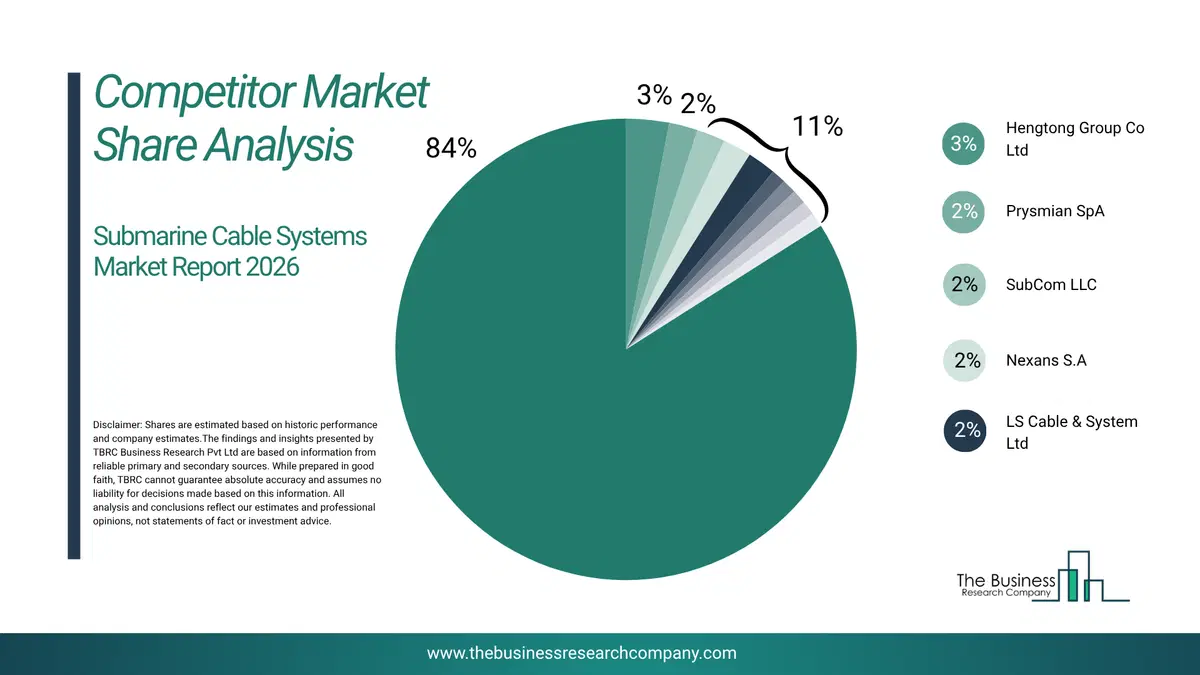
This chart is for illustrative purposes; the full report includes a detailed competitor analysis and comprehensive overview of the top 10 companies in the market.
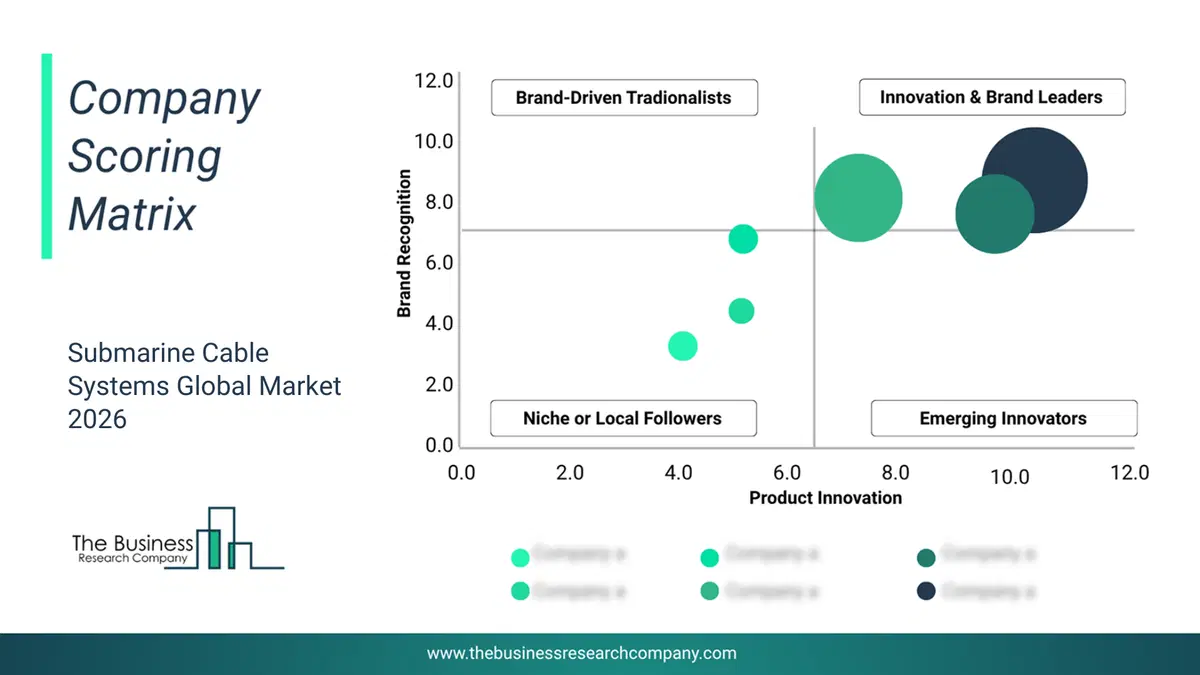
This chart maps companies by product innovation and brand strength, with bubble size indicating relative revenue, helping identify market leaders, challengers, and niche players. This is an illustrative chart; the full report provides a complete and accurate competitive analysis.
Global Submarine cable systems Market Trends and Insights
Major companies operating in the Submarine Cable Systems market are focusing on developing innovative solutions, such as cable systems, to enhance global connectivity, increase data transmission capacity, improve network reliability, and support the growing demand for high-speed internet and cloud-based services across regions. Cable systems refer to interconnected networks of cables designed to transmit electrical power, telecommunications signals, or data between locations. For instance, in September 2024, China Mobile Limited, a China-based telecommunications company, launched the PEACE (Pakistan & East Africa Connecting Europe) subsea cable system, an advanced fiber-optic network connecting Asia, Africa, and Europe. The PEACE cable system spans approximately 21,500 kilometers and features a high-capacity open cable design supporting flexible bandwidth configurations and low-latency routes between Asia and Europe. It enhances regional connectivity, promotes digital economy growth, and strengthens China Mobile’s global infrastructure presence by enabling faster and more resilient international data transmission.What Are Latest Mergers And Acquisitions In The Submarine cable systems Market?
In October 2023, Citaglobal, a Malaysian-based technology and engineering company, acquired a 30% stake in Ifactors Sdn Bhd for $5.544 million USD. The aim of the acquisition is to strengthen Citaglobal's position in the submarine cable systems market and boost its capabilities in renewable energy and telecommunications. Ifactors SDN Bhd is a Malaysia-based submarine cable systems company.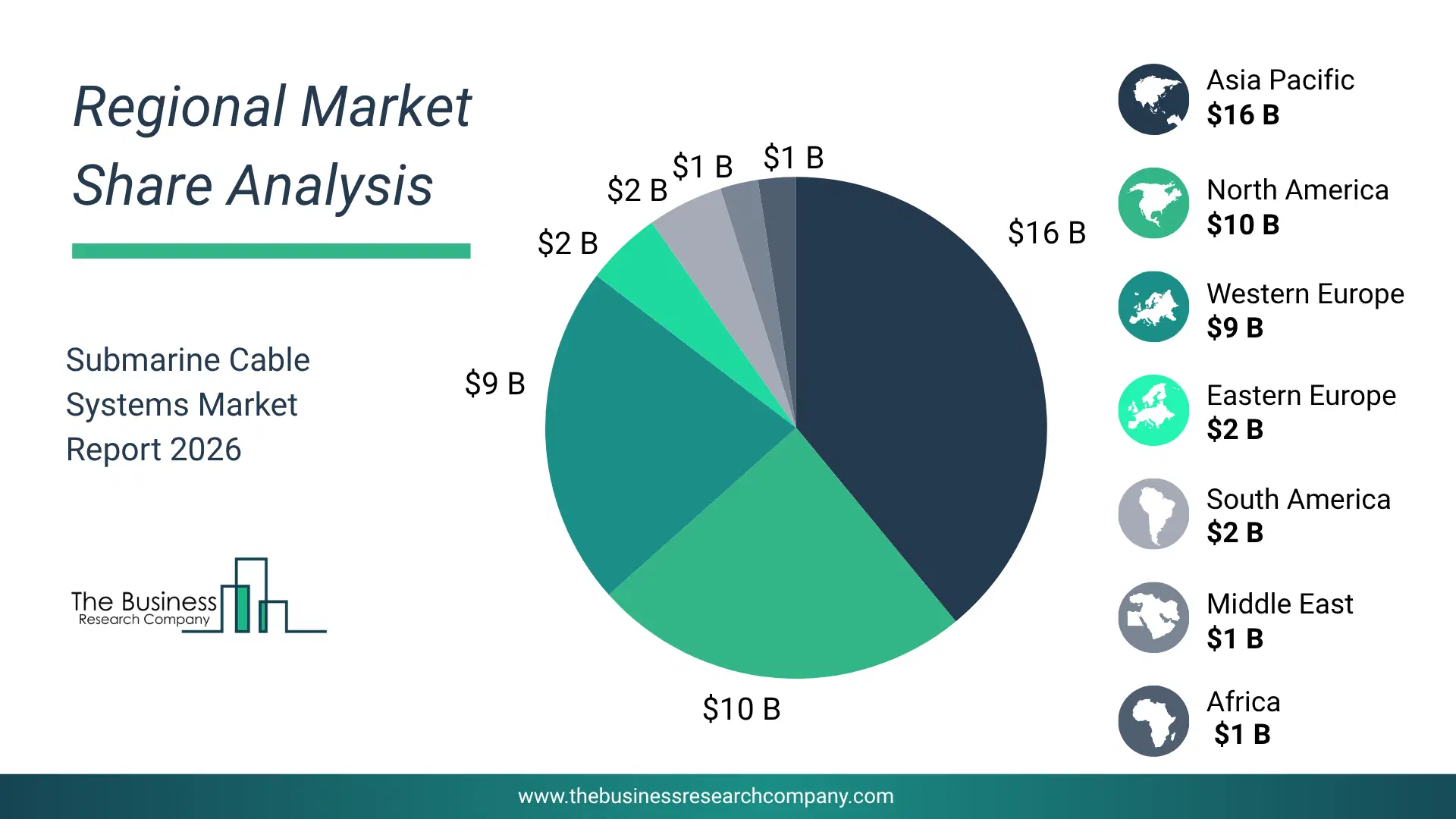
Regional Outlook
Asia-Pacific was the largest region in the submarine cable systems market share in 2025. Asia-Pacific is expected to be the fastest-growing region in the forecast period. The regions covered in this market report are Asia-Pacific, South East Asia, Western Europe, Eastern Europe, North America, South America, Middle East, Africa. The countries covered in this market report are Australia, Brazil, China, France, Germany, India, Indonesia, Japan, Taiwan, Russia, South Korea, UK, USA, Canada, Italy, Spain.What Defines the Submarine cable systems Market?
The submarine cable system market consists of sales of multicore fiber and single-core fiber. Values in this market are ‘factory gate’ values, that is the value of goods sold by the manufacturers or creators of the goods, whether to other entities (including downstream manufacturers, wholesalers, distributors and retailers) or directly to end customers. The value of goods in this market includes related services sold by the creators of the goods.How is Market Value Defined and Measured?
The market value is defined as the revenues that enterprises gain from the sale of goods and/or services within the specified market and geography through sales, grants, or donations in terms of the currency (in USD unless otherwise specified). The revenues for a specified geography are consumption values that are revenues generated by organizations in the specified geography within the market, irrespective of where they are produced. It does not include revenues from resales along the supply chain, either further along the supply chain or as part of other products.
This chart presents market attractiveness based on a quantitative evaluation of growth, competition, strategic alignment, and risk, offering a clear view of opportunity areas for decision-making. This chart is for illustrative purposes; the full report contains the complete analysis.

This chart highlights the Total Addressable Market (TAM) by estimating the maximum revenue opportunity using an assumption-driven approach, supporting strategic planning and opportunity sizing across markets. The chart is illustrative; the full report provides a more comprehensive analysis.
What Key Data and Analysis Are Included in the Submarine cable systems Market Report 2026?
The submarine cable systems market research report is one of a series of new reports from The Business Research Company that provides market statistics, including industry global market size, regional shares, competitors with the market share, detailed market segments, market trends and opportunities, and any further data you may need to thrive in the submarine cable systems industry. The market research report delivers a complete perspective of everything you need, with an in-depth analysis of the current and future state of the industry.Submarine cable systems Market Report 2026 Market Report Forecast Analysis
| Report Attribute | Details |
|---|---|
| Market Size Value In 2026 | $24.96 billion |
| Revenue Forecast In 2030 | $40.14 billion |
| Growth Rate | CAGR of 12.5% from 2026 to 2030 |
| Base Year For Estimation | 2025 |
| Actual Estimates/Historical Data | 2020-2025 |
| Forecast Period | 2026 - 2030 |
| Market Representation | Revenue in USD Billion and CAGR from 2026 to 2030 |
| Segments Covered | Component, Type, Voltage, Application, End User |
| Regional Scope | Asia-Pacific, Western Europe, Eastern Europe, North America, South America, Middle East, Africa |
| Country Scope | The countries covered in the report are Australia, Brazil, China, France, Germany, India, Indonesia, Japan, Taiwan, Russia, South Korea, UK, USA, Canada, Italy, Spain. |
| Key Companies Profiled | Sumitomo Electric Industries Ltd., Fujitsu Limited, NEC Corporation, Hengtong Group Co Ltd., TE Connectivity Ltd., Corning Incorporated, Prysmian SpA, Nexans S.A., Leoni Special Cables GmbH, NKT A/S, Apar Industries Ltd., Cablel Group Ltd., Tele-fonika Kable S.A., Hexatronic Cables & Interconnect Systems AB, SubCom LLC, The Okonite Company Inc., LS Cable & System Ltd., ZTT International Ltd., Alcatel Submarine Networks Company, JDR Cable Systems Ltd., Huawei Marine Networks Co Ltd, Xtera Communications Inc., Hesfibel SA, Norddeutsche Seekabelwerke GmbH, Amphenol Fiber Systems International, Elettra Communications Ltd., KokusAI Cable Ship Co Ltd., Global Marine Group Ltd., Orange S.A., PCCW Global Ltd., Aqua Comms Limited, Seaborn Networks LLC, Hawaiki Submarine Cable LP, Southern Cross Cable Network Ltd., MainOne Cable Company Limited, Angola Cables SA |
| Customization Scope | Request for Customization |
| Pricing And Purchase Options | Explore Purchase Options |