
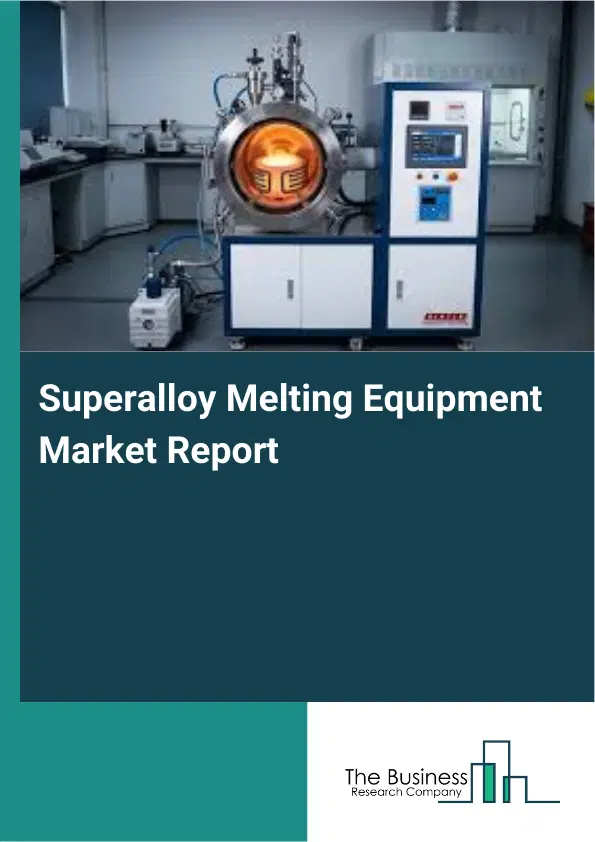
Superalloy Melting Equipment Market Report 2026
Global Outlook – By Type (Induction Melting Equipment, Vacuum Arc Remelting (VAR) Equipment, Vacuum Induction Melting (VIM) Equipment, Electron Beam Melting (EBM) Equipment, Plasma Arc Melting (PAM) Equipment), By Sales Channel (Original Equipment Manufacturer (OEM), Aftermarket), By Application (Commercial, Industrial) – Market Size, Trends, Strategies, and Forecast to 2030
Superalloy Melting Equipment Market Overview
• Superalloy Melting Equipment market size has reached to $1.12 billion in 2025 • Expected to grow to $1.53 billion in 2030 at a compound annual growth rate (CAGR) of 6.4% • Growth Driver: Increasing Aircraft Deliveries Drive Growth In Superalloy Melting Equipment Market • Market Trend: Large-Capacity Vacuum Melting Technologies Advancing High-Purity Superalloy Production • Asia-Pacific was the largest region in 2025.What Is Covered Under Superalloy Melting Equipment Market?
Superalloy melting equipment is a specialized machinery used to melt and process superalloys, which are high-performance materials designed to withstand extreme temperatures, pressures, and corrosive environments. This equipment includes induction furnaces, vacuum arc remelters, and electron beam melters, ensuring precise control over temperature and atmospheric conditions to maintain the integrity and quality of the superalloys. The main types of superalloy melting equipment are benchtop hot-melt equipment and glue guns. Benchtop hot-melt equipment is a compact and efficient device designed to melt and apply adhesive materials at high temperatures. The sales channels are original equipment manufacturer (OEM) and aftermarket, and it is used in various applications, such as commercial and industrial.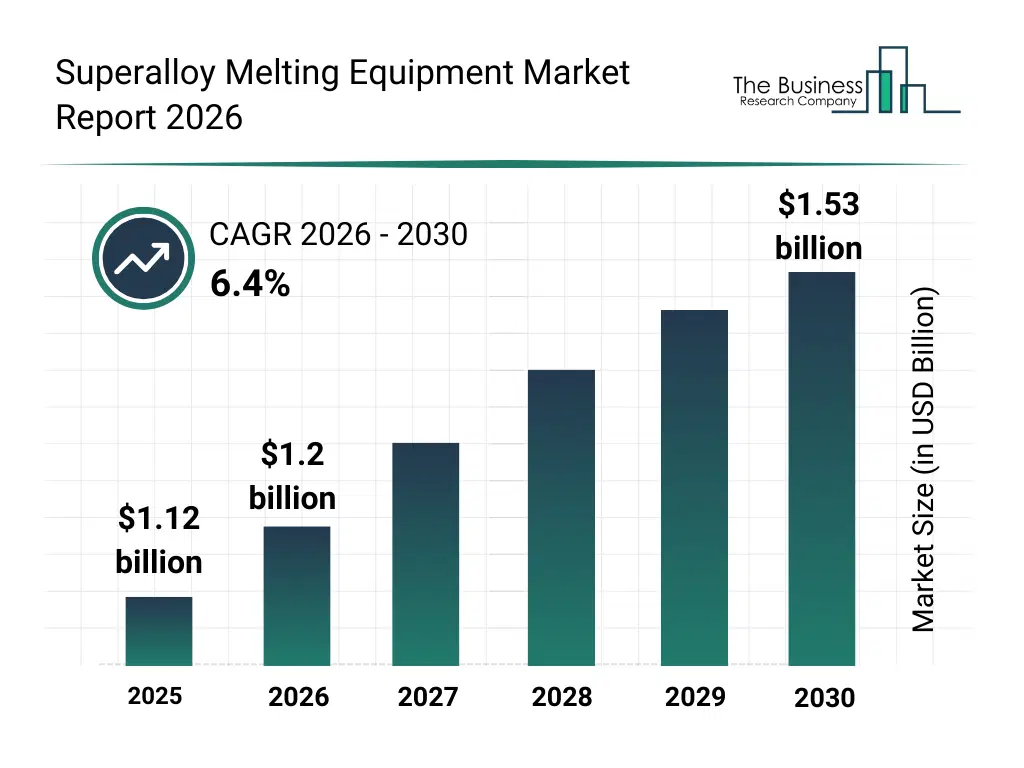
What Is The Superalloy Melting Equipment Market Size and Share 2026?
The superalloy melting equipment market size has grown strongly in recent years. It will grow from $1.12 billion in 2025 to $1.2 billion in 2026 at a compound annual growth rate (CAGR) of 6.7%. The growth in the historic period can be attributed to growth in aerospace materials demand, development of high temperature alloys, defense sector expansion, industrial metallurgical advancements, adoption of vacuum melting techniques.What Is The Superalloy Melting Equipment Market Growth Forecast?
The superalloy melting equipment market size is expected to see strong growth in the next few years. It will grow to $1.53 billion in 2030 at a compound annual growth rate (CAGR) of 6.4%. The growth in the forecast period can be attributed to next generation aircraft production, demand for high performance materials, investment in advanced metallurgy, automation in metal processing, expansion of energy and turbine sectors. Major trends in the forecast period include rising demand from aerospace manufacturing, increasing use of vacuum based melting technologies, growing adoption of precision controlled furnaces, expansion of superalloy production capacity, integration of automation in melting processes.Tariff Impact On Superalloy Melting Equipment Market
Tariffs have influenced the superalloy melting equipment market by increasing costs of furnace components, vacuum systems, and electronic controls. Aerospace and defense sectors are most affected, particularly in Asia Pacific. Capital equipment costs have risen. However, tariffs have supported localized equipment manufacturing.
Global Superalloy Melting Equipment Market Segmentation
1) By Type: Induction Melting Equipment, Vacuum Arc Remelting (VAR) Equipment, Vacuum Induction Melting (VIM) Equipment, Electron Beam Melting (EBM) Equipment, Plasma Arc Melting (PAM) Equipment 2) By Sales Channel: Original Equipment Manufacturer (OEM), Aftermarket 3) By Application: Commercial, Industrial Subsegments: 1) By Induction Melting Equipment: Coreless Induction Furnaces, Channel Induction Furnaces, Atmospheric Induction Melting Systems, Inert Gas Induction Melting Systems 2) By Vacuum Induction Melting (VIM) Equipment: Laboratory-Scale VIM Furnaces, Industrial-Scale VIM Furnaces, Continuous VIM Systems, Multi-Chamber VIM Systems 3) By Vacuum Arc Remelting (VAR) Equipment: Single-Electrode VAR Furnaces, Multi-Electrode VAR Furnaces, Automated VAR Systems, High-Capacity VAR Furnaces 4) By Electron Beam Melting (EBM) Equipment: Single-Gun Electron Beam Furnaces, Multi-Gun Electron Beam Furnaces, Cold Hearth Electron Beam Melting Systems, Drip Melting Electron Beam Furnaces 5) By Plasma Arc Melting (PAM) Equipment: Transferred Arc Plasma Furnaces, Non-Transferred Arc Plasma Furnaces, Multi-Torch Plasma Melting Systems, Inert Atmosphere Plasma FurnacesWhat Are The Drivers Of The Superalloy Melting Equipment Market?
The increasing aircraft deliveries are expected to propel the growth of the superalloy melting equipment market going forward. Aircraft deliveries are increasing due to rising demand for air travel, fleet expansion, and the replacement of older aircraft with newer, more efficient models. Superalloy melting equipment is used in aircraft deliveries to produce high-performance components that can withstand extreme conditions in aerospace applications. For instance, in January 2024, according to Airbus SE, a Netherlands-based aerospace and defense company, it delivered 735 commercial aircraft in 2023, marking an 11% increase compared to the 663 aircraft delivered in 2022. Therefore, the increasing aircraft deliveries are driving the growth of the superalloy melting equipment industry. The expansion of the renewable energy industry is expected to propel the growth of the superalloy melting equipment market going forward. The renewable energy industry encompasses the production, distribution, and utilization of energy derived from natural sources that are replenished on a human timescale, such as solar, wind, hydro, and geothermal power. The expansion of the renewable energy industry is driven by technological advancements that reduce costs and increase global awareness and policies to combat climate change. Superalloy melting equipment is crucial in the renewable energy industry for manufacturing high-performance components in wind turbines and solar power systems, enhancing efficiency and durability. For instance, in January 2024, according to The Energy Information Administration, a US-based government agency, solar capacity operated by the electric power sector increased by 38% from 95 gigawatts (GW) at the end of 2023 to 131 GW by the end of 2024. Therefore, the expansion of the renewable energy industry is driving the superalloy melting equipment industry.Key Players In The Global Superalloy Melting Equipment Market
Major companies operating in the superalloy melting equipment market are ALD Vacuum Technologies GmbH, SMS group GmbH, Inductotherm Group LLC, ABP Induction Systems GmbH, SECO/WARWICK S.A., TAV Vacuum Furnaces S.p.A., ECM Technologies, IPSEN International GmbH, Tenova S.p.A., Fives Group, Danieli Group, Hitachi Industrial Equipment Systems Co., Ltd., OTTO JUNKER GmbH, PVA TePla AG, Electrotherm (India) Limited, Can-Eng Furnaces International Limited, Consarc Engineering, Retech Systems LLC, Harper International, BMI Fours Industriels, EBNER Industrieofenbau GmbH, VACUUMSCHMELZE GmbH
This chart is for illustrative purposes; the full report includes a detailed competitor analysis and comprehensive overview of the top 10 companies in the market.
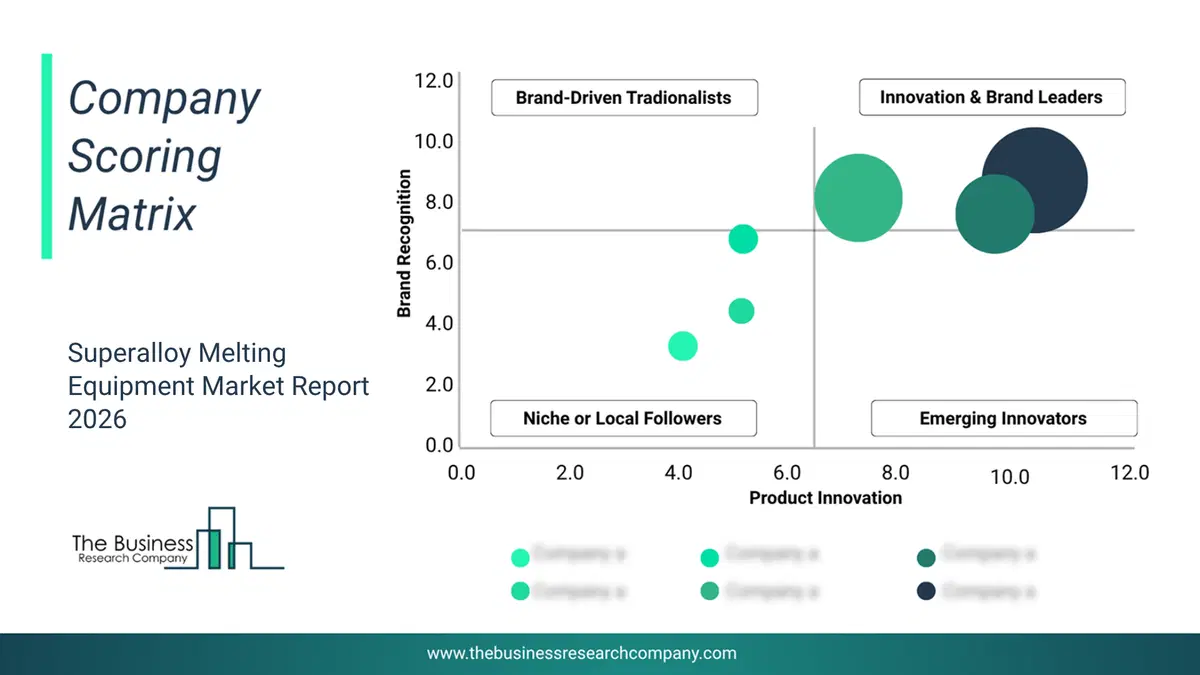
This chart maps companies by product innovation and brand strength, with bubble size indicating relative revenue, helping identify market leaders, challengers, and niche players. This is an illustrative chart; the full report provides a complete and accurate competitive analysis.
Global Superalloy Melting Equipment Market Trends and Insights
Major companies operating in the global superalloy melting equipment market are focusing on developing large-capacity vacuum-induction melting (VIM) systems, such as 20-ton VIM furnaces, to enable high-purity alloy production with consistent chemical composition, reduced contamination, and scalable melt volumes for aerospace and industrial gas turbine applications. A 20-ton VIM furnace is a high-capacity vacuum melting system designed to process large alloy batches under tightly controlled atmospheric and thermal conditions, ensuring uniform melting, degassing, and solidification of nickel- and cobalt-based superalloys. For instance, in April 2024, Ellwood Group, a US-based specialty metals company, introduced plans to install a 20-ton vacuum induction melting furnace at its New Castle, Pennsylvania facility. The system features large melt capacity suitable for industrial-scale superalloy production, a vacuum-controlled melting chamber to minimize oxidation and impurity absorption, and flexibility to process multiple alloy families including carbon steel, stainless steel, and advanced superalloys, supporting the growing demand for high-performance materials in aerospace and energy applications.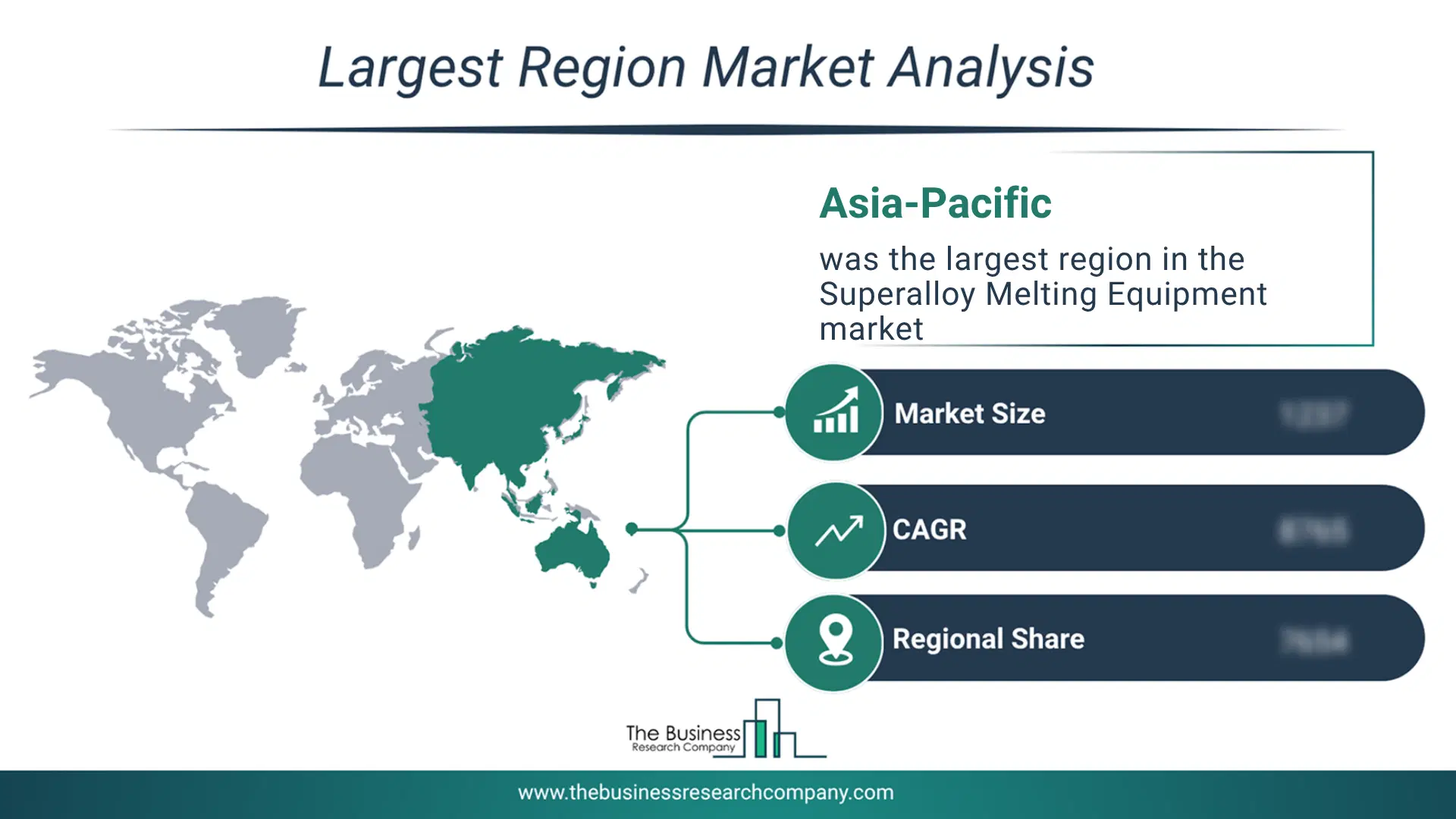
Regional Outlook
Asia-Pacific was the largest region in the superalloy melting equipment market in 2025. The regions covered in this market report are Asia-Pacific, South East Asia, Western Europe, Eastern Europe, North America, South America, Middle East, Africa The countries covered in this market report are Australia, Brazil, China, France, Germany, India, Indonesia, Japan, Taiwan, Russia, South Korea, UK, USA, Canada, Italy, Spain.What Defines the Superalloy Melting Equipment Market?
The superalloy melting equipment market consists of sales of induction furnaces, vacuum induction melting (VIM) furnaces, vacuum arc melters (VAR), electroslag melting (ESR) furnaces, electron beam melters, and plasma arc melters. Values in this market are ‘factory gate’ values, that is, the value of goods sold by the manufacturers or creators of the goods, whether to other entities (including downstream manufacturers, wholesalers, distributors, and retailers) or directly to end customers. The value of goods in this market includes related services sold by the creators of the goods.How is Market Value Defined and Measured?
The market value is defined as the revenues that enterprises gain from the sale of goods and/or services within the specified market and geography through sales, grants, or donations in terms of the currency (in USD unless otherwise specified). The revenues for a specified geography are consumption values that are revenues generated by organizations in the specified geography within the market, irrespective of where they are produced. It does not include revenues from resales along the supply chain, either further along the supply chain or as part of other products.
This chart presents market attractiveness based on a quantitative evaluation of growth, competition, strategic alignment, and risk, offering a clear view of opportunity areas for decision-making. This chart is for illustrative purposes; the full report contains the complete analysis.

This chart highlights the Total Addressable Market (TAM) by estimating the maximum revenue opportunity using an assumption-driven approach, supporting strategic planning and opportunity sizing across markets. The chart is illustrative; the full report provides a more comprehensive analysis.
What Key Data and Analysis Are Included in the Superalloy Melting Equipment Market Report 2026?
The superalloy melting equipment market research report is one of a series of new reports from The Business Research Company that provides market statistics, including industry global market size, regional shares, competitors with the market share, detailed market segments, market trends and opportunities, and any further data you may need to thrive in the superalloy melting equipment industry. The market research report delivers a complete perspective of everything you need, with an in-depth analysis of the current and future state of the industry.Superalloy Melting Equipment Market Report Forecast Analysis
| Report Attribute | Details |
|---|---|
| Market Size Value In 2026 | $1.2 billion |
| Revenue Forecast In 2030 | $1.53 billion |
| Growth Rate | CAGR of 6.4% from 2026 to 2030 |
| Base Year For Estimation | 2025 |
| Actual Estimates/Historical Data | 2020-2025 |
| Forecast Period | 2026 - 2030 |
| Market Representation | Revenue in USD Billion and CAGR from 2026 to 2030 |
| Segments Covered | Type, Sales Channel, Application |
| Regional Scope | Asia-Pacific, Western Europe, Eastern Europe, North America, South America, Middle East, Africa |
| Key Companies Profiled | ALD Vacuum Technologies GmbH, SMS group GmbH, Inductotherm Group LLC, ABP Induction Systems GmbH, SECO/WARWICK S.A., TAV Vacuum Furnaces S.p.A., ECM Technologies, IPSEN International GmbH, Tenova S.p.A., Fives Group, Danieli Group, Hitachi Industrial Equipment Systems Co., Ltd., OTTO JUNKER GmbH, PVA TePla AG, Electrotherm (India) Limited, Can-Eng Furnaces International Limited, Consarc Engineering, Retech Systems LLC, Harper International, BMI Fours Industriels, EBNER Industrieofenbau GmbH, VACUUMSCHMELZE GmbH |
| Customization Scope | Request for Customization |
| Pricing And Purchase Options | Explore Purchase Options |