
Superconducting Quantum Computing Market Report 2026
Global Outlook – By Component (Qubits, Control Systems, Cryogenic Systems, Software, Services), By Deployment (On-Premises, Cloud-Based, Hybrid), By Application (Quantum Simulation, Quantum Optimization, Quantum Machine Learning, Other Applications), By End User (Banking Financial Services And Insurance, Healthcare, Information Technology And Telecommunications, Government, Aerospace And Defense, Research Institutes, Other End Users) – Market Size, Trends, Strategies, and Forecast to 2030
Superconducting Quantum Computing Market Overview
• Superconducting Quantum Computing market size has reached to $1.83 billion in 2025 • Expected to grow to $6.57 billion in 2030 at a compound annual growth rate (CAGR) of 29% • Growth Driver: Rising Quantum Research And Development Investments Driving Market Growth Through Superconducting Technology Advancements • Market Trend: Increasing Adoption Of Quantum Computing-As-A-Service Platforms To Enhance Accessibility, Scalability, And Industry Adoption Of Superconducting Quantum Computing Systems • North America was the largest region in 2025 and Asia-Pacific is the fastest growing region.What Is Covered Under Superconducting Quantum Computing Market?
Superconducting quantum computing is a type of quantum computing that uses superconducting electrical circuits, typically made from materials operating at extremely low temperatures, to create and control quantum bits (qubits). These qubits leverage quantum phenomena such as superposition and entanglement to perform complex computations that can outperform classical computers for specific applications. The main components of superconducting quantum computing include qubits, control systems, cryogenic systems, software, and services. Qubits refer to quantum computing units that can represent and process quantum information using superconducting circuits maintained at extremely low temperatures. These systems are deployed through On-Premises, Cloud-Based, and hybrid models. The key applications include quantum simulation, quantum optimization, quantum machine learning, and others, while the end-users include banking, financial services, and insurance, healthcare, information technology and telecommunications, government, aerospace and defense, research institutes, and others.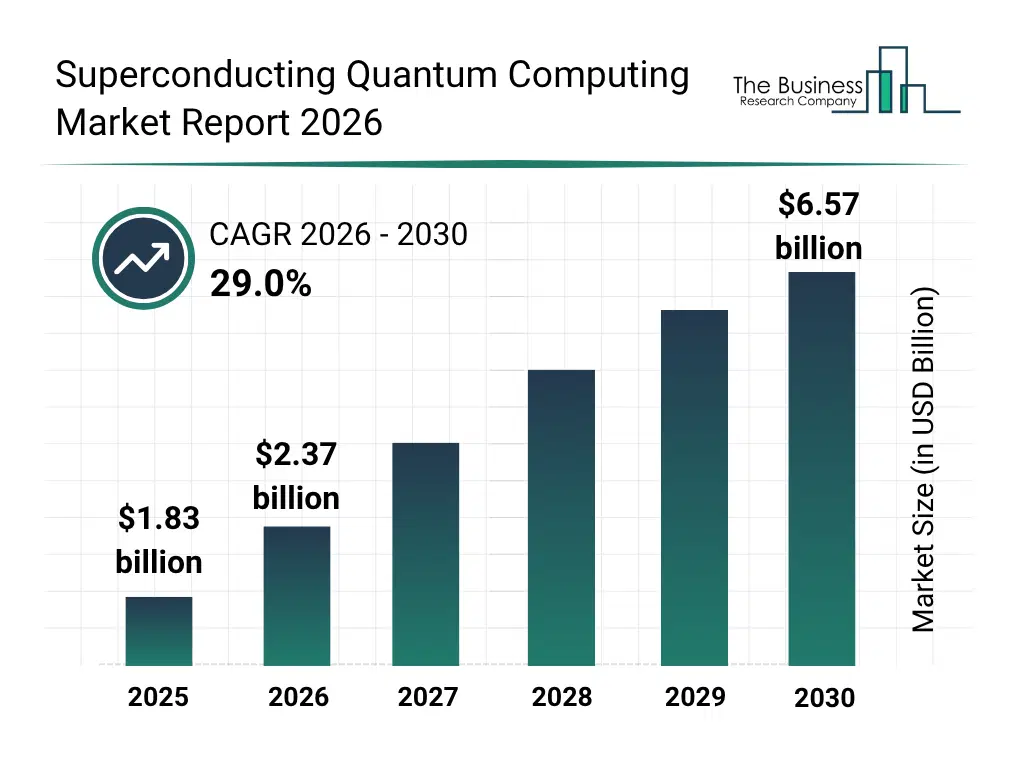
What Is The Superconducting Quantum Computing Market Size and Share 2026?
The superconducting quantum computing market size has grown exponentially in recent years. It will grow from $1.83 billion in 2025 to $2.37 billion in 2026 at a compound annual growth rate (CAGR) of 29.4%. The growth in the historic period can be attributed to increasing investment in superconducting quantum computing research, growing development of Josephson junction qubits, rising adoption of cryogenic quantum computing infrastructure, increasing government funding for quantum technology programs, growing demand for high-performance quantum processors.What Is The Superconducting Quantum Computing Market Growth Forecast?
The superconducting quantum computing market size is expected to see exponential growth in the next few years. It will grow to $6.57 billion in 2030 at a compound annual growth rate (CAGR) of 29.0%. The growth in the forecast period can be attributed to increasing development of fault-tolerant superconducting quantum computers, rising adoption of quantum error correction architectures, growing demand for scalable qubit fabrication technologies, increasing integration of advanced quantum control systems, expanding commercial deployment of superconducting quantum computing platforms. Major trends in the forecast period include advances in superconducting qubit architectures, increasing adoption of dilution refrigerator systems, growing development of quantum error correction techniques, rising investment in quantum processor scaling, increasing optimization of quantum control and readout systems.
Global Superconducting Quantum Computing Market Segmentation
1) By Component: Qubits, Control Systems, Cryogenic Systems, Software, Services 2) By Deployment: On-Premises, Cloud-Based, Hybrid 3) By Application: Quantum Simulation, Quantum Optimization, Quantum Machine Learning, Other Applications 4) By End User: Banking Financial Services And Insurance, Healthcare, Information Technology And Telecommunications, Government, Aerospace And Defense, Research Institutes, Other End Users Subsegments: 1) By Qubits: Transmon Qubits, Flux Qubits, Phase Qubits, Charge Qubits, Xmon Qubits, Tunable Coupler Qubits, Topological Qubits, Hybrid Superconducting Qubits 2) By Control Systems: Quantum Control Electronics, Microwave Signal Generators, Pulse Generation Systems, Readout And Measurement Systems, Synchronization And Timing Systems, Feedback And Error Correction Controllers, Quantum Processing Unit Control Systems, Integrated Control Platforms 3) By Cryogenic Systems: Dilution Refrigerators, Cryogenic Cooling Units, Cryogenic Wiring And Interconnects, Vacuum Chambers, Thermal Shielding Systems, Cryogenic Amplifiers, Cryogenic Filters, Cryogenic Monitoring Systems 4) By Software: Quantum Programming Software, Quantum Development Kits, Quantum Compiler Software, Quantum Simulation Software, Quantum Error Correction Software, Quantum Resource Management Software, Quantum Cloud Computing Platforms, Application Programming Interface Software 5) By Services: Quantum Computing As A Service, Consulting Services, System Integration Services, Maintenance And Support Services, Training And Education Services, Research And Development Services, Cloud Access Services, Managed Quantum Computing ServicesWhat Is The Driver Of The Superconducting Quantum Computing Market?
The rising investments in quantum research and development are expected to propel the growth of the superconducting quantum computing market going forward. Quantum research and development refers to the systematic study, design, and advancement of quantum technologies, including quantum computing, quantum communication, quantum sensing, and quantum materials, to develop innovative solutions based on quantum mechanical principles. Rising investments in quantum research and development are primarily driven by increasing government funding initiatives to accelerate quantum technology innovation and commercialization. Investments in quantum research and development accelerate advancements in superconducting qubit technologies, error correction methods, and scalable quantum architectures, supporting the growth of superconducting quantum computing. For instance, in October 2025, according to the Private Equity Council (USPEC), a US-based professional body, venture funding in quantum computing reached more than $1.25 billion in Q1 2025, marking a 128% increase compared to Q1 2024. Therefore, the rising investments in quantum research and development are driving the growth of the superconducting quantum computing industry.Key Players In The Global Superconducting Quantum Computing Market
Major companies operating in the superconducting quantum computing market are Google LLC, IBM Corporation, Intel Corporation, Fujitsu Limited, NEC Corporation, Amazon.com Inc., Microsoft Corporation, Keysight Technologies Inc., D-Wave Quantum Inc., Bluefors Oy, Rigetti Computing Inc., FormFactor Inc., Zurich Instruments AG, IQM Finland Oy, Oxford Quantum Circuits Ltd., SEEQC Inc., Anyon Systems Inc., Quantum Machines Technologies Ltd., QuantWare B.V., SpinQ Technology Inc., Nord Quantique Inc., Bleximo Corporation, Qilimanjaro Quantum Tech S.L.
This chart is for illustrative purposes; the full report includes a detailed competitor analysis and comprehensive overview of the top 10 companies in the market.
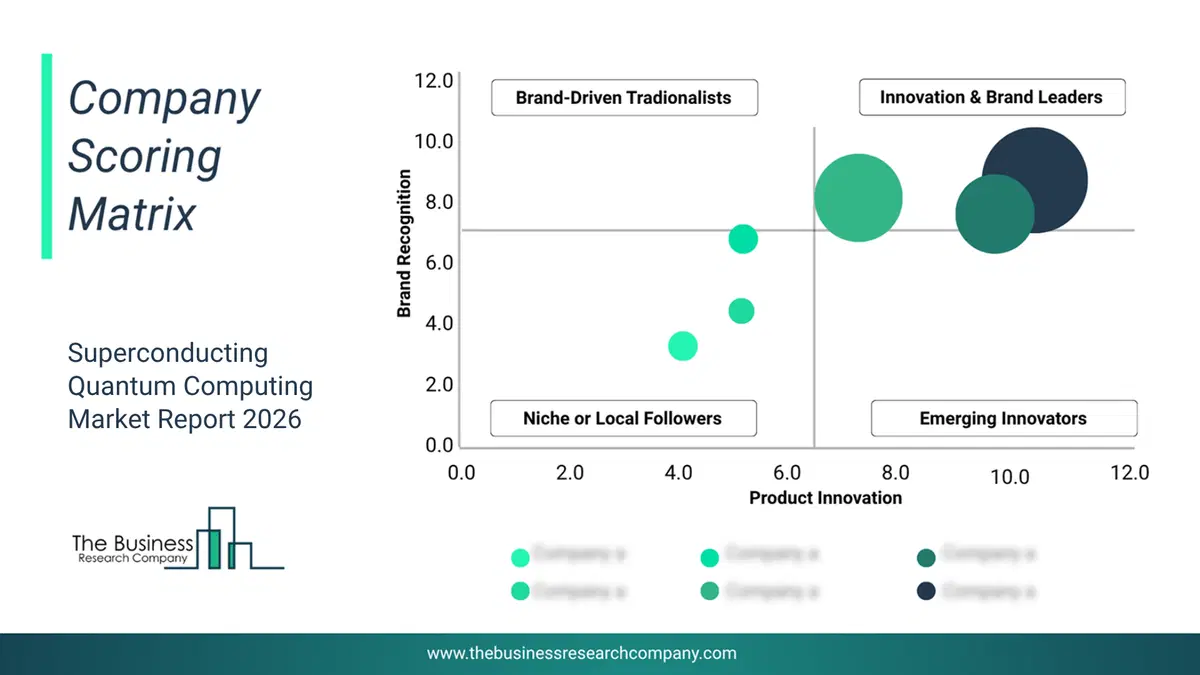
This chart maps companies by product innovation and brand strength, with bubble size indicating relative revenue, helping identify market leaders, challengers, and niche players. This is an illustrative chart; the full report provides a complete and accurate competitive analysis.
Global Superconducting Quantum Computing Market Trends and Insights
Major companies operating in the superconducting quantum computing market are focusing on developing innovative solutions, such as Quantum computing-as-a-Service, to enhance accessibility, scalability, computational efficiency, and industry adoption of superconducting quantum systems. Quantum computing-as-a-Service (QCaaS) is a cloud-based service model that provides users with remote access to quantum computing resources, including quantum processors, software tools, and development environments, without requiring them to own or maintain quantum hardware. For instance, in July 2026, Logical Qubit Technology Co Ltd, a China-based quantum computing technology company, launched its Quantum Cloud Platform for superconducting quantum computing, an innovative cloud-based quantum computing solution designed to provide access to superconducting quantum hardware and research capabilities. The platform integrates logical qubit technology’s AGate quantum chips, including 30-qubit and 100-qubit superconducting quantum systems, enabling researchers and enterprises to remotely perform quantum computations. It supports physical qubit operations, logical qubit research, and pulse-level control capabilities for advanced quantum experiments. The platform provides high-fidelity quantum gate operations, including single-qubit and two-qubit gate execution, to improve computation accuracy and reliability. It enables applications across sectors such as biomedicine, chemistry, materials science, energy, artificial intelligence, finance, and logistics by reducing barriers to quantum technology adoption.What Are Latest Mergers And Acquisitions In The Superconducting Quantum Computing Market?
In October 2025, Google LLC, a US-based technology company, acquired Atlantic Quantum for an undisclosed amount. With this acquisition, Google aims to strengthen its superconducting quantum computing capabilities by integrating Atlantic Quantum’s advanced qubit architecture and research expertise to accelerate the development of scalable, fault-tolerant quantum systems. Atlantic Quantum Corp is a US-based quantum computing company developing advanced superconducting qubit technologies and scalable quantum processors.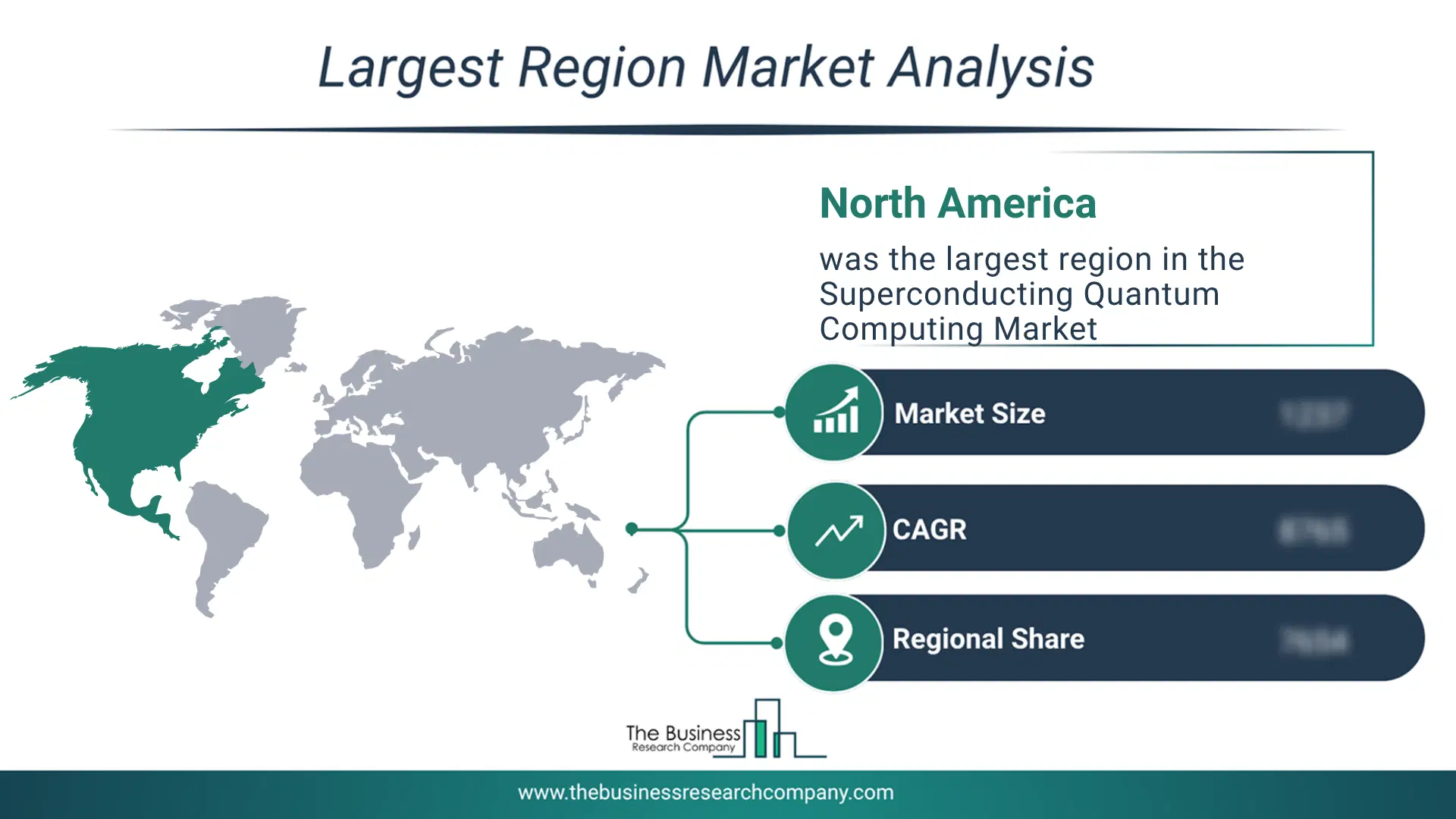
Regional Outlook
North America was the largest region in the superconducting quantum computing market in 2025. Asia-Pacific is expected to be the fastest-growing region in the forecast period. The regions covered in this market report are Asia-Pacific, South East Asia, Western Europe, Eastern Europe, North America, South America, Middle East, Africa. The countries covered in this market report are Australia, Brazil, China, France, Germany, India, Indonesia, Japan, Taiwan, Russia, South Korea, UK, USA, Canada, Italy, Spain.What Defines the Superconducting Quantum Computing Market?
The superconducting quantum computing market consists of revenues earned by entities by providing services such as quantum computing as a service, quantum software development and integration, quantum algorithm development, and quantum research and consulting services. The market value includes the value of related goods sold by the service provider or included within the service offering. The superconducting quantum computing market also includes sales of superconducting quantum processors, superconducting qubit chips, cryogenic refrigeration systems, and quantum control electronics. Values in this market are ‘factory gate’ values, that is the value of goods sold by the manufacturers or creators of the goods, whether to other entities (including downstream manufacturers, wholesalers, distributors and retailers) or directly to end customers. The value of goods in this market includes related services sold by the creators of the goods.How is Market Value Defined and Measured?
The market value is defined as the revenues that enterprises gain from the sale of goods and/or services within the specified market and geography through sales, grants, or donations in terms of the currency (in USD unless otherwise specified). The revenues for a specified geography are consumption values that are revenues generated by organizations in the specified geography within the market, irrespective of where they are produced. It does not include revenues from resales along the supply chain, either further along the supply chain or as part of other products.
This chart presents market attractiveness based on a quantitative evaluation of growth, competition, strategic alignment, and risk, offering a clear view of opportunity areas for decision-making. This chart is for illustrative purposes; the full report contains the complete analysis.

This chart highlights the Total Addressable Market (TAM) by estimating the maximum revenue opportunity using an assumption-driven approach, supporting strategic planning and opportunity sizing across markets. The chart is illustrative; the full report provides a more comprehensive analysis.
What Key Data and Analysis Are Included in the Superconducting Quantum Computing Market Report 2026?
The superconducting quantum computing market research report is one of a series of new reports from The Business Research Company that provides market statistics, including industry global market size, regional shares, competitors with the market share, detailed market segments, market trends and opportunities, and any further data you may need to thrive in the superconducting quantum computing industry. The market research report delivers a complete perspective of everything you need, with an in-depth analysis of the current and future state of the industry.Superconducting Quantum Computing Market Report Forecast Analysis
| Report Attribute | Details |
|---|---|
| Market Size Value In 2026 | $2.37 billion |
| Revenue Forecast In 2030 | $6.57 billion |
| Growth Rate | CAGR of 29.0% from 2026 to 2030 |
| Base Year For Estimation | 2025 |
| Actual Estimates/Historical Data | 2020-2025 |
| Forecast Period | 2026 - 2030 |
| Market Representation | Revenue in USD Billion and CAGR from 2026 to 2030 |
| Segments Covered | Component, Deployment, Application, End User |
| Regional Scope | Asia-Pacific, Western Europe, Eastern Europe, North America, South America, Middle East, Africa |
| Country Scope | The countries covered in the report are Australia, Brazil, China, France, Germany, India, Indonesia, Japan, Taiwan, Russia, South Korea, UK, USA, Canada, Italy, Spain. |
| Key Companies Profiled | Google LLC, IBM Corporation, Intel Corporation, Fujitsu Limited, NEC Corporation, Amazon.com Inc., Microsoft Corporation, Keysight Technologies Inc., D-Wave Quantum Inc., Bluefors Oy, Rigetti Computing Inc., FormFactor Inc., Zurich Instruments AG, IQM Finland Oy, Oxford Quantum Circuits Ltd., SEEQC Inc., Anyon Systems Inc., Quantum Machines Technologies Ltd., QuantWare B.V., SpinQ Technology Inc., Nord Quantique Inc., Bleximo Corporation, Qilimanjaro Quantum Tech S.L. |
| Customization Scope | Request for Customization |
| Pricing And Purchase Options | Explore Purchase Options |