

Supermirrors Market Report 2026
Global Outlook – By Type (Dielectric Supermirrors, Metallic Supermirrors, Hybrid Coated Supermirrors), By Material (Glass Substrate, Fused Silica, Silicon), By Application (Aerospace And Defense, Optics And Photonics, Industrial Manufacturing, Medical Technology, Research And Development), By End-User Industry (Automotive, Electronics, Healthcare, Energy And Power, Consumer Goods) – Market Size, Trends, Strategies, and Forecast to 2030
Supermirrors Market Overview
• Supermirrors market size has reached to $12.26 billion in 2025 • Expected to grow to $18.22 billion in 2030 at a compound annual growth rate (CAGR) of 8.3% • Growth Driver: The Rising Adoption Of Quantum Technologies Is Driving Market Growth Due To Demand For Precision-Enabling Components • North America was the largest region in 2025 and Asia-Pacific is the fastest growing region.What Is Covered Under Supermirrors Market?
Supermirrors are advanced multilayer reflective optical components engineered to achieve reflectivity beyond the limits of conventional single-layer mirrors. They are typically fabricated by depositing alternating thin films of materials with different refractive indices to enhance reflection across a wider range of angles or wavelengths. These components efficiently guide, reflect, or manipulate high-energy or low-intensity beams with minimal loss. The main types of supermirrors include dielectric supermirrors, metallic supermirrors, and hybrid coated supermirrors. Dielectric supermirrors refer to high-reflectivity optical mirrors composed of multiple alternating dielectric thin-film layers designed to achieve extremely low optical loss across specific wavelength ranges. The supermirrors are manufactured using materials such as glass substrate, fused silica, and silicon, selected based on optical performance and thermal stability requirements. The various applications involved are aerospace and defense, optics and photonics, industrial manufacturing, medical technology, and research and development. The end-user industries utilizing supermirrors include automotive, electronics, healthcare, energy and power, and consumer goods.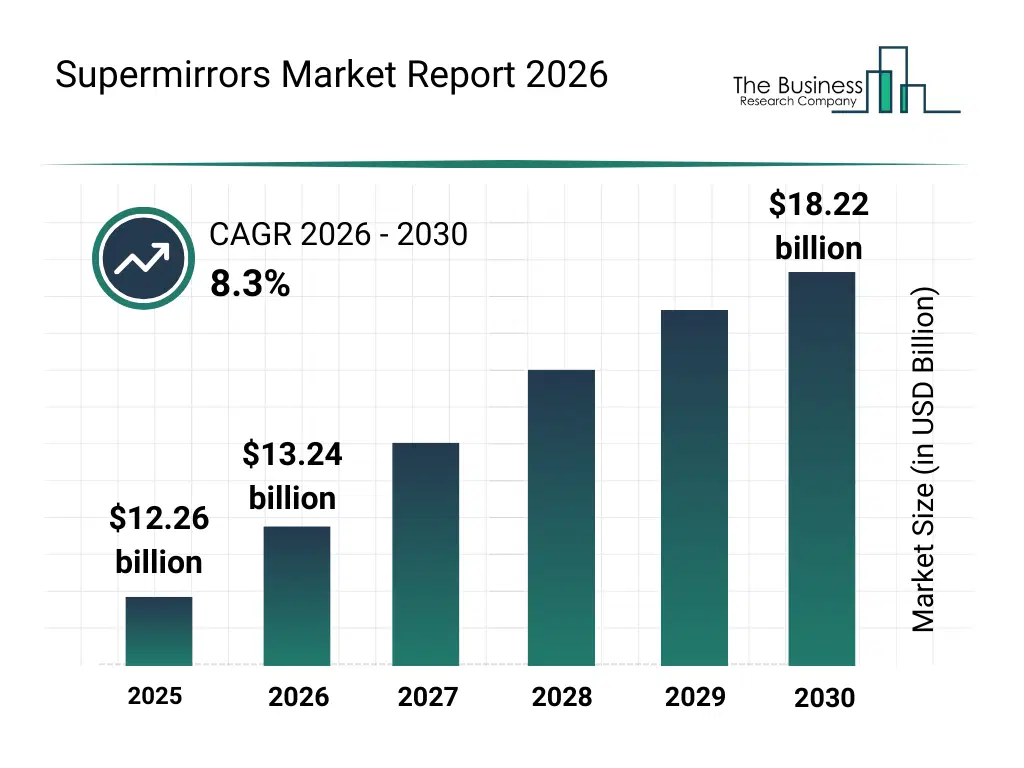
What Is The Supermirrors Market Size and Share 2026?
The supermirrors market size has grown strongly in recent years. It will grow from $12.26 billion in 2025 to $13.24 billion in 2026 at a compound annual growth rate (CAGR) of 8.1%. The growth in the historic period can be attributed to growth in scientific research funding, expansion of aerospace and defense optics demand, increase in semiconductor manufacturing equipment, rising laser technology adoption, development of advanced photonics laboratories.What Is The Supermirrors Market Growth Forecast?
The supermirrors market size is expected to see strong growth in the next few years. It will grow to $18.22 billion in 2030 at a compound annual growth rate (CAGR) of 8.3%. The growth in the forecast period can be attributed to expansion of quantum computing research, increasing demand for medical imaging precision optics, growth in space exploration missions, rising investments in high energy physics facilities, development of next generation laser systems. Major trends in the forecast period include expansion of multilayer thin film coating technologies, growing demand for high reflectivity optical components, miniaturization of precision optical assemblies, increasing adoption in neutron and laser beam applications, advancements in hybrid coating deposition techniques.
Global Supermirrors Market Segmentation
1) By Type: Dielectric Supermirrors, Metallic Supermirrors, Hybrid Coated Supermirrors 2) By Material: Glass Substrate, Fused Silica, Silicon 3) By Application: Aerospace And Defense, Optics And Photonics, Industrial Manufacturing, Medical Technology, Research And Development 4) By End-User Industry: Automotive, Electronics, Healthcare, Energy And Power, Consumer Goods Subsegments: 1) By Dielectric Supermirrors: Multilayer Dielectric Stacks, Non-Polarizing Dielectric Mirrors, Ultra-Low Loss Coatings, High Laser-Induced Damage Threshold Coatings, Broadband Dielectric Coatings 2) By Metallic Supermirrors: Enhanced Aluminum Coatings, Protected Silver Coatings, Enhanced Gold Coatings, Ultra-High Reflection Metallic Coatings 3) By Hybrid Coated Supermirrors: Dielectric-Metallic Multilayer Stacks, Metal Oxide Enhanced Coatings, Ion Beam Sputtered Hybrid Coatings, Plasma-Assisted Hybrid DepositionsWhat Are The Drivers Of The Supermirrors Market?
The rising adoption of quantum technologies is expected to drive the growth in the supermirrors market going forward. Quantum technologies refer to a class of advanced technologies that exploit fundamental principles of quantum mechanics to enable capabilities in computation, communication, sensing, and measurement that are fundamentally unattainable with classical systems. The rising adoption of quantum technologies is primarily driven by their ability to solve complex problems with precision beyond classical limits, making them highly valuable for applications where conventional technologies face physical or computational constraints. Supermirrors play a positive enabling role in the adoption of quantum technologies by providing highly efficient control and reflection of quantum particles, particularly neutrons and photons, which enhances experimental accuracy, system stability, and overall performance in quantum research and quantum-enabled devices. For instance, in June 2025, according to the Department for Science, Innovation & Technology, a UK-based government department, global employment in the quantum computing sector is projected to expand significantly, reaching approximately 250,000 new jobs by 2030 and 840,000 by 2035, with a substantial share driven by leading quantum nations such as the United States and the United Kingdom. Therefore, the rising adoption of quantum technologies is driving the growth of the supermirrors industry. The expansion of scientific research infrastructure is expected to propel the growth of the supermirrors market going forward. Scientific research infrastructure refers to the physical facilities, equipment, and specialized spaces where research and development activities are conducted. The increasing investment in research infrastructure is driven by growing demand for advanced scientific capabilities in fields such as particle physics, astronomy, and precision optics, requiring larger and more sophisticated laboratory spaces to accommodate cutting-edge experimental equipment. Expanding research facilities directly increases demand for high-performance optical components like supermirrors, which are essential for precision instruments in particle accelerators, gravitational wave detectors, optical atomic clocks, and high-energy physics experiments. For instance, in December 2024, according to the National Center for Science and Engineering Statistics (NCSES), a US-based government statistical agency within the National Science Foundation, academic institutions broke ground on 5.5 million net assignable square feet of new science and engineering research space construction projects in fiscal years 2022-23. Therefore, expansion of scientific research infrastructure is driving the growth of the supermirrors industry. The increasing aerospace and space applications are expected to propel the growth of the supermirrors market going forward. Aerospace and space applications refer to the use of advanced technologies and systems designed for operations in aircraft, spacecraft, and satellites for both atmospheric and outer space environments. The rise in aerospace and space applications is driven by expanding commercial satellite constellations and the proliferation of space-based technologies, as private companies and government agencies deploy more satellites for communications, navigation, Earth observation, and scientific research, this necessitates advanced infrastructure and supporting technologies. The growing number of aerospace and space applications requires supermirrors because these specialized optical components provide superior reflectivity and thermal control essential for satellite instrumentation, telescopes, and spacecraft systems operating in harsh space environments. For instance, in January 2024, according to Space Foundation, a US-based nonprofit organization, global launch activity reached 223 launch attempts in 2023, compared to 186 launches in 2022, reflecting an increase of 37 launches. Therefore, the increasing aerospace and space applications are driving the growth of the supermirrors industry.Key Players In The Global Supermirrors Market
Major companies operating in the supermirrors market are Newport Corporation, Thorlabs Inc, Rigaku Corporation, CASTECH Inc, OptoSigma Corporation, Layertec GmbH, Altechna UAB, Shanghai Optics, Laser Components GmbH, Research Electro-Optics Inc, OPTOMAN, UltraFast Innovations GmbH, NeutronOptics, LASEROPTIK GmbH, Optical Mechanics Inc, Lambda Research Optics Inc, Nippon Advanced Technology Co Ltd, AccuCoat Inc, Perkins Precision Developments LLC, and Avantier Inc.
This chart is for illustrative purposes; the full report includes a detailed competitor analysis and comprehensive overview of the top 10 companies in the market.
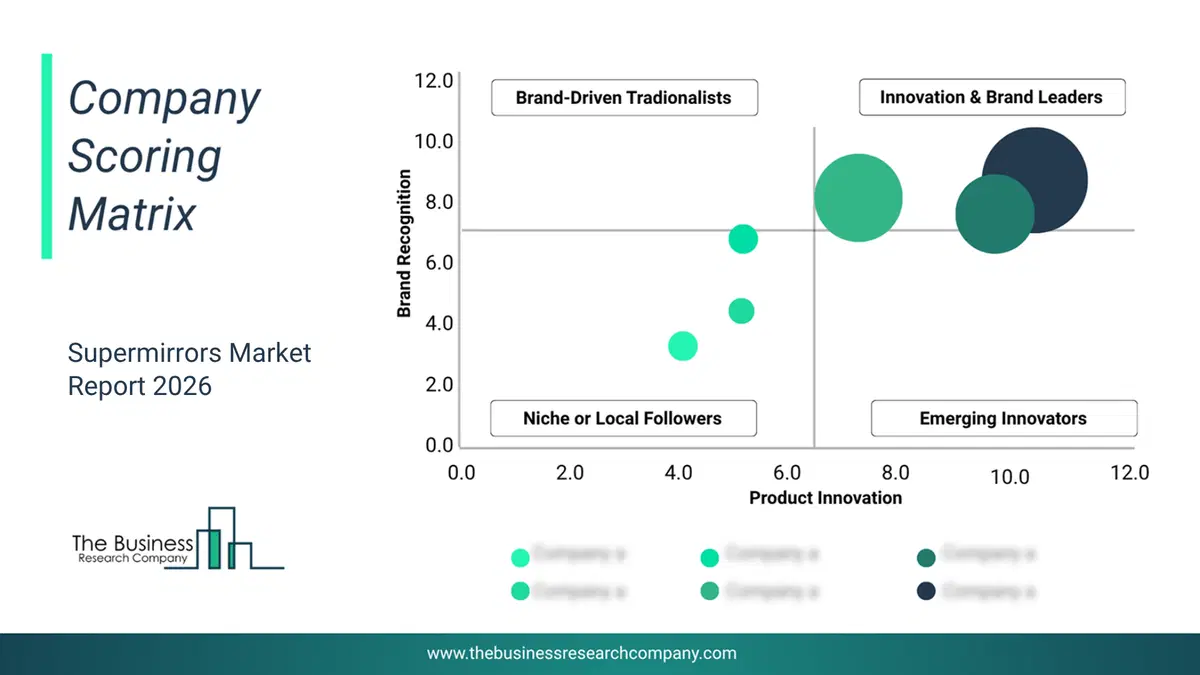
This chart maps companies by product innovation and brand strength, with bubble size indicating relative revenue, helping identify market leaders, challengers, and niche players. This is an illustrative chart; the full report provides a complete and accurate competitive analysis.
Regional Outlook
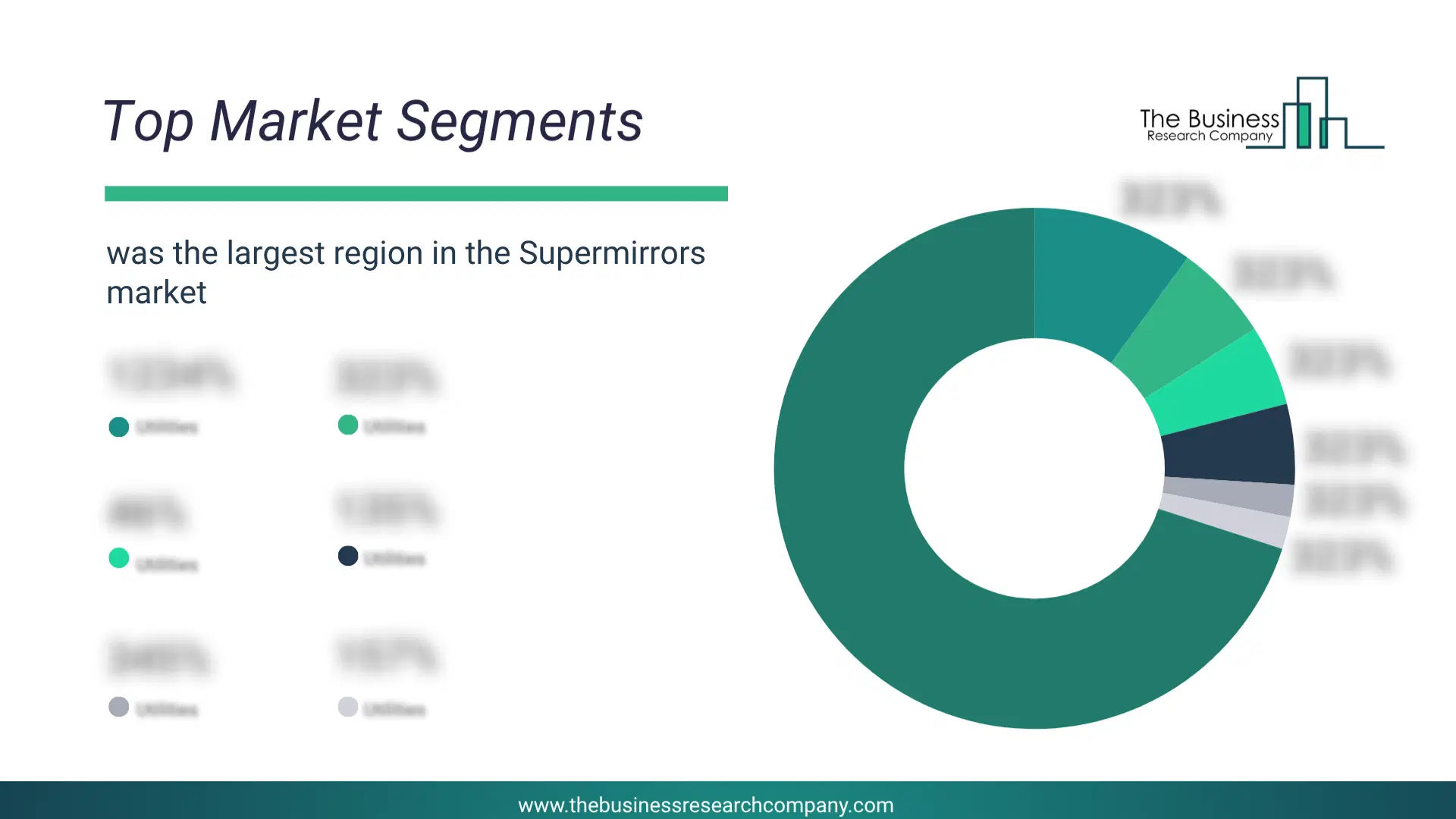
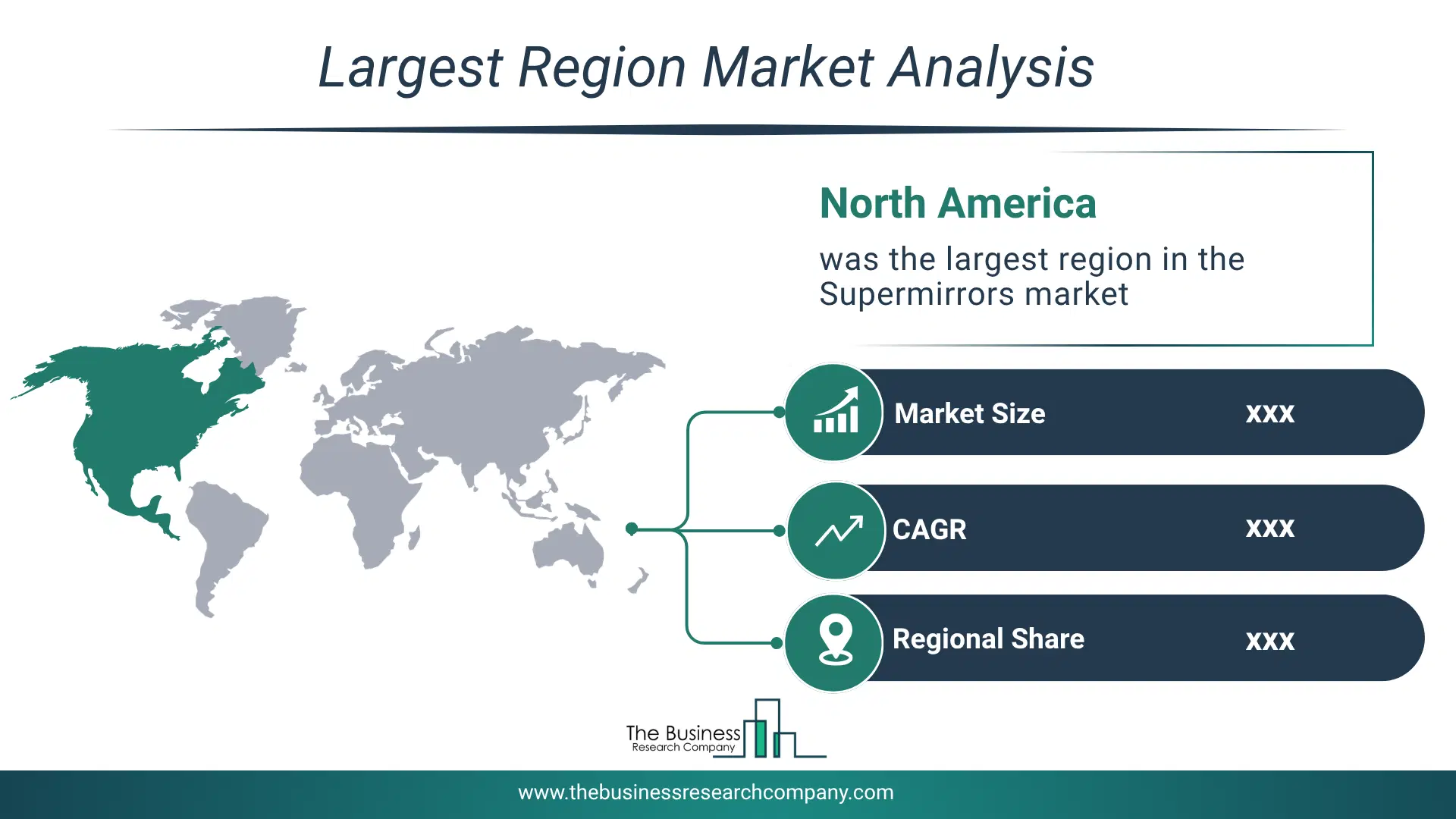
North America was the largest region in the supermirrors market in 2025. Asia-Pacific is expected to be the fastest-growing region in the forecast period. The regions covered in this market report are Asia-Pacific, South East Asia, Western Europe, Eastern Europe, North America, South America, Middle East, Africa. The countries covered in this market report are Australia, Brazil, China, France, Germany, India, Indonesia, Japan, Taiwan, Russia, South Korea, UK, USA, Canada, Italy, Spain.What Defines the Supermirrors Market?
The supermirrors market consists of sales of supermirror coatings, neutron supermirrors, multilayer mirror substrates, reflective mirror plates, coated glass mirrors, silicon wafer mirrors, optical mirror panels, and precision mirror assemblies. Values in this market are ‘factory gate’ values, that is, the value of goods sold by the manufacturers or creators of the goods, whether to other entities (including downstream manufacturers, wholesalers, distributors, and retailers) or directly to end customers. The value of goods in this market includes related services sold by the creators of the goods.How is Market Value Defined and Measured?
The market value is defined as the revenues that enterprises gain from the sale of goods and/or services within the specified market and geography through sales, grants, or donations in terms of the currency (in USD unless otherwise specified). The revenues for a specified geography are consumption values that are revenues generated by organizations in the specified geography within the market, irrespective of where they are produced. It does not include revenues from resales along the supply chain, either further along the supply chain or as part of other products.
This chart presents market attractiveness based on a quantitative evaluation of growth, competition, strategic alignment, and risk, offering a clear view of opportunity areas for decision-making. This chart is for illustrative purposes; the full report contains the complete analysis.

This chart highlights the Total Addressable Market (TAM) by estimating the maximum revenue opportunity using an assumption-driven approach, supporting strategic planning and opportunity sizing across markets. The chart is illustrative; the full report provides a more comprehensive analysis.
What Key Data and Analysis Are Included in the Supermirrors Market Report 2026?
The supermirrors market research report is one of a series of new reports from The Business Research Company that provides market statistics, including industry global market size, regional shares, competitors with the market share, detailed market segments, market trends and opportunities, and any further data you may need to thrive in the supermirrors industry. The market research report delivers a complete perspective of everything you need, with an in-depth analysis of the current and future state of the industry.Supermirrors Market Report Forecast Analysis
| Report Attribute | Details |
|---|---|
| Market Size Value In 2026 | $13.24 billion |
| Revenue Forecast In 2030 | $18.22 billion |
| Growth Rate | CAGR of 8.1% from 2026 to 2030 |
| Base Year For Estimation | 2025 |
| Actual Estimates/Historical Data | 2020-2025 |
| Forecast Period | 2026 - 2030 |
| Market Representation | Revenue in USD Billion and CAGR from 2026 to 2030 |
| Segments Covered | Type, Material, Application, End-User Industry |
| Regional Scope | Asia-Pacific, Western Europe, Eastern Europe, North America, South America, Middle East, Africa |
| Country Scope | The countries covered in the report are Australia, Brazil, China, France, Germany, India, Indonesia, Japan, Taiwan, Russia, South Korea, UK, USA, Canada, Italy, Spain. |
| Key Companies Profiled | Newport Corporation, Thorlabs Inc, Rigaku Corporation, CASTECH Inc, OptoSigma Corporation, Layertec GmbH, Altechna UAB, Shanghai Optics, Laser Components GmbH, Research Electro-Optics Inc, OPTOMAN, UltraFast Innovations GmbH, NeutronOptics, LASEROPTIK GmbH, Optical Mechanics Inc, Lambda Research Optics Inc, Nippon Advanced Technology Co Ltd, AccuCoat Inc, Perkins Precision Developments LLC, and Avantier Inc. |
| Customization Scope | Request for Customization |
| Pricing And Purchase Options | Explore Purchase Options |