
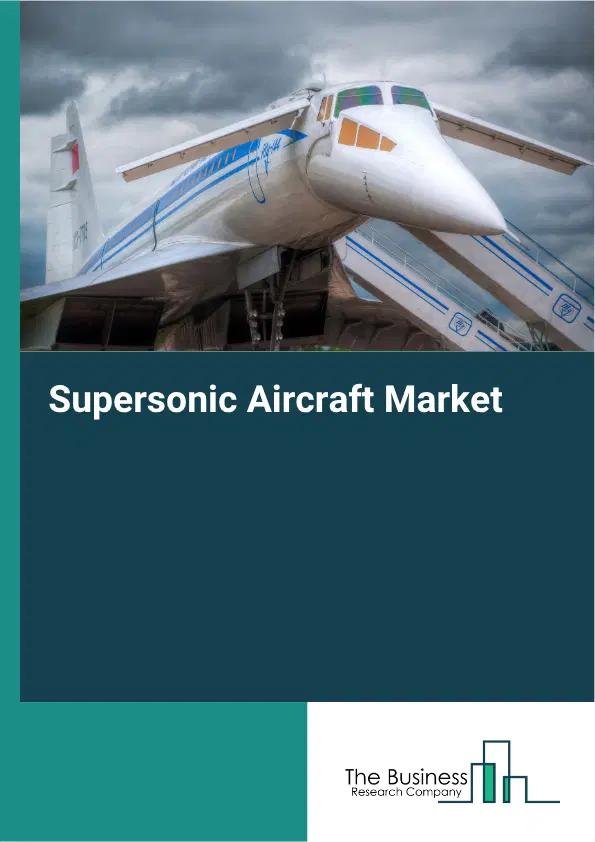
Supersonic Aircraft Market Report 2026
Global Outlook – By Component (Airframe, Engine, Avionics, Landing Gear, Other Components), By Aircraft Type (Commercial, Military, Business Jets), By Speed Range (Mach 1, Mach 2, Mach 3), By Application (Passenger Transport, Defense, Research And Development, Other Applications), By End User (Civil, Government And Defense, Private) – Market Size, Trends, Strategies, and Forecast to 2030
Supersonic Aircraft Market Overview
• Supersonic Aircraft market size has reached to $27.16 billion in 2025 • Expected to grow to $38.47 billion in 2030 at a compound annual growth rate (CAGR) of 7.1% • Growth Driver: Rising Demand For Faster Air Travel Is Fueling The Growth Of The Market Due To Reduced Flight Times • Market Trend: Advanced Purpose-Built Supersonic Propulsion Systems Enhance High-Speed Flight Performance • North America was the largest region in 2025 and Asia-Pacific is the fastest growing region.What Is Covered Under Supersonic Aircraft Market?
Supersonic aircraft are advanced aerospace vehicles designed to travel at speeds exceeding the speed of sound, typically above Mach 1, using high-performance aerodynamic designs and propulsion systems. They are engineered to withstand high-speed airflow, thermal stress, and sonic boom effects while maintaining stable and efficient flight performance. Supersonic aircraft enable significantly faster air travel through advanced structures, engines, materials, and aerodynamic technologies. The main components of supersonic aircraft include airframe, engine, avionics, landing gear, and other components. Airframe refers to the main structural body of an aircraft that supports the wings, engines, landing gear, and other aircraft systems. These components are used in commercial aircraft, military aircraft, and business jets, and operate at speed ranges including Mach 1, Mach 2, and Mach 3. The key applications include passenger transport, defense, research and development, and others, while the end-users include civil, government and defense, and private.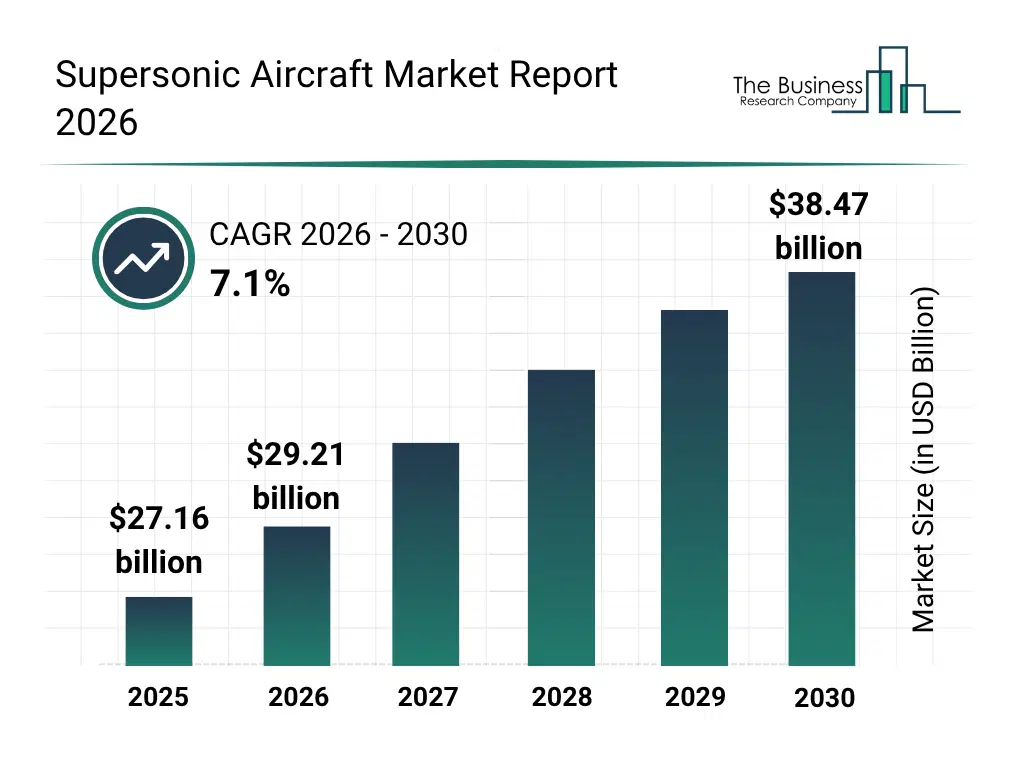
What Is The Supersonic Aircraft Market Size and Share 2026?
The supersonic aircraft market size has grown strongly in recent years. It will grow from $27.16 billion in 2025 to $29.21 billion in 2026 at a compound annual growth rate (CAGR) of 7.6%. The growth in the historic period can be attributed to increasing defense expenditure and military aircraft modernization, rising demand for faster long-distance air transportation, advancements in aerospace propulsion technologies, development of lightweight aircraft structures, growing investment in supersonic aircraft research and development.What Is The Supersonic Aircraft Market Growth Forecast?
The supersonic aircraft market size is expected to see strong growth in the next few years. It will grow to $38.47 billion in 2030 at a compound annual growth rate (CAGR) of 7.1%. The growth in the forecast period can be attributed to increasing commercial interest in supersonic passenger travel, rising development of low-boom supersonic aircraft, advancements in next-generation high-speed engine technologies, growing demand for rapid government and defense transportation, increasing private investment in supersonic aviation programs. Major trends in the forecast period include development of quieter supersonic aircraft designs, advancement of high-speed propulsion technologies, increasing use of lightweight high-strength aerospace materials, development of advanced aerodynamic configurations for reduced drag, growing investment in next-generation supersonic passenger aircraft.Tariff Impact On Supersonic Aircraft Market
Tariffs are impacting the supersonic aircraft market by increasing the cost of imported aerospace components, propulsion systems, avionics, specialty materials, and precision manufacturing equipment required for high-speed aircraft development. This is increasing production and development costs across commercial, military, and business jet segments, particularly in regions dependent on international aerospace supply chains such as North America, Europe, and Asia-Pacific. Hardware-intensive components including engines, avionics, airframes, and flight-control systems are most exposed to tariff-related cost pressures and supply-chain disruptions. However, tariffs are also encouraging domestic aerospace manufacturing, regional supplier diversification, localized component production, and investment in resilient aerospace supply chains.
Global Supersonic Aircraft Market Segmentation
1) By Component: Airframe, Engine, Avionics, Landing Gear, Other Components 2) By Aircraft Type: Commercial, Military, Business Jets 3) By Speed Range: Mach 1, Mach 2, Mach 3 4) By Application: Passenger Transport, Defense, Research And Development, Other Applications 5) By End User: Civil, Government And Defense, Private Subsegments: 1) By Airframe: Fuselage, Wings, Empennage, Flight Control Surfaces 2) By Engine: Turbojet Engine, Turbofan Engine, Ramjet Engine, Scramjet Engine 3) By Avionics: Flight Control Systems, Navigation Systems, Communication Systems, Flight Management Systems, Surveillance Systems 4) By Landing Gear: Nose Landing Gear, Main Landing Gear, Tail Landing Gear 5) By Other Components: Fuel System, Hydraulic System, Electrical System, Environmental Control System, Auxiliary Power Unit, Actuation SystemWhat Is The Driver Of The Supersonic Aircraft Market?
The rising demand for faster air travel is expected to propel the growth of the supersonic aircraft market going forward. Faster air travel refers to the ability to transport passengers and goods over long distances in shorter periods through higher-speed aircraft. The rising demand for faster air travel is driven by time savings, as higher-speed aircraft reduce travel times and enable passengers to reach their destinations more quickly. The rising demand for faster air travel supports the supersonic aircraft by increasing the need for aircraft capable of achieving speeds significantly higher than conventional commercial aircraft, enabling shorter flight durations. For instance, in June 2026, according to the US Department of Transportation, a US-based government department, aircraft traveling at Mach 1 or above can reach speeds of approximately 770+ miles per hour, compared with 550–600 miles per hour for conventional commercial aircraft. Therefore, the rising demand for faster air travel is driving the growth of the supersonic aircraft industry.Key Players In The Global Supersonic Aircraft Market
Major companies operating in the supersonic aircraft market are The Boeing Company, Airbus SE, Lockheed Martin Corporation, RTX Corporation, Northrop Grumman Corporation, BAE Systems plc, Rolls-Royce plc, Safran S.A., Mitsubishi Heavy Industries Ltd., Leonardo S.p.A., Dassault Aviation SA, Aviation Industry Corporation of China Ltd., Public Joint-Stock Company United Aircraft Corporation, Saab AB, Hindustan Aeronautics Limited, Israel Aerospace Industries Ltd., Korea Aerospace Industries Ltd., Turkish Aerospace Industries Inc., Boom Technology Inc., Space Transportation Co. Ltd., Dawn Aerospace Limited, Hermeus Corporation, Spike Aerospace Inc., Hypersonix Launch Systems Ltd.
This chart is for illustrative purposes; the full report includes a detailed competitor analysis and comprehensive overview of the top 10 companies in the market.
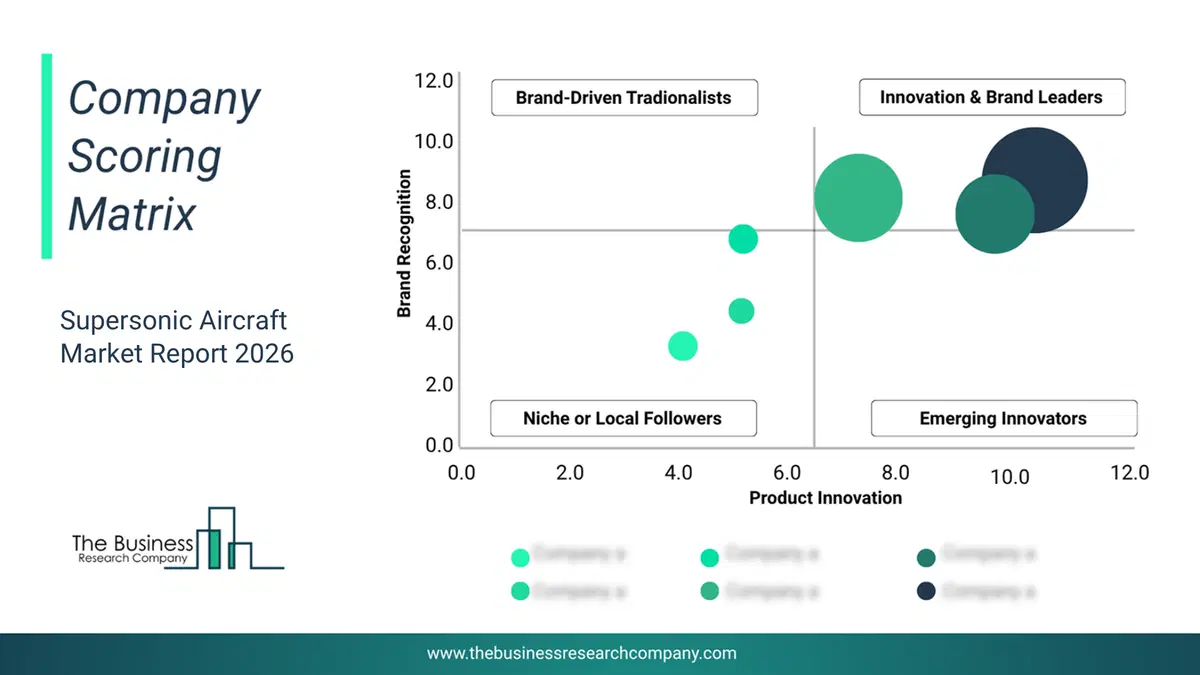
This chart maps companies by product innovation and brand strength, with bubble size indicating relative revenue, helping identify market leaders, challengers, and niche players. This is an illustrative chart; the full report provides a complete and accurate competitive analysis.
Global Supersonic Aircraft Market Trends and Insights
Major companies operating in the supersonic aircraft market are focusing on developing advanced purpose-built supersonic propulsion systems and advanced engine testing technologies to improve high-speed flight efficiency, propulsion performance, and operational capabilities. A purpose-built supersonic propulsion system is an engine specifically designed to generate efficient thrust at speeds above the speed of sound while optimizing aircraft performance, fuel efficiency, and noise reduction. For instance, in April 2025, Boom Supersonic, a US-based aerospace company, announced a dedicated test site at Colorado Air and Space Port for its Symphony propulsion system, a medium-bypass turbofan engine specifically optimized for supersonic flight. The company invested $3 million to $5 million in the facility and planned to begin testing the Symphony prototype core, comprising the compressor, combustor, and turbine, by the end of 2025, followed by full-scale turbofan testing. It is vertically integrating propulsion development and testing. Boom Supersonic aims to accelerate engine development, optimize propulsion performance, and enable Overture to achieve efficient supersonic flight while supporting its Boomless Cruise capability.What Are Latest Mergers And Acquisitions In The Supersonic Aircraft Market?
In March 2025, Boom Supersonic, a US-based supersonic aircraft manufacturer, partnered with NASA to conduct specialized photography and collect acoustic data during supersonic flight tests of its XB-1 demonstrator aircraft. Through this partnership, Boom Supersonic aimed to analyze shock waves and sonic boom characteristics during supersonic flight, supporting the development of its Overture commercial supersonic airliner. NASA is a US-based government agency responsible for civil space exploration, scientific research, aeronautics research, Earth science, and the development of advanced space technologies.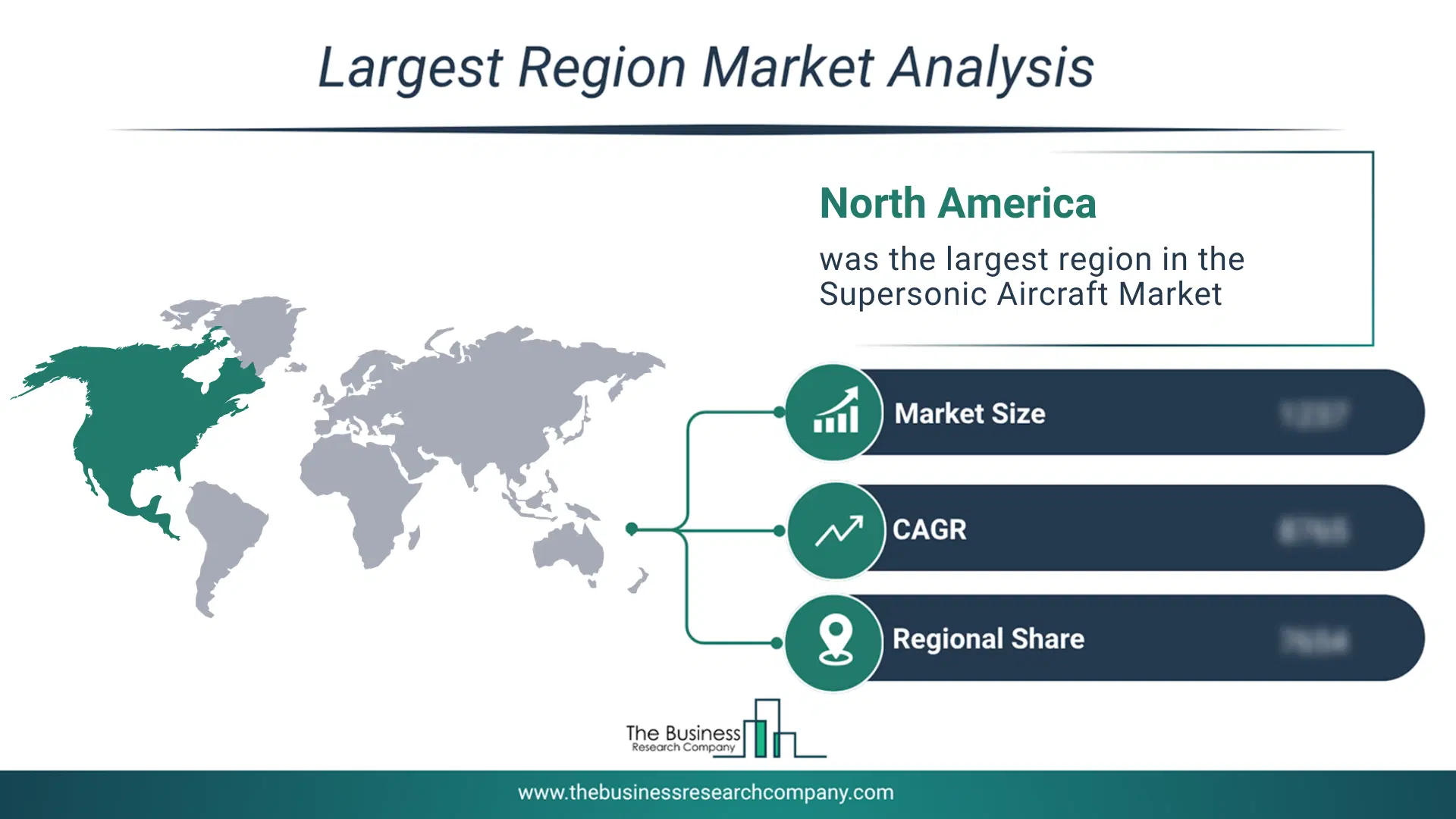
Regional Outlook
North America was the largest region in the supersonic aircraft market in 2025. Asia-Pacific is expected to be the fastest-growing region in the forecast period. The regions covered in this market report are Asia-Pacific, South East Asia, Western Europe, Eastern Europe, North America, South America, Middle East, Africa. The countries covered in this market report are Australia, Brazil, China, France, Germany, India, Indonesia, Japan, Taiwan, Russia, South Korea, UK, USA, Canada, Italy, Spain.What Defines the Supersonic Aircraft Market?
The supersonic aircraft market consists of sales of supersonic interceptor aircraft, supersonic strike aircraft, and supersonic bomber aircraft. Values in this market are ‘factory gate’ values, that is, the value of goods sold by the manufacturers or creators of the goods, whether to other entities (including downstream manufacturers, wholesalers, distributors, and retailers) or directly to end customers. The value of goods in this market includes related services sold by the creators of the goods.How is Market Value Defined and Measured?
The market value is defined as the revenues that enterprises gain from the sale of goods and/or services within the specified market and geography through sales, grants, or donations in terms of the currency (in USD unless otherwise specified). The revenues for a specified geography are consumption values that are revenues generated by organizations in the specified geography within the market, irrespective of where they are produced. It does not include revenues from resales along the supply chain, either further along the supply chain or as part of other products.
This chart presents market attractiveness based on a quantitative evaluation of growth, competition, strategic alignment, and risk, offering a clear view of opportunity areas for decision-making. This chart is for illustrative purposes; the full report contains the complete analysis.

This chart highlights the Total Addressable Market (TAM) by estimating the maximum revenue opportunity using an assumption-driven approach, supporting strategic planning and opportunity sizing across markets. The chart is illustrative; the full report provides a more comprehensive analysis.
What Key Data and Analysis Are Included in the Supersonic Aircraft Market Report 2026?
The supersonic aircraft market research report is one of a series of new reports from The Business Research Company that provides market statistics, including industry global market size, regional shares, competitors with the market share, detailed market segments, market trends and opportunities, and any further data you may need to thrive in the supersonic aircraft industry. The market research report delivers a complete perspective of everything you need, with an in-depth analysis of the current and future state of the industry.Supersonic Aircraft Market Report Forecast Analysis
| Report Attribute | Details |
|---|---|
| Market Size Value In 2026 | $29.21 billion |
| Revenue Forecast In 2030 | $38.47 billion |
| Growth Rate | CAGR of 7.1% from 2026 to 2030 |
| Base Year For Estimation | 2025 |
| Actual Estimates/Historical Data | 2020-2025 |
| Forecast Period | 2026 - 2030 |
| Market Representation | Revenue in USD Billion and CAGR from 2026 to 2030 |
| Segments Covered | Component, Aircraft Type, Speed Range, Application, End User |
| Regional Scope | Asia-Pacific, Western Europe, Eastern Europe, North America, South America, Middle East, Africa |
| Country Scope | The countries covered in the report are Australia, Brazil, China, France, Germany, India, Indonesia, Japan, Taiwan, Russia, South Korea, UK, USA, Canada, Italy, Spain. |
| Key Companies Profiled | The Boeing Company, Airbus SE, Lockheed Martin Corporation, RTX Corporation, Northrop Grumman Corporation, BAE Systems plc, Rolls-Royce plc, Safran S.A., Mitsubishi Heavy Industries Ltd., Leonardo S.p.A., Dassault Aviation SA, Aviation Industry Corporation of China Ltd., Public Joint-Stock Company United Aircraft Corporation, Saab AB, Hindustan Aeronautics Limited, Israel Aerospace Industries Ltd., Korea Aerospace Industries Ltd., Turkish Aerospace Industries Inc., Boom Technology Inc., Space Transportation Co. Ltd., Dawn Aerospace Limited, Hermeus Corporation, Spike Aerospace Inc., Hypersonix Launch Systems Ltd. |
| Customization Scope | Request for Customization |
| Pricing And Purchase Options | Explore Purchase Options |