
Supersonic Business Jet Market Report 2026
Global Outlook – By Aircraft Type (Light Supersonic Business Jets, Mid Size Supersonic Business Jets, Large Cabin Supersonic Business Jets), By Material (Composite Materials, Titanium Alloys, Aluminum Alloys, Ceramic Matrix Composites, Carbon Fiber Reinforced Polymers), By Propulsion Technology (Afterburning Turbofans, Non-Afterburning Turbofans, Advanced Low-Bypass Turbofans, Variable Cycle Engines, Other Advanced Turbofan Technologies), By Seating Capacity (Up To 8 Passengers, 9 To 16 Passengers, Above 16 Passengers), By End User (Corporate Executives, Government And Defense, Private Charter Operators, High Net Worth Individuals, Business Aviation Fleets) – Market Size, Trends, Strategies, and Forecast to 2030
Supersonic Business Jet Market Overview
• Supersonic Business Jet market size has reached to $2.31 billion in 2025 • Expected to grow to $4.39 billion in 2030 at a compound annual growth rate (CAGR) of 13.7% • Growth Driver: The Rising Business Travel Is Driving The Market Due To Increasing Global Business Expansion Requiring Faster Executive Transportation • Market Trend: Next-Generation Quiet Supersonic Aviation Accelerates Sustainable High-Speed Executive Business Travel • North America was the largest region in 2025 and Asia-Pacific is the fastest growing region.What Is Covered Under Supersonic Business Jet Market?
The supersonic business jet is a high performance fixed wing aircraft designed to transport passengers at speeds exceeding the speed of sound while providing advanced operational efficiency, long range capability, and premium travel performance. It incorporates specialized aerodynamic configurations, advanced propulsion systems, lightweight structural materials, sophisticated flight control technologies, and integrated avionics to enable stable, safe, and efficient supersonic flight. The main aircraft types of supersonic business jets include light supersonic business jets, mid size supersonic business jets, and large cabin supersonic business jets. Light supersonic business jets refer to compact business aircraft designed to operate at speeds exceeding the speed of sound while providing high-speed executive transportation with reduced travel times and specialized aerodynamic and propulsion systems. These aircraft are constructed using materials such as composite materials, titanium alloys, aluminum alloys, ceramic matrix composites, and carbon fiber reinforced polymers, and use propulsion technologies such as afterburning turbofans, non-afterburning turbofans, advanced low-bypass turbofans, and variable cycle engines. They are available with seating capacities such as up to 8 passengers, 9 to 16 passengers, and above 16 passengers for end users such as corporate executives, government and defense, private charter operators, high net worth individuals, and business aviation fleets.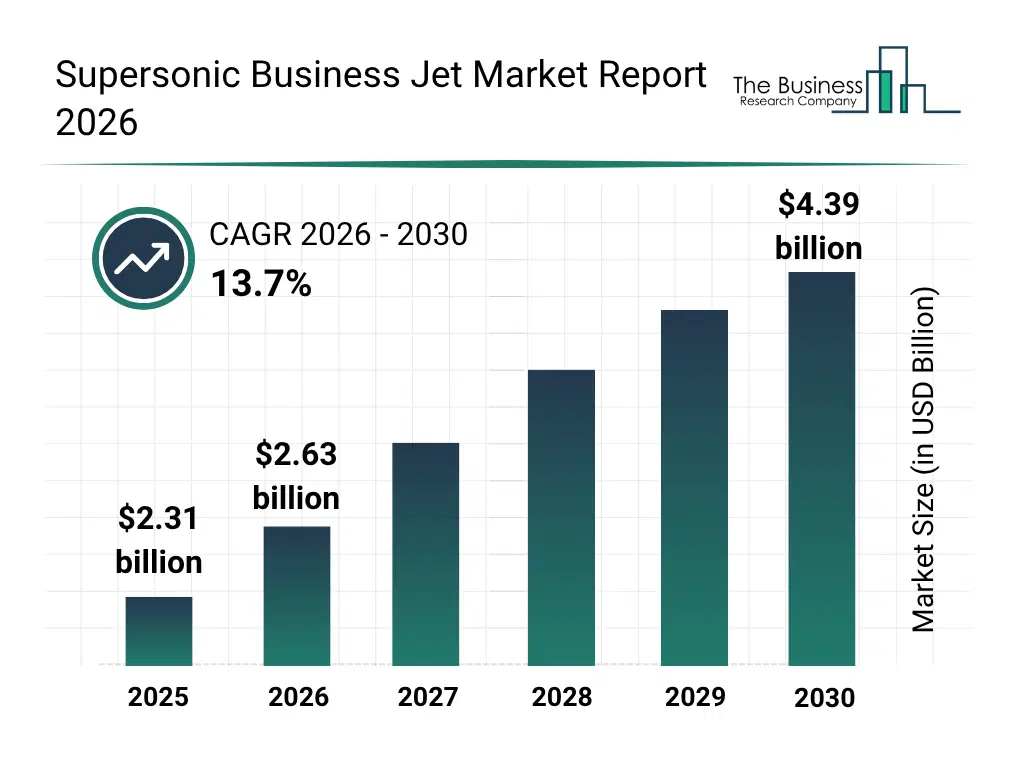
What Is The Supersonic Business Jet Market Size and Share 2026?
The supersonic business jet market size has grown rapidly in recent years. It will grow from $2.31 billion in 2025 to $2.63 billion in 2026 at a compound annual growth rate (CAGR) of 14.1%. The growth in the historic period can be attributed to growing demand for time-efficient executive travel, advancements in supersonic aerodynamic engineering, increasing investment in business aviation infrastructure, development of lightweight aerospace materials, rising research and development in high-speed propulsion.What Is The Supersonic Business Jet Market Growth Forecast?
The supersonic business jet market size is expected to see rapid growth in the next few years. It will grow to $4.39 billion in 2030 at a compound annual growth rate (CAGR) of 13.7%. The growth in the forecast period can be attributed to increasing demand for premium long-distance business travel, growing commercialization of supersonic business jets, advancements in sustainable aviation fuel compatibility, increasing development of low-boom aircraft technologies, rising private investment in next-generation business aviation. Major trends in the forecast period include development of low-boom supersonic flight technologies, advancement of advanced supersonic propulsion systems, increasing use of lightweight composite airframe structures, integration of adaptive aerodynamic configurations, development of enhanced thermal management systems.Tariff Impact On Supersonic Business Jet Market
Tariffs are impacting the supersonic business jet market by increasing the cost of imported aerospace materials, propulsion components, avionics, precision equipment, and specialized manufacturing inputs. This is raising aircraft development and production costs across light, mid size, and large cabin supersonic business jets, particularly in North America, Europe, and Asia-Pacific where aerospace supply chains rely on international sourcing. Composite materials, titanium alloys, propulsion systems, avionics, and advanced flight-control components are among the areas most exposed to tariff-related cost pressures and supply-chain disruptions. However, tariffs can also encourage localized aerospace manufacturing, supplier diversification, domestic component production, and investment in more resilient aircraft supply chains.
Global Supersonic Business Jet Market Segmentation
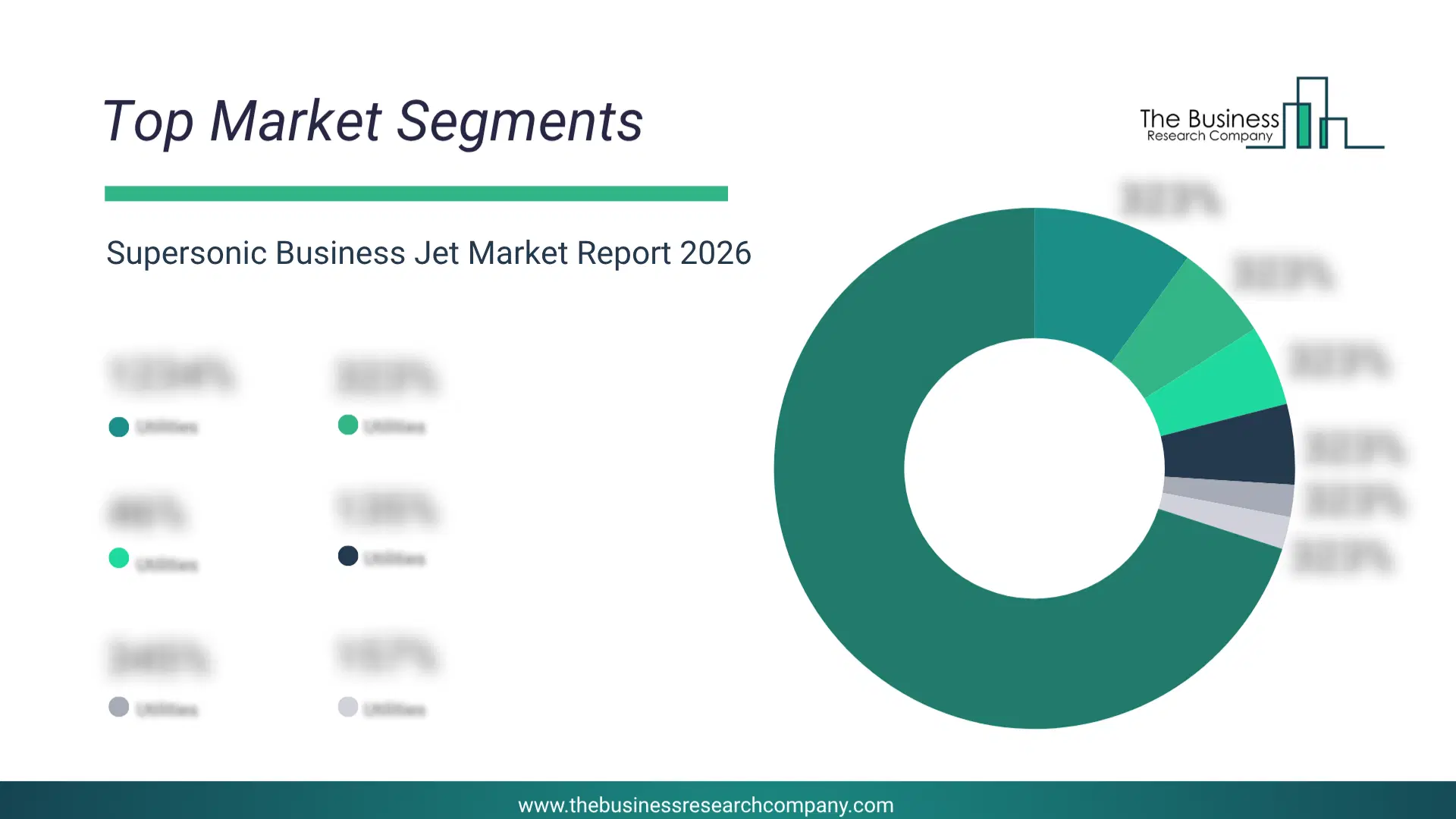
1) By Aircraft Type: Light Supersonic Business Jets, Mid Size Supersonic Business Jets, Large Cabin Supersonic Business Jets 2) By Material: Composite Materials, Titanium Alloys, Aluminum Alloys, Ceramic Matrix Composites, Carbon Fiber Reinforced Polymers 3) By Propulsion Technology: Afterburning Turbofans, Non-Afterburning Turbofans, Advanced Low-Bypass Turbofans, Variable Cycle Engines, Other Advanced Turbofan Technologies 4) By Seating Capacity: Up To 8 Passengers, 9 To 16 Passengers, Above 16 Passengers 5) By End User: Corporate Executives, Government And Defense, Private Charter Operators, High Net Worth Individuals, Business Aviation Fleets Subsegments: 1) By Light Supersonic Business Jets: Very Light Supersonic Business Jets, Entry Level Supersonic Business Jets, Compact Cabin Supersonic Business Jets, Single Aisle Light Supersonic Business Jets 2) By Mid Size Supersonic Business Jets: Standard Mid Size Supersonic Business Jets, Super Mid Size Supersonic Business Jets, Extended Range Mid Size Supersonic Business Jets, Premium Mid Size Supersonic Business Jets 3) By Large Cabin Supersonic Business Jets: Standard Large Cabin Supersonic Business Jets, Ultra Long Range Supersonic Business Jets, Executive Large Cabin Supersonic Business Jets, VIP Large Cabin Supersonic Business JetsWhat Are The Drivers Of The Supersonic Business Jet Market?
The rising business travel is expected to propel the growth of the supersonic business jet market going forward. Business travel refers to work-related travel undertaken by employees, executives, entrepreneurs, and professionals to attend meetings, conferences, client engagements, site visits, training programs, negotiations, and other business activities that require physical presence away from their primary workplace. Rising business travel is primarily driven by increasing global business expansion, as organizations entering new markets and strengthening international partnerships require frequent in-person interactions to build trust, negotiate agreements, oversee operations, and maintain long-term commercial relationships that cannot be fully replicated through virtual communication. Rising business travel increases the preference for supersonic business jets by enabling executives to complete long distance trips in significantly less time, improving productivity and supporting time sensitive business engagements. For instance, in May 2026, according to the U.S. Travel Association, a US-based non-profit organization, business travel spending reached $317 billion in 2025 after growing 1.1% and is projected to increase by a further 0.7% to $319 billion in 2026. Therefore, the rising business travel is driving the growth of the supersonic business jet industry. The rising number of high-net-worth individuals is expected to propel the growth of the supersonic business jet market going forward. High-net-worth individuals refer to individuals with substantial financial wealth and the capacity to purchase or access premium financial, lifestyle, and travel services. The number of high-net-worth individuals is increasing due to the growth in personal wealth and asset values, expanding the global pool of affluent individuals with greater financial capacity. The rising number of high-net-worth individuals increases demand for supersonic business jets by expanding the potential customer base for premium private aviation and increasing the number of affluent individuals seeking faster and more time-efficient long-distance air travel. For instance, in June 2026, according to UBS Group AG, a Switzerland-based financial services company, the number of U.S. dollar millionaires increased by 1.5% in 2025, equivalent to nearly 1 million new millionaires globally, or more than 2,600 new millionaires per day. Therefore, the rising number of high-net-worth individuals is driving the growth of the supersonic business jet industry.Key Players In The Global Supersonic Business Jet Market
Major companies operating in the supersonic business jet market are The Boeing Company, RTX Corporation, Airbus SE, Lockheed Martin Corporation, General Dynamics Corporation, Northrop Grumman Corporation, BAE Systems plc, GE Aerospace, Leonardo S.p.A., Safran, Rolls-Royce plc, Honeywell International Inc, Dassault Aviation SA, Bombardier Inc, Boom Technology Inc, Hermeus Corporation, Destinus SA, Venus Aerospace Corporation, Astro Mechanica Inc, Spike Aerospace Inc, EON Aerospace LLC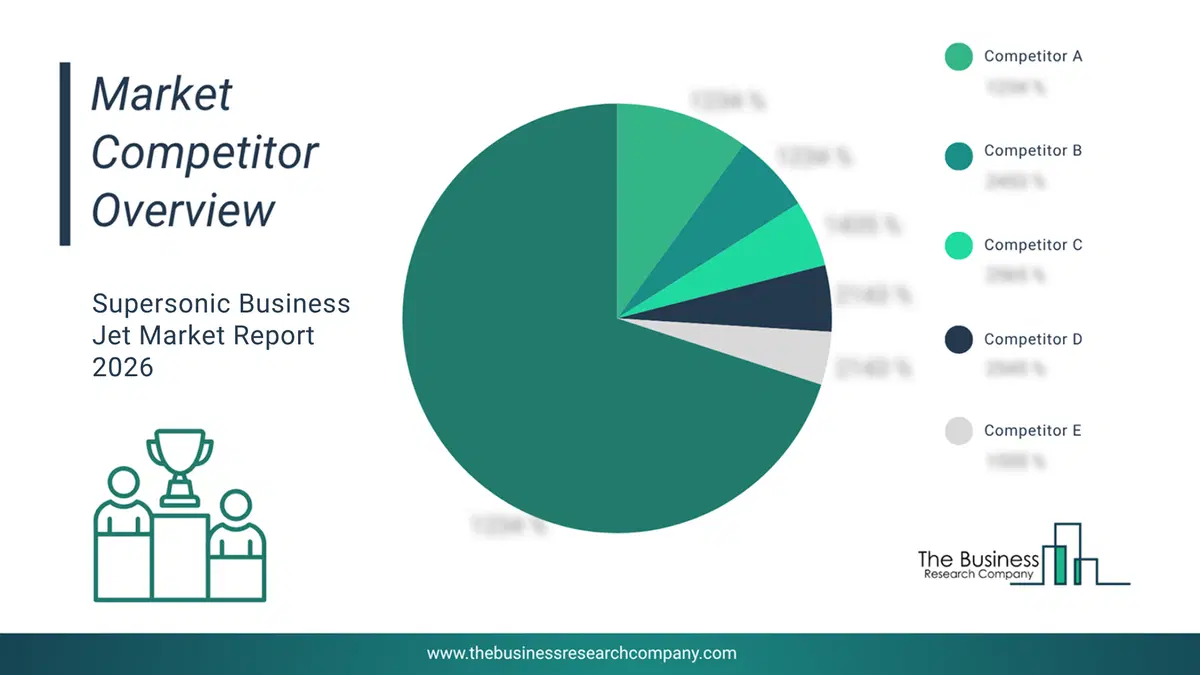
This chart is for illustrative purposes; the full report includes a detailed competitor analysis and comprehensive overview of the top 10 companies in the market.
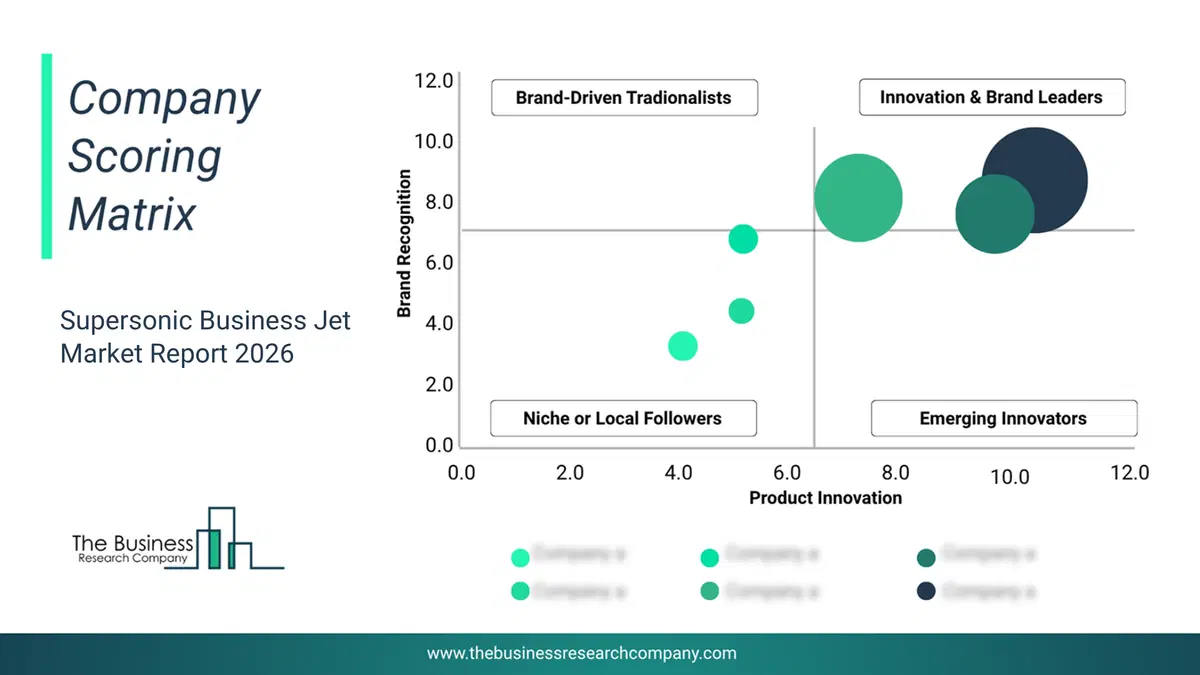
This chart maps companies by product innovation and brand strength, with bubble size indicating relative revenue, helping identify market leaders, challengers, and niche players. This is an illustrative chart; the full report provides a complete and accurate competitive analysis.
Global Supersonic Business Jet Market Trends and Insights
Major companies operating in the supersonic business jet market are focusing on developing innovative products, such as low-boom supersonic business jets to enable quieter, faster, and more sustainable executive air travel. A low boom supersonic business jet is an aircraft designed for executive travel that flies faster than the speed of sound while using advanced aerodynamic technologies to significantly reduce the intensity of the sonic boom heard on the ground. For instance, in May 2025, Spike Aerospace, a US-based aerospace company developing next-generation supersonic aircraft, announced the launch of Spike S-512 Diplomat, a low-boom supersonic business jet. The aircraft is being engineered to achieve Mach 1.6 performance with low-boom technology, compatibility with sustainable aviation fuel, and a productivity-focused cabin for long-range executive travel. The development reinforces industry efforts to commercialize environmentally responsible supersonic aviation while addressing regulatory and operational challenges associated with overland high-speed flight.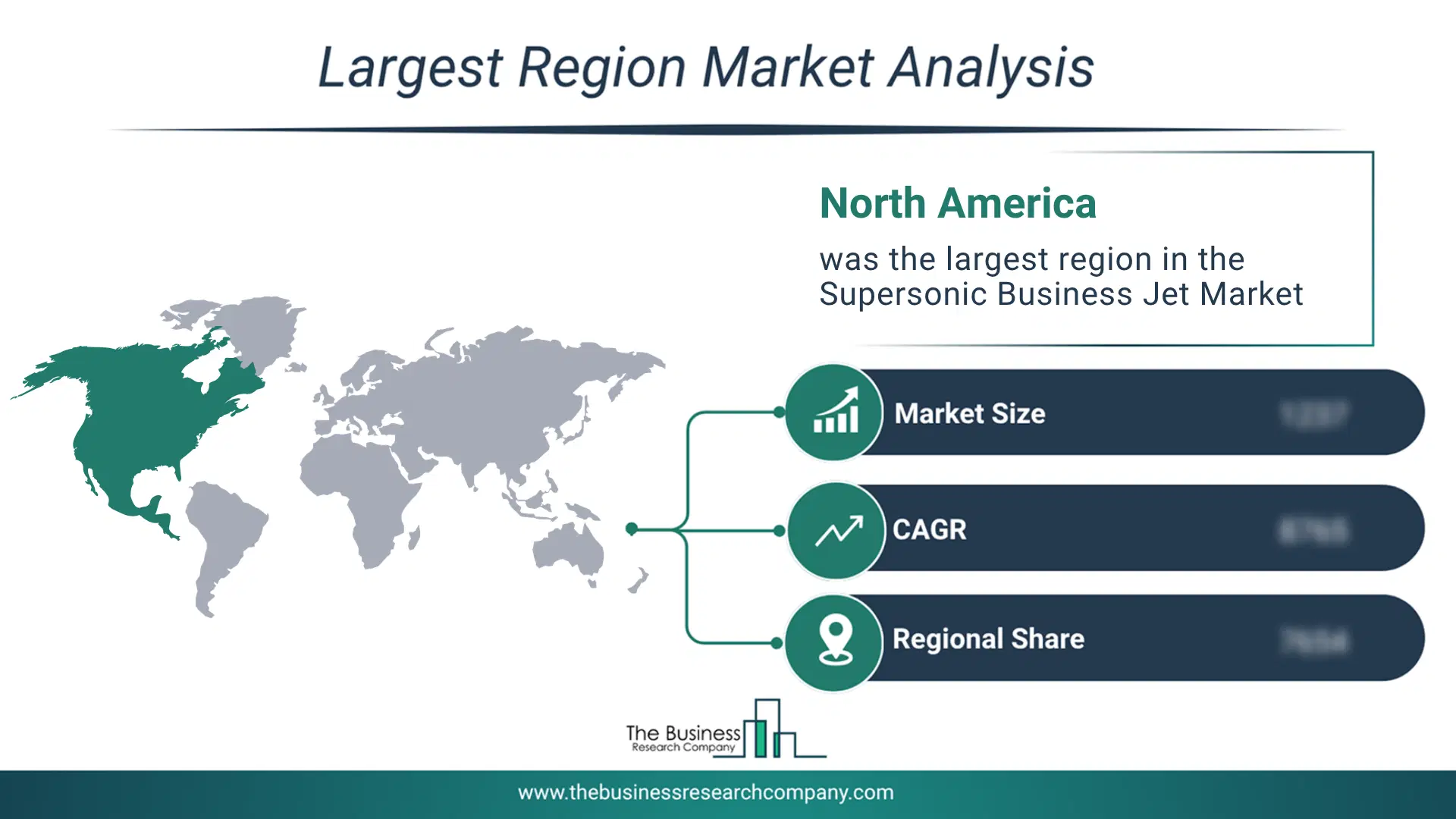
Regional Outlook
North America was the largest region in the supersonic business jet market in 2025. Asia-Pacific is expected to be the fastest-growing region in the forecast period. The regions covered in this market report are Asia-Pacific, South East Asia, Western Europe, Eastern Europe, North America, South America, Middle East, Africa. The countries covered in this market report are Australia, Brazil, China, France, Germany, India, Indonesia, Japan, Taiwan, Russia, South Korea, UK, USA, Canada, Italy, Spain.What Defines the Supersonic Business Jet Market?
The supersonic business jet market consists of sales of engine nacelles, flight control systems, advanced avionics systems, glass cockpit displays, and landing gear systems. Values in this market are ‘factory gate’ values, that is the value of goods sold by the manufacturers or creators of the goods, whether to other entities (including downstream manufacturers, wholesalers, distributors and retailers) or directly to end customers. The value of goods in this market includes related services sold by the creators of the goods.How is Market Value Defined and Measured?
The market value is defined as the revenues that enterprises gain from the sale of goods and/or services within the specified market and geography through sales, grants, or donations in terms of the currency (in USD unless otherwise specified). The revenues for a specified geography are consumption values that are revenues generated by organizations in the specified geography within the market, irrespective of where they are produced. It does not include revenues from resales along the supply chain, either further along the supply chain or as part of other products.
This chart presents market attractiveness based on a quantitative evaluation of growth, competition, strategic alignment, and risk, offering a clear view of opportunity areas for decision-making. This chart is for illustrative purposes; the full report contains the complete analysis.

This chart highlights the Total Addressable Market (TAM) by estimating the maximum revenue opportunity using an assumption-driven approach, supporting strategic planning and opportunity sizing across markets. The chart is illustrative; the full report provides a more comprehensive analysis.
What Key Data and Analysis Are Included in the Supersonic Business Jet Market Report 2026?
The supersonic business jet market research report is one of a series of new reports from The Business Research Company that provides market statistics, including industry global market size, regional shares, competitors with the market share, detailed market segments, market trends and opportunities, and any further data you may need to thrive in the supersonic business jet industry. The market research report delivers a complete perspective of everything you need, with an in-depth analysis of the current and future state of the industry.Supersonic Business Jet Market Report Forecast Analysis
| Report Attribute | Details |
|---|---|
| Market Size Value In 2026 | $2.63 billion |
| Revenue Forecast In 2030 | $4.39 billion |
| Growth Rate | CAGR of 13.7% from 2026 to 2030 |
| Base Year For Estimation | 2025 |
| Actual Estimates/Historical Data | 2020-2025 |
| Forecast Period | 2026 - 2030 |
| Market Representation | Revenue in USD Billion and CAGR from 2026 to 2030 |
| Segments Covered | Aircraft Type, Material, Propulsion Technology, Seating Capacity, End User |
| Regional Scope | Asia-Pacific, Western Europe, Eastern Europe, North America, South America, Middle East, Africa |
| Country Scope | The countries covered in the report are Australia, Brazil, China, France, Germany, India, Indonesia, Japan, Taiwan, Russia, South Korea, UK, USA, Canada, Italy, Spain. |
| Key Companies Profiled | The Boeing Company, RTX Corporation, Airbus SE, Lockheed Martin Corporation, General Dynamics Corporation, Northrop Grumman Corporation, BAE Systems plc, GE Aerospace, Leonardo S.p.A., Safran, Rolls-Royce plc, Honeywell International Inc, Dassault Aviation SA, Bombardier Inc, Boom Technology Inc, Hermeus Corporation, Destinus SA, Venus Aerospace Corporation, Astro Mechanica Inc, Spike Aerospace Inc, EON Aerospace LLC |
| Customization Scope | Request for Customization |
| Pricing And Purchase Options | Explore Purchase Options |