

Supersonic Passenger Jet Market Report 2026
Global Outlook – By Aircraft Type (Business Jets, Commercial Jets), By Component (Airframe, Engine, Avionics, Landing Gear, Other Components), By Speed (Mach 1.0–1.5, Mach 1.5–2.0, Above Mach 2.0), By Range (Short Range, Medium Range, Long Range), By End User (Airlines, Private Operators, Government And Defense) – Market Size, Trends, Strategies, and Forecast to 2030
Supersonic Passenger Jet Market Overview
• Supersonic Passenger Jet market size has reached to $1.74 billion in 2025 • Expected to grow to $3.45 billion in 2030 at a compound annual growth rate (CAGR) of 14.6% • Growth Driver: Growth Of Business Aviation Driving The Market Growth Due To Increasing Demand For Faster Air Travel Solutions • Market Trend: Innovative Cloud Solutions Improve Scalability And Adoption Of Quantum Technologies • North America was the largest region in 2025 and Asia-Pacific is the fastest growing region.What Is Covered Under Supersonic Passenger Jet Market?
Supersonic passenger jets refer to advanced aircraft designed to carry passengers at speeds exceeding the speed of sound. These aircraft incorporate specialized aerodynamic structures, high-performance propulsion technologies, and advanced onboard systems to achieve reduced travel times while maintaining safety, efficiency, and operational reliability. The main aircraft types of supersonic passenger jets include business jets and commercial jets. Business jets refer to supersonic aircraft designed to transport a limited number of passengers, typically offering high-speed travel for private or corporate use. These aircraft incorporate airframe, engine, avionics, landing gear, and other components and operate at speeds of Mach 1.0–1.5, Mach 1.5–2.0, and above Mach 2.0. They are designed for short range, medium range, and long range operations and are used end users by airlines, private operators, and government and defense.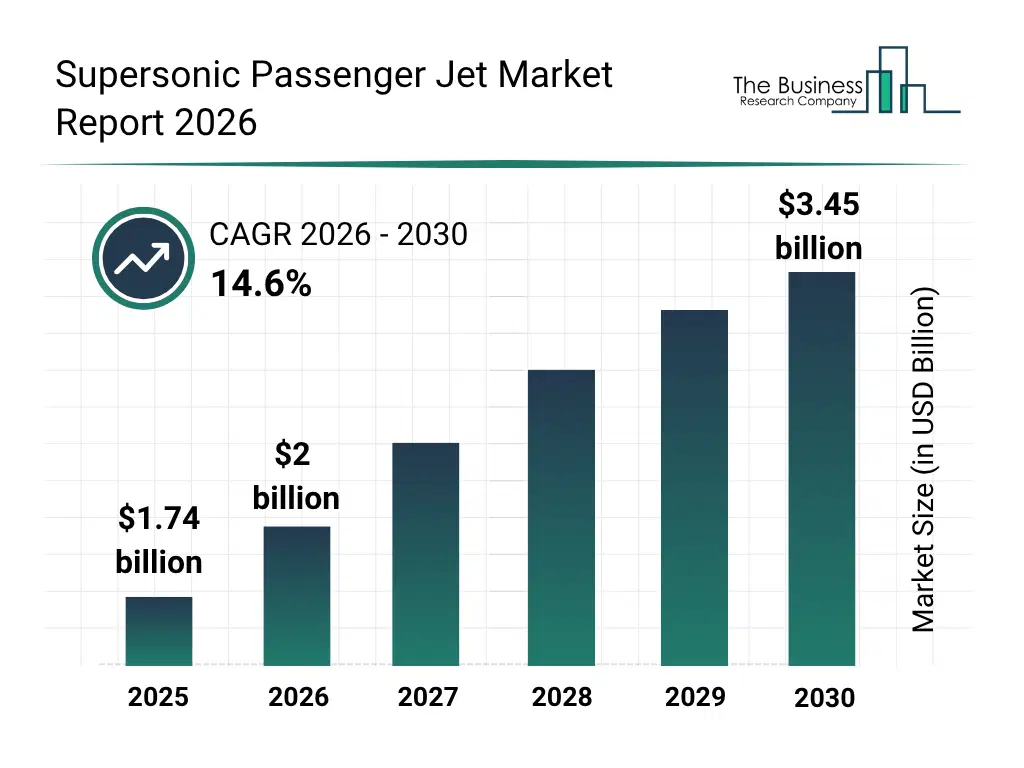
What Is The Supersonic Passenger Jet Market Size and Share 2026?
The supersonic passenger jet market size has grown rapidly in recent years. It will grow from $1.74 billion in 2025 to $2 billion in 2026 at a compound annual growth rate (CAGR) of 15.0%. The growth in the historic period can be attributed to increasing investment in supersonic aircraft development, growing demand for reduced long-distance travel times, rising advancements in high-speed aircraft propulsion, increasing development of advanced aerodynamic technologies, growing interest in commercial supersonic aviation.What Is The Supersonic Passenger Jet Market Growth Forecast?
The supersonic passenger jet market size is expected to see rapid growth in the next few years. It will grow to $3.45 billion in 2030 at a compound annual growth rate (CAGR) of 14.6%. The growth in the forecast period can be attributed to increasing development of fuel-efficient supersonic propulsion systems, rising adoption of low-boom aircraft technologies, growing demand for premium high-speed air travel, increasing commercialization of next-generation supersonic passenger aircraft, expanding development of sustainable aviation technologies. Major trends in the forecast period include advanced supersonic propulsion systems, low-boom supersonic aircraft design, lightweight aerodynamic structures, high-temperature materials for supersonic flight, advanced passenger cabin pressurization systems.
Global Supersonic Passenger Jet Market Segmentation
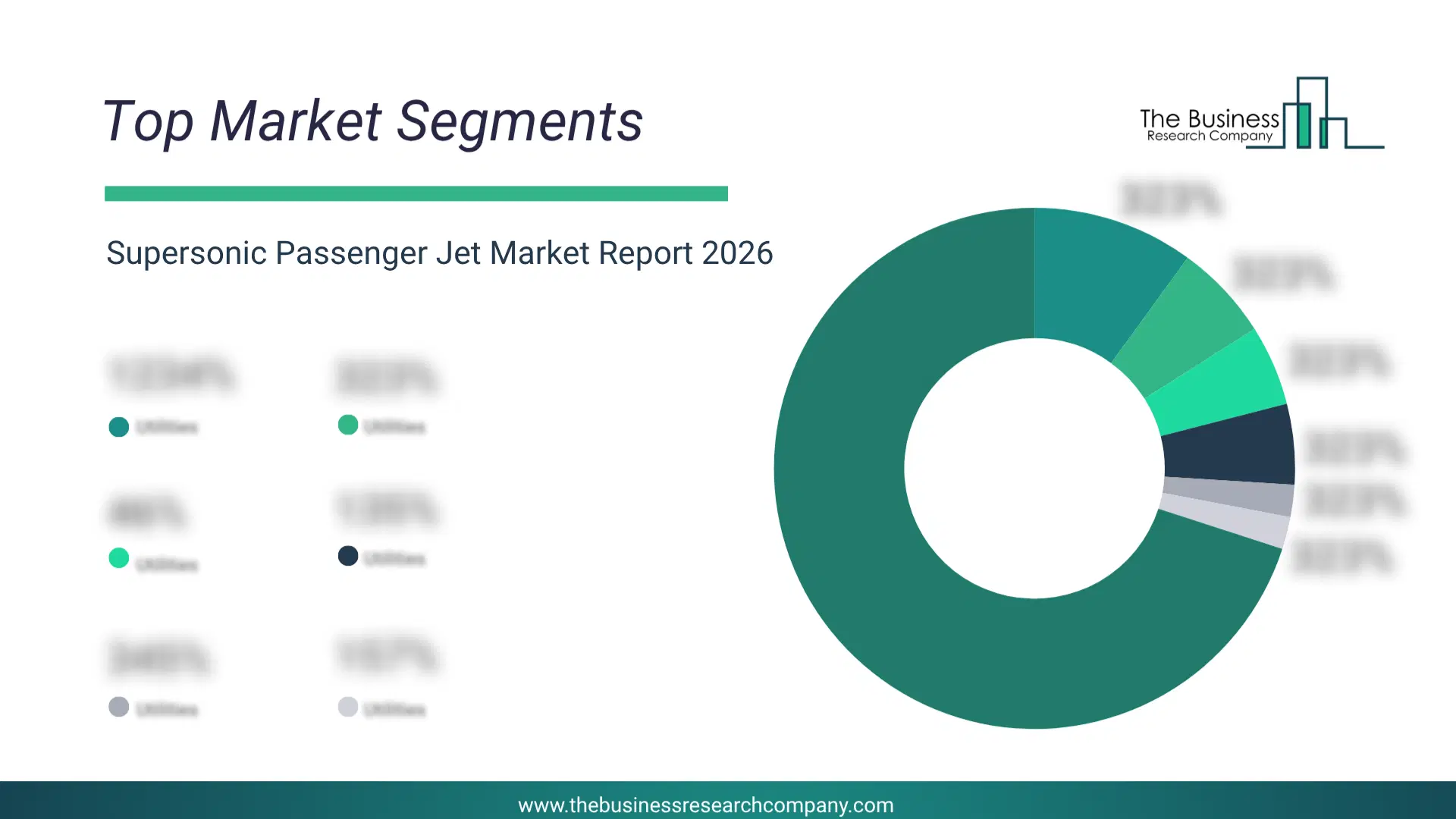
1) By Aircraft Type: Business Jets, Commercial Jets 2) By Component: Airframe, Engine, Avionics, Landing Gear, Other Components 3) By Speed: Mach 1.0–1.5, Mach 1.5–2.0, Above Mach 2.0 4) By Range: Short Range, Medium Range, Long Range 5) By End User: Airlines, Private Operators, Government And Defense Subsegments: 1) By Business Jets: Light Business Jets, Midsize Business Jets, Large Cabin Business Jets 2) By Commercial Jets: Narrow Body Passenger Jets, Wide Body Passenger Jets, Regional Passenger JetsWhat Is The Driver Of The Supersonic Passenger Jet Market?
The growth of business aviation is expected to propel the growth of the supersonic passenger jet market going forward. Business aviation refers to the use of aircraft for corporate travel, executive transportation, and private aviation purposes, enabling faster and more efficient global connectivity. Business aviation is rising due to increasing demand for reduced travel times, as companies and high-net-worth individuals are seeking faster and more flexible transportation solutions that enable efficient long-distance travel. Business aviation increases the demand for supersonic passenger jets by creating a need for advanced aircraft that offer faster point-to-point travel, improved operational efficiency, and enhanced passenger convenience for long-distance business travel. For instance, in August 2025, according to the Aircraft Performance Group, a US-based flight operations software solution provider, forecasts indicate that approximately 8,700 new business jets are expected to be delivered globally over the next decade, with more than half of these deliveries projected to take place in North America. Therefore, the growth of business aviation is driving the growth of the supersonic passenger jet industry.Key Players In The Global Supersonic Passenger Jet Market
Major companies operating in the supersonic passenger jet market are The Boeing Company, Airbus SE, RTX Corporation, Lockheed Martin Corporation, GE Aerospace, Safran SA, Northrop Grumman Corporation, BAE Systems plc, Rolls-Royce Holdings plc, General Dynamics Corporation, Bombardier Inc., Dassault Aviation SA, Hermeus Corporation, Venus Aerospace Corporation, Destinus SA, Spike Aerospace Inc., Space Transportation Inc.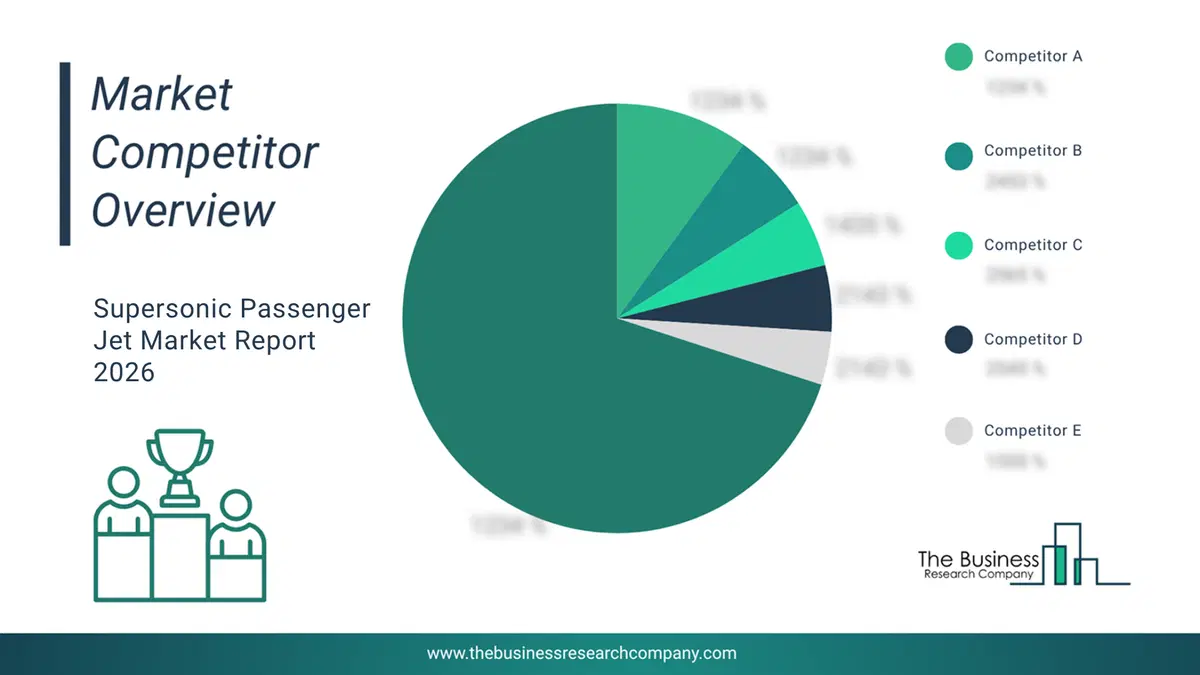
This chart is for illustrative purposes; the full report includes a detailed competitor analysis and comprehensive overview of the top 10 companies in the market.
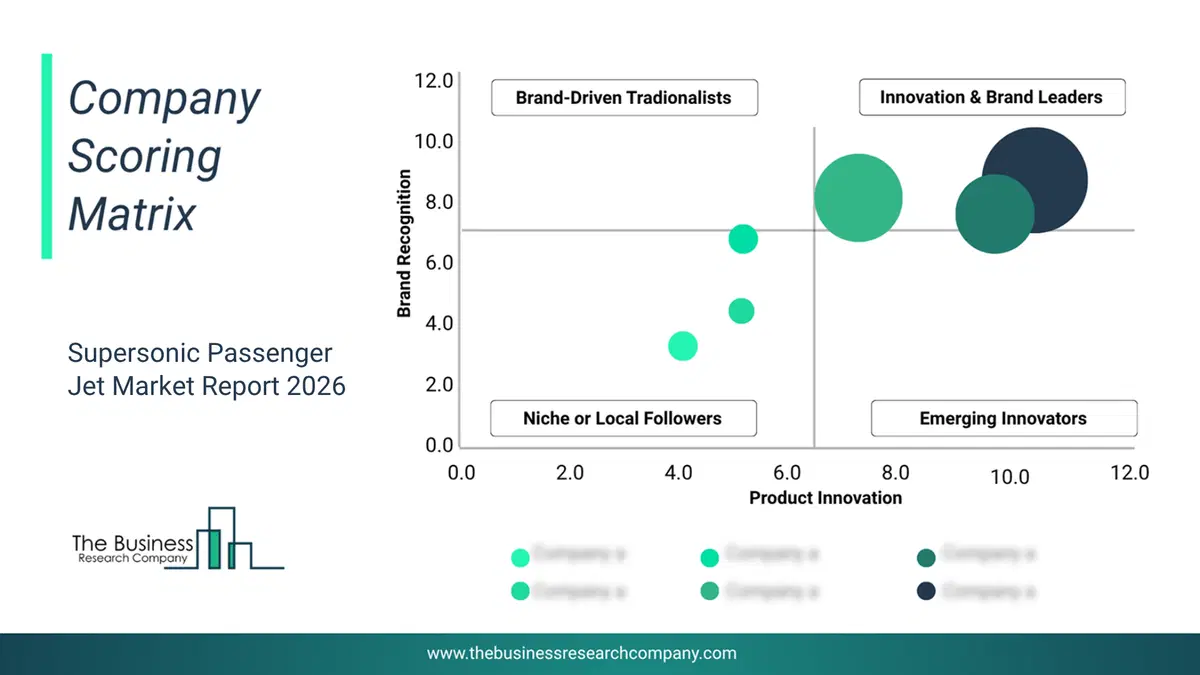
This chart maps companies by product innovation and brand strength, with bubble size indicating relative revenue, helping identify market leaders, challengers, and niche players. This is an illustrative chart; the full report provides a complete and accurate competitive analysis.
Global Supersonic Passenger Jet Market Trends and Insights
Major companies operating in the supersonic passenger jet market are focusing on developing advanced solutions such as, advanced supersonic demonstrator aircraft technologies to enhance high-speed air travel, fuel efficiency, passenger experience, and sustainable aviation capabilities. Advanced supersonic aircraft technologies integrate lightweight composite materials, digitally optimized aerodynamics, advanced avionics, and specialized propulsion systems to enable aircraft to achieve speeds beyond conventional commercial jets while improving operational efficiency and reducing environmental impact. For instance, in March 2024, Boom Supersonic, a US-based aerospace company, successfully conducted the first flight of XB-1, an independently developed supersonic jet demonstrator aircraft designed to validate technologies for its upcoming supersonic passenger airliner, Overture. The XB-1 aircraft incorporates carbon fiber composite structures that provide a lightweight yet strong airframe, digitally optimized aerodynamics developed through computational fluid dynamics simulations, advanced avionics, and an augmented reality vision system to improve pilot visibility during takeoff and landing. The aircraft also features supersonic air intakes that efficiently manage airflow at high speeds, enabling conventional jet engines to support supersonic flight operations. The successful test flight demonstrated key technologies required for the development of Overture, which is designed to carry 64–80 passengers at Mach 1.7, approximately twice the speed of today’s subsonic passenger aircraft, while supporting the use of sustainable aviation fuel.What Are Latest Mergers And Acquisitions In The Supersonic Passenger Jet Market?
In March 2025, Boom Supersonic Inc., a US-based aerospace company developing supersonic passenger aircraft, partnered with National Aeronautics and Space Administration (NASA) to capture specialized data and imagery during supersonic flight tests of Boom’s XB-1 demonstrator aircraft. With this partnership, Boom Supersonic, Inc. and NASA aim to advance understanding of supersonic flight characteristics, analyze shock waves and acoustic performance, support the development of quieter supersonic aircraft, and accelerate the future adoption of sustainable commercial supersonic travel. National Aeronautics and Space Administration (NASA) is a US-based government agency specializing in space exploration, aeronautics research, and advanced aviation technologies.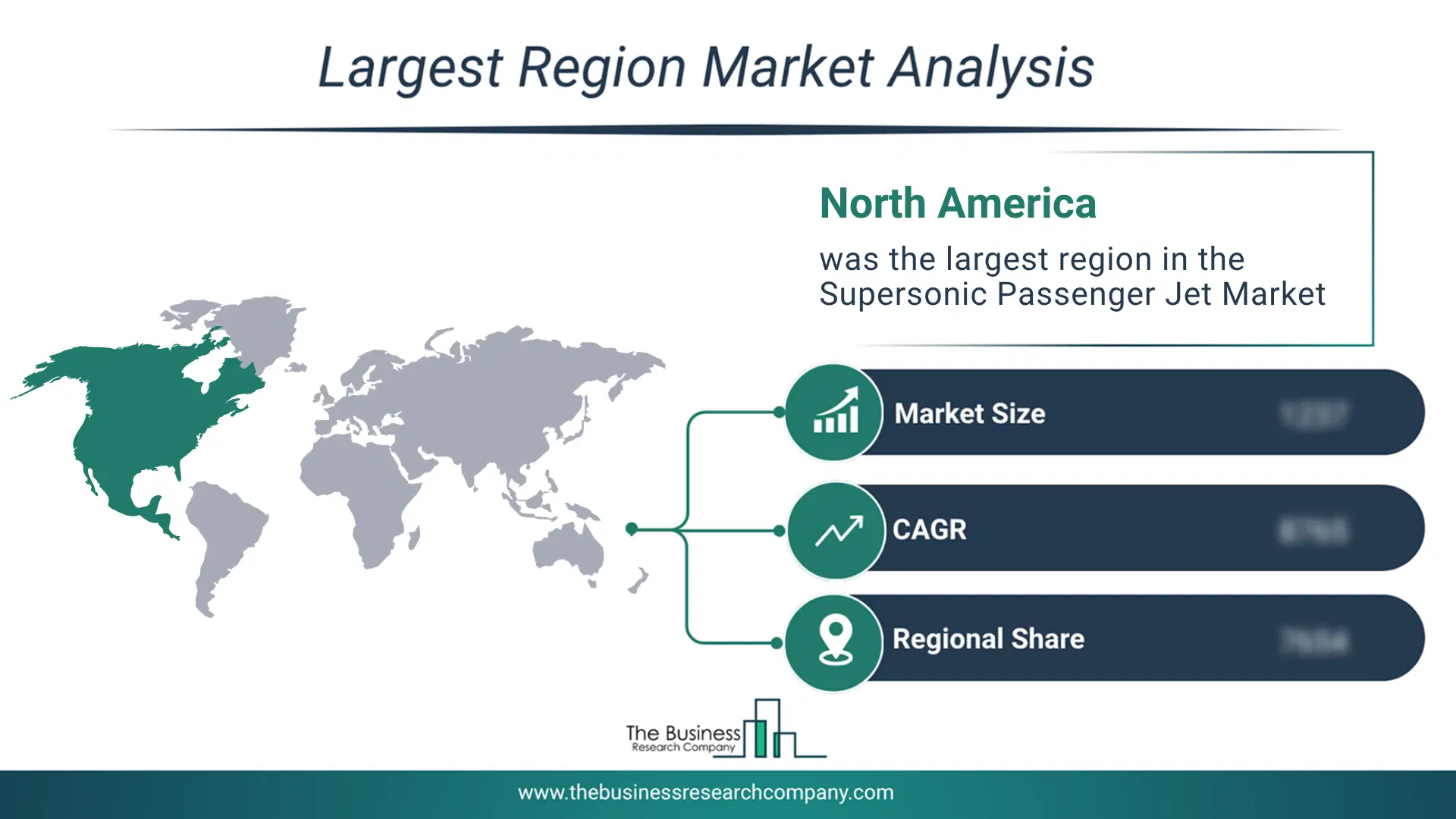
Regional Outlook
North America was the largest region in the supersonic passenger jet market in 2025. Asia-Pacific is expected to be the fastest-growing region in the forecast period. The regions covered in this market report are Asia-Pacific, South East Asia, Western Europe, Eastern Europe, North America, South America, Middle East, Africa. The countries covered in this market report are Australia, Brazil, China, France, Germany, India, Indonesia, Japan, Taiwan, Russia, South Korea, UK, USA, Canada, Italy, Spain.What Defines the Supersonic Passenger Jet Market?
The supersonic passenger jet market consists of sales of airframes, engines, avionics systems, landing gear, and other aircraft components. Values in this market are ‘factory gate’ values, that is, the value of goods sold by the manufacturers or creators of the goods, whether to other entities (including downstream manufacturers, wholesalers, distributors, and retailers) or directly to end customers. The value of goods in this market includes related services sold by the creators of the goods.How is Market Value Defined and Measured?
The market value is defined as the revenues that enterprises gain from the sale of goods and/or services within the specified market and geography through sales, grants, or donations in terms of the currency (in USD unless otherwise specified). The revenues for a specified geography are consumption values that are revenues generated by organizations in the specified geography within the market, irrespective of where they are produced. It does not include revenues from resales along the supply chain, either further along the supply chain or as part of other products.
This chart presents market attractiveness based on a quantitative evaluation of growth, competition, strategic alignment, and risk, offering a clear view of opportunity areas for decision-making. This chart is for illustrative purposes; the full report contains the complete analysis.

This chart highlights the Total Addressable Market (TAM) by estimating the maximum revenue opportunity using an assumption-driven approach, supporting strategic planning and opportunity sizing across markets. The chart is illustrative; the full report provides a more comprehensive analysis.
What Key Data and Analysis Are Included in the Supersonic Passenger Jet Market Report 2026?
The supersonic passenger jet market research report is one of a series of new reports from The Business Research Company that provides market statistics, including industry global market size, regional shares, competitors with the market share, detailed market segments, market trends and opportunities, and any further data you may need to thrive in the supersonic passenger jet industry. The market research report delivers a complete perspective of everything you need, with an in-depth analysis of the current and future state of the industry.Supersonic Passenger Jet Market Report Forecast Analysis
| Report Attribute | Details |
|---|---|
| Market Size Value In 2026 | $2 billion |
| Revenue Forecast In 2030 | $3.45 billion |
| Growth Rate | CAGR of 14.6% from 2026 to 2030 |
| Base Year For Estimation | 2025 |
| Actual Estimates/Historical Data | 2020-2025 |
| Forecast Period | 2026 - 2030 |
| Market Representation | Revenue in USD Billion and CAGR from 2026 to 2030 |
| Segments Covered | Aircraft Type, Component, Speed, Range, End User |
| Regional Scope | Asia-Pacific, Western Europe, Eastern Europe, North America, South America, Middle East, Africa |
| Country Scope | The countries covered in the report are Australia, Brazil, China, France, Germany, India, Indonesia, Japan, Taiwan, Russia, South Korea, UK, USA, Canada, Italy, Spain. |
| Key Companies Profiled | The Boeing Company, Airbus SE, RTX Corporation, Lockheed Martin Corporation, GE Aerospace, Safran SA, Northrop Grumman Corporation, BAE Systems plc, Rolls-Royce Holdings plc, General Dynamics Corporation, Bombardier Inc., Dassault Aviation SA, Hermeus Corporation, Venus Aerospace Corporation, Destinus SA, Spike Aerospace Inc., Space Transportation Inc. |
| Customization Scope | Request for Customization |
| Pricing And Purchase Options | Explore Purchase Options |