
Surgical Fluid Waste Management System Market Report 2026
Global Outlook – By Installation Configuration (Mobile, Wall-Mounted), By Product Type (Surgical Fluid Waste Containers, Fluid Collection Systems, Fluid Disposal Systems, Filters And Waste Management Accessories), By Application (General Surgery, Orthopedic Surgery, Plastic And Reconstructive Surgery, Cardiovascular Surgery, Other Applications), By End Use (Hospitals, Specialty Clinics, Ambulatory Surgical Centers, Other End Users) - Market Size, Trends, And Global Forecast 2026-2035
Surgical Fluid Waste Management System Market Overview
• Surgical Fluid Waste Management System market size has reached to $1.38 billion in 2025 • Expected to grow to $1.97 billion in 2030 at a compound annual growth rate (CAGR) of 7.4% • Growth Driver: Rising Number Of Surgical Procedures Fueling The Growth Of The Market Due To Increasing Demand For Safe And Sterile Operating Environments • Market Trend: Innovative Suction Canisters Enhance Surgical Fluid Management • North America was the largest region in 2025 and Europe is the fastest growing region.Market Gains By 2030 – Top Opportunities By Segment
Market Gain identifies the most promising market opportunities by highlighting the segments or products expected to generate the highest incremental revenue growth over the next five years.
What Is Covered Under Surgical Fluid Waste Management System Market?
A surgical fluid waste management system is a specialized medical device designed to collect, contain, and dispose of bodily fluids generated during surgical procedures. It helps maintain a sterile environment in the operating room by preventing fluid spills and contamination. Its primary purpose is to ensure efficient and hygienic fluid handling, enhancing safety for both patients and healthcare staff. The main types of surgical fluid waste management systems are mobile and wall-mounted. Mobile surgical fluid waste management systems refer to portable, wheeled units designed to collect, contain, and dispose of surgical fluids efficiently during procedures. The various product types include surgical fluid waste containers, fluid collection systems, fluid disposal systems, filters, and waste management accessories and are used for various applications, such as general surgery, orthopedic surgery, plastic and reconstructive surgery, cardiovascular surgery, and others. These serve various end users, including hospitals, specialty clinics, ambulatory surgical centers, and others.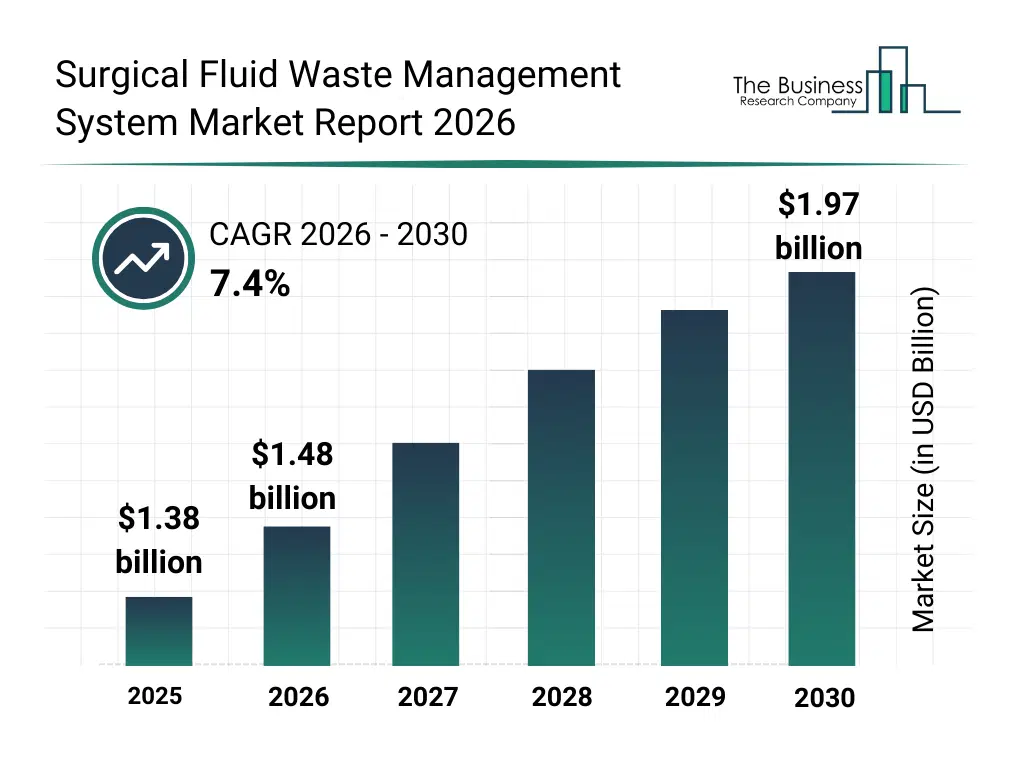
What Is The Surgical Fluid Waste Management System Market Size and Share 2026?
The surgical fluid waste management system market size has grown strongly in recent years. It will grow from $1.38 billion in 2025 to $1.48 billion in 2026 at a compound annual growth rate (CAGR) of 7.2%. The growth in the historic period can be attributed to increasing number of surgical procedures globally, rising awareness of operating room safety, adoption of fluid management protocols, expansion of hospital surgical infrastructure, availability of portable waste management systems.What Is The Surgical Fluid Waste Management System Market Growth Forecast?
The surgical fluid waste management system market size is expected to see strong growth in the next few years. It will grow to $1.97 billion in 2030 at a compound annual growth rate (CAGR) of 7.4%. The growth in the forecast period can be attributed to growing focus on infection prevention technologies, rising demand for automated operating room equipment, expansion of ambulatory surgical centers, increasing adoption of sustainable medical waste solutions, technological advancements in fluid handling systems. Major trends in the forecast period include increasing adoption of closed fluid collection systems, rising demand for touchless fluid disposal solutions, growing focus on infection control compliance, expansion of single-use waste management accessories, enhanced integration of automated suction systems.
Global Surgical Fluid Waste Management System Market Segmentation
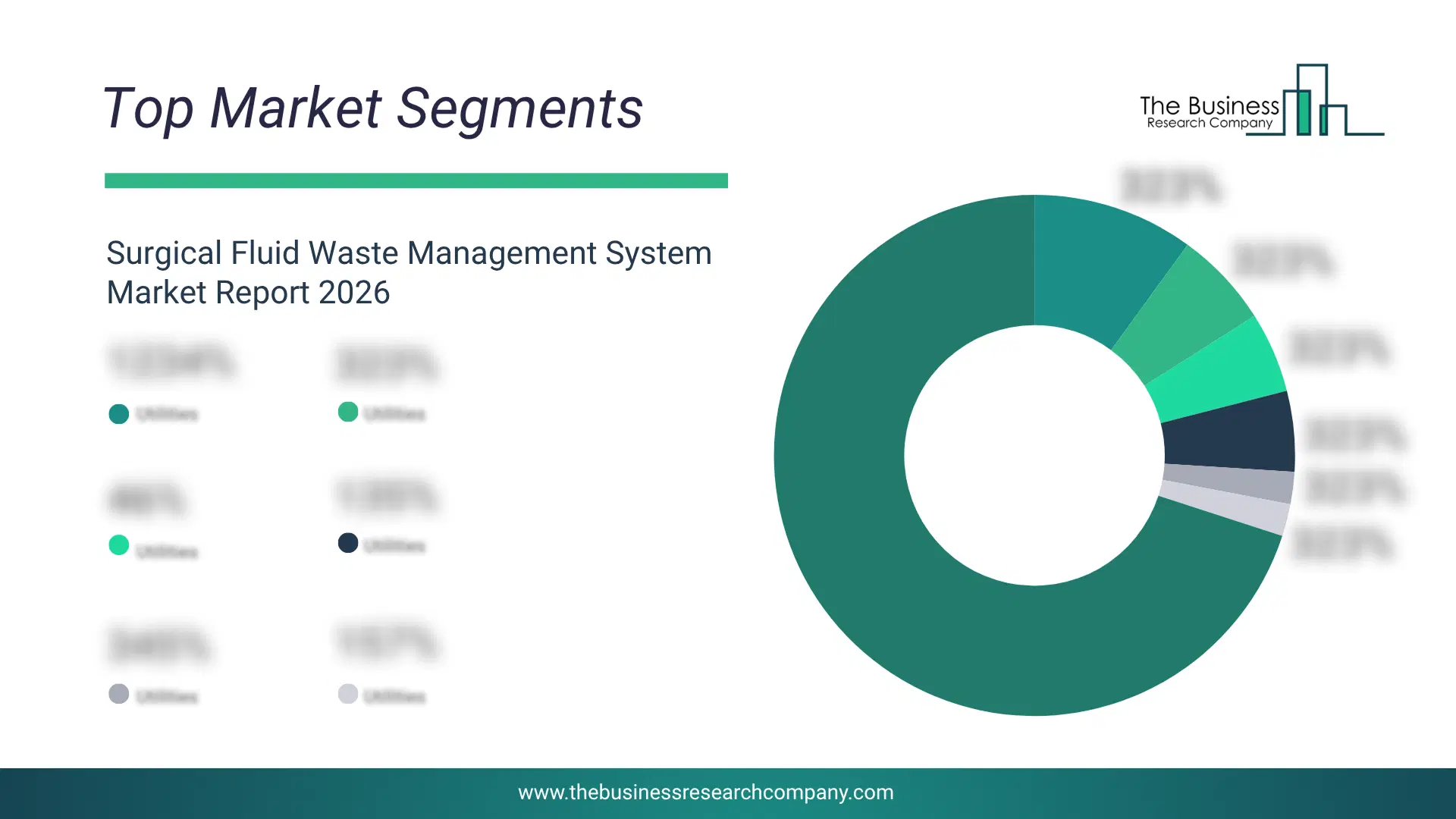
1) By Installation Configuration: Mobile, Wall-Mounted 2) By Product Type: Surgical Fluid Waste Containers, Fluid Collection Systems, Fluid Disposal Systems, Filters And Waste Management Accessories 3) By Application: General Surgery, Orthopedic Surgery, Plastic And Reconstructive Surgery, Cardiovascular Surgery, Other Applications 4) By End Use: Hospitals, Specialty Clinics, Ambulatory Surgical Centers, Other End Users Subsegments: 1) By Mobile: Trolley-Based Systems, Canister-Based Mobile Units, Battery-Operated Mobile Units, Mobile Suction Units With Inbuilt Fluid Solidifiers 2) By Wall-Mounted: Direct-To-Drain Wall Systems, Wall-Mounted Canister-Based Units, Fixed Vacuum-Assisted Wall Units, Modular Wall Suction Stations The top segments in the surgical fluid waste management system market will be: • Mobile will reach $864.3 Million by 2025. • Hospitals will reach $724.8 Million by 2025. • Wall-Mounted will reach $513.2 Million by 2025. • Surgical Fluid Waste Containers will reach $507.6 Million by 2025. • General Surgery will reach $443.4 Million by 2025.What Is The Driver Of The Surgical Fluid Waste Management System Market?
The rising number of surgical procedures is expected to propel the growth of the surgical fluid waste management system market going forward. Surgical procedures refer to medical operations involving manual or instrumental techniques performed to treat diseases, injuries, or deformities. The number of surgical procedures is increasing due to the aging population as older individuals are more prone to chronic illnesses and conditions that often require surgical treatment. Surgical fluid waste management systems aid in surgical procedures by ensuring safe and efficient fluid collection, maintaining a sterile environment in the operating room. They reduce manual handling of biohazardous waste, minimizing infection risk and enhancing surgical workflow efficiency. For instance, in October 2025, according to the UK Government, a UK-based federal agency, the agency reported that in 2023–2024, surveillance data on 135,619 operations showed that the number of surgical procedures submitted rose 8.4% compared to the previous year. Therefore, the rising number of surgical procedures is driving the growth of the surgical fluid waste management system industry.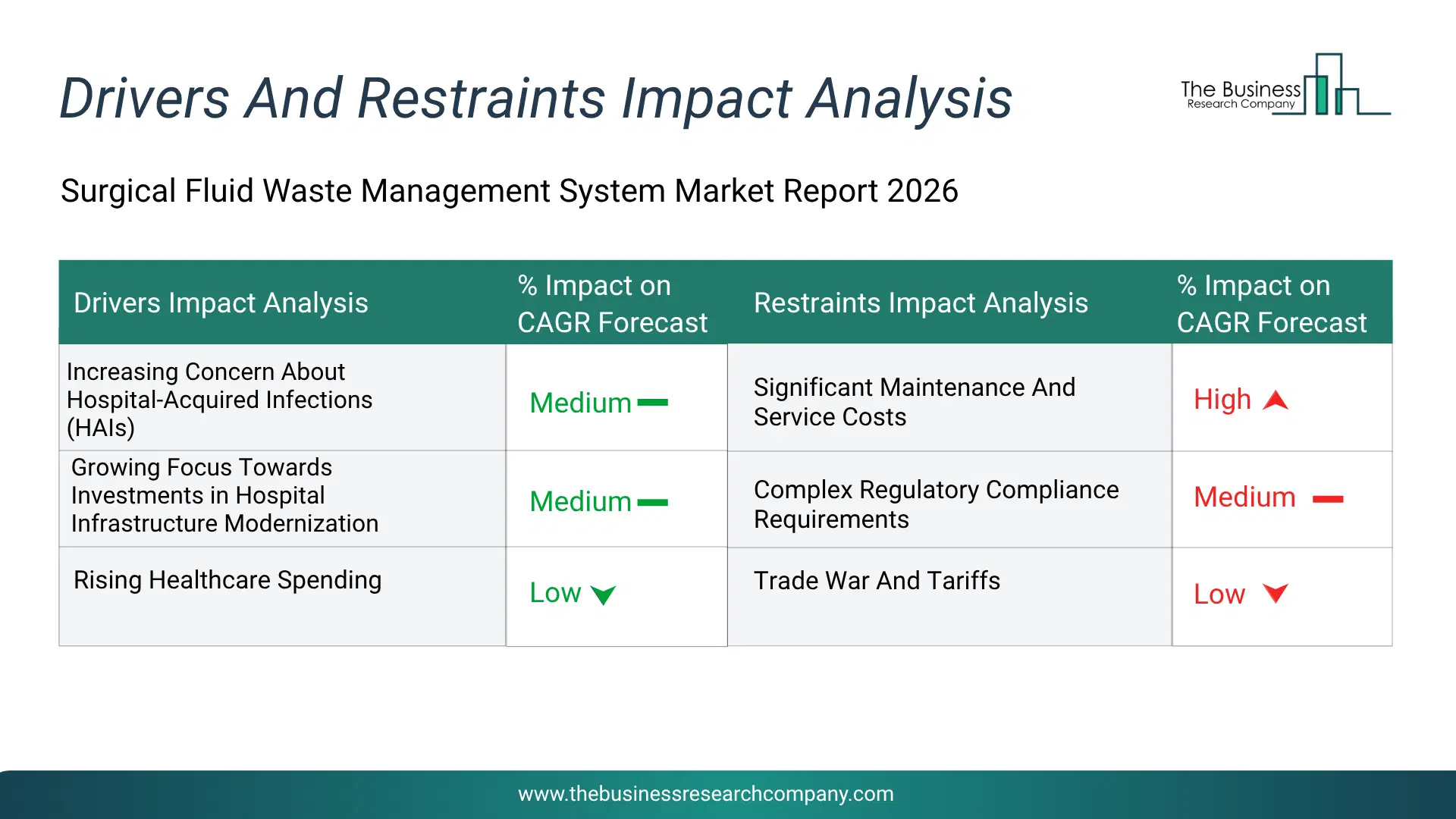
Infographic Chart Showing Key Market Drivers Analysis And Restraints For Surgical Fluid Waste Management System Market
The chart presents an impact analysis of key drivers and restraints, quantifying their relative influence on the market's growth rate and helping assess the balance between growth enablers and limiting factors. This chart offers a high-level perspective; the full report contains more detailed insights.
How Will The Drivers Impact Growth In The Global Surgical Fluid Waste Management System Market?
• Increasing Concern About Hospital-Acquired Infections (HAIs) (Medium) – The growing concern about hospital-acquired infections (HAIs) will become a key driver of growth in the surgical fluid waste management system market by 2030. Increasing awareness among healthcare providers and patients about infection risks associated with contaminated surgical environments is encouraging hospitals to adopt more stringent hygiene and sterilization protocols. Surgical fluid waste management systems play a crucial role in minimizing cross-contamination by ensuring the safe collection, containment and disposal of infectious bodily fluids generated during procedures. As regulatory bodies continue to emphasize infection prevention and patient safety standards, healthcare facilities are increasingly investing in advanced waste management solutions, thereby supporting sustained market expansion. As a result, the growing concern about hospital-acquired infections (HAIs) is anticipated to contributing to a 1.8% annual growth in the market. • Growing Focus Towards Investments in Hospital Infrastructure Modernization (Medium) – The growing focus towards investments in hospital infrastructure modernization will emerge as a major factor driving the expansion of the market by 2030. Healthcare providers are allocating substantial capital toward upgrading operating rooms, integrating advanced medical technologies and improving infection control standards. As hospitals transition toward more efficient and digitally enabled surgical environments, the demand for sophisticated fluid waste management solutions is rising. These systems play a critical role in ensuring safe, hygienic and compliant handling of surgical fluids while enhancing operational efficiency. Consequently, infrastructure modernization initiatives are creating strong growth opportunities for market expansion across both developed and emerging healthcare systems. Consequently, the growing focus towards investments in hospital infrastructure modernization is projected to contributing to a 1.5% annual growth in the market. • Rising Healthcare Spending (Low) – The rising healthcare spending will serve as a key growth catalyst for the market by 2030, as governments, private institutions and healthcare providers allocate higher budgets to strengthen medical infrastructure, hospitals are increasingly able to invest in advanced surgical technologies and support systems. This includes modern fluid waste management solutions that enhance operational efficiency, ensure infection control and comply with stringent regulatory standards. Increased spending also facilitates the adoption of automated and high-capacity systems in operating rooms, improving overall patient safety and workflow management. Consequently, expanding healthcare investments are creating a favourable environment for sustained market growth globally. Therefore, this rising healthcare spending is projected to supporting to a 0.8% annual growth in the market. • Rising Burden Of Trauma And Emergency Surgical Procedures (Low) – The rising burden of trauma and emergency surgical procedures will become a significant driver contributing to the growth of the market by 2030. Rising accident rates, medical emergencies and complex surgical interventions are contributing to increased generation of bodily fluid waste in operating rooms, thereby strengthening the demand for efficient and safe disposal solutions. Healthcare facilities are increasingly prioritizing advanced fluid management systems to maintain hygiene, ensure regulatory compliance and reduce infection risks. Consequently, these factors collectively support sustained market growth and encourage investments in innovative waste handling technologies across surgical care settings. Consequently, the rising burden of trauma and emergency surgical procedures is projected to contributing to a 0.5% annual growth in the market.How Will The Restraints Impact Growth In The Global Surgical Fluid Waste Management System Market?
• Significant Maintenance And Service Costs (Medium) – Significant maintenance and service costs is expected to restrain market growth during the forecast period. It creates operational, financial, regulatory, or commercial challenges that can increase costs, delay projects, reduce investments, or discourage purchasing decisions depending on the market. These challenges can reduce product adoption, affect business confidence, and limit the ability of companies to expand efficiently across key regions. This can reduce operational efficiency, delay expansion plans, and affect the ability of companies to achieve sustainable business growth. • Complex Regulatory Compliance Requirements (Medium) – During the forecast period, complex regulatory compliance requirements is likely to limit market expansion. It creates operational, financial, regulatory, or commercial challenges that can increase costs, delay projects, reduce investments, or discourage purchasing decisions depending on the market. These challenges can reduce product adoption, affect business confidence, and limit the ability of companies to expand efficiently across key regions. As a result, businesses may face increased cost pressures, slower commercial adoption, and reduced revenue opportunities. • Trade War And Tariffs (Low) – The market is expected to face challenges due to trade war and tariffs over the forecast period. It creates operational, financial, regulatory, or commercial challenges that can increase costs, delay projects, reduce investments, or discourage purchasing decisions depending on the market. These challenges can reduce product adoption, affect business confidence, and limit the ability of companies to expand efficiently across key regions. This may discourage new investments, delay strategic expansion initiatives, and weaken the overall competitive position of market participants.Key Players In The Global Surgical Fluid Waste Management System Market
Major companies operating in the surgical fluid waste management system market are Cardinal Health Inc., Medtronic Plc, Stryker Corporation, Ecolab Inc., Smith & Nephew Plc, Baxter International Inc., B. Braun Melsungen AG, Olympus Corporation, Stericycle Inc., Hartmann Group, CONMED Corporation, Amsino International Inc., Veolia Environmental Services, BioMedical Waste Solutions LLC, Serres Oy, IndoSurgicals Private Limited, Getinge AB, STERIS plc, Metrex Research LLC, Medela AG, Rocket Medical plc, Laerdal Medical
This chart is for illustrative purposes; the full report includes a detailed competitor analysis and comprehensive overview of the top 10 companies in the market.
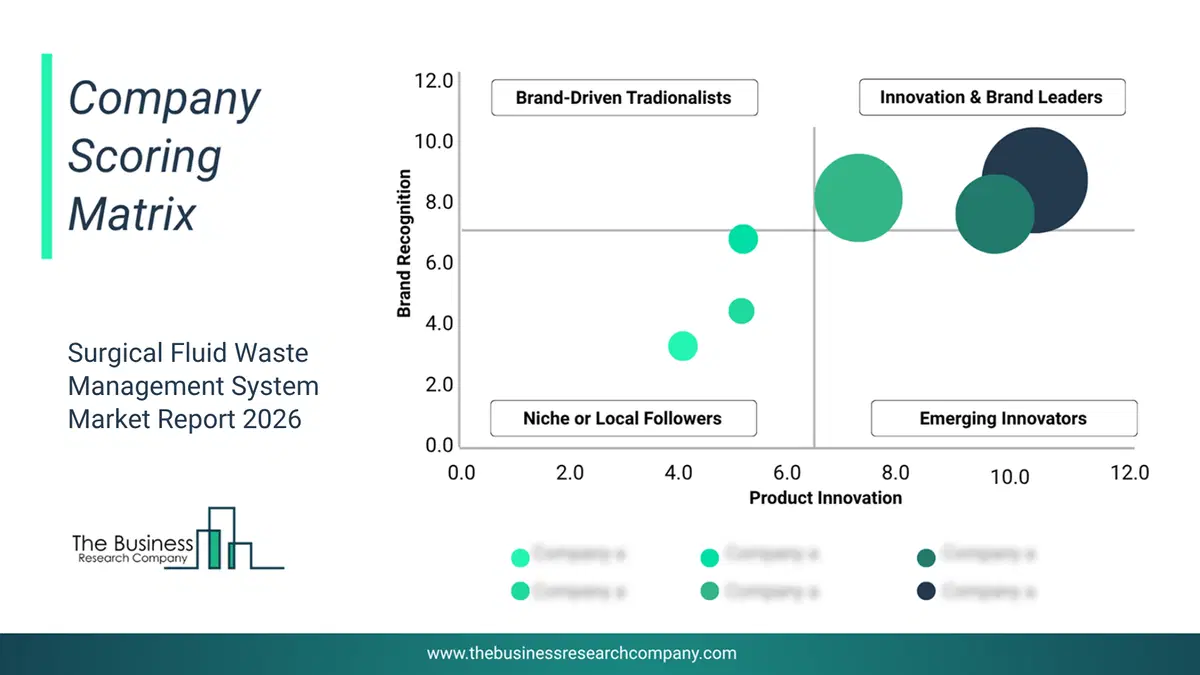
This chart maps companies by product innovation and brand strength, with bubble size indicating relative revenue, helping identify market leaders, challengers, and niche players. This is an illustrative chart; the full report provides a complete and accurate competitive analysis.
Global Surgical Fluid Waste Management System Market Trends and Insights
Major companies operating in the surgical fluid waste management system market are focusing on developing innovative solutions, such suction canisters, to improve safety, efficiency, and compliance in operating rooms. Suction canisters refer to medical containers used to collect and store bodily fluids, such as blood or irrigation fluids, during surgical or medical procedures. They are connected to suction systems and play a critical role in maintaining a clean and safe operating environment by efficiently managing fluid waste. For instance, in April 2024, Typenex Medical LLC, a US-based medical device company, launched fluid fighter suction canisters and liners as part of its expanded fluid waste management portfolio, offering a comprehensive solution for fluid waste retention and disposal in clinical settings. The new product line includes reusable suction canisters, disposable liners, trolleys, wall mounts, solidifiers, and various auxiliary accessories, all designed for compatibility with leading brands and seamless integration into existing workflows. These canisters and liners offer superior durability and advanced hydrophobic filtration, ensuring safe and reliable fluid waste containment in demanding clinical environments.What Are Latest Mergers And Acquisitions In The Surgical Fluid Waste Management System Market?
In March 2025, DeRoyal Industries Inc., a US-based medical device manufacturer, acquired the wall suction waste fluid management product line and related assets from Skyline Medical Inc. for an undisclosed amount. With this acquisition, DeRoyal aims to expand its surgical portfolio, boost its OR waste management presence, and provide more integrated, automated fluid disposal solutions. Skyline Medical Inc. is a US-based medical device manufacturing company specializing in automated surgical fluid waste management systems.
Regional Outlook
North America was the largest region in the surgical fluid waste management system market in 2025. Europe is expected to be the fastest-growing region in the forecast period. The regions covered in this market report are Asia-Pacific, South East Asia, Western Europe, Eastern Europe, North America, South America, Middle East, Africa. The countries covered in this market report are Australia, Brazil, China, France, Germany, India, Indonesia, Japan, Taiwan, Russia, South Korea, UK, USA, Canada, Italy, Spain.What Defines the Surgical Fluid Waste Management System Market?
The surgical fluid waste management system market consists of revenues earned by entities by providing services such as fluid suction and disposal, odor and aerosol control, automated cleaning, fluid collection, and volume measurement and monitoring. The market value includes the value of related goods sold by the service provider or contained within the service offering. The surgical fluid waste management system market also consists of sales of specialized surgical suction devices, fluid collection canisters, waste disposal containers, and filtration or separation units. Values in this market are ‘factory gate’ values, that is, the value of goods sold by the manufacturers or creators of the goods, whether to other entities (including downstream manufacturers, wholesalers, distributors, and retailers) or directly to end customers. The value of goods in this market includes related services sold by the creators of the goods.How is Market Value Defined and Measured?
The market value is defined as the revenues that enterprises gain from the sale of goods and/or services within the specified market and geography through sales, grants, or donations in terms of the currency (in USD unless otherwise specified). The revenues for a specified geography are consumption values that are revenues generated by organizations in the specified geography within the market, irrespective of where they are produced. It does not include revenues from resales along the supply chain, either further along the supply chain or as part of other products.
This chart presents market attractiveness based on a quantitative evaluation of growth, competition, strategic alignment, and risk, offering a clear view of opportunity areas for decision-making. This chart is for illustrative purposes; the full report contains the complete analysis.

This chart highlights the Total Addressable Market (TAM) by estimating the maximum revenue opportunity using an assumption-driven approach, supporting strategic planning and opportunity sizing across markets. The chart is illustrative; the full report provides a more comprehensive analysis.
What Key Data and Analysis Are Included in the Surgical Fluid Waste Management System Market Report 2026?
The surgical fluid waste management system market research report is one of a series of new reports from The Business Research Company that provides market statistics, including industry global market size, regional shares, competitors with the market share, detailed market segments, market trends and opportunities, and any further data you may need to thrive in the surgical fluid waste management system industry. The market research report delivers a complete perspective of everything you need, with an in-depth analysis of the current and future state of the industry.Surgical Fluid Waste Management System Market Report Forecast Analysis
| Report Attribute | Details |
|---|---|
| Market Size Value In 2026 | $1.48 billion |
| Revenue Forecast In 2035 | $1.97 billion |
| Growth Rate | CAGR of 7.2% from 2026 to 2035 |
| Base Year For Estimation | 2025 |
| Actual Estimates/Historical Data | 2020-2025 |
| Forecast Period | 2026 - 2030 - 2035 |
| Market Representation | Revenue in USD Billion and CAGR from 2026 to 2035 |
| Segments Covered | Installation Configuration, Product Type, Application, End Use |
| Regional Scope | Asia-Pacific, Western Europe, Eastern Europe, North America, South America, Middle East, Africa |
| Country Scope | The countries covered in the report are Australia, Brazil, China, France, Germany, India, ... |
| Key Companies Profiled | Cardinal Health Inc., Medtronic Plc, Stryker Corporation, Ecolab Inc., Smith & Nephew Plc, Baxter International Inc., B. Braun Melsungen AG, Olympus Corporation, Stericycle Inc., Hartmann Group, CONMED Corporation, Amsino International Inc., Veolia Environmental Services, BioMedical Waste Solutions LLC, Serres Oy, IndoSurgicals Private Limited, Getinge AB, STERIS plc, Metrex Research LLC, Medela AG, Rocket Medical plc, Laerdal Medical |
| Customization Scope | Request for Customization |
| Pricing And Purchase Options | Explore Purchase Options |