
Surgical Visualization Products Market 2026
By Product Type (Endoscopic Camera, Accessories, Light Sources, Display And Monitors, Video Recorders And Processor, Camera Heads And Video Converters), By Distribution Channel (Direct Tender, Third Party Distributors), By Application (Arthroscopy, Laparoscopy, ENT Endoscopy, Obstetrics And Gynecology Endoscopy, Urology Endoscopy, Gastroscopy, Other Applications), By End User (Hospital, Specialty Clinics, Diagnostic Imaging Centers, Ambulatory Surgical Centers, Other End Users), And By Region, Opportunities And Strategies – Global Forecast To 2035
Surgical Visualization Products Market Definition
Surgical visualization refers to the use of advanced imaging and optical technologies to provide surgeons with enhanced, real-time views of the operative field during medical procedures. This includes tools such as endoscopes, surgical microscopes, 3D imaging systems, augmented reality (AR) and high-definition cameras to improve accuracy and precision. The primary purpose of surgical visualization is to improve surgical outcomes by enabling precise navigation, minimizing tissue damage and enhancing intraoperative decision-making. The surgical visualization products market consists of sales, by entities (organizations, sole traders, or partnerships), of surgical visualization products that are essential tools in modern surgical practices, allowing surgeons to view internal structures with precision and clarity, thereby enhancing surgical accuracy and improving patient outcomes. The users of surgical visualization products include surgeons, surgical assistants, operating room staff and medical imaging technicians across hospitals, specialty clinics, diagnostic centers and ambulatory surgical centers.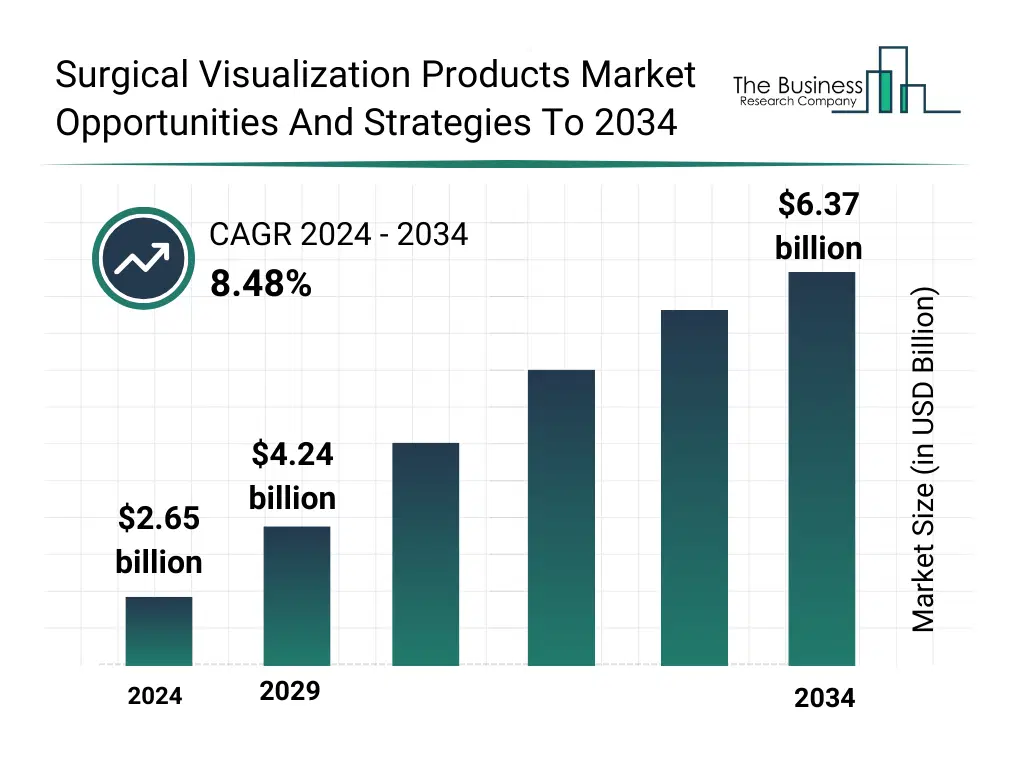
Surgical Visualization Products Market Size
The global surgical visualization products market reached a value of nearly $2,653.18 million in 2024, having grown at a compound annual growth rate (CAGR) of 7.71% since 2019. The market is expected to grow from $2,653.18 million in 2024 to $4,237.32 million in 2029 at a rate of 9.82%. The market is then expected to grow at a CAGR of 8.48% from 2029 and reach $6,366.17 million in 2034. Growth in the historic period resulted from rising number of surgeries, growth in minimally invasive surgical procedures (MIS), increasing medical tourism and growing number hospital infrastructure. Factors that negatively affected growth in the historic period were high upfront costs for advanced surgical visualization systems and shortage of skilled professionals. Going forward, rising prevalence of chronic diseases, increasing use of endoscopic procedures, increased emphasis on surgical training and simulation systems and government initiatives and funding for modernizing healthcare systems will drive growth. Factors that could hinder the growth of the surgical visualization products market in the future include frequent software updates and technical downtime, maintenance and sterilization challenges and trade war and tariffs.Surgical Visualization Products Market Drivers
The key drivers of the surgical visualization products market include: Rising Prevalence Of Chronic Diseases During forecast period, the rising prevalence of chronic diseases is expected to propel the growth of the surgical visualization products market. As the incidence of conditions such as cardiovascular disorders, cancer and neurological ailments rises globally, the demand for advanced surgical interventions is expected to grow correspondingly. Surgeons are increasingly relying on high-precision visualization tools to enhance procedural accuracy, reduce operative risks and improve patient outcomes. Consequently, hospitals and healthcare providers are investing in state-of-the-art imaging and visualization solutions to meet the growing clinical demand. This trend is anticipated to serve as a key growth driver for the market in the coming years. Therefore, the rising prevalence of chronic diseases will drive the growth of the surgical visualization products market. The increasing prevalence of chronic diseases growth during the forecast period in 2024 is 1.50%.Surgical Visualization Products Market Restraints
The key restraints on the surgical visualization products market include: High Upfront Costs For Advanced Surgical Visualization Systems High upfront costs for advanced surgical visualization systems hindered the growth of the surgical visualization products market in the historic period. These state-of-the-art technologies, including high-definition imaging systems, endoscopic equipment and integrated surgical platforms, require significant capital investment, which can be a barrier for hospitals and healthcare providers, particularly in cost-sensitive regions. The substantial initial expenditure often delayed adoption, limiting the widespread deployment of these solutions. Additionally, smaller clinics and emerging-market healthcare facilities faced budgetary constraints that hindered their ability to invest in such advanced equipment. For instance, according to the National Institutes of Health (NIH), a US-based government organization, reported that conventional endoscopes are expensive, costing about $20,000–$40,000 for a single tube and $80,000–$120,000 for a complete dual-tube system, while an additional endoscopic ultrasound system can cost around $200,000. Therefore, high upfront costs for advanced surgical visualization systems hindered the growth of the surgical visualization products market. Growth affected by high upfront costs for advanced surgical visualization systems during the forecast period in 2024 is -1.55%.Surgical Visualization Products Market Trends
Major trends shaping the surgical visualization products market include: Advanced Multi-Specialty 4K Imaging Enhances Surgical Precision And Patient Outcomes Companies operating in the surgical visualization products market are focusing on delivering multi-specialty 4K imaging platforms with enhanced fluorescence, wide color gamut, high dynamic range, advanced perfusion mapping and OLED displays to improve surgical precision, visualization and patient outcomes. For instance, in September 2024, Stryker Corporation, a US-based medical technology company, has launched its 1788 advanced imaging platform in India, marking a major leap in surgical visualization technology. Designed for use across multiple specialties, the 1788 platform delivers ultra-clear 4K imaging with enhanced fluorescence capabilities, enabling superior visualization of perfusion, tumors and complex anatomy. Featuring a wider color gamut, high dynamic range and the new color segmented fluorescence (CSF) mode for precise perfusion mapping, it supports agents like CYTALUX and future fluorescence modes. Equipped with an OLED display, the system ensures vibrant, balanced images. Developed with surgeon input, the 1788 platform reinforces Stryker’s commitment to advancing surgical precision, user experience and improved patient outcomes in diverse clinical applications. High-Resolution Endoscopic Imaging Enhances Precision In Minimally Invasive Procedures Major companies operating in the surgical visualization products market are focusing on developing high-resolution 4K endoscopic imaging systems with multiple visualization modes, compact designs and enhanced tissue and vascular clarity to improve diagnostic accuracy, support minimally invasive procedures and optimize patient outcomes. For instance, in September 2024, Olympus Corporation, a Japan-based optics and reprography products manufacturing company, has introduced the CH-S700-08-LB, a new 4K camera head for endoscopic urology and gynecology, compatible with the VISERA ELITE III system. Developed with Sony Olympus Medical Solutions, the device delivers four times the resolution of HD, supporting 4K white light, 4K narrow band imaging (NBI) and blue light (BL) observation. These imaging modes enable enhanced visualization of vascular and tissue structures, aiding in the detection and treatment of conditions such as bladder cancer. By integrating advanced imaging into one compact device, Olympus aims to improve diagnostic accuracy, support minimally invasive procedures and enhance patient outcomes across urological and gynecological care pathways.Opportunities And Recommendations In The Surgical Visualization Products Market
Opportunities – The top opportunities in the surgical visualization products market segmented by product type will arise in the endoscopic camera segment, which will gain $574.92 million of global annual sales by 2029. The top opportunities in the surgical visualization products market segmented by distribution channel will arise in the direct tender segment, which will gain $877.76 million of global annual sales by 2029. The top opportunities in the surgical visualization products market segmented by application will arise in the laparoscopy segment, which will gain $499.08 million of global annual sales by 2029. The top opportunities in the surgical visualization products market segmented by end-user will arise in the hospital segment, which will gain $583.54 million of global annual sales by 2029. The surgical visualization products market size will gain the most in the USA at $559.29 million. Recommendations- To take advantage of the opportunities, The Business Research Company recommends the surgical visualization products companies to focus on intelligent robotic visualization platforms with integrated data connectivity, focus on multi-specialty 4K platforms with advanced fluorescence and display performance, focus on compact 4K endoscopic systems with multi-mode visualization, focus on large-format 4K surgical displays with multi-source visualization and reliable integration, focus on high-zoom 4K surgical cameras with remote collaboration support, focus on compact high-brightness 4K mini-LED monitors with visual accuracy and durability, focus on high-growth display and monitor systems, focus on third-party distributor channels, focus on ENT endoscopy applications, expand in emerging markets, continue to focus on developed markets, focus on disciplined price architecture aligned with clinical value, build credibility through evidence and education, align promotion with buyer decision processes and focus on ambulatory surgical centers.
Surgical Visualization Products Market Segmentation
The surgical visualization products market is segmented by product type, by distribution channel, by application and by end-user.By Product Type –
The surgical visualization products market is segmented by product type into:
- a) Endoscopic Camera
- b) Accessories
- c) Light Sources
- d) Display And Monitors
- e) Video Recorders And Processor
- f) Camera Heads And Video Converters
By Distribution Channel –
The surgical visualization products market is segmented by distribution channel into:
- a) Direct Tender
- b) Third Party Distributors
By Application –
The surgical visualization products market is segmented by application into:
- a) Arthroscopy
- b) Laparoscopy
- c) ENT Endoscopy
- d) Obstetrics And Gynecology Endoscopy
- e) Urology Endoscopy
- f) Gastroscopy
- g) Other Applications
By End-User –
The surgical visualization products market is segmented by end-user into:
- a) Hospitals
- b) Specialty Clinics
- c) Diagnostic Imaging Centers
- d) Ambulatory Surgical Centers
- e) Other End Users
By Geography - The surgical visualization products market is segmented by geography into:
- • China
- • India
- • Japan
- • Australia
- • Indonesia
- • South Korea
- • USA
- • Canada
- • Brazil
- • France
- • Germany
- • UK
- • Italy
- • Spain
- • Russia
-
o Asia Pacific
o Africa