

Sustainability Certification Market Report 2026
Global Outlook – By Certification Type (Environmental Certifications, Social Certifications, Product Certifications, Sustainable Supply Chain Certifications), By Service Type (Certification And Auditing, Training And Education, Consulting, Other Service Types), By Service Provider (Third-Party Certifying Bodies, Government And Non-Governmental Agencies), By Vertical (Industrial, Commercial), By End-Use (Industrial Machinery, Automotive, Construction, Food And Beverage, Information Technology, Energy And Utilities, Aerospace And Defense, Healthcare, Other End-Uses) – Market Size, Trends, Strategies, and Forecast to 2030
Sustainability Certification Market Overview
• Sustainability Certification market size has reached to $3.1 billion in 2025 • Expected to grow to $4.49 billion in 2030 at a compound annual growth rate (CAGR) of 7.6% • Growth Driver: Rising Consumer Demand For Green Products Is Fueling The Growth Of The Market Due To Increasing Preference For Verified Sustainable Choices • Market Trend: Focus On Single-Attribute Certifications To Combat Greenwashing And Ensure Credibility • North America was the largest region in 2025 and Asia-Pacific is the fastest growing region.What Is Covered Under Sustainability Certification Market?
Sustainability certification is a formal recognition granted by an independent organization to verify that a product, service, or company meets specific environmental, social, and economic standards. This certification helps businesses demonstrate their commitment to responsible practices, improve transparency across supply chains, and build consumer trust by validating sustainable performance. The main certification types of sustainability certification are environmental certifications, social certifications, product certifications, and sustainable supply chain certifications. Environmental certifications are formal recognitions awarded to products, services, or organizations that meet specific environmental standards and demonstrate sustainable and eco-friendly practices. The various service types are certification and auditing, training and education, consulting, and others, provided by service providers such as third-party certifying bodies, government and non-governmental agencies, and in-house corporate certification programs. The sustainability certification is used in various verticals such as industrial, commercial, and residential, in several end-uses such as industrial machinery, automotive, construction, food and beverage, information technology, energy and utilities, aerospace and defense, healthcare, and others.
What Is The Sustainability Certification Market Size and Share 2026?
The sustainability certification market size has grown strongly in recent years. It will grow from $3.1 billion in 2025 to $3.35 billion in 2026 at a compound annual growth rate (CAGR) of 7.9%. The growth in the historic period can be attributed to increasing corporate sustainability reporting requirements, growth of global supply chain auditing, rising consumer demand for ethical products, expansion of environmental compliance frameworks, early adoption of third-party certification models.What Is The Sustainability Certification Market Growth Forecast?
The sustainability certification market size is expected to see strong growth in the next few years. It will grow to $4.49 billion in 2030 at a compound annual growth rate (CAGR) of 7.6%. The growth in the forecast period can be attributed to increasing regulatory enforcement of sustainability standards, rising integration of digital traceability tools, expansion of ESG-driven procurement policies, growing focus on lifecycle impact assessment, increasing investments in sustainability assurance services. Major trends in the forecast period include increasing demand for verified environmental certifications, rising adoption of supply chain transparency standards, growing use of digital certification platforms, expansion of industry-specific sustainability standards, enhanced focus on compliance and audit automation.
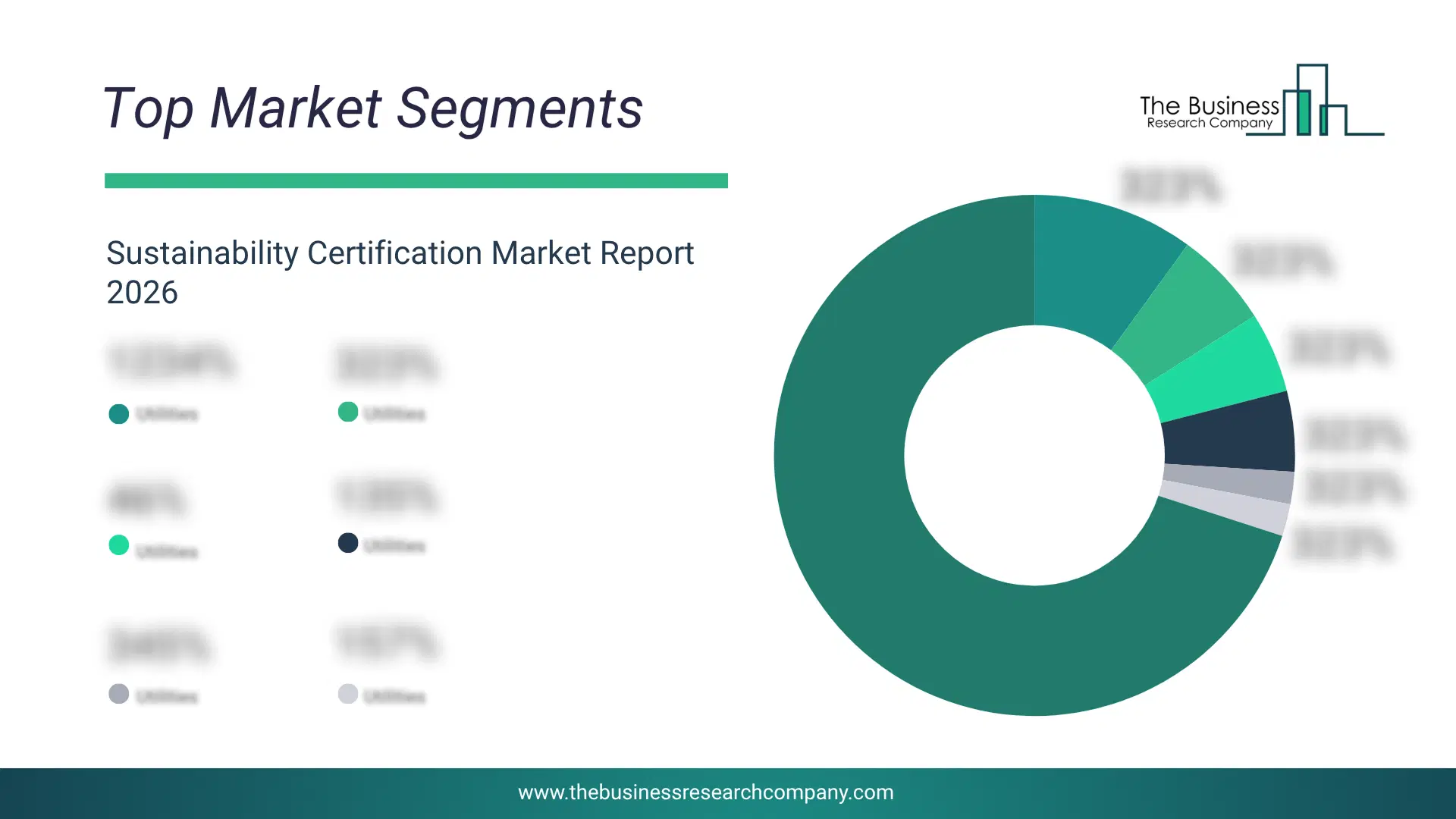
Global Sustainability Certification Market Segmentation
1) By Certification Type: Environmental Certifications, Social Certifications, Product Certifications, Sustainable Supply Chain Certifications 2) By Service Type: Certification And Auditing, Training And Education, Consulting, Other Service Types 3) By Service Provider: Third-Party Certifying Bodies, Government And Non-Governmental Agencies 4) By Vertical: Industrial, Commercial 5) By End-Use: Industrial Machinery, Automotive, Construction, Food And Beverage, Information Technology, Energy And Utilities, Aerospace And Defense, Healthcare, Other End-Uses Subsegments: 1) By Environmental Certifications: Carbon Neutral Certification, Energy Efficiency Certification, Water Stewardship Certification, Waste Management Certification, Biodiversity Certification 2) By Social Certifications: Fair Trade Certification, Labor Rights Certification, Community Impact Certification, Diversity And Inclusion Certification, Occupational Health And Safety Certification 3) By Product Certifications: Organic Certification, Non-Genetically Modified Organism Certification, Eco-Label Certification, Biodegradable Certification, Recycled Content Certification 4) By Sustainable Supply Chain Certifications: Responsible Sourcing Certification, Conflict-Free Certification, Supply Chain Transparency Certification, Ethical Procurement Certification, Sustainable Logistics CertificationWhat Is The Driver Of The Sustainability Certification Market?
The rising consumer demand for green products is expected to propel the growth of the sustainability certification market going forward. Green products are environmentally friendly goods that are designed, produced, and used in ways that minimize their impact on the environment throughout their lifecycle. The rise in consumer demand for green products is due to environmentally conscious buyers seeking sustainable choices that reduce ecological impact, promote health, and align with ethical values without compromising on quality or convenience. Sustainability certification supports green products by verifying their environmental integrity, giving consumers confidence that the products meet credible standards for responsible and eco-friendly practices. For instance, in June 2024, according to Converged by Propel, a US-based company that provides SaaS (Software as a Service), U.S. consumers have spent 33% more on sustainable items than they did the year before, with the average yearly spending on green products having increased to $12,000 from the $9,000 reported in 2023. Therefore, rising consumer demand for green products is driving growth in the sustainability certification industry.Key Players In The Global Sustainability Certification Market
Major companies operating in the sustainability certification market are Technischer Überwachungsverein Rheinland, Bureau Veritas SA, DEKRA SE, Intertek Group Public Limited Company, Canadian Standards Association Group, SGS Société Générale de Surveillance SA, NSF International, Scientific Certification Systems Global Services, Forest Stewardship Council, Leadership in Energy and Environmental Design – U.S. Green Building Council, The Carbon Trust, Rainforest Alliance Inc., Soil Association Limited, SustainCert SA, Bio Suisse Association, Global Organic Textile Standard International Working Group, Bureau of Indian Standards, Responsible Jewellery Council, Joint Accreditation System of Australia and New Zealand, Cradle to Cradle Products Innovation Institute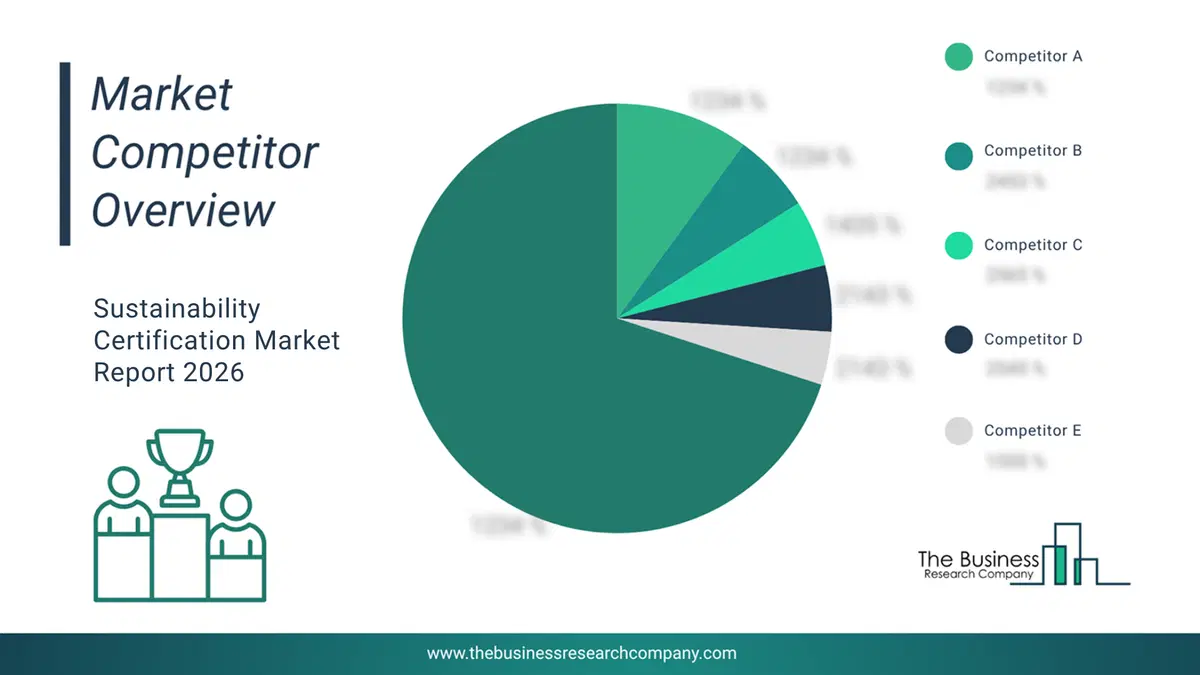
This chart is for illustrative purposes; the full report includes a detailed competitor analysis and comprehensive overview of the top 10 companies in the market.
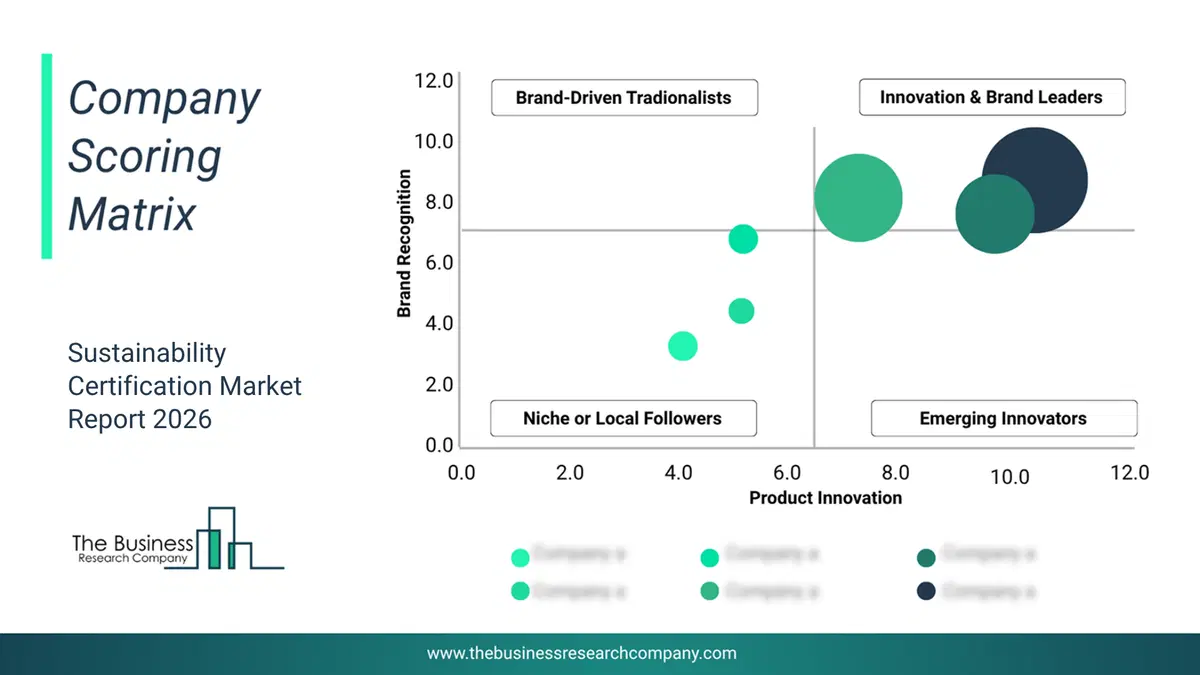
This chart maps companies by product innovation and brand strength, with bubble size indicating relative revenue, helping identify market leaders, challengers, and niche players. This is an illustrative chart; the full report provides a complete and accurate competitive analysis.
Global Sustainability Certification Market Trends and Insights
Major companies operating in the sustainability certification market are focusing on the single-attribute certifications to demonstrate specific environmental claims with greater transparency and regulatory alignment. Single-attribute certifications are sustainability labels that verify one specific environmental claim, such as recycled content, biodegradability, or energy efficiency. For instance, in May 2024, SGS S.A., a Switzerland-based company that provides verification, testing, and certification services, launched the SGS Green Mark, a sustainability certification program verifying seven environmental claims, including recycled content and biodegradability. This launch allows companies across industries to prove the credibility of their environmental efforts through independent third-party verification, ensuring claims are scientifically validated and meet recognized standards. It's unique focus on single-attribute certification simplifies the process, enabling businesses to clearly showcase specific environmental features and address growing regulatory scrutiny against greenwashing.What Are Latest Mergers And Acquisitions In The Sustainability Certification Market?
In January 2025, SGS S.A., a Switzerland-based company that provides verification, testing, and certification services, acquired Aster Global Environmental Solutions Inc. for an undisclosed amount. Through this acquisition, SGS aims to strengthen its sustainability service offerings by expanding expertise in greenhouse gas validation and verification, enhancing its ability to meet growing global demand for accurate environmental and social responsibility disclosures. Aster Global Environmental Solutions Inc. is a US-based environmental services company that provides sustainability certification.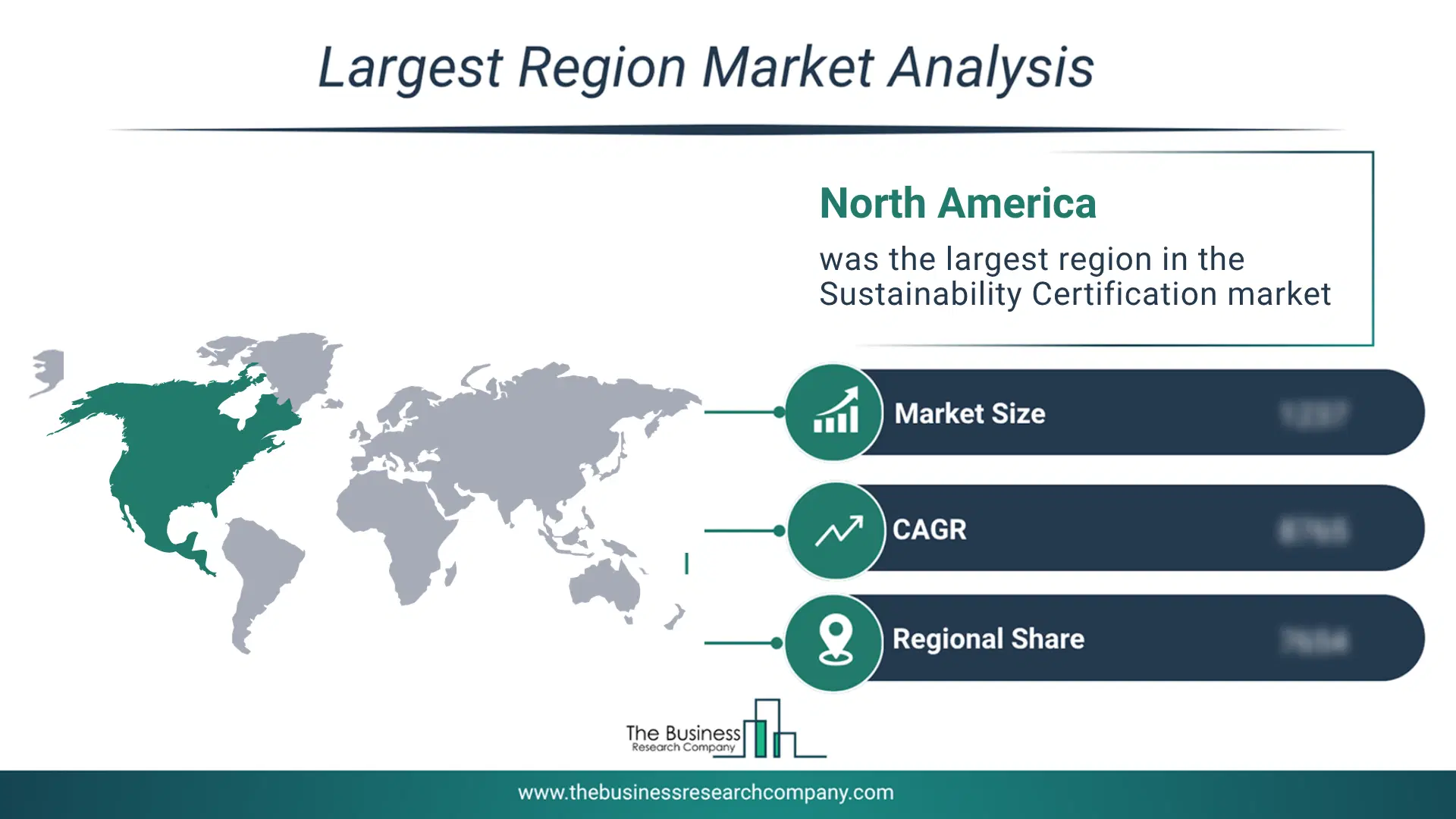
Regional Insights
North America was the largest region in the sustainability certification market in 2025. Asia-Pacific is expected to be the fastest-growing region in the forecast period. The regions covered in this market report are Asia-Pacific, South East Asia, Western Europe, Eastern Europe, North America, South America, Middle East, Africa. The countries covered in this market report are Australia, Brazil, China, France, Germany, India, Indonesia, Japan, Taiwan, Russia, South Korea, UK, USA, Canada, Italy, Spain.What Defines the Sustainability Certification Market?
The sustainability certification market includes revenues earned by entities through the carbon footprint assessment services, life cycle assessment (LCA), sustainability reporting and disclosure support, supply chain risk assessment, pre-assessment and readiness review, and sustainability strategy development. The market value includes the value of related goods sold by the service provider or included within the service offering. Only goods and services traded between entities or sold to end consumers are included.How is Market Value Defined and Measured?
The market value is defined as the revenues that enterprises gain from the sale of goods and/or services within the specified market and geography through sales, grants, or donations in terms of the currency (in USD unless otherwise specified). The revenues for a specified geography are consumption values that are revenues generated by organizations in the specified geography within the market, irrespective of where they are produced. It does not include revenues from resales along the supply chain, either further along the supply chain or as part of other products.
This chart presents market attractiveness based on a quantitative evaluation of growth, competition, strategic alignment, and risk, offering a clear view of opportunity areas for decision-making. This chart is for illustrative purposes; the full report contains the complete analysis.

This chart highlights the Total Addressable Market (TAM) by estimating the maximum revenue opportunity using an assumption-driven approach, supporting strategic planning and opportunity sizing across markets. The chart is illustrative; the full report provides a more comprehensive analysis.
What Key Data and Analysis Are Included in the Sustainability Certification Market Report 2026?
The sustainability certification market research report is one of a series of new reports from The Business Research Company that provides market statistics, including industry global market size, regional shares, competitors with the market share, detailed market segments, market trends and opportunities, and any further data you may need to thrive in the sustainability certification industry. The market research report delivers a complete perspective of everything you need, with an in-depth analysis of the current and future state of the industry.Sustainability Certification Market Report Forecast Analysis
| Report Attribute | Details |
|---|---|
| Market Size Value In 2026 | $3.35 billion |
| Revenue Forecast In 2030 | $4.49 billion |
| Growth Rate | CAGR of 7.9% from 2026 to 2030 |
| Base Year For Estimation | 2025 |
| Actual Estimates/Historical Data | 2020-2025 |
| Forecast Period | 2026 - 2030 |
| Market Representation | Revenue in USD Billion and CAGR from 2026 to 2030 |
| Segments Covered | Certification Type, Service Type, Service Provider, Vertical, End-Use |
| Regional Scope | Asia-Pacific, Western Europe, Eastern Europe, North America, South America, Middle East, Africa |
| Country Scope | The countries covered in the report are Australia, Brazil, China, France, Germany, India, Indonesia, Japan, Taiwan, Russia, South Korea, UK, USA, Canada, Italy, Spain. |
| Key Companies Profiled | Technischer Überwachungsverein Rheinland, Bureau Veritas SA, DEKRA SE, Intertek Group Public Limited Company, Canadian Standards Association Group, SGS Société Générale de Surveillance SA, NSF International, Scientific Certification Systems Global Services, Forest Stewardship Council, Leadership in Energy and Environmental Design – U.S. Green Building Council, The Carbon Trust, Rainforest Alliance Inc., Soil Association Limited, SustainCert SA, Bio Suisse Association, Global Organic Textile Standard International Working Group, Bureau of Indian Standards, Responsible Jewellery Council, Joint Accreditation System of Australia and New Zealand, Cradle to Cradle Products Innovation Institute |
| Customization Scope | Request for Customization |
| Pricing And Purchase Options | Explore Purchase Options |