
Sustainable Cabin Textiles Market Report 2026
Global Outlook – By Product Type (Seat Upholstery Fabrics, Carpets And Floor Coverings, Curtains And Drapes, Wall Panels And Coverings, Headliners And Ceiling Fabrics, Insulation Textiles, Decorative And Trim Fabrics), By Material Type (Organic Cotton, Recycled Polyester, Hemp, Bamboo, Wool, Other Material Types), By Distribution Channel (Direct Sales, Distributors Or Wholesalers, Online Retail, Other Distribution Channels), By Application (Seating Upholstery, Curtains And Drapes, Carpets And Rugs, Wall Coverings, Other Applications), By End-Use (Aviation, Marine, Railways, Automotive, Other End-Uses) – Market Size, Trends, Strategies, and Forecast to 2035
Sustainable Cabin Textiles Market Overview
• Sustainable Cabin Textiles market size has reached to $2.24 billion in 2025 • Expected to grow to $3.68 billion in 2030 at a compound annual growth rate (CAGR) of 10.5% • Growth Driver: Growth in Global Air Travel Driving The Expansion Of The Market Due To Increasing Passenger Demand And Airline Capacity Utilization • Market Trend: Sustainable Airline Textile Solutions Enhance Cabin Comfort While Meeting Environmental Standards • Europe was the largest region in the sustainable cabin textiles market in 2025. Asia Pacific was the largest region in 2025 and Asia-Pacific is the fastest growing region.What Is Covered Under Sustainable Cabin Textiles Market?
Sustainable cabin textiles are eco-friendly fabric materials designed for use in interior cabin environments, produced using renewable, recycled, or low-impact resources to minimize environmental footprint. They incorporate advanced manufacturing processes that reduce energy consumption, emissions, and waste while maintaining durability, safety, and performance standards. These textiles emphasize life cycle sustainability, including recyclability, biodegradability, and responsible sourcing of raw materials. The main product types of sustainable cabin textiles include seat upholstery fabrics, carpets and floor coverings, curtains and drapes, wall panels and coverings, headliners and ceiling fabrics, insulation textiles, and decorative and trim fabrics. Seat upholstery fabrics refer to eco-friendly textile materials designed for covering seats while ensuring durability, comfort, and reduced environmental impact. These textiles are made using material types such as organic cotton, recycled polyester, hemp, bamboo, wool, and other material types and are distributed through direct sales, distributors or wholesalers, online retail, and other distribution channels. The key applications of seating upholstery, curtains and drapes, carpets and rugs, wall coverings, and other applications, while the end-use includes aviation, marine, railways, automotive, and others.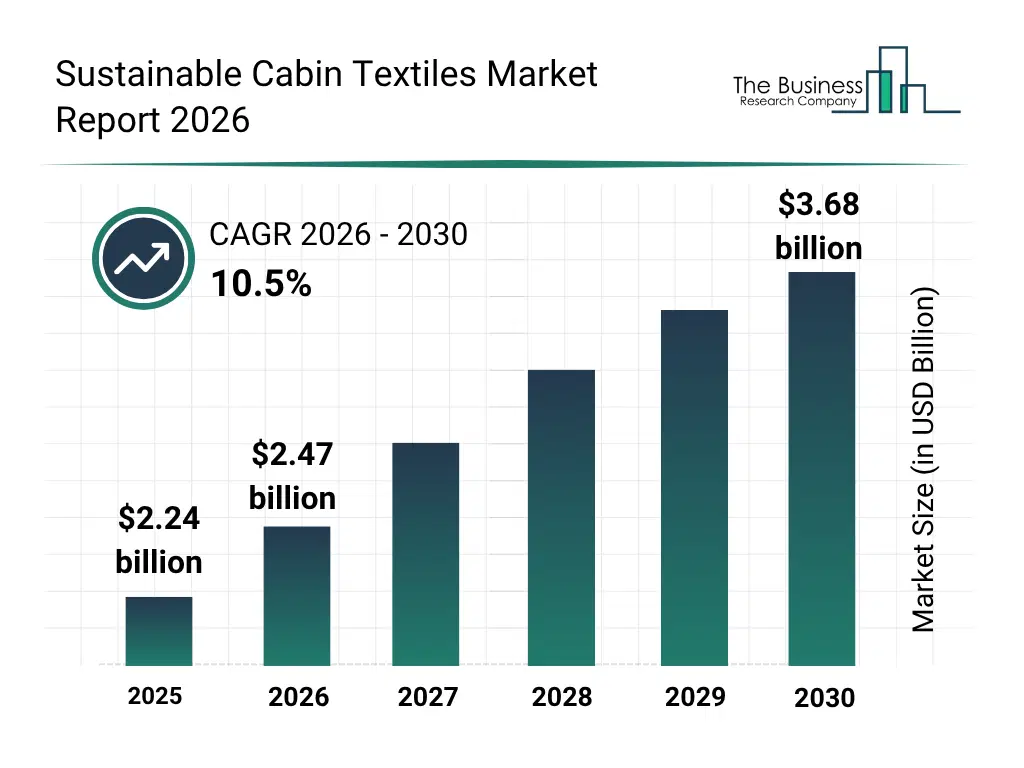
What Is The Sustainable Cabin Textiles Market Size and Share 2026?
The sustainable cabin textiles market size has grown rapidly in recent years.It will grow from $2.24 billion in 2025 to $2.47 billion in 2026 at a compound annual growth rate (CAGR) of 10.2%. The growth in the historic period can be attributed to rising demand for durable and aesthetic cabin interiors, increasing adoption of synthetic upholstery materials in transport cabins, growth in aviation and automotive interior upgrades, expansion of mass production textile manufacturing, rising focus on passenger comfort and safety standards.What Is The Sustainable Cabin Textiles Market Growth Forecast?
The sustainable cabin textiles market size is expected to see rapid growth in the next few years.It will grow to $3.68 billion by 2030 at a compound annual growth rate (CAGR) of 10.5%. The growth in the forecast period can be attributed to increasing shift toward circular textile economy models, growing demand for eco-certified cabin materials, expansion of electric and next-generation mobility platforms, rising investment in sustainable aviation and marine interiors, increasing regulatory pressure on emissions and material toxicity standards.Major trends in the forecast period include bio-based fiber innovation for cabin interior applications, development of closed-loop textile recycling systems for cabin materials, increasing demand for low voc and non-toxic cabin fabrics, adoption of antimicrobial and hygienic textile coatings in enclosed environments, rising use of lightweight and high-durability natural fiber blends in cabin interiors.
Global Sustainable Cabin Textiles Market Segmentation
1) By Product Type: Seat Upholstery Fabrics, Carpets And Floor Coverings, Curtains And Drapes, Wall Panels And Coverings, Headliners And Ceiling Fabrics, Insulation Textiles, Decorative And Trim Fabrics 2) By Material Type: Organic Cotton, Recycled Polyester, Hemp, Bamboo, Wool, Other Material Types 3) By Distribution Channel: Direct Sales, Distributors Or Wholesalers, Online Retail, Other Distribution Channels 4) By Application: Seating Upholstery, Curtains And Drapes, Carpets And Rugs, Wall Coverings, Other Applications 5) By End-Use: Aviation, Marine, Railways, Automotive, Other End-Uses Subsegments: 1) By Seat Upholstery Fabrics: Recycled Polyester Upholstery Fabrics, Organic Cotton Upholstery Fabrics, Natural Fiber Upholstery Fabrics, Blended Sustainable Upholstery Fabrics, Flame Resistant Upholstery Fabrics 2) By Carpets And Floor Coverings: Recycled Fiber Carpets, Wool Based Floor Coverings, Bio Based Fiber Carpets, Low Emission Floor Coverings, Modular Carpet Tiles 3) By Curtains And Drapes: Organic Cotton Curtains, Recycled Polyester Drapes, Light Filtering Curtains, Blackout Sustainable Drapes, Fire Retardant Curtains 4) By Wall Panels And Coverings: Textile Wall Panels, Acoustic Fabric Panels, Recycled Fiber Wall Coverings, Bio Based Wall Fabrics, Decorative Textile Panels 5) By Headliners And Ceiling Fabrics: Lightweight Ceiling Fabrics, Recycled Fiber Headliners, Acoustic Ceiling Fabrics, Thermal Insulation Headliners, Low Emission Ceiling Fabrics 6) By Insulation Textiles: Thermal Insulation Textiles, Acoustic Insulation Textiles, Recycled Fiber Insulation, Bio Based Insulation Textiles, Fire Resistant Insulation Fabrics 7) By Decorative And Trim Fabrics: Eco Friendly Trim Fabrics, Recycled Decorative Fabrics, Natural Fiber Trim Materials, Embroidered Sustainable Fabrics, Low Impact Dyed Decorative FabricsWhat Is The Driver Of The Sustainable Cabin Textiles Market?
The growth in global air travel is expected to propel the growth of the sustainable cabin textiles industry going forward.The growth in global air travel is driven by expanding tourism, rising disposable incomes, and increased connectivity through airline network expansions, leading to higher passenger volumes and more frequent flights.Sustainable cabin textiles support this growth by enabling airlines to incorporate eco-friendly, durable, and lightweight materials in aircraft interiors, helping reduce environmental impact while maintaining passenger comfort and regulatory compliance.For instance, in January 2026, according to the International Air Transport Association, a Canada-based trade organization, international full-year passenger demand in 2025 increased by 7.1% compared to 2024, while capacity rose by 6.8%, and the international load factor reached 83.5%, reflecting higher aircraft utilization.Therefore, the growth in global air travel is driving the growth of the sustainable cabin textiles industry.Key Players In The Global Sustainable Cabin Textiles Market
Major companies operating in the sustainable cabin textiles market are Aunde Group, Milliken & Company, Anker Gebr. Schoeller GmbH + Co. KG, Glen Raven Inc., Haeco Cabin Solutions, Mohawk Group, Lantal Textiles AG, Camira Fabrics, Trevira GmbH, Kufner Holding GmbH, Aerofoam Industries, Acro Aircraft Seating, InTech Aerospace, Botany Weaving, Sattler AG, Tapis Corporation, Svensson Markspelle AB, Sioen Industries NV, Replin Fabrics, Wollsdorf Leather GmbH, Spectra Interior Products, E-Leather Ltd., Schoepf AG, Innova Aviation Interiors, Gierlings VelporGlobal Sustainable Cabin Textiles Market Trends and Insights
Major companies operating in the sustainable cabin textiles market are focusing on developing advanced sustainable textile solutions, such as eco-friendly airline bedding and soft furnishing systems, to enhance passenger comfort while meeting stringent environmental and regulatory standards. Sustainable airline textile solutions are cabin interior products made using responsibly sourced, recyclable, or low-impact materials that maintain durability, comfort, and compliance with aviation requirements. For instance, in October 2024, John Horsfall & Sons, a UK-based textile manufacturer, expanded its portfolio of sustainable airline textiles, supplying premium blankets, bedding, pillows, and mattress pads to major global carriers. These products are designed to balance passenger comfort with sustainability by incorporating eco-conscious materials and production practices while maintaining high-quality performance standards required for airline use. Additionally, the company positions itself as a key partner for airlines seeking to reduce environmental impact in cabin interiors without compromising passenger experience, supporting broader adoption of sustainable cabin textile solutions across the aviation industry.What Are Latest Mergers And Acquisitions In The Sustainable Cabin Textiles Market?
In October 2024, Lenzing Group, an Austria-based producer of sustainable regenerated cellulose fibers, acquired a minority stake in TreeToTextile AB for an undisclosed amount. Through this acquisition, Lenzing strengthens its position in next-generation sustainable fiber technologies, supporting the development of low-impact, resource-efficient textile production processes and accelerating the commercialization of environmentally friendly fibers. TreeToTextile AB is a Sweden-based company developing sustainable fiber technologies, supporting sustainable cabin textile applications.Regional Insights
Europe was the largest region in the sustainable cabin textiles market in 2025. Asia Pacific is expected to be the fastest-growing region in the forecast period. The regions covered in this market report are Asia-Pacific, South East Asia, Western Europe, Eastern Europe, North America, South America, Middle East and Africa. The countries covered in this market report are Australia, Brazil, China, France, Germany, India, Indonesia, Japan, Taiwan, Russia, South Korea, UK, USA, Canada, Italy, Spain.What Defines the Sustainable Cabin Textiles Market?
The sustainable cabin textiles market consists of sales of seat fabrics, upholstery covers, cabin carpets, floor mats, curtains, window shades, blankets, and pillow covers. Values in this market are ‘factory gate’ values, that is, the value of goods sold by the manufacturers or creators of the goods, whether to other entities (including downstream manufacturers, wholesalers, distributors, and retailers) or directly to end customers. The value of goods in this market includes related services sold by the creators of the goods.What is the Market Assessment and Strategic Outlook for the Sustainable Cabin Textiles Industry?
The sustainable cabin textiles market research report is one of a series of new reports from The Business Research Company that provides market statistics, including industry global market size, regional shares, competitors with the market share, detailed market segments, market trends and opportunities, and any further data you may need to thrive in the sustainable cabin textiles industry. The market research report delivers a complete perspective of everything you need, with an in-depth analysis of the current and future state of the industry.What is the Market Assessment and Strategic Outlook for the Sustainable Cabin Textiles Market Report 2026?
The sustainable cabin textiles market research report is one of a series of new reports from The Business Research Company that provides sustainable cabin textiles market statistics, including sustainable cabin textiles industry global market size, regional shares, competitors with a sustainable cabin textiles market share, detailed sustainable cabin textiles market segments, market trends and opportunities, and any further data you may need to thrive in the sustainable cabin textiles industry. This sustainable cabin textiles market research report delivers a complete perspective of everything you need, with an in-depth analysis of the current and future scenario of the industry.Sustainable Cabin Textiles Market Report Forecast Analysis
| Report Attribute | Details |
|---|---|
| Market Size Value In 2026 | $2.47 billion |
| Revenue Forecast In 2035 | $3.68 billion |
| Growth Rate | CAGR of 10.5% from 2026 to 2035 |
| Base Year For Estimation | 2025 |
| Actual Estimates/Historical Data | 2020-2025 |
| Forecast Period | 2026 - 2030 - 2035 |
| Market Representation | Revenue in USD Billion and CAGR from 2026 to 2035 |
| Segments Covered | Product Type, Material Type, Distribution Channel, Application, End-Use |
| Regional Scope | Asia-Pacific, Western Europe, Eastern Europe, North America, South America, Middle East, Africa |
| Country Scope | The countries covered in the report are Australia, Brazil, China, France, Germany, India, Indonesia, Japan, Taiwan, Russia, South Korea, UK, USA, Canada, Italy, Spain. |
| Key Companies Profiled | Aunde Group, Milliken & Company, Anker Gebr. Schoeller GmbH + Co. KG, Glen Raven Inc., Haeco Cabin Solutions, Mohawk Group, Lantal Textiles AG, Camira Fabrics, Trevira GmbH, Kufner Holding GmbH, Aerofoam Industries, Acro Aircraft Seating, InTech Aerospace, Botany Weaving, Sattler AG, Tapis Corporation, Svensson Markspelle AB, Sioen Industries NV, Replin Fabrics, Wollsdorf Leather GmbH, Spectra Interior Products, E-Leather Ltd., Schoepf AG, Innova Aviation Interiors, Gierlings Velpor |
| Customization Scope | Request for Customization |
| Pricing And Purchase Options | Explore Purchase Options |