
Synthetic Aperture Radar Market Report 2026
Global Outlook – By Component (Receiver, Transmitter, Antenna), By Platform (Airborne, Ground ), By Mode (Single Mode, Multimode ), By Frequency Band (X Band, L Band, C Band, S Band, K, Ku, Ka Band, UHF Or VHF Band ), By Application (Military And Defense, Monitoring And Exploration) – Market Size, Trends, Strategies, and Forecast to 2030
Synthetic Aperture Radar Market Overview
• Synthetic Aperture Radar market size has reached to $5.49 billion in 2025 • Expected to grow to $9.96 billion in 2030 at a compound annual growth rate (CAGR) of 12.5% • Growth Driver: Surveillance UAV Investments Propel Growth InThe Synthetic Aperture Radar Market • Market Trend: Innovative Products InThe Synthetic Aperture Radar Market • North America was the largest region in 2025 and Asia-Pacific is the fastest growing region.What Is Covered Under Synthetic Aperture Radar Market?
A synthetic aperture radar (SAR) is an active sensor that sends microwave signals and receives back the backscattered signals from the Earth's surface. The synthetic aperture radar produces fine-resolution images from a resolution-limited radar system. The main components of synthetic aperture radar market are receiver, transmitter, and antenna. Receiver refers to the radar system that receives electrical signals. The SAR has different platforms such as airborne and ground. The modes for synthetic aperture radar are single mode and multimode. SAR has various frequency bands such as X band, L band, S band, C band, K, Ku, Ka, band, and UHF/VHF band. These synthetic aperture radar systems are used in applications that are military and defense and monitoring and exploration.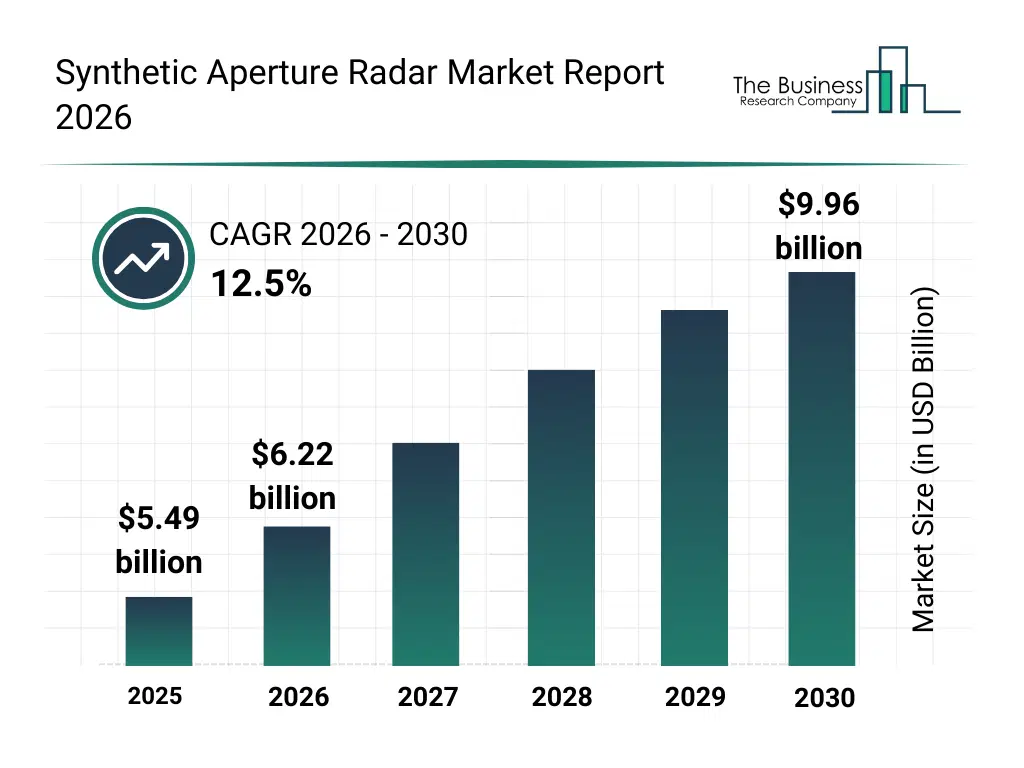
What Is The Synthetic Aperture Radar Market Size and Share 2026?
The synthetic aperture radar market size has grown rapidly in recent years. It will grow from $5.49 billion in 2025 to $6.22 billion in 2026 at a compound annual growth rate (CAGR) of 13.4%. The growth in the historic period can be attributed to growing demand for high-resolution earth observation driving procurement of airborne and spaceborne sar systems, increased government investments in defense surveillance programs leveraging sar capabilities, advancements in microwave signal processing improving imaging accuracy, expansion of commercial remote-sensing operators adopting side-looking radar systems, rising requirement for manufacturer-provided warranty-period maintenance and support services.What Is The Synthetic Aperture Radar Market Growth Forecast?
The synthetic aperture radar market size is expected to see rapid growth in the next few years. It will grow to $9.96 billion in 2030 at a compound annual growth rate (CAGR) of 12.5%. The growth in the forecast period can be attributed to increasing adoption of SAR for climate monitoring and disaster management applications, rising deployment of SAR-equipped small satellites enabling high revisit rates, growing investment in advanced digital SAR architectures for enhanced image resolution, expanding commercial demand for all-weather and day-night imaging capabilities, expected increase in integrated after-sales and lifecycle support services bundled with new sar systems. Major trends in the forecast period include miniaturization of sar systems for small satellite integration, increased adoption of spaceborne sar for earth observation, development of multi-frequency and multi-mode sar systems, integration of sar with unmanned aerial vehicles (uavs), advancements in real-time sar data processing and analytics.
Global Synthetic Aperture Radar Market Segmentation
1) By Component: Receiver, Transmitter, Antenna 2) By Platform: Airborne, Ground 3) By Mode: Single Mode, Multimode 4) By Frequency Band: X Band, L Band, C Band, S Band, K, Ku, Ka Band, UHF Or VHF Band 5) By Application: Military And Defense, Monitoring And Exploration Subsegments: 1) By Receiver: Analog Receivers, Digital Receivers, Frequency-Selective Receivers 2) By Transmitter: Solid-State Transmitters, Magnetron Transmitters, Traveling Wave Tube (TWT) Transmitters 3) By Antenna: Phased Array Antennas, Parabolic Antennas, Aperture AntennasWhat Is Driver Of The Synthetic Aperture Radar Market?
An increase in the investment in the UAVs for surveillance and attacks is contributing to the growth of the synthetic aperture radar market. UAVs are used in numerous occurrences due to their advancement in safety. With their remote-control abilities, drones monitor locations, communicate possible hazards, they notify threatening conditions such as oil and gas refineries, pipelines, and flare stacks. Drone Technology is employed in the military during high-risk periods. MILSAR SAR/MTI Radar is designed to be used on airborne platforms for intelligence, surveillance, reconnaissance, deterrence, and attack operations. For instance, in February 2024, The UK Ministry of Defense, launched a new drone strategy that includes at least 4.5 billion pounds ($5.7 billion) of investment in new unmanned aerial systems over the next decade. Thus, increase in investments in the UAVs for surveillance will drive the growth of the synthetic aperture radar industry.Key Players In The Global Synthetic Aperture Radar Market
Major companies operating in the synthetic aperture radar market are Raytheon Technologies Corporation, Airbus Defence and Space S.A.S., Lockheed Martin Corporation, German Aerospace Center, Northrop Grumman Corporation, BAE Systems plc, Thales Group, L3Harris Technologies Inc., Leonardo S.p.A., General Atomics Aeronautical Systems Inc., Israel Aerospace Industries Ltd., Saab AB, SAR Aero Inc., Cobham plc, Aselsan A.S., OHB SE, MacDonald Dettwiler and Associates Ltd., ICEYE Oyj, Intellisense Systems Inc., Capella Space Corporation, IMSAR LLC, SRC Inc., MetaSensing B.V., MetaSensing Group
This chart is for illustrative purposes; the full report includes a detailed competitor analysis and comprehensive overview of the top 10 companies in the market.
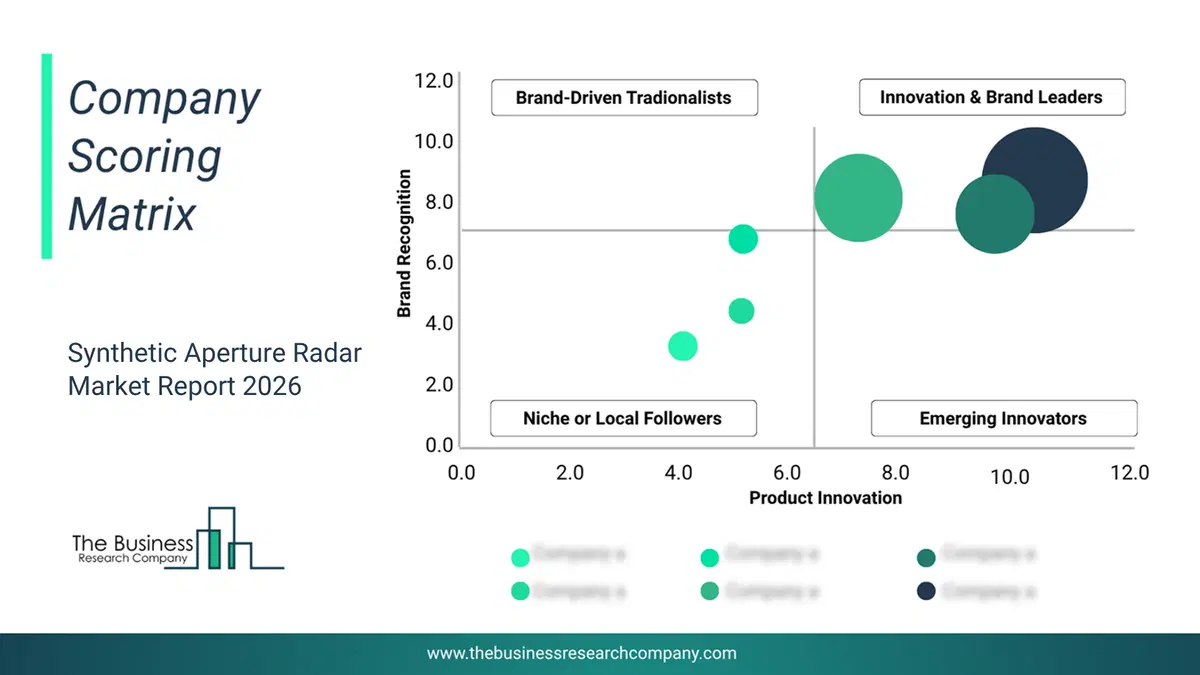
This chart maps companies by product innovation and brand strength, with bubble size indicating relative revenue, helping identify market leaders, challengers, and niche players. This is an illustrative chart; the full report provides a complete and accurate competitive analysis.
Global Synthetic Aperture Radar Market Trends and Insights
Major companies operating in the synthetic aperture radar market are developing advanced products, such as drone-based synthetic aperture radar (SAR), to meet larger customer bases, increase sales, and increase revenue. Drone-based synthetic aperture radar (SAR) refers to the integration of synthetic aperture radar technology with unmanned aerial vehicles (UAVs) or drones. For instance, in August 2023, GalaxEye Space, an India-based space tech startup, launched an aerial drone-based synthetic aperture radar (SAR) system. This state-of-the-art technology offers the capability of delivering remarkably detailed and high-resolution all-weather imaging, even under challenging weather conditions. GalaxEye's successful development and demonstration of this innovation establish it as the first private company in India to achieve such a milestone. The SAR system incorporates proprietary data fusion technology, representing a significant advancement in space-based insights. This unique feature enables satellite constellations to conduct all-weather imaging without being impeded by the atmospheric constraints that traditional single-sensor satellites encounter. GalaxEye's pioneering technology sets the stage for generating highly detailed images through a compact satellite constellation, revolutionizing aerial drone-based synthetic aperture radar systems.What Are Latest Mergers And Acquisitions In The Synthetic Aperture Radar Market? Rheinmetall Partners With ICEYE To Enhance SAR Satellite Capabilities In Europe
In September 2024, Rheinmetall AG, a Germany-based defense and automotive technology company, partnered with ICEYE. This partnership aims to secure exclusive distribution rights for Synthetic Aperture Radar (SAR) satellites in Germany and Hungary. This agreement allows Rheinmetall to integrate ICEYE's capabilities into its next-generation battlefield systems, enhancing military and government applications in these markets. ICEYE Ltd. is a Finland-based microsatellite manufacturer offering synthetic aperture radar (SAR) technology.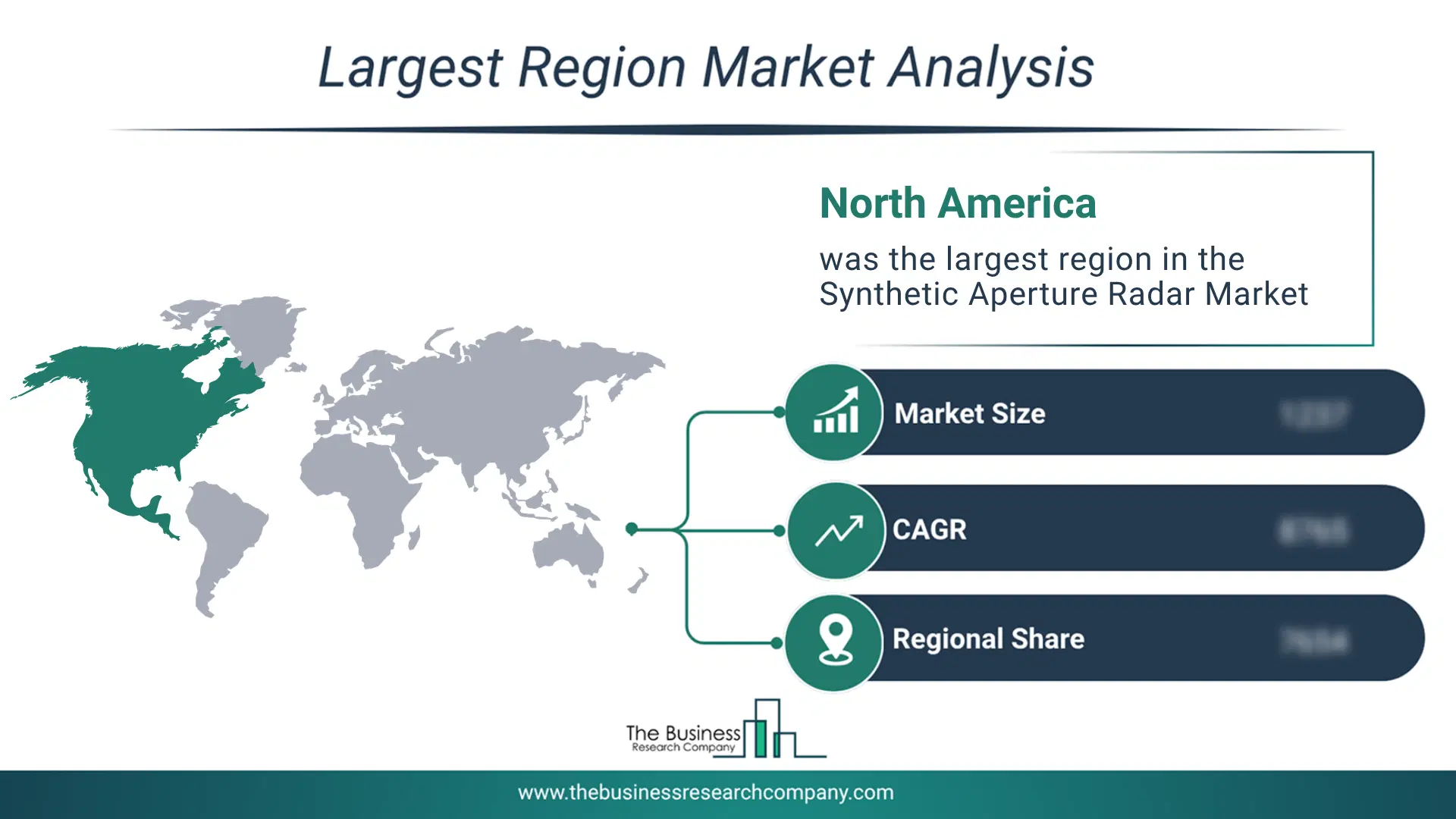
Regional Insights
North America was the largest region in the synthetic aperture radar market in 2025. Asia-Pacific is expected to be the fastest-growing region in the forecast period. The regions covered in this market report are Asia-Pacific, South East Asia, Western Europe, Eastern Europe, North America, South America, Middle East, Africa. The countries covered in this market report are Australia, Brazil, China, France, Germany, India, Indonesia, Japan, Taiwan, Russia, South Korea, UK, USA, Canada, Italy, SpainWhat Defines the Synthetic Aperture Radar Market?
The synthetic aperture radar market consists of sales of airborne or spaceborne side looking radar systems. Values in this market are ‘factory gate’ values, that is the value of goods sold by the manufacturers or creators of the goods, whether to other entities (including downstream manufacturers, wholesalers, distributors, and retailers) or directly to end customers. The value of goods in this market includes related services sold by the creators of the goods.How is Market Value Defined and Measured?
The market value is defined as the revenues that enterprises gain from the sale of goods and/or services within the specified market and geography through sales, grants, or donations in terms of the currency (in USD unless otherwise specified). The revenues for a specified geography are consumption values that are revenues generated by organizations in the specified geography within the market, irrespective of where they are produced. It does not include revenues from resales along the supply chain, either further along the supply chain or as part of other products.
This chart presents market attractiveness based on a quantitative evaluation of growth, competition, strategic alignment, and risk, offering a clear view of opportunity areas for decision-making. This chart is for illustrative purposes; the full report contains the complete analysis.

This chart highlights the Total Addressable Market (TAM) by estimating the maximum revenue opportunity using an assumption-driven approach, supporting strategic planning and opportunity sizing across markets. The chart is illustrative; the full report provides a more comprehensive analysis.
What Key Data and Analysis Are Included in the Synthetic Aperture Radar Market Report 2026?
The synthetic aperture radar market research report is one of a series of new reports from The Business Research Company that provides market statistics, including industry global market size, regional shares, competitors with the market share, detailed market segments, market trends and opportunities, and any further data you may need to thrive in the synthetic aperture radar industry. The market research report delivers a complete perspective of everything you need, with an in-depth analysis of the current and future state of the industry.Synthetic Aperture Radar Market Report Forecast Analysis
| Report Attribute | Details |
|---|---|
| Market Size Value In 2026 | $6.22 billion |
| Revenue Forecast In 2030 | $9.96 billion |
| Growth Rate | CAGR of 12.5% from 2026 to 2030 |
| Base Year For Estimation | 2025 |
| Actual Estimates/Historical Data | 2020-2025 |
| Forecast Period | 2026 - 2030 |
| Market Representation | Revenue in USD Billion and CAGR from 2026 to 2030 |
| Segments Covered | Component, Platform, Mode, Frequency Band, Application |
| Regional Scope | Asia-Pacific, Western Europe, Eastern Europe, North America, South America, Middle East, Africa |
| Country Scope | The countries covered in the synthetic aperture radar market report are Australia, Brazil, China, France, Germany, India, Indonesia, Japan, Taiwan, Russia, South Korea, UK, USA, Canada, Italy, Spain |
| Key Companies Profiled | Raytheon Technologies Corporation, Airbus Defence and Space S.A.S., Lockheed Martin Corporation, German Aerospace Center, Northrop Grumman Corporation, BAE Systems plc, Thales Group, L3Harris Technologies Inc., Leonardo S.p.A., General Atomics Aeronautical Systems Inc., Israel Aerospace Industries Ltd., Saab AB, SAR Aero Inc., Cobham plc, Aselsan A.S., OHB SE, MacDonald Dettwiler and Associates Ltd., ICEYE Oyj, Intellisense Systems Inc., Capella Space Corporation, IMSAR LLC, SRC Inc., MetaSensing B.V., MetaSensing Group |
| Customization Scope | Request for Customization |
| Pricing And Purchase Options | Explore Purchase Options |