
Synthetic Application Programming Interface (API) Testing Market Report 2026
Global Outlook – By Component (Software, Services), By Deployment Mode (Cloud based, On premise), By Testing Type (Functional testing, Performance testing, Load testing, Regression testing, End to end synthetic monitoring), By Application (Web Services, Mobile Applications, Microservices, IoT Devices, Cloud Application Programming Interfaces), By End Use Vertical (Banking Financial Services and Insurance, Information Technology and Telecommunication, Retail and E-commerce, Government, Manufacturing and Automotive, Healthcare, Media and Entertainment, Other End Use Verticals) – Market Size, Trends, Strategies, and Forecast to 2030
Synthetic Application Programming Interface (API) Testing Market Overview
• Synthetic Application Programming Interface (API) Testing market size has reached to $1.84 billion in 2025 • Expected to grow to $3.86 billion in 2030 at a compound annual growth rate (CAGR) of 15.9% • Growth Driver: Surge In Adoption Of Automated Testing Driving Growth Of The Market Due To Rising Need For Reliable, High-Performance, And Continuously Validated APIs • Market Trend: AI-Enhanced Test Generation Streamlines API Quality Assurance Across the Software Development Lifecycle • North America was the largest region in 2025 and Asia-Pacific is the fastest growing region.Market Gains By 2030 – Top Opportunities By Segment
Market Gain identifies the most promising market opportunities by highlighting the segments or products expected to generate the highest incremental revenue growth over the next five years.
What Is Covered Under Synthetic Application Programming Interface (API) Testing Market?
Synthetic Application Programming Interface testing uses artificially generated requests to simulate real-world interactions with an application programming interface to evaluate its functionality, reliability, and performance. It helps teams identify failures, latency issues, and behavioral inconsistencies before they impact production systems. The approach enables continuous monitoring and proactive detection of problems by imitating user and system traffic in controlled conditions. The main components of synthetic api testing include software and services. Software refers to platforms and tools designed to simulate, monitor, and validate application programming interfaces (APIs) for performance, functionality, and reliability. Different deployment modes are cloud based and on premise. Multiple testing types are functional testing, performance testing, load testing, regression testing, and end-to-end synthetic monitoring. Various applications covered are web services, mobile applications, microservices, IoT devices, and cloud application programming interfaces, and they are used by several end-use verticals such as banking, financial services and insurance, information technology and telecommunication, retail and e-commerce, government, manufacturing and automotive, healthcare, media and entertainment, and others.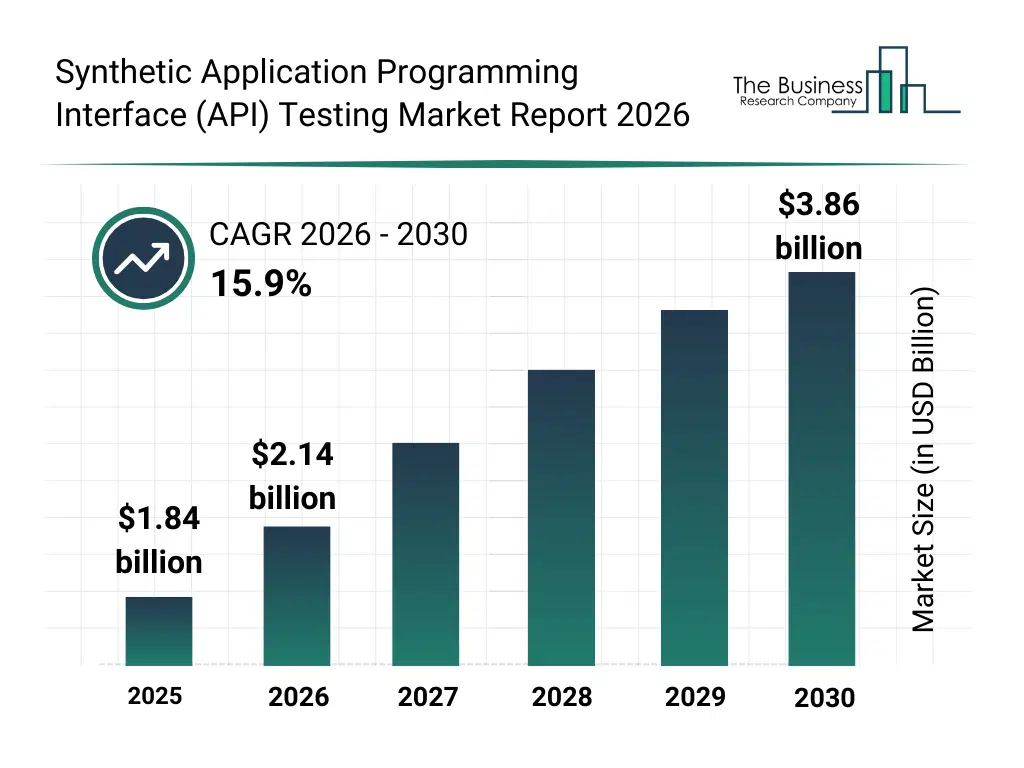
What Is The Synthetic Application Programming Interface (API) Testing Market Size and Share 2026?
The synthetic application programming interface (API) testing market size has grown rapidly in recent years. It will grow from $1.84 billion in 2025 to $2.14 billion in 2026 at a compound annual growth rate (CAGR) of 16.2%. The growth in the historic period can be attributed to increasing adoption of application programming interface based architectures, growing need for proactive application reliability monitoring, rising failures in distributed applications driving synthetic validation, expansion of automated software testing practices, increasing shift toward microservices deployments.What Is The Synthetic Application Programming Interface (API) Testing Market Growth Forecast?
The synthetic application programming interface (API) testing market size is expected to see rapid growth in the next few years. It will grow to $3.86 billion in 2030 at a compound annual growth rate (CAGR) of 15.9%. The growth in the forecast period can be attributed to increasing integration of synthetic testing in continuous delivery workflows, growing demand for high availability digital services, rising adoption of artificial intelligence enabled testing automation, expansion of internet of things ecosystems requiring application programming interface reliability, increasing shift toward mobile first applications. Major trends in the forecast period include technological advancements in autonomous test generation, innovation in artificial intelligence driven synthetic monitoring, developments in unified functional and performance testing platforms, research and developments in application programming interface virtualization, innovation in cloud native synthetic testing frameworks.
Global Synthetic Application Programming Interface (API) Testing Market Segmentation
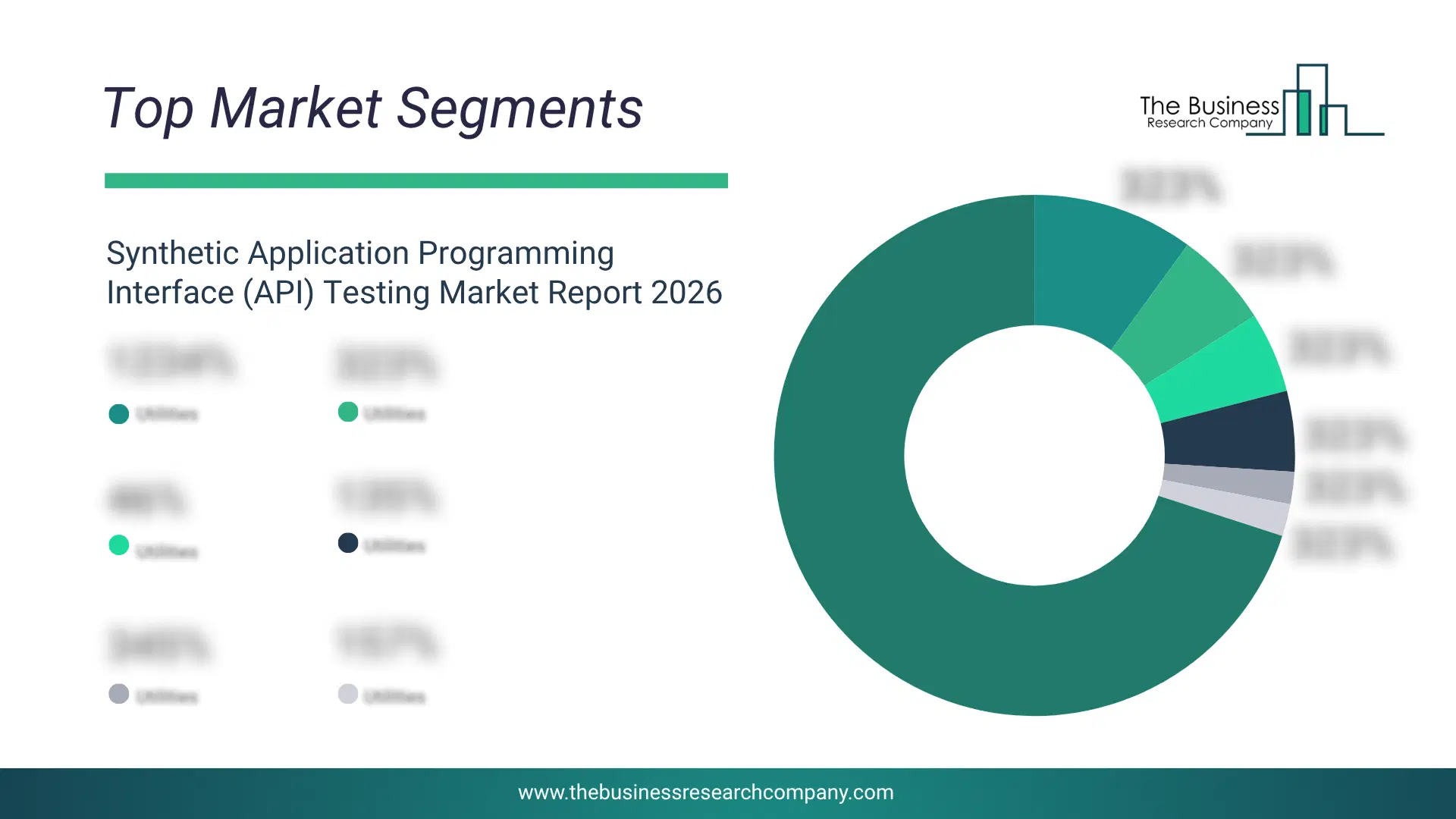
1) By Component: Software, Services 2) By Deployment Mode: Cloud based, On premise 3) By Testing Type: Functional testing, Performance testing, Load testing, Regression testing, End to end synthetic monitoring 4) By Application: Web Services, Mobile Applications, Microservices, IoT Devices, Cloud Application Programming Interfaces 5) By End Use Vertical: Banking Financial Services and Insurance, Information Technology and Telecommunication, Retail and E-commerce, Government, Manufacturing and Automotive, Healthcare, Media and Entertainment, Other End Use Verticals Subsegments: 1) By Software: Automated Application Programming Interface Testing Tools, Synthetic Monitoring Platforms, Application Programming Interface Virtualization Software, Performance And Load Testing Suites, Continuous Quality Engineering Tools 2) By Services: Implementation Services, Managed Synthetic Testing Services, Consulting And Advisory Services, Training And Support Services, Performance Monitoring Services The top segments in the synthetic application programming interface (api) testing market will be: • Software will reach $2.09 Billion by 2030. • Services will reach $1.38 Billion by 2030.What Are The Drivers Of The Synthetic Application Programming Interface (API) Testing Market?
The increasing adoption of automated testing is expected to propel the growth of the synthetic application programming interface (API) testing market going forward. Automated testing refers to the use of software tools that automatically execute predefined test scripts to validate API functionality, reliability, and performance without manual involvement. Adoption of automated testing is rising as organizations need faster and more reliable software releases that integrate continuous testing into agile and DevOps pipelines while reducing manual effort and production defects. The synthetic API testing supports automated testing by enabling engineering teams to run continuous, simulated API requests that detect issues before real users experience them and ensure consistent behavior across environments. For instance, in November 2025, according to PractiTest Ltd., an Israel-based software testing platform, the share of organizations reporting that automation replaced 75% or more of manual testing efforts increased from 18% in 2023 to 19% in 2024 and 20% in 2025. Therefore, the increasing adoption of automated testing is driving the growth of the synthetic application programming interface (API) testing industry. The increasing adoption of cloud-based applications is expected to propel the growth of the synthetic application programming interface (API) testing market going forward. Cloud-based applications refer to software and services hosted on remote servers and accessed via the internet, offering scalability, flexibility, and on-demand computing resources for businesses and developers. Adoption of cloud-based applications is rising s businesses seek scalable systems that can rapidly adjust to fluctuating workloads without requiring major investments in physical hardware. Synthetic application programming interface (API) testing enhances cloud-based application ecosystems by enabling automated, scalable validation of API performance, functionality, and reliability across distributed environments. It reduces manual testing effort by proactively identifying defects and performance issues, improving application stability, deployment speed, and overall operational efficiency. For instance, in September 2024, according to Cloud Institute, a US-based cloud training and advisory organization, businesses were expected to spend 678.8 billion dollars on public cloud services in 2024 reflecting a 20.4 percent rise from 2023 while global cloud infrastructure spending was projected to surpass 1 trillion dollars in the same period. Therefore, the increasing adoption of cloud-based applications is driving the growth of the synthetic application programming interface (API) testing industry.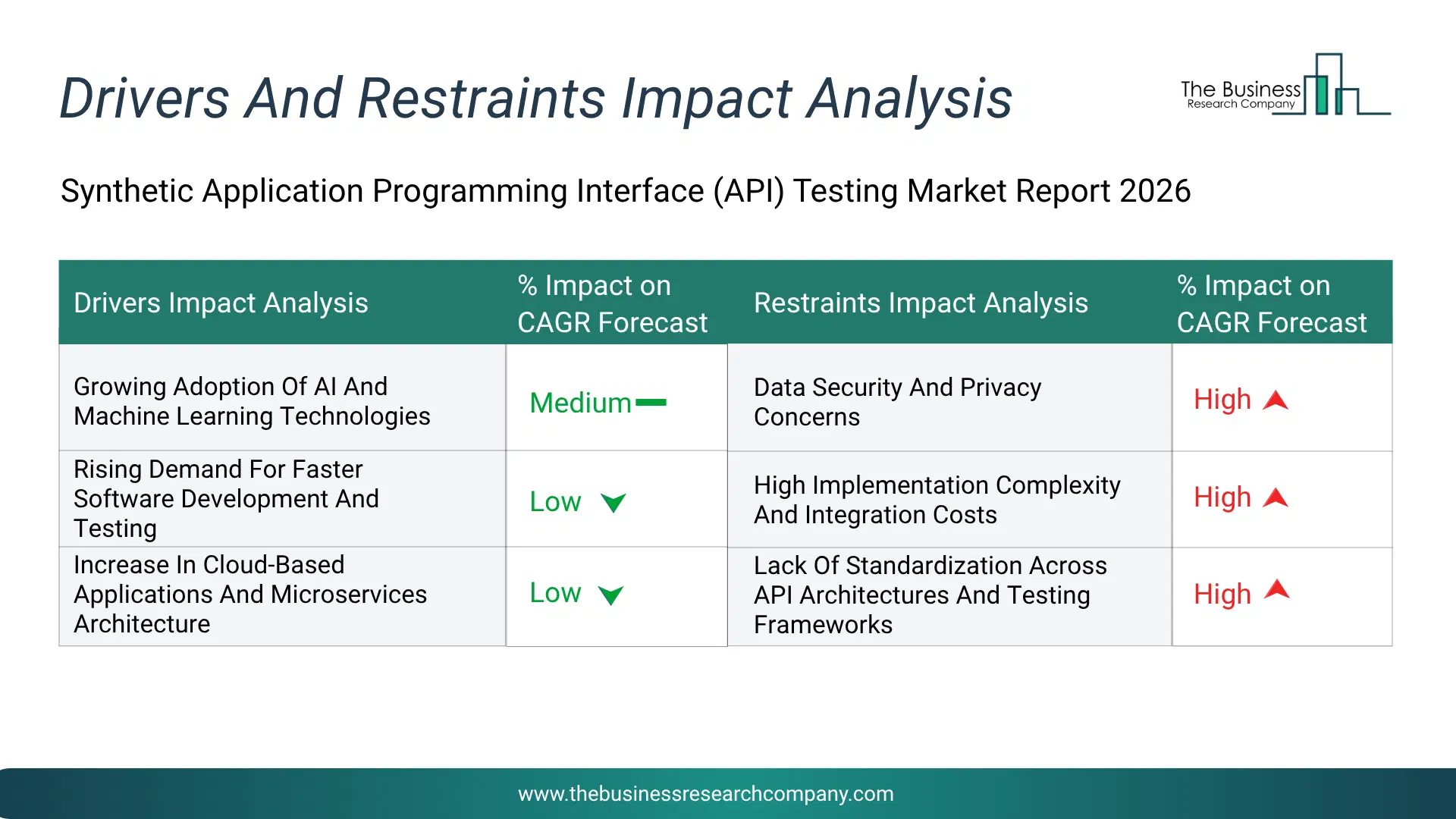
Infographic Chart Showing Key Market Drivers Analysis And Restraints For Synthetic Application Programming Interface (Api) Testing Market
The chart presents an impact analysis of key drivers and restraints, quantifying their relative influence on the market's growth rate and helping assess the balance between growth enablers and limiting factors. This chart offers a high-level perspective; the full report contains more detailed insights.
How Will The Drivers Impact Growth In The Global Synthetic Application Programming Interface (API) Testing Market?
• Growing Adoption Of AI And Machine Learning Technologies (Medium) – During the forecast period, the growing adoption of AI and machine learning technologies is expected to become a key growth driver for the synthetic application programming interface (API) testing market by 2030. Enterprises are increasingly deploying AI-enabled applications that require intelligent API simulation, automated test generation, and continuous validation across dynamic software environments. Machine learning capabilities enhance anomaly detection, optimize test execution, and improve the accuracy of synthetic testing while reducing operational complexity. Software providers are therefore integrating advanced AI-driven testing capabilities to improve application quality and development efficiency. • Rising Demand For Faster Software Development And Testing (Low) – During the forecast period, the rising demand for faster software development and testing is expected to emerge as a major factor driving the expansion of the synthetic application programming interface (API) testing market by 2030. Organizations are accelerating software release cycles through agile development methodologies and continuous delivery practices, creating greater demand for virtual testing environments that eliminate dependencies on production systems. Synthetic API testing enables faster validation of application functionality, minimizes testing delays, and improves deployment confidence throughout the software lifecycle. Increasing enterprise focus on rapid digital innovation is further strengthening demand for automated API testing solutions. • Increase In Cloud-Based Applications And Microservices Architecture (Low) – During the forecast period, the increase in cloud-based applications and microservices architecture is expected to act as a key growth catalyst for the synthetic application programming interface (API) testing market by 2030. The growing adoption of distributed application environments is creating greater requirements for validating service interactions, monitoring application availability, and ensuring reliable API communication across interconnected platforms. Synthetic API testing enables organizations to evaluate application performance under diverse operating conditions while supporting scalable testing across cloud-native infrastructures. As cloud computing and microservices deployments continue expanding globally, demand for intelligent API testing platforms is expected to increase steadily.How Will The Restraints Impact Growth In The Global Synthetic Application Programming Interface (API) Testing Market?
• Data Security And Privacy Concerns (Medium) – During the forecast period, the data security and privacy concerns are restraining the Synthetic Application Programming Interface (API) testing market as organizations handle sensitive business and customer data within simulated testing environments. The use of synthetic APIs can increase the risk of data leakage, unauthorized access, and compliance violations if proper security controls are not implemented. Strict regulatory frameworks such as GDPR and other data protection laws also require enterprises to carefully manage how test data is generated, stored, and used, which slows down adoption and increases implementation complexity for synthetic API testing solutions. • High Implementation Complexity And Integration Costs (Low) – During the forecast period, the high implementation complexity and integration costs are restraining the Synthetic Application Programming Interface (API) testing market as organizations often face difficulties in deploying these solutions within existing legacy IT infrastructures. Integrating synthetic API testing tools with diverse systems, cloud platforms, and microservices environments requires specialized technical expertise, increasing dependency on skilled professionals. Additionally, the initial setup costs, customization requirements, and ongoing maintenance expenses can be significant, making it challenging for small and medium-sized enterprises to adopt these solutions at scale. • Lack Of Standardization Across API Architectures And Testing Frameworks (Low) – During the forecast period, the lack of standardization across API architectures and testing frameworks is expected to restrain the growth of the synthetic application programming interface (API) testing market. Organizations increasingly develop and deploy APIs using diverse architectures, communication protocols, and development frameworks, including REST, SOAP, GraphQL, gRPC, and event-driven APIs. This diversity creates interoperability challenges for synthetic API testing solutions, as testing tools often require extensive customization to support different API specifications and enterprise environments. Variations in API documentation, authentication methods, data formats, and versioning practices further increase testing complexity and reduce automation efficiency. Organizations may also face difficulties in maintaining consistent testing workflows across hybrid cloud, on-premise, and microservices-based infrastructures. These standardization challenges increase implementation time, operational costs, and dependency on specialized technical expertise. Consequently, the lack of standardization across API architectures and testing frameworks remains a significant restraint on the growth of the synthetic application programming interface (API) testing market.Key Players In The Global Synthetic Application Programming Interface (API) Testing Market
Major companies operating in the synthetic application programming interface (api) testing market are Apidog Inc., OpenText Corporation, Datadog Inc., Dynatrace GmbH, New Relic Inc., Postman Inc., AppDynamics LLC, ThousandEyes Inc., Parasoft Corporation, Katalon Inc., Catchpoint Systems Inc., Sematext Group Inc., Site24x7, Testsigma Technologies Inc., Dotcom-Monitor Inc., Checkly Inc., Uptime.com Inc., Uptrends Monitoring B.V., UptimeRobot Ltd., APImetrics Ltd.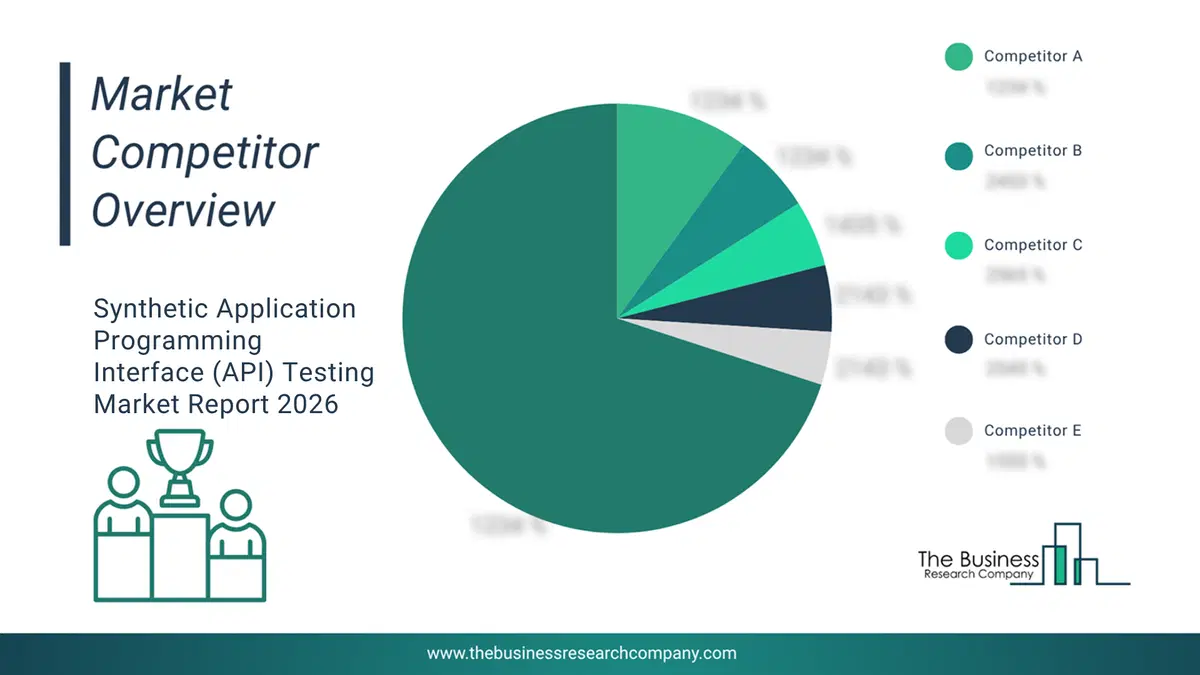
This chart is for illustrative purposes; the full report includes a detailed competitor analysis and comprehensive overview of the top 10 companies in the market.
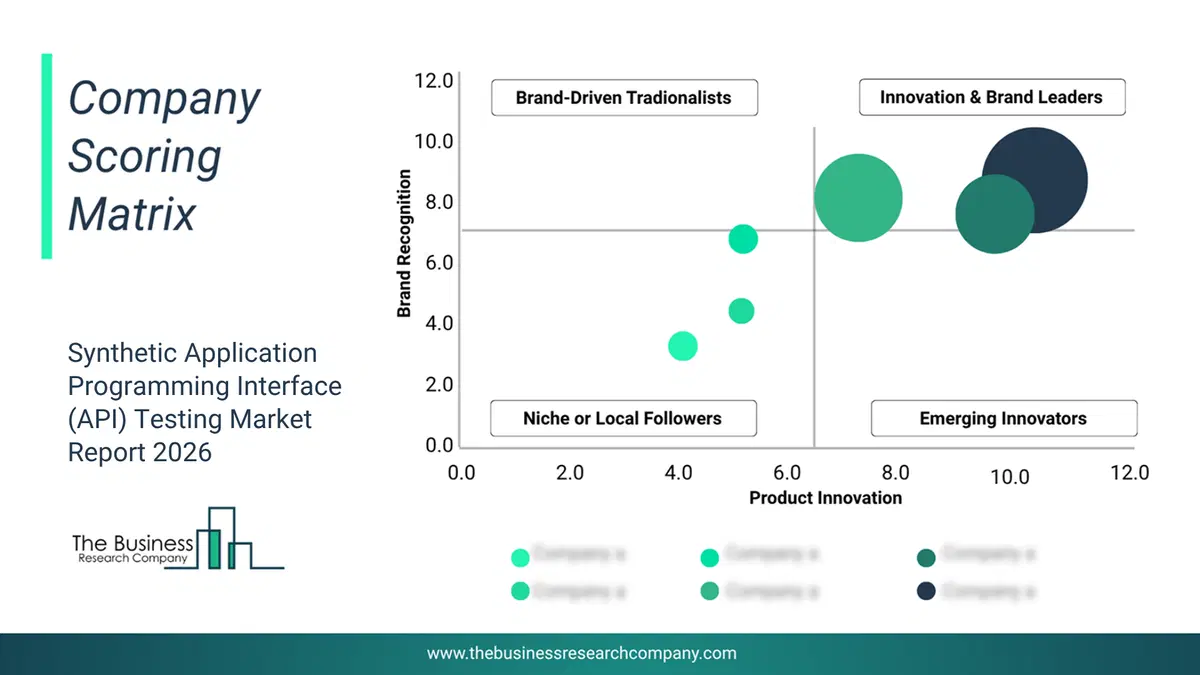
This chart maps companies by product innovation and brand strength, with bubble size indicating relative revenue, helping identify market leaders, challengers, and niche players. This is an illustrative chart; the full report provides a complete and accurate competitive analysis.
Global Synthetic Application Programming Interface (API) Testing Market Trends and Insights
Major companies operating in the synthetic API testing market are focusing on developing technologically advanced solutions, such as AI-enhanced test impact analysis, which enables precise identification of affected code areas and automated generation of targeted test cases. AI-enhanced test impact analysis refers to leveraging machine learning algorithms to analyze code changes, predict potential defects, and prioritize test execution for maximum efficiency and accuracy. For instance, in December 2025, Parasoft Inc., a US-based AI-powered software testing solutions company, launched its latest Agentic AI capabilities within SOAtest and the Continuous Testing Platform (CTP). The update introduces AI-assisted API test scenario generation, allowing testers to create automated test cases in natural language using service definition files. Additionally, the platform now extends code coverage collection and AI-enhanced test impact analysis to manual tests for Java and NET applications, enabling teams to determine precisely which tests need rerunning, thereby trimming retesting time and improving collaboration between development and quality assurance teams.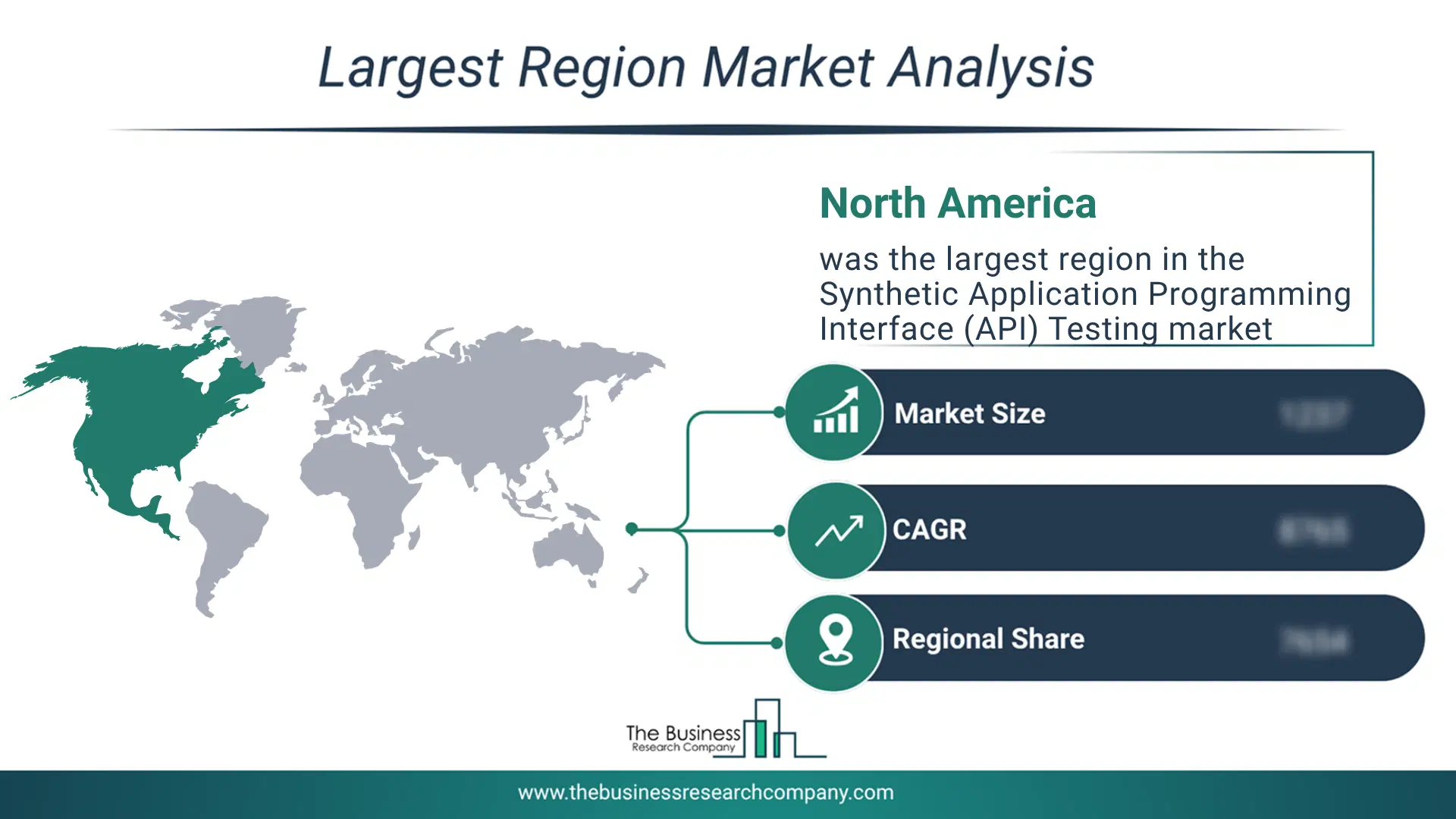
Regional Insights
North America was the largest region in the synthetic application programming interface (API) testing market in 2025. Asia-Pacific is expected to be the fastest-growing region in the forecast period. The regions covered in this market report are Asia-Pacific, South East Asia, Western Europe, Eastern Europe, North America, South America, Middle East, Africa. The countries covered in this market report are Australia, Brazil, China, France, Germany, India, Indonesia, Japan, Taiwan, Russia, South Korea, UK, USA, Canada, Italy, Spain.What Defines the Synthetic Application Programming Interface (API) Testing Market?
The synthetic application programming interface testing market consists of revenues earned by entities by providing services such as automated simulation of application programming interface calls, continuous performance monitoring, fault detection and alerting, virtualized test data generation, and proactive validation of application programming interface reliability across environments. The market value includes the value of related goods sold by the service provider or included within the service offering. The synthetic application programming Interface testing market includes sales of automated application programming interface testing platforms, synthetic monitoring tools, application programming interface virtualization software, load and performance testing suites, and continuous quality engineering tools. Values in this market are ‘factory gate’ values, that is, the value of goods sold by the manufacturers or creators of the goods, whether to other entities (including downstream manufacturers, wholesalers, distributors, and retailers) or directly to end customers. The value of goods in this market includes related services sold by the creators of the goods.How is Market Value Defined and Measured?
The market value is defined as the revenues that enterprises gain from the sale of goods and/or services within the specified market and geography through sales, grants, or donations in terms of the currency (in USD unless otherwise specified). The revenues for a specified geography are consumption values that are revenues generated by organizations in the specified geography within the market, irrespective of where they are produced. It does not include revenues from resales along the supply chain, either further along the supply chain or as part of other products.
This chart presents market attractiveness based on a quantitative evaluation of growth, competition, strategic alignment, and risk, offering a clear view of opportunity areas for decision-making. This chart is for illustrative purposes; the full report contains the complete analysis.

This chart highlights the Total Addressable Market (TAM) by estimating the maximum revenue opportunity using an assumption-driven approach, supporting strategic planning and opportunity sizing across markets. The chart is illustrative; the full report provides a more comprehensive analysis.
What Key Data and Analysis Are Included in the Synthetic Application Programming Interface (API) Testing Market Report 2026?
The synthetic application programming interface (api) testing market research report is one of a series of new reports from The Business Research Company that provides market statistics, including industry global market size, regional shares, competitors with the market share, detailed market segments, market trends and opportunities, and any further data you may need to thrive in the synthetic application programming interface (api) testing industry. The market research report delivers a complete perspective of everything you need, with an in-depth analysis of the current and future state of the industry.Synthetic Application Programming Interface (API) Testing Market Report Forecast Analysis
| Report Attribute | Details |
|---|---|
| Market Size Value In 2026 | $2.14 billion |
| Revenue Forecast In 2030 | $3.86 billion |
| Growth Rate | CAGR of 16.2% from 2026 to 2030 |
| Base Year For Estimation | 2025 |
| Actual Estimates/Historical Data | 2020-2025 |
| Forecast Period | 2026 - 2030 |
| Market Representation | Revenue in USD Billion and CAGR from 2026 to 2030 |
| Segments Covered | Component, Deployment Mode, Testing Type, Application, End Use Vertical |
| Regional Scope | Asia-Pacific, Western Europe, Eastern Europe, North America, South America, Middle East, Africa |
| Country Scope | The countries covered in the report are Australia, Brazil, China, France, Germany, India, Indonesia, Japan, Taiwan, Russia, South Korea, UK, USA, Canada, Italy, Spain. |
| Key Companies Profiled | Apidog Inc., OpenText Corporation, Datadog Inc., Dynatrace GmbH, New Relic Inc., Postman Inc., AppDynamics LLC, ThousandEyes Inc., Parasoft Corporation, Katalon Inc., Catchpoint Systems Inc., Sematext Group Inc., Site24x7, Testsigma Technologies Inc., Dotcom-Monitor Inc., Checkly Inc., Uptime.com Inc., Uptrends Monitoring B.V., UptimeRobot Ltd., APImetrics Ltd. |
| Customization Scope | Request for Customization |
| Pricing And Purchase Options | Explore Purchase Options |