
Synthetic Data In Financial Services Market Report 2026
Global Outlook – By Component (Software, Services, Hardware), By Deployment Mode (On-Premises, Cloud), By Data Type (Tabular Data, Time Series Data, Text Data, Image And Video Data, Other Data Types), By Application (Fraud Detection And Risk Management, Algorithm Testing And Model Validation, Customer Analytics, Regulatory Compliance, Other Applications), By End User (Banks, Insurance Companies, Investment Firms, FinTech Companies, Other End-Users) – Market Size, Trends, Strategies, and Forecast to 2030
Synthetic Data In Financial Services Market Overview
• Synthetic Data In Financial Services market size has reached to $1.74 billion in 2025 • Expected to grow to $6.71 billion in 2030 at a compound annual growth rate (CAGR) of 31% • Growth Driver: Expansion Of Digital Banking Driving The Market Growth Due To Increasing Need For Privacy-Preserving Data Testing And Development • Market Trend: Innovations In Synthetic Data Platforms Enhance Secure Fintech Innovation And Regulatory Compliance In Financial Services • North America was the largest region in 2025 and Asia-Pacific is the fastest growing region.Market Gains By 2030 – Top Opportunities By Segment
Market Gain identifies the most promising market opportunities by highlighting the segments or products expected to generate the highest incremental revenue growth over the next five years.
What Is Covered Under Synthetic Data In Financial Services Market?
Synthetic data in financial services refers to artificially generated data that mimics the statistical properties and patterns of real financial datasets, used to train, test, or validate AI and analytics models without exposing sensitive customer information. It is used for testing, model training, risk analysis, and fraud detection without exposing real customer data. It helps to enable secure, privacy-compliant experimentation, and analytics without risking exposure of sensitive or personal data. The main components of synthetic data in financial services are software, services, and hardware. Software refers to platforms that generate artificial financial data to simulate real-world scenarios for analysis, testing, and modeling while preserving data privacy. These solutions are deployed through different deployment modes, including on-premises and cloud. They support various data types, such as tabular data, time series data, text data, image and video data, and other data types, and are used across multiple applications, including fraud detection and risk management, algorithm testing and model validation, customer analytics, regulatory compliance, and other applications. The solutions serve various end-users, including banks, insurance companies, investment firms, FinTech companies, and other end-users.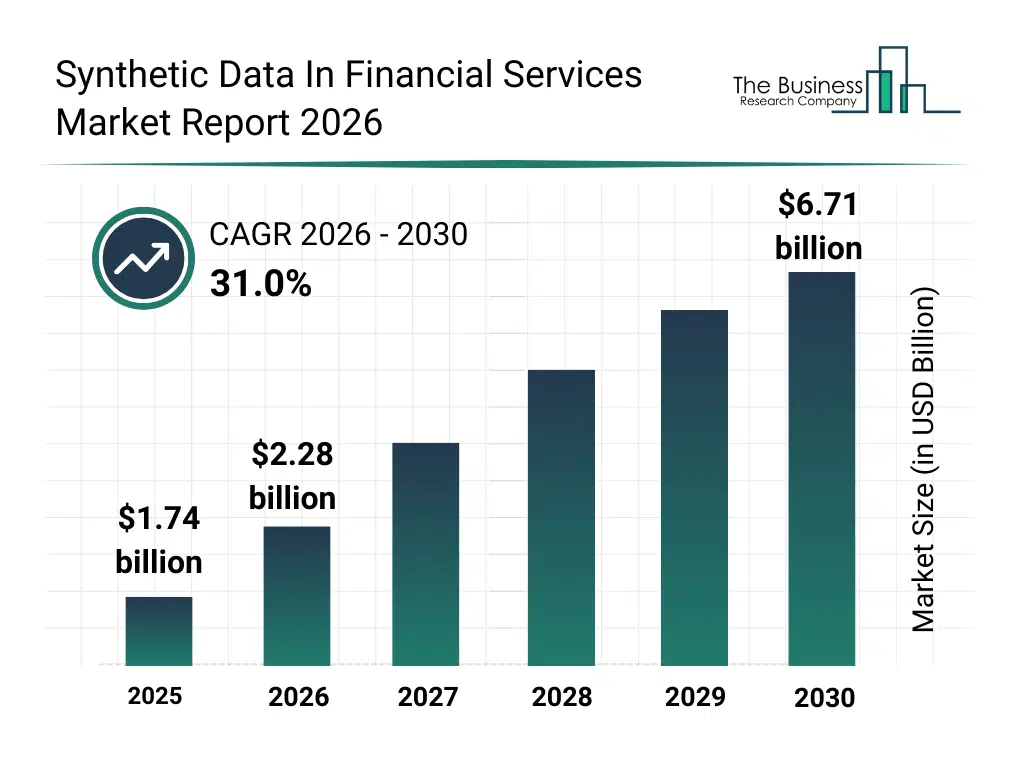
What Is The Synthetic Data In Financial Services Market Size and Share 2026?
The synthetic data in financial services market size has grown exponentially in recent years. It will grow from $1.74 billion in 2025 to $2.28 billion in 2026 at a compound annual growth rate (CAGR) of 30.7%. The growth in the historic period can be attributed to increasing financial data breaches, rising regulatory compliance requirements, rapid digitization of banking operations, expansion of online financial services, growing demand for secure model testing.What Is The Synthetic Data In Financial Services Market Growth Forecast?
The synthetic data in financial services market size is expected to see exponential growth in the next few years. It will grow to $6.71 billion in 2030 at a compound annual growth rate (CAGR) of 31.0%. The growth in the forecast period can be attributed to growing AI-driven financial analytics adoption, increasing investment in privacy-enhancing technologies, rising demand for advanced fraud detection testing, expansion of open banking ecosystems, demand for scalable synthetic dataset generation. Major trends in the forecast period include expansion of privacy-compliant data testing environments, growth in fraud simulation and scenario modeling platforms, rising adoption of synthetic customer behavior modeling, increase in stress testing and risk simulation tools, development of cross-border compliance validation frameworks.
Global Synthetic Data In Financial Services Market Segmentation
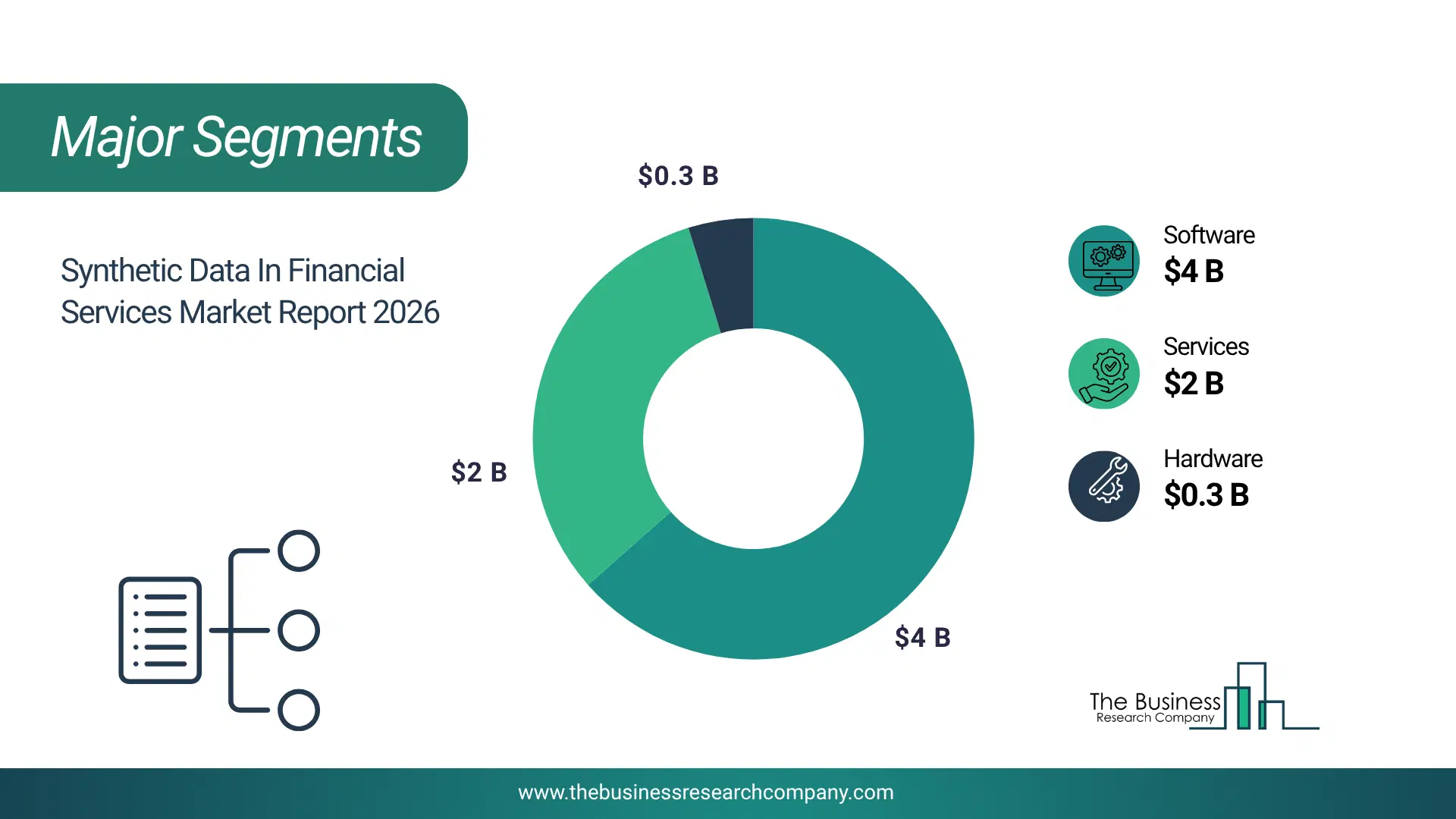
1) By Component: Software, Services, Hardware 2) By Deployment Mode: On-Premises, Cloud 3) By Data Type: Tabular Data, Time Series Data, Text Data, Image And Video Data, Other Data Types 4) By Application: Fraud Detection And Risk Management, Algorithm Testing And Model Validation, Customer Analytics, Regulatory Compliance, Other Applications 5) By End User: Banks, Insurance Companies, Investment Firms, FinTech Companies, Other End-Users Subsegments: 1) By Software: Data Generation Software, Privacy Preservation Software, Analytics And Modeling Software, Data Validation And Quality Software, Reporting And Visualization Software 2) By Services: Consulting Services, Implementation And Integration Services, Data Annotation And Preparation Services, Monitoring And Optimization Services, Support And Maintenance Services 3) By Hardware: High Performance Servers, Storage And Memory Systems, Networking Devices, Edge Computing Devices, Accelerator Cards The top segments in the synthetic data in financial services market will be: • Software will reach $4.46 Billion by 2030. • Services will reach $1.94 Billion by 2030. • Hardware will reach $0.33 Billion by 2030.What Is The Driver Of The Synthetic Data In Financial Services Market?
The expansion of digital banking is expected to propel the growth of synthetic data in the financial services market going forward. Digital banking is the digitization of traditional banking activities and services through online and mobile platforms that allow customers to access and manage their financial accounts without visiting physical branches. The digital banking expansion is driven by consumer preference for mobile-first financial services, as households increasingly adopt smartphones and mobile applications as their primary method to conduct banking transactions, manage accounts, and access financial services. Digital banking expansion drives demand for platforms that generate synthetic data to develop, test, and validate new digital banking features, artificial intelligence models, and fraud detection systems while protecting actual customer information and maintaining regulatory compliance. For instance, in April 2024, UK Finance Limited, a UK-based trade association for the banking and financial services sector, reported that digital-only bank accounts were experiencing significant growth, increasing from 24% in 2023 to 36% in 2024. Therefore, the expansion of digital banking is driving the growth of synthetic data in the financial services market.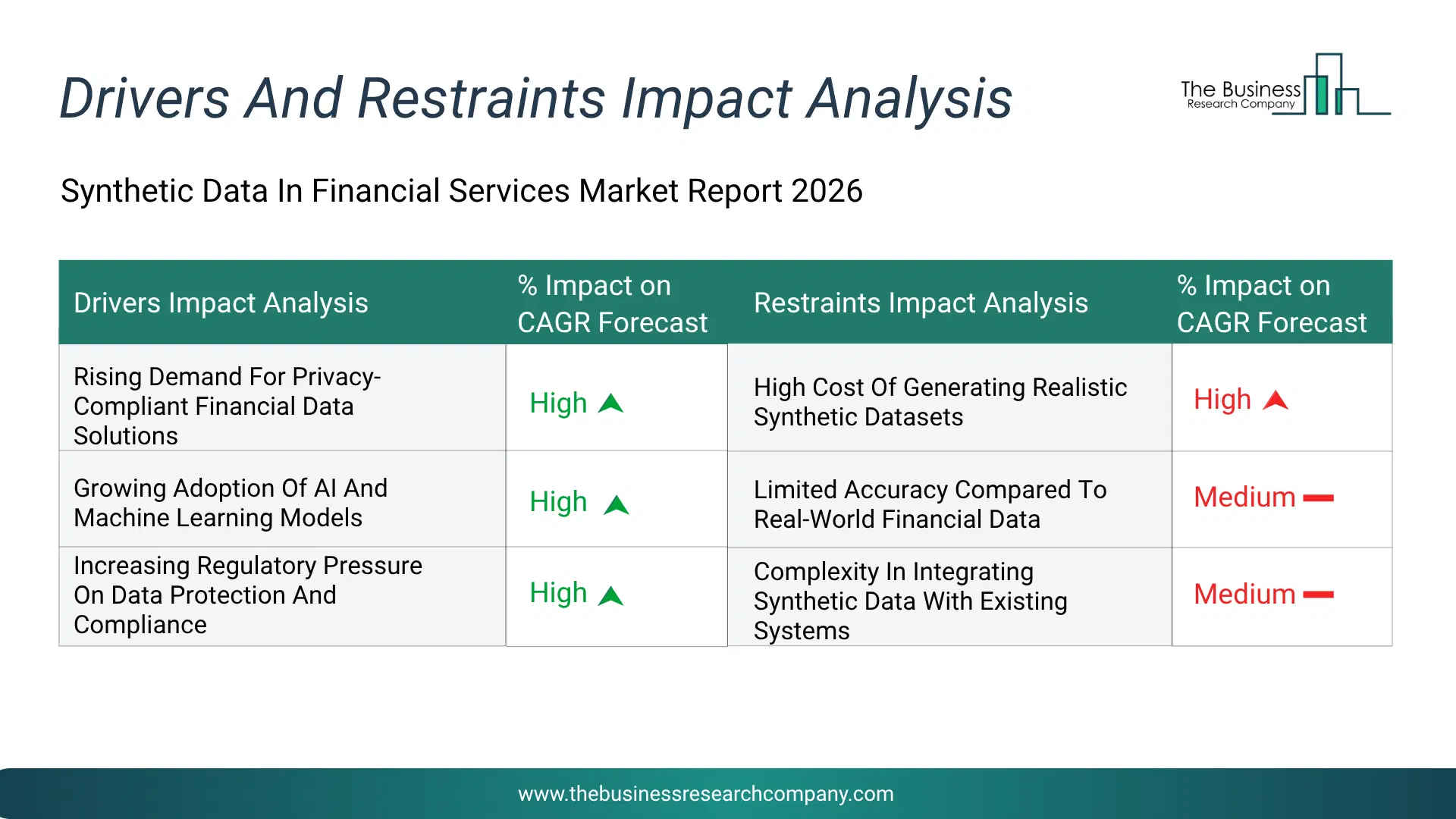
Infographic Chart Showing Key Market Drivers Analysis And Restraints For Synthetic Data In Financial Services Market
The chart presents an impact analysis of key drivers and restraints, quantifying their relative influence on the market's growth rate and helping assess the balance between growth enablers and limiting factors. This chart offers a high-level perspective; the full report contains more detailed insights.
How Will The Drivers Impact Growth In The Global Synthetic Data In Financial Services Market?
• Rising Demand For Privacy-Compliant Financial Data Solutions (High) – During the forecast period, the rising demand for privacy-compliant financial data solutions is expected to become a key growth driver for the synthetic data in financial services market by 2030. Financial institutions are increasingly leveraging synthetic data to replicate real-world datasets without exposing sensitive customer information, enabling safer data utilization across analytics, testing, and collaboration environments. This approach allows organizations to unlock the value of data while adhering to strict privacy standards and minimizing risks associated with data breaches. As digital financial services expand, the need for secure and compliant data alternatives continues to intensify. • Growing Adoption Of AI And Machine Learning Models (High) – During the forecast period, the growing adoption of AI and machine learning models is expected to emerge as a major factor driving the expansion of the synthetic data in financial services market by 2030. Financial institutions require large volumes of diverse and high-quality datasets to train, validate, and optimize predictive models used in areas such as credit scoring, fraud detection, and algorithmic trading. Synthetic data enables the generation of scalable datasets that overcome limitations of real-world data availability and imbalance. This capability enhances model accuracy and accelerates innovation cycles within financial organizations. • Increasing Regulatory Pressure On Data Protection And Compliance (High) – During the forecast period, the increasing regulatory pressure on data protection and compliance is expected to act as a key growth catalyst for the synthetic data in financial services market by 2030. Governments and regulatory bodies across global markets are enforcing stringent data governance frameworks, compelling financial institutions to adopt solutions that ensure compliance while maintaining operational efficiency. Synthetic data provides a practical approach to meet regulatory requirements by enabling data anonymization and controlled usage in development and testing environments. As compliance obligations become more complex, organizations are accelerating the adoption of synthetic data solutions.How Will The Restraints Impact Growth In The Global Synthetic Data In Financial Services Market?
• High Cost Of Generating Realistic Synthetic Datasets (High) – During the forecast period, high cost of generating realistic synthetic datasets is restricting the growth of the synthetic data in financial services market. Significant investment required for advanced modeling techniques, computing resources, and data validation processes is increasing overall costs and limiting adoption • Limited Accuracy Compared To Real-World Financial Data (High) – During the forecast period, limited accuracy compared to real-world financial data is restricting the growth of the synthetic data in financial services market. Challenges in replicating complex financial patterns and behaviors are reducing data reliability and limiting its effectiveness for critical applications • Complexity In Integrating Synthetic Data With Existing Systems (High) – During the forecast period, complexity in integrating synthetic data with existing systems is restricting the growth of the synthetic data in financial services market. Difficulties in aligning synthetic datasets with legacy systems, data pipelines, and analytics platforms are creating operational challenges and slowing deploymentKey Players In The Global Synthetic Data In Financial Services Market
Major companies operating in the synthetic data in financial services market are Google LLC, Microsoft Corporation, Amazon Web Services Inc., International Business Machines Corporation, Accenture plc, NVIDIA Corporation, Capgemini SE, Cognizant Technology Solutions Corporation, Databricks Inc, K2view Ltd, Duality Technologies Ltd, MOSTLY AI GmbH, Syntheticus AG, DataCebo Inc, Betterdata Pte Ltd, Aindo S p A, Syntho B V, DataMasque Limited, Facteus Inc, GenRocket Inc, TransValue B V, and Syndata AB.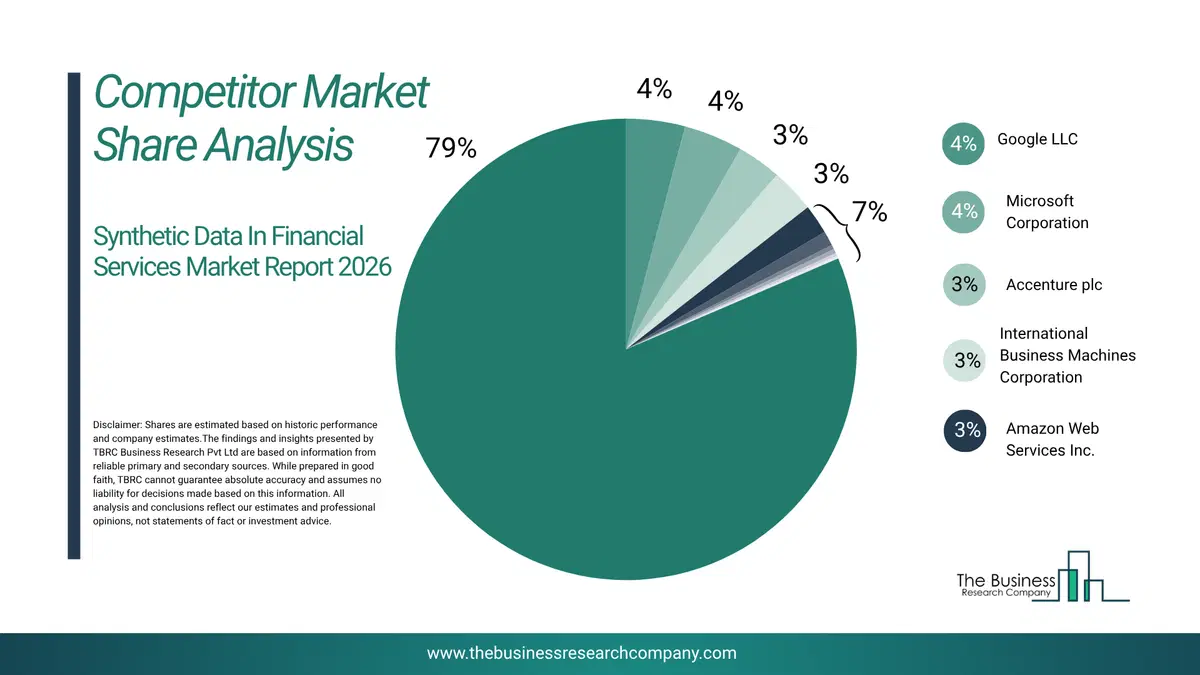
This chart is for illustrative purposes; the full report includes a detailed competitor analysis and comprehensive overview of the top 10 companies in the market.
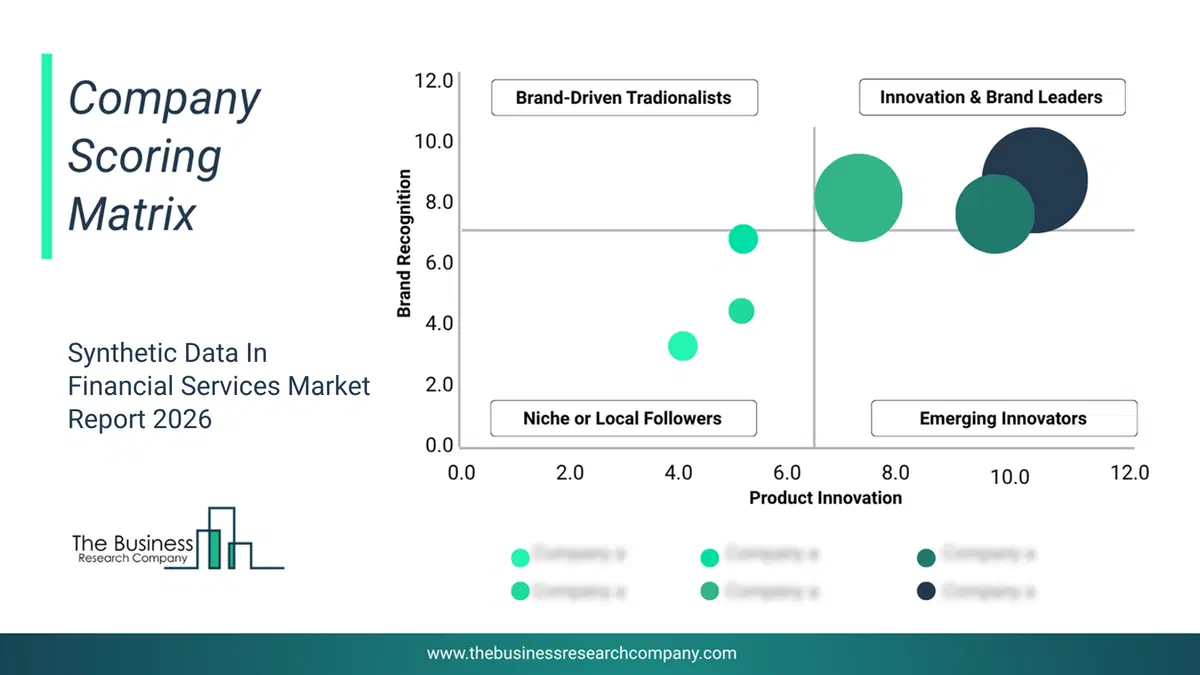
This chart maps companies by product innovation and brand strength, with bubble size indicating relative revenue, helping identify market leaders, challengers, and niche players. This is an illustrative chart; the full report provides a complete and accurate competitive analysis.
Global Synthetic Data In Financial Services Market Trends and Insights
Major companies operating in the synthetic data in the financial services market are focusing on developing advanced solutions, such as digital sandbox environment-based fintech innovation platforms, to enhance regulatory compliance without exposing sensitive customer information. A digital sandbox environment-based fintech innovation platform enables secure testing and rapid development of financial solutions using synthetic data while ensuring compliance and data privacy. For instance, in April 2023, Valley National Bank, a US-based banking institution, launched a fintech innovation platform powered by NayaOne. The platform is designed to streamline collaboration with fintech companies by providing access to hundreds of fintech products and services, along with tools for generating and applying synthetic data within a secure sandbox environment. This approach enables rapid design, testing, and deployment of innovative digital banking solutions, improving customer experience, operational efficiency, and time-to-market for new financial services across Valley National Bank’s regional network.What Are Latest Mergers And Acquisitions In The Synthetic Data In Financial Services Market?
In October 2024, Mostly AI, an Austria-based provider of GenAI-powered synthetic data solutions, partnered with Databricks to integrate its synthetic data generation platform into the Databricks Data Intelligence Platform. Through this collaboration, financial institutions can generate high-quality, privacy-preserving synthetic financial data directly within Databricks that enables compliant AI analytics, model development, and data access without exposing sensitive customer information. The integration includes a ready-to-use solution accelerator and governance via Unity Catalog, accelerating data innovation for analytics and AI teams in the financial services sector. Databricks is a US-based provider of synthetic data in financial services.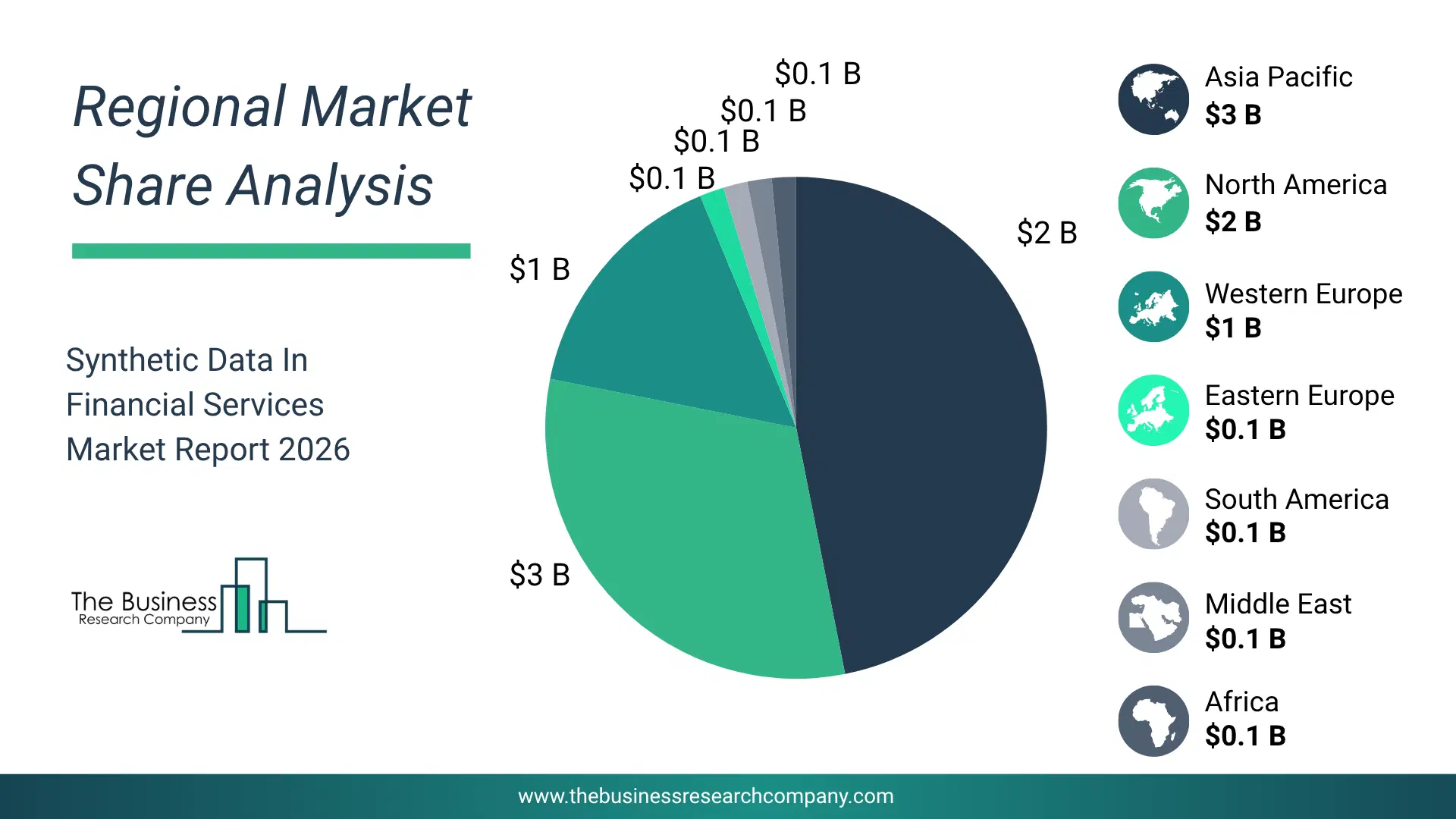
Regional Outlook
North America was the largest region in the synthetic data in the financial services market in 2025. Asia-Pacific is expected to be the fastest-growing region in the forecast period. The regions covered in this market report are Asia-Pacific, South East Asia, Western Europe, Eastern Europe, North America, South America, Middle East, Africa. The countries covered in this market report are Australia, Brazil, China, France, Germany, India, Indonesia, Japan, Taiwan, Russia, South Korea, UK, USA, Canada, Italy, Spain.What Defines the Synthetic Data In Financial Services Market?
The synthetic data in financial services market consists of revenues earned by entities by providing services such as data anonymization, model training and testing, scenario simulation, fraud detection testing, risk analysis, privacy-preserving analytics, data augmentation, stress testing, compliance validation, and synthetic dataset generation. The market value includes the value of related goods sold by the service provider or included within the service offering. The synthetic data in financial services market includes sales of tabular synthetic data models, time-series synthetic data models, transactional synthetic data models, customer behavior synthetic data models, market simulation synthetic data models, and risk modeling synthetic data models. Values in this market are ‘factory gate’ values, that is, the value of goods sold by the manufacturers or creators of the goods, whether to other entities (including downstream manufacturers, wholesalers, distributors, and retailers) or directly to end customers. The value of goods in this market includes related services sold by the creators of the goods.How is Market Value Defined and Measured?
The market value is defined as the revenues that enterprises gain from the sale of goods and/or services within the specified market and geography through sales, grants, or donations in terms of the currency (in USD unless otherwise specified). The revenues for a specified geography are consumption values that are revenues generated by organizations in the specified geography within the market, irrespective of where they are produced. It does not include revenues from resales along the supply chain, either further along the supply chain or as part of other products.
This chart presents market attractiveness based on a quantitative evaluation of growth, competition, strategic alignment, and risk, offering a clear view of opportunity areas for decision-making. This chart is for illustrative purposes; the full report contains the complete analysis.

This chart highlights the Total Addressable Market (TAM) by estimating the maximum revenue opportunity using an assumption-driven approach, supporting strategic planning and opportunity sizing across markets. The chart is illustrative; the full report provides a more comprehensive analysis.
What Key Data and Analysis Are Included in the Synthetic Data In Financial Services Market Report 2026?
The synthetic data in financial services market research report is one of a series of new reports from The Business Research Company that provides market statistics, including industry global market size, regional shares, competitors with the market share, detailed market segments, market trends and opportunities, and any further data you may need to thrive in the synthetic data in financial services industry. The market research report delivers a complete perspective of everything you need, with an in-depth analysis of the current and future state of the industry.Synthetic Data In Financial Services Market Report Forecast Analysis
| Report Attribute | Details |
|---|---|
| Market Size Value In 2026 | $2.28 billion |
| Revenue Forecast In 2030 | $6.71 billion |
| Growth Rate | CAGR of 30.7% from 2026 to 2030 |
| Base Year For Estimation | 2025 |
| Actual Estimates/Historical Data | 2020-2025 |
| Forecast Period | 2026 - 2030 |
| Market Representation | Revenue in USD Billion and CAGR from 2026 to 2030 |
| Segments Covered | Component, Deployment Mode, Data Type, Application, End User |
| Regional Scope | Asia-Pacific, Western Europe, Eastern Europe, North America, South America, Middle East, Africa |
| Country Scope | The countries covered in the report are Australia, Brazil, China, France, Germany, India, Indonesia, Japan, Taiwan, Russia, South Korea, UK, USA, Canada, Italy, Spain. |
| Key Companies Profiled | Google LLC, Microsoft Corporation, Amazon Web Services Inc., International Business Machines Corporation, Accenture plc, NVIDIA Corporation, Capgemini SE, Cognizant Technology Solutions Corporation, Databricks Inc, K2view Ltd, Duality Technologies Ltd, MOSTLY AI GmbH, Syntheticus AG, DataCebo Inc, Betterdata Pte Ltd, Aindo S p A, Syntho B V, DataMasque Limited, Facteus Inc, GenRocket Inc, TransValue B V, and Syndata AB. |
| Customization Scope | Request for Customization |
| Pricing And Purchase Options | Explore Purchase Options |