
Synthetic Dye Market Report 2026
Global Outlook – By Product Type (Acid Dyes, Disperse Dyes, Reactive Dyes, Direct Dyes, Basic Dyes, VAT Dyes, Other Product Types), By Form (Powder, Liquid), By End User Industry (Textile, Food And Beverages, Paper, Ink, Leather, Other End Use Industries ) – Market Size, Trends, Strategies, and Forecast to 2030
Synthetic Dye Market Overview
• Synthetic Dye market size has reached to $16.49 billion in 2025 • Expected to grow to $23.84 billion in 2030 at a compound annual growth rate (CAGR) of 7.8% • Growth Driver: The Rise Of The Packaging Industry Driving The Growth Of The Market Due To Rising E-Commerce And Retail Demand • Market Trend: Integration Of Resource-Efficient Reactive Dyes Enhances Sustainable Dark Shade Dyeing • Asia-Pacific was the largest region in 2025 and Asia-Pacific is the fastest growing region.What Is Covered Under Synthetic Dye Market?
Synthetic dyes are predominantly organic (carbon-based) chemical compounds that are generally derived from petrochemical derivatives. A dye is a colored substance that has an affinity for the substrate to which the dye is applied. Dyes are applied in an aqueous solution and may require a mordant to make them fast on the fiber. Synthetic dyes are used to impart color to paper, textiles, leather, and other materials. Eosin Y, fast green, basic fuchsin, aniline blue, methylene blue, and orange G are examples of synthetic dyes. The main product types of synthetic dyes are acid dyes, dispersed dyes, reactive dyes, direct dyes, basic dyes, vat dyes, and other product types. Acid dye is a class of dyes containing one or more acidic groups, such as the sulfo group used in acid solution chiefly for dyeing wool and silk. The product types involved are acid dyes, dispersed dyes, reactive dyes, direct dyes, basic dyes, vat dyes, and other product types. The various end-use industries are textiles, food & beverages, paper, ink, leather, and other end-use industries.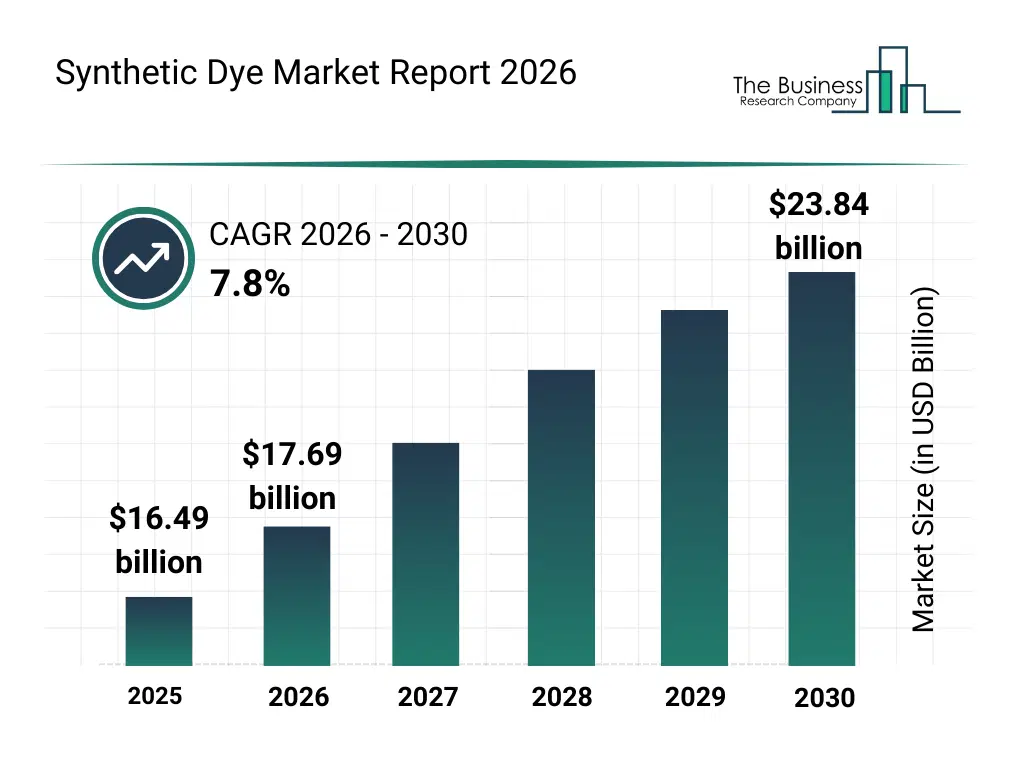
What Is The Synthetic Dye Market Size and Share 2026?
The synthetic dye market size has grown strongly in recent years. It will grow from $16.49 billion in 2025 to $17.69 billion in 2026 at a compound annual growth rate (CAGR) of 7.3%. The growth in the historic period can be attributed to growth of textile manufacturing, expansion of apparel exports, long term use in leather processing, rising paper production, established chemical dyeing processes.What Is The Synthetic Dye Market Growth Forecast?
The synthetic dye market size is expected to see strong growth in the next few years. It will grow to $23.84 billion in 2030 at a compound annual growth rate (CAGR) of 7.8%. The growth in the forecast period can be attributed to growing demand for colored packaging, expansion of technical textiles, rising industrial dye applications, increasing demand from emerging economies, innovation in dye formulations. Major trends in the forecast period include growing demand for textile coloration, rising use in paper and packaging, expansion of reactive and disperse dyes, increasing focus on color fastness, rising demand for cost efficient dyes.
Global Synthetic Dye Market Segmentation
1) By Product Type: Acid Dyes, Disperse Dyes, Reactive Dyes, Direct Dyes, Basic Dyes, VAT Dyes, Other Product Types 2) By Form: Powder, Liquid 3) By End User Industry: Textile, Food And Beverages, Paper, Ink, Leather, Other End Use Industries Subsegments: 1) By Acid Dyes: Acid Aniline Dyes, Other Acid Dyes 2) By Disperse Dyes: Disperse Anionic Dyes, Disperse Cationic Dyes 3) By Reactive Dyes: Monochlorotriazine Reactive Dyes, Dichlorotriazine Reactive Dyes, Vinylsulfone Reactive Dyes 4) By Direct Dyes: Direct Aniline Dyes, Other Direct Dyes 5) By Basic Dyes: Cationic Dyes, Other Basic Dyes 6) By VAT Dyes: Indigo Dyes, Other VAT Dyes 7) By Other Product Types: Sulfur Dyes, Metal Complex Dyes, Optical BrightenersWhat Is The Driver Of The Synthetic Dye Market?
The growing packaging industry is expected to propel the growth of the superabsorbent polymers (SAP) market going forward. The packaging industry refers to the sector of business involved in designing, producing, and supplying materials and containers used to protect, store, transport, and present products across various markets. The growth of the packaging industry is primarily driven by rising e-commerce and retail demand, which increases the need for protective, attractive, and convenient packaging solutions. Superabsorbent polymers enhance the packaging industry by efficiently absorbing and retaining liquids, preventing leaks, maintaining product integrity, and extending shelf life. For instance, in September 2024, according to the State of the Flexible Packaging Industry Report by the Flexible Packaging Association, a US-based association, the U.S. flexible packaging industry reached an estimated $42.9 billion in sales in 2023, reflecting a 3.4% rise compared with $41.5 billion in 2022. Therefore, the growing packaging industry is driving the growth of the superabsorbent polymers market.Key Players In The Global Synthetic Dye Market
Major companies operating in the synthetic dye market are BASF SE, Sumitomo Chemical Co. Ltd., DuPont de Nemours Inc., Huntsman Corp., Clariant International Ltd., Zhejiang Longsheng Group Co. Ltd., Archroma Management LLC, Kemira Oyj, Heubach Gmbh, Dystar Singapore Pte Ltd., DyStar Group, Atul Ltd., Milliken & Company, Everlight Chemical Industrial Corporation, Synthesia A.S., Bodal Chemicals Ltd., Steiner Group Ltd., Kiri Industries Ltd., Cromatos S.A, Loxim Industries Limited, Stahl Holdings BV, Organic Dyes and Pigments LLC, OCI Company Ltd., Lanxess AG, Waterside colours Ltd., Vedant Textile Pigments Limited, Colorantes Industriales S.A. de C.V., Aries Dye Chem Inc., Trumpler GmbH & Co. KG, Ravi Dyeware Co. Pvt. Ltd., Haining Tongyuan Chemical Factory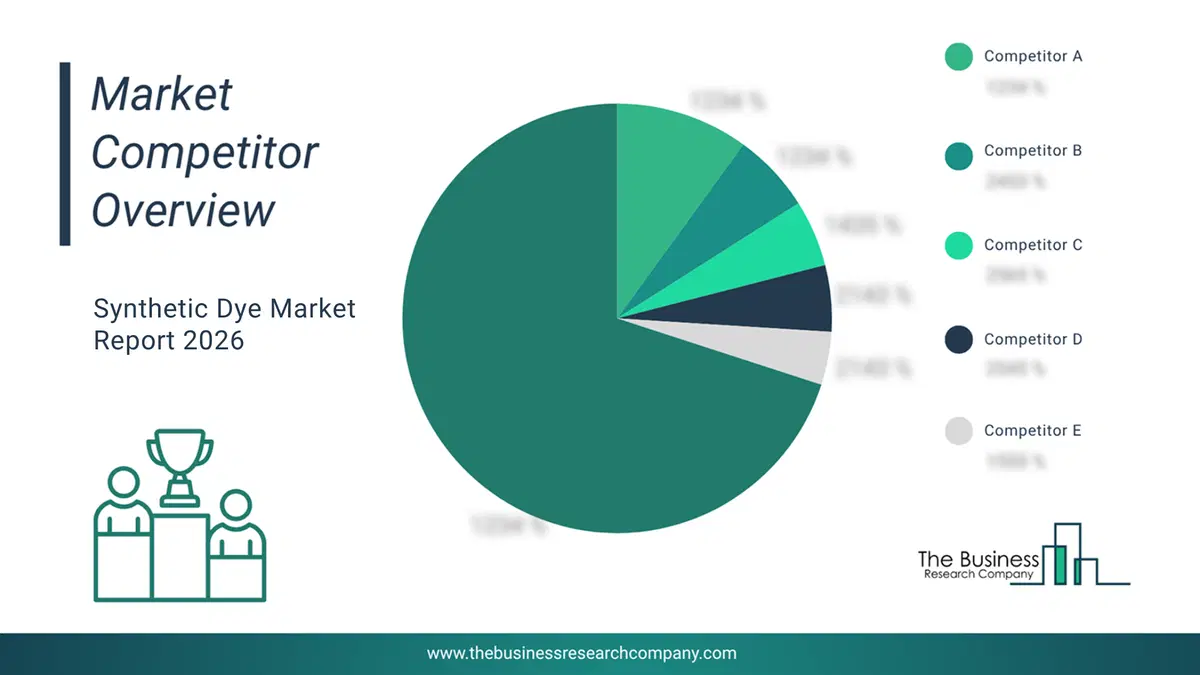
This chart is for illustrative purposes; the full report includes a detailed competitor analysis and comprehensive overview of the top 10 companies in the market.
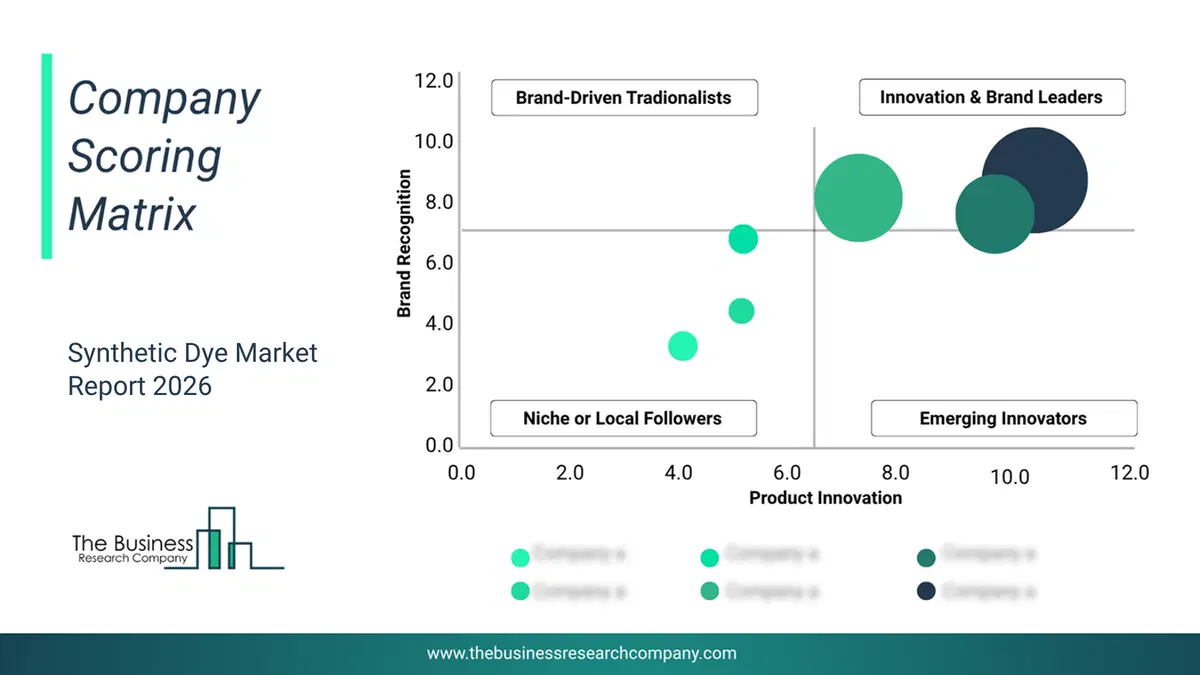
This chart maps companies by product innovation and brand strength, with bubble size indicating relative revenue, helping identify market leaders, challengers, and niche players. This is an illustrative chart; the full report provides a complete and accurate competitive analysis.
Global Synthetic Dye Market Trends and Insights
Major companies operating in the synthetic dye market are focusing on integrating resource-efficient reactive dye systems, such as next-generation low-temperature, high-fixation reactive dyes for dark and extra-dark shades, to reduce water and energy consumption while maintaining color performance and fastness. These next-generation reactive dye systems are engineered to dye cellulosic fibers and blends at lower temperatures with faster wash-off, allowing mills to achieve deep shades with less re-dyeing, lower effluent load, and improved productivity. For instance, in 2024, Archroma Management GmbH, a Switzerland-based specialty chemicals company, launched AVITERA SE GENERATION NEXT, an extension of its AVITERA SE reactive dye range featuring three new dark colors: Black Pearl SE, Blue Horizon SE, and Night Storm SE, optimized for deep and extra-dark shades. The new dyes incorporate low-temperature high-speed wash-off technology, which can reduce water and energy consumption by up to 50% and cut CO₂ emissions and effluent by the same margin. Additionally, the range offers an improved cost-to-performance ratio, potentially increasing mill output by 25% or more while maintaining excellent color fastness and consistency, promoting more sustainable dyeing practices in synthetic textiles.What Are Latest Mergers And Acquisitions In The Synthetic Dye Market?
In March 2025, Sudarshan Chemical Industries Ltd., an India-based manufacturing company, acquired Heubach Group for an undisclosed amount. With this acquisition, Sudarshan aimed to expand its global footprint and become a leader in the pigment industry by combining its operations with Heubach’s global assets and technologies. Heubach Group is a Germany‑based specialty chemicals manufacturer that specializes in producing synthetic dyes as part of its extensive portfolio of color solutions.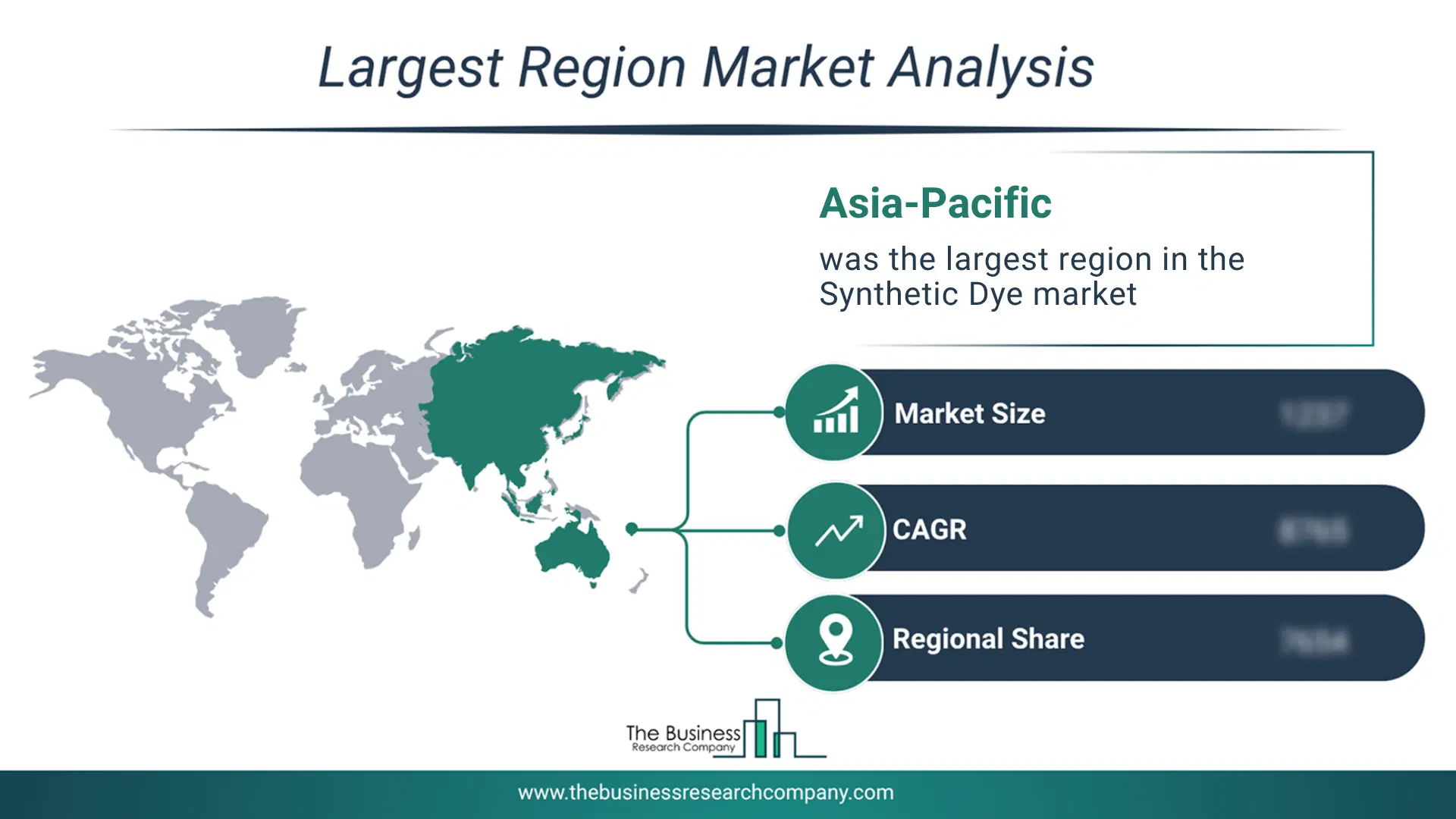
Regional Insights
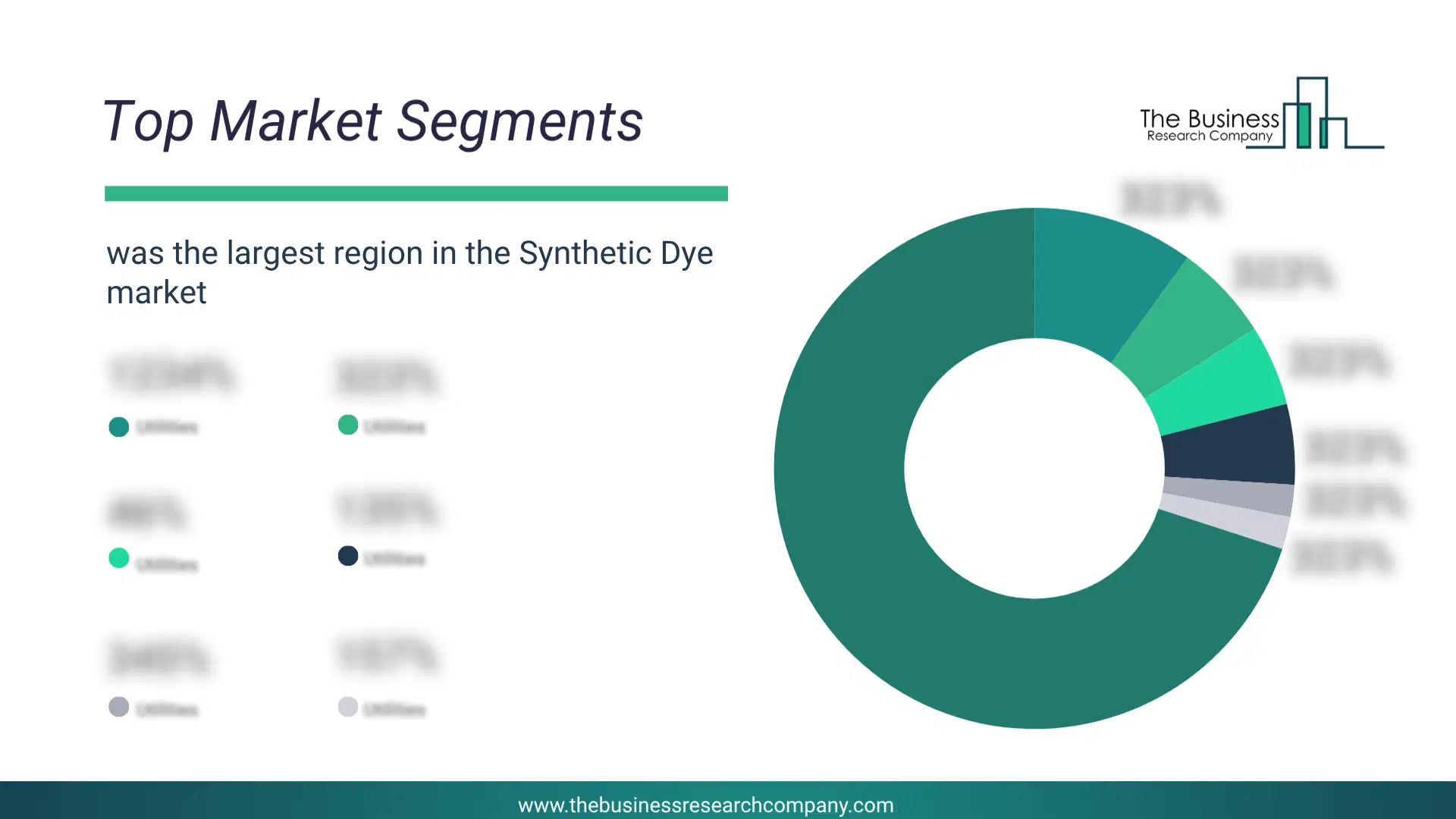
Asia-Pacific was the largest region in the synthetic dyes market in 2025. Western Europe was the second-largest region in the global synthetic dyes market share. The regions covered in this market report are Asia-Pacific, South East Asia, Western Europe, Eastern Europe, North America, South America, Middle East, Africa The countries covered in this market report are Australia, Brazil, China, France, Germany, India, Indonesia, Japan, Taiwan, Russia, South Korea, UK, USA, Canada, Italy, SpainWhat Defines the Synthetic Dye Market?
The synthetic dyes market consists of the sales of azoic dyes, chrome dyes, developed dyes, and direct dyes. Values in this market are factory gate values, that is the value of goods sold by the manufacturers or creators of the goods, whether to other entities (including downstream manufacturers, wholesalers, distributors, and retailers) or directly to end customers. The value of goods in this market includes related services sold by the creators of the goods.How is Market Value Defined and Measured?
The market value is defined as the revenues that enterprises gain from the sale of goods and/or services within the specified market and geography through sales, grants, or donations in terms of the currency (in USD unless otherwise specified). The revenues for a specified geography are consumption values that are revenues generated by organizations in the specified geography within the market, irrespective of where they are produced. It does not include revenues from resales along the supply chain, either further along the supply chain or as part of other products.
This chart presents market attractiveness based on a quantitative evaluation of growth, competition, strategic alignment, and risk, offering a clear view of opportunity areas for decision-making. This chart is for illustrative purposes; the full report contains the complete analysis.

This chart highlights the Total Addressable Market (TAM) by estimating the maximum revenue opportunity using an assumption-driven approach, supporting strategic planning and opportunity sizing across markets. The chart is illustrative; the full report provides a more comprehensive analysis.
What Key Data and Analysis Are Included in the Synthetic Dye Market Report 2026?
The synthetic dye market research report is one of a series of new reports from The Business Research Company that provides market statistics, including industry global market size, regional shares, competitors with the market share, detailed market segments, market trends and opportunities, and any further data you may need to thrive in the synthetic dye industry. The market research report delivers a complete perspective of everything you need, with an in-depth analysis of the current and future state of the industry.Synthetic Dye Market Report Forecast Analysis
| Report Attribute | Details |
|---|---|
| Market Size Value In 2026 | $17.69 billion |
| Revenue Forecast In 2030 | $23.84 billion |
| Growth Rate | CAGR of 7.3% from 2026 to 2030 |
| Base Year For Estimation | 2025 |
| Actual Estimates/Historical Data | 2020-2025 |
| Forecast Period | 2026 - 2030 |
| Market Representation | Revenue in USD Billion and CAGR from 2026 to 2030 |
| Segments Covered | Product Type, Form, End User Industry |
| Regional Scope | Asia-Pacific, Western Europe, Eastern Europe, North America, South America, Middle East, Africa |
| Country Scope | The countries covered in this market report are Australia, Brazil, China, France, Germany, India, Indonesia, Japan, Taiwan, Russia, South Korea, UK, USA, Canada, Italy, Spain |
| Key Companies Profiled | BASF SE, Sumitomo Chemical Co. Ltd., DuPont de Nemours Inc., Huntsman Corp., Clariant International Ltd., Zhejiang Longsheng Group Co. Ltd., Archroma Management LLC, Kemira Oyj, Heubach Gmbh, Dystar Singapore Pte Ltd., DyStar Group, Atul Ltd., Milliken & Company, Everlight Chemical Industrial Corporation, Synthesia A.S., Bodal Chemicals Ltd., Steiner Group Ltd., Kiri Industries Ltd., Cromatos S.A, Loxim Industries Limited, Stahl Holdings BV, Organic Dyes and Pigments LLC, OCI Company Ltd., Lanxess AG, Waterside colours Ltd., Vedant Textile Pigments Limited, Colorantes Industriales S.A. de C.V., Aries Dye Chem Inc., Trumpler GmbH & Co. KG, Ravi Dyeware Co. Pvt. Ltd., Haining Tongyuan Chemical Factory |
| Customization Scope | Request for Customization |
| Pricing And Purchase Options | Explore Purchase Options |