
Synthetic Electronic Health Record (EHR) Data Generation Platforms Market Report 2026
Global Outlook – By Component (Software, Services), By Offering (Fully Synthetic Data, Partially Synthetic Data, Hybrid Synthetic Data), By Deployment Mode (On-Premises, Cloud-Based), By Application (Healthcare Analytics, Medical Research, Clinical Trials, Data Privacy And Security, Other Applications), By End-User (Hospitals And Clinics, Research Organizations, Pharmaceutical And Biotechnology Companies, Academic Institutions, Other End Users) – Market Size, Trends, Strategies, and Forecast to 2035
Synthetic Electronic Health Record (EHR) Data Generation Platforms Market Overview
• Synthetic Electronic Health Record (EHR) Data Generation Platforms market size has reached to $0.62 billion in 2025 • Expected to grow to $1.98 billion in 2030 at a compound annual growth rate (CAGR) of 26.4% • Growth Driver: Impact Of Growing Electronic Health Records Adoption On The Market Due To Enhanced Data Privacy And AI Training Needs • North America was the largest region in 2025 and Asia-Pacific is the fastest growing region.What Is Covered Under Synthetic Electronic Health Record (EHR) Data Generation Platforms Market?
Synthetic electronic health record (EHR) data generation platforms are software solutions that create realistic but artificial electronic health record (EHR) data, mimicking patient information and clinical events while protecting privacy. They are used for testing healthcare applications, training AI models, and conducting research without exposing real patient data. The main components of synthetic electronic health record data generation platforms include software and services. Software refers to platforms that generate realistic synthetic EHR data to support analytics, research, and testing while preserving patient privacy. They are offered as fully synthetic data, partially synthetic data, or hybrid synthetic data and are deployed through on-premises and cloud-based models. They find application in healthcare analytics, medical research, clinical trials, data privacy and security, and other applications, serving end users including hospitals and clinics, research organizations, pharmaceutical and biotechnology companies, academic institutions, and other end users.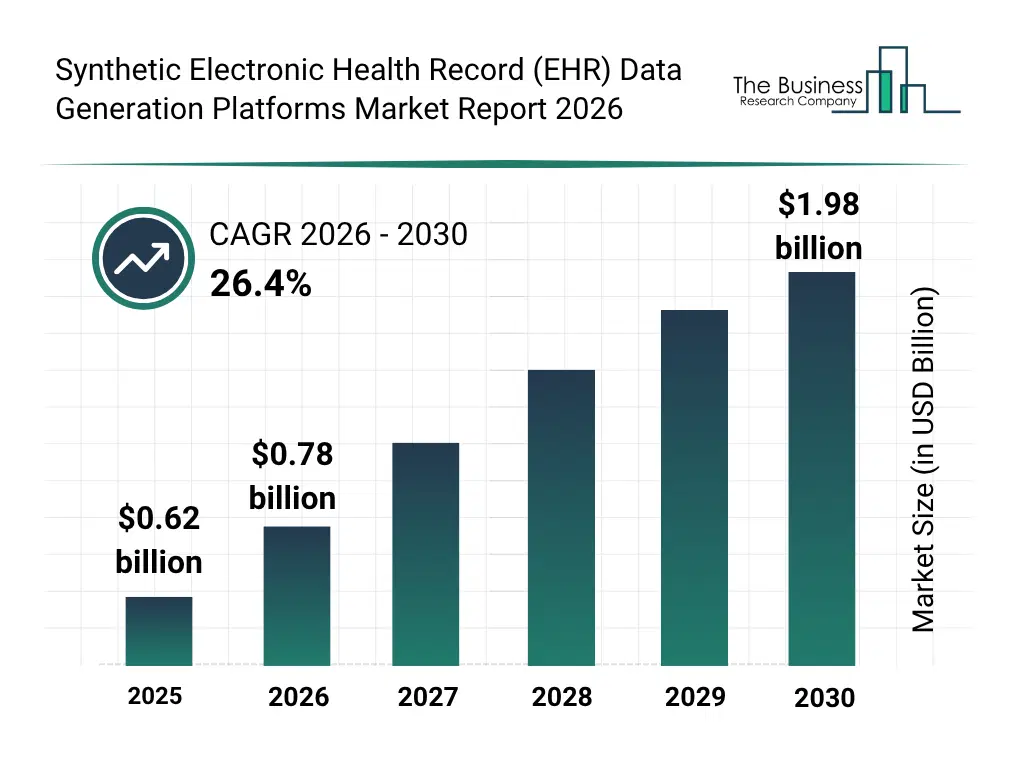
What Is The Synthetic Electronic Health Record (EHR) Data Generation Platforms Market Size and Share 2026?
The synthetic electronic health record (EHR) data generation platforms market size has grown exponentially in recent years. It will grow from $0.62 billion in 2025 to $0.78 billion in 2026 at a compound annual growth rate (CAGR) of 26.2%. The growth in the historic period can be attributed to increasing adoption of electronic health records, growth in healthcare ai initiatives, demand for secure patient data, limited access to real patient datasets, rising clinical research activities.What Is The Synthetic Electronic Health Record (EHR) Data Generation Platforms Market Growth Forecast?
The synthetic electronic health record (EHR) data generation platforms market size is expected to see exponential growth in the next few years. It will grow to $1.98 billion in 2030 at a compound annual growth rate (CAGR) of 26.4%. The growth in the forecast period can be attributed to expansion of ai-enabled synthetic data platforms, adoption of cloud-based healthcare solutions, regulatory emphasis on data privacy, growth in precision medicine research, increasing use of synthetic data for clinical trials. Major trends in the forecast period include synthetic data validation and testing, ai-driven ehr simulation, privacy-preserving data generation, cloud-based deployment and integration, scenario modeling for clinical research.
Global Synthetic Electronic Health Record (EHR) Data Generation Platforms Market Segmentation
1) By Component: Software, Services 2) By Offering: Fully Synthetic Data, Partially Synthetic Data, Hybrid Synthetic Data 3) By Deployment Mode: On-Premises, Cloud-Based 4) By Application: Healthcare Analytics, Medical Research, Clinical Trials, Data Privacy And Security, Other Applications 5) By End-User: Hospitals And Clinics, Research Organizations, Pharmaceutical And Biotechnology Companies, Academic Institutions, Other End Users Subsegments: 1) By Software: Synthetic Data Generation Software, Data Anonymization And De-Identification Software, Scenario Simulation And Modeling Software, Data Quality Validation And Testing Software, Application Programming Interface Integration Software 2) By Services: Consulting And Use Case Design Services, Customization And Platform Integration Services, Data Governance And Compliance Services, Training And Technical Support Services, Maintenance And Platform Update ServicesWhat Are The Drivers Of The Synthetic Electronic Health Record (EHR) Data Generation Platforms Market?
The increasing adoption of electronic health records is expected to propel the growth of the synthetic electronic health records data generation platforms market going forward. Electronic health records (EHR) refer to a digital record of a patient’s medical information that can be securely accessed, updated, and shared by authorized healthcare providers. The adoption of electronic health records (EHR) is increasing as they improve healthcare efficiency by enabling quick access to patient data, reducing paperwork, and streamlining clinical workflows. Synthetic electronic health records (EHR) data generation platforms help by creating realistic but artificial patient data that preserves privacy, enabling healthcare organizations to train AI models, test software, and conduct research without risking exposure of real patient information. For instance, in December 2024, according to the Centers for Disease Control and Prevention (CDC), a US-based national public health agency, the percentage of office-based physicians using the electronic health records system was 88.2%, however, the adoption of certified EHR systems percentage is 77.8%. Therefore, the increasing adoption of electronic health records is driving the growth of the synthetic electronic health records data generation platforms market. The growing cloud adoption is expected to propel the growth of the synthetic electronic health records data generation platforms market going forward. Cloud adoption refers to the process of using cloud-based computing services instead of on-premises infrastructure to improve scalability, flexibility, and efficiency. Cloud adoption is increasing due to scalability, as businesses can quickly adjust computing resources up or down in the cloud to meet changing demand without investing in additional physical infrastructure. Synthetic electronic health record (EHR) data generation platforms help cloud adoption by enabling secure, scalable, and compliant testing and development in cloud environments without using real patient data, allowing healthcare organizations to leverage cloud computing for analytics, AI training, and software deployment safely. For instance, in March 2025, according to the Office for National Statistics, a UK-based government department, in 2023, artificial intelligence (AI) was adopted by 9% of firms, while cloud-based computing systems and applications were adopted by 69% of firms in the UK. Therefore, the growing cloud adoption is driving the growth of the synthetic electronic health records data generation platforms market.Key Players In The Global Synthetic Electronic Health Record (EHR) Data Generation Platforms Market
Major companies operating in the synthetic electronic health record (EHR) data generation platforms market are Datavant Inc, Insilico Medicine Inc, Quantiphi Inc, Syncora.ai, Saama Technologies Inc, MDClone Ltd, Gretel Labs Inc, Unlearn.ai Inc, TonicAI Inc, Medisyn Inc, Aindo S.r.l, Hazy Limited, MOSTLY AI Solutions MP GmbH, Syntegra, Syntho B V, GenRocket Inc, Datomize, Statice GmbH, Generative Medical Inc, and AnonyMed.What Are Latest Mergers And Acquisitions In The Synthetic Electronic Health Record (EHR) Data Generation Platforms Market?
In April 2024, SA Health, an Australia-based government portfolio, partnered with Gretel AI to use synthetic data to safely share and analyze Electronic Health Records (EHR) for research while protecting patient privacy. With this partnership, companies aim to enhance healthcare research and analytics by enabling secure, privacy-preserving access to synthetic patient data. Gretel AI is a US-based provider of synthetic data generation tools that can be used to generate synthetic EHR data suitable for analytics, machine learning, testing, and other healthcare-oriented applications.Regional Insights
North America was the largest region in the synthetic electronic health record data (EHR) generation platforms market in 2025. Asia-Pacific is expected to be the fastest-growing region in the forecast period. The regions covered in this market report are Asia-Pacific, South East Asia, Western Europe, Eastern Europe, North America, South America, Middle East, Africa. The countries covered in this market report are Australia, Brazil, China, France, Germany, India, Indonesia, Japan, Taiwan, Russia, South Korea, UK, USA, Canada, Italy, Spain.What Defines the Synthetic Electronic Health Record (EHR) Data Generation Platforms Market?
The synthetic electronic health record data (EHR) generation platforms market consists of revenues earned by entities by providing services such as synthetic patient record generation, clinical workflow simulation, and software testing and benchmarking. The market value includes the value of related goods sold by the service provider or included within the service offering. Only goods and services traded between entities or sold to end consumers are included.How is Market Value Defined and Measured?
The market value is defined as the revenues that enterprises gain from the sale of goods and/or services within the specified market and geography through sales, grants, or donations in terms of the currency (in USD unless otherwise specified). The revenues for a specified geography are consumption values that are revenues generated by organizations in the specified geography within the market, irrespective of where they are produced. It does not include revenues from resales along the supply chain, either further along the supply chain or as part of other products.What Key Data And Analysis Are Included In The Synthetic Electronic Health Record (EHR) Data Generation Platforms Market Report 2026?
The synthetic electronic health record (ehr) data generation platforms market research report is one of a series of new reports from The Business Research Company that provides market statistics, including industry global market size, regional shares, competitors with the market share, detailed market segments, market trends and opportunities, and any further data you may need to thrive in the synthetic electronic health record (ehr) data generation platforms industry. The market research report delivers a complete perspective of everything you need, with an in-depth analysis of the current and future state of the industry.Synthetic Electronic Health Record (EHR) Data Generation Platforms Market Report Forecast Analysis
| Report Attribute | Details |
|---|---|
| Market Size Value In 2026 | $0.78 billion |
| Revenue Forecast In 2035 | $1.98 billion |
| Growth Rate | CAGR of 26.2% from 2026 to 2035 |
| Base Year For Estimation | 2025 |
| Actual Estimates/Historical Data | 2020-2025 |
| Forecast Period | 2026 - 2030 - 2035 |
| Market Representation | Revenue in USD Billion and CAGR from 2026 to 2035 |
| Segments Covered | Component, Offering, Deployment Mode, Application, End-User |
| Regional Scope | Asia-Pacific, Western Europe, Eastern Europe, North America, South America, Middle East, Africa |
| Country Scope | The countries covered in the report are Australia, Brazil, China, France, Germany, India, Indonesia, Japan, Taiwan, Russia, South Korea, UK, USA, Canada, Italy, Spain. |
| Key Companies Profiled | Datavant Inc, Insilico Medicine Inc, Quantiphi Inc, Syncora.ai, Saama Technologies Inc, MDClone Ltd, Gretel Labs Inc, Unlearn.ai Inc, TonicAI Inc, Medisyn Inc, Aindo S.r.l, Hazy Limited, MOSTLY AI Solutions MP GmbH, Syntegra, Syntho B V, GenRocket Inc, Datomize, Statice GmbH, Generative Medical Inc, and AnonyMed. |
| Customization Scope | Request for Customization |
| Pricing And Purchase Options | Explore Purchase Options |