
Synthetic Gene Circuits Market Report 2026
Global Outlook – By Product Type (Toggle Switches, Oscillators, Logic Gates, Other Product Types), By Application (Healthcare And Therapeutics, Industrial Biotechnology, Research And Development, Agriculture, Other Applications), By End User (Pharmaceutical And Biotechnology Companies, Academic And Research Institutes, Other End Users) – Market Size, Trends, Strategies, and Forecast to 2035
Synthetic Gene Circuits Market Overview
• Synthetic Gene Circuits market size has reached to $2.02 billion in 2025 • Expected to grow to $4.64 billion in 2030 at a compound annual growth rate (CAGR) of 18.1% • Growth Driver: Increasing Demand For Precision Medicine Driving The Market Growth Through Higher Regulatory Approvals Of Targeted Therapies • Market Trend: Advancements In Synthetic Gene Circuit Engineering Enable Precise And Tunable Control Of Transgene Expression In Cells • North America was the largest region in 2025 and Asia-Pacific is the fastest growing region.What Is Covered Under Synthetic Gene Circuits Market?
Synthetic gene circuits are artificially designed DNA networks that function as electronic circuits inside living cells, allowing precise control over gene expression. Their main objective is to engineer cells to carry out defined tasks such as targeted therapeutics, disease sensing, metabolic engineering, and environmental monitoring by systematically regulating cellular activities across biotechnology and healthcare applications. The main product types of synthetic gene circuits include toggle switches, oscillators, logic gates, and other product types. Toggle switches are engineered genetic modules that control gene expression in a predictable, switch-like manner, enabling precise regulation of cellular functions for research and therapeutic applications. They find application in healthcare and therapeutics, industrial biotechnology, research and development, agriculture, and other applications, serving end users including pharmaceutical and biotechnology companies, academic and research institutes, and other end users.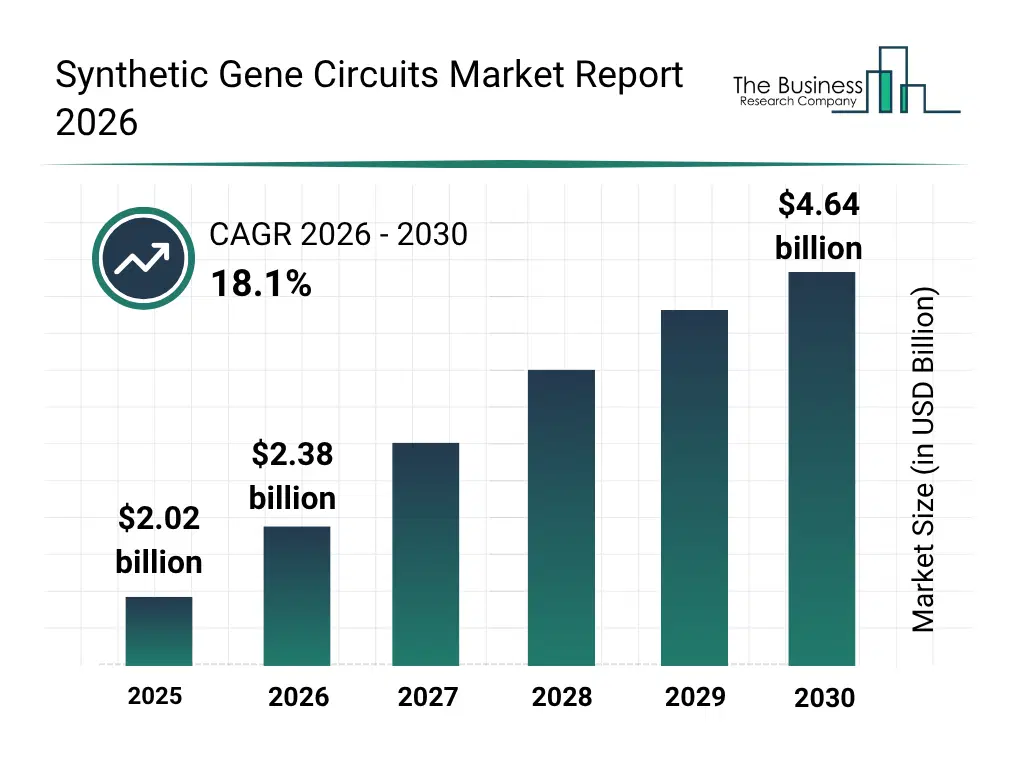
What Is The Synthetic Gene Circuits Market Size and Share 2026?
The synthetic gene circuits market size has grown rapidly in recent years. It will grow from $2.02 billion in 2025 to $2.38 billion in 2026 at a compound annual growth rate (CAGR) of 17.9%. The growth in the historic period can be attributed to advancements in molecular biology techniques, rising investment in biotechnology research, adoption of synthetic gene circuits in academic studies, increasing demand for targeted therapeutics, growth of industrial biotechnology.What Is The Synthetic Gene Circuits Market Growth Forecast?
The synthetic gene circuits market size is expected to see rapid growth in the next few years. It will grow to $4.64 billion in 2030 at a compound annual growth rate (CAGR) of 18.1%. The growth in the forecast period can be attributed to integration of ai in gene circuit design, expansion of synthetic biology applications in healthcare, demand for programmable cellular therapies, growth in environmental biosensing, adoption of automated high-throughput screening. Major trends in the forecast period include programmable gene expression circuits, synthetic biological oscillators, genetic toggle switch innovation, cell-based biosensors, metabolic pathway engineering.
Global Synthetic Gene Circuits Market Segmentation
1) By Product Type: Toggle Switches, Oscillators, Logic Gates, Other Product Types 2) By Application: Healthcare And Therapeutics, Industrial Biotechnology, Research And Development, Agriculture, Other Applications 3) By End User: Pharmaceutical And Biotechnology Companies, Academic And Research Institutes, Other End Users Subsegments: 1) By Toggle Switches: Single Input Toggle Switches, Double Input Toggle Switches, Inducible Toggle Switches, Bistable Genetic Toggle Switches, Reversible Genetic Toggle Switches 2) By Oscillators: Repressilator Circuits, Feedback Loop Oscillators, Inducible Genetic Oscillators, Synthetic Biological Clocks, Multi Component Oscillators 3) By Logic Gates: And Logic Gates, Or Logic Gates, Not Logic Gates, Nand Logic Gates, Nor Logic Gates, Exclusive Or Logic Gates 4) By Other Product Types: Signal Amplifier Circuits, Memory Storage Circuits, Pattern Formation Circuits, Sensor Responsive Circuits, Programmable Gene Expression CircuitsWhat Are The Drivers Of The Synthetic Gene Circuits Market?
The increasing demand for precision medicine is expected to propel the growth of the synthetic gene circuits market going forward. Precision medicine is a medical approach that customizes disease prevention and treatment strategies based on an individual’s genetic profile, environment, and lifestyle to improve therapeutic effectiveness and safety. The demand for precision medicine is rising due to the growing burden of cancer and rare genetic disorders that require targeted and mutation-specific treatments. The synthetic gene circuits support precision medicine by enabling programmable control of gene expression and cellular responses, which allows researchers and manufacturers to design highly specific and patient-tailored therapeutic interventions. For instance, in February 2024, according to the Personalized Medicine Coalition, a US-based hospital and health care organization, in 2023, the Food and Drug Administration (FDA) approved 16 new personalized treatments for rare disease patients, up from six in 2022. Therefore, the increasing demand for precision medicine is driving the growth of the synthetic gene circuits industry. The growing investment in research and development is expected to propel the growth of the synthetic gene circuits market going forward. Research and development (R&D) investment refers to the systematic allocation of financial resources by governments, academic institutions, and private organizations toward scientific exploration aimed at generating new knowledge and advancing technological capabilities. The rising level of R&D investment is largely driven by the increasing demand for precision therapeutics and next-generation biomedical solutions, as stakeholders across the public and private sectors channel greater funding into biotechnology research to address complex and unmet clinical needs. Growing R&D investment enables scientists and engineers to design, refine, and validate increasingly sophisticated programmable biological components, accelerating their translation into viable commercial and therapeutic applications. For instance, in February 2025, according to the National Center for Science and Engineering Statistics (NCSES), a US-based government statistical agency, U.S. research and development expenditures rose from $892 billion in 2022 to $940 billion in 2023, reflecting an increase of $48 billion. Therefore, growing investment in research and development is driving the growth of the synthetic gene circuits industry.Key Players In The Global Synthetic Gene Circuits Market
Major companies operating in the synthetic gene circuits market are Thermo Fisher Scientific Inc, Broad Institute of MIT Harvard, GenScript Biotech Corporation, Twist Bioscience Corporation, Ginkgo Bioworks Holdings Inc, Bioneer Corporation, Weizmann Institute of Science, Wyss Institute at Harvard University, Telesis Bio Inc, Asimov Inc, Addgene Inc, Precigen Inc, Massachusetts Institute of Technology, Blue Heron Biotech LLC, Synlogic Inc, Max Planck Gesellschaft, Senti Biosciences Inc, Boston University Khalil Lab, ETH Zurich Fussenegger Lab, Cello Biosciences Inc, Caltech Synthetic Biology Group.Global Synthetic Gene Circuits Market Trends and Insights
Major companies operating in the synthetic gene circuits market are focusing on developing advanced modular synthetic gene circuits to enable precise, programmable, and scalable control of cellular functions for therapeutic and research applications. A modular synthetic gene circuit is a customizable genetic framework built from interchangeable DNA parts that coordinate sensing, processing, and response elements to regulate gene expression and control cellular behavior precisely. For instance, in October 2025, engineers at the Massachusetts Institute of Technology, a US-based private university, developed DIAL, a modular synthetic gene circuit that precisely controls transgene expression in cells by inserting editable "spacer" between transcription factor binding sites and the promoter. These spacers are excised via recombinases like Cre to dial expression levels from off/low to high, enabling heritable, tunable setpoints across a wide dynamic range for applications in gene therapy and cell reprogramming.Regional Insights
North America was the largest region in the synthetic gene circuits market in 2025. Asia-Pacific is expected to be the fastest-growing region in the forecast period. The regions covered in this market report are Asia-Pacific, South East Asia, Western Europe, Eastern Europe, North America, South America, Middle East, Africa. The countries covered in this market report are Australia, Brazil, China, France, Germany, India, Indonesia, Japan, Taiwan, Russia, South Korea, UK, USA, Canada, Italy, Spain.What Defines the Synthetic Gene Circuits Market?
The synthetic gene circuits market consists of sales of riboswitch-based regulatory circuits, CRISPR-dCas programmable gene regulators, synthetic biosensor circuits, and metabolic pathway optimization circuits. Values in this market are ‘factory gate’ values, that is, the value of goods sold by the manufacturers or creators of the goods, whether to other entities (including downstream manufacturers, wholesalers, distributors, and retailers) or directly to end customers. The value of goods in this market includes related services sold by the creators of the goods.How is Market Value Defined and Measured?
The market value is defined as the revenues that enterprises gain from the sale of goods and/or services within the specified market and geography through sales, grants, or donations in terms of the currency (in USD unless otherwise specified). The revenues for a specified geography are consumption values that are revenues generated by organizations in the specified geography within the market, irrespective of where they are produced. It does not include revenues from resales along the supply chain, either further along the supply chain or as part of other products.What Key Data And Analysis Are Included In The Synthetic Gene Circuits Market Report 2026?
The synthetic gene circuits market research report is one of a series of new reports from The Business Research Company that provides market statistics, including industry global market size, regional shares, competitors with the market share, detailed market segments, market trends and opportunities, and any further data you may need to thrive in the synthetic gene circuits industry. The market research report delivers a complete perspective of everything you need, with an in-depth analysis of the current and future state of the industry.Synthetic Gene Circuits Market Report Forecast Analysis
| Report Attribute | Details |
|---|---|
| Market Size Value In 2026 | $2.38 billion |
| Revenue Forecast In 2035 | $4.64 billion |
| Growth Rate | CAGR of 17.9% from 2026 to 2035 |
| Base Year For Estimation | 2025 |
| Actual Estimates/Historical Data | 2020-2025 |
| Forecast Period | 2026 - 2030 - 2035 |
| Market Representation | Revenue in USD Billion and CAGR from 2026 to 2035 |
| Segments Covered | Product Type, Application, End User |
| Regional Scope | Asia-Pacific, Western Europe, Eastern Europe, North America, South America, Middle East, Africa |
| Country Scope | The countries covered in the report are Australia, Brazil, China, France, Germany, India, Indonesia, Japan, Taiwan, Russia, South Korea, UK, USA, Canada, Italy, Spain. |
| Key Companies Profiled | Thermo Fisher Scientific Inc, Broad Institute of MIT Harvard, GenScript Biotech Corporation, Twist Bioscience Corporation, Ginkgo Bioworks Holdings Inc, Bioneer Corporation, Weizmann Institute of Science, Wyss Institute at Harvard University, Telesis Bio Inc, Asimov Inc, Addgene Inc, Precigen Inc, Massachusetts Institute of Technology, Blue Heron Biotech LLC, Synlogic Inc, Max Planck Gesellschaft, Senti Biosciences Inc, Boston University Khalil Lab, ETH Zurich Fussenegger Lab, Cello Biosciences Inc, Caltech Synthetic Biology Group. |
| Customization Scope | Request for Customization |
| Pricing And Purchase Options | Explore Purchase Options |