
Synthetic Image Generation Market Report 2026
Global Outlook – By Technology (Computer Generated Imagery (CGI) And Procedural Techniques, Simulation And Physics-Based Rendering, Artificial Intelligence-Based Image Generation, Hybrid Techniques, Other Technologies), By Quality Level (Fully Synthetic, Partially Synthetic), By End Use (Marketing And Advertising, Entertainment And Media, E-Commerce And Retail, Gaming, Healthcare, Fashion And Design, Defense And Security, Other End Uses) – Market Size, Trends, Strategies, and Forecast to 2030
Synthetic Image Generation Market Overview
• Synthetic Image Generation market size has reached to $2.36 billion in 2025 • Expected to grow to $6.75 billion in 2030 at a compound annual growth rate (CAGR) of 23.3% • Growth Driver: Surge in Increasing Demand for Visual Content in Marketing and Media Driving the Growth of the Market Due to Rising Digital Engagement and Content Strategy Shifts • Market Trend: Standalone Generative Tools Expand Access To Synthetic Visual Creation • North America was the largest region in 2025 and Asia-Pacific is the fastest growing region.What Is Covered Under Synthetic Image Generation Market?
Synthetic image generation is the process of using computer algorithms and artificial intelligence models to create realistic or artificial images that do not originate from real world camera capture. The purpose of synthetic image generation is to produce large, flexible and cost-effective visual data sets for training artificial intelligence systems, testing scenarios, creative design and simulation use cases where real images are limited, expensive or impractical to obtain. The main technologies used in synthetic image generation include computer-generated imagery (CGI) and procedural techniques, simulation and physics-based rendering, artificial intelligence–based image generation, hybrid techniques, and other technologies. Computer generated imagery and procedural techniques refer to the creation of digital images and visual scenes using computer algorithms, mathematical rules and automated processes that generate textures, objects and environments without manual drawing or photography, allowing highly controlled and repeatable visual outputs. The quality levels involved include fully synthetic images and partially synthetic images, depending on the extent of artificial generation and real-data blending. The key end uses include marketing and advertising, entertainment and media, e-commerce and retail, gaming, healthcare, fashion and design, defense and security, and others.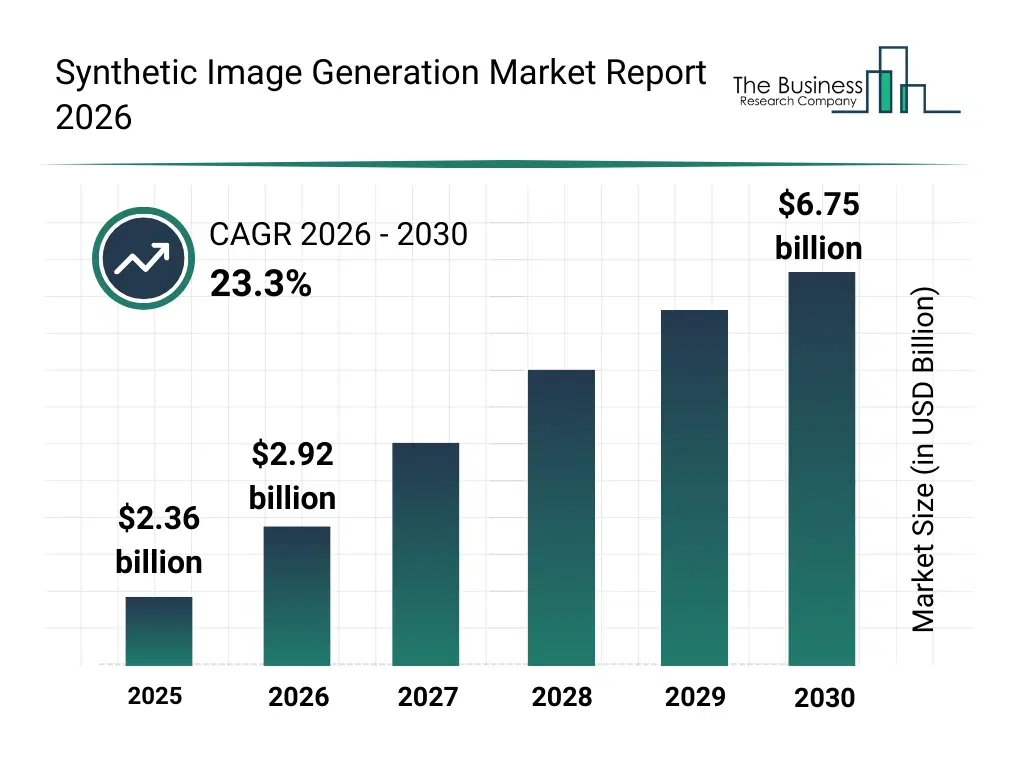
What Is The Synthetic Image Generation Market Size and Share 2026?
The synthetic image generation market size has grown exponentially in recent years. It will grow from $2.36 billion in 2025 to $2.92 billion in 2026 at a compound annual growth rate (CAGR) of 23.5%. The growth in the historic period can be attributed to the growing use of computer graphics in media and entertainment, the increasing application of simulated data in artificial intelligence (AI) training, the rising demand for cost-effective visual content creation, the expansion of gaming and virtual environment development, and the growing adoption of digital twins and simulation tools.What Is The Synthetic Image Generation Market Growth Forecast?
The synthetic image generation market size is expected to see exponential growth in the next few years. It will grow to $6.75 billion in 2030 at a compound annual growth rate (CAGR) of 23.3%. The growth in the forecast period can be attributed to increasing demand for artificial intelligence (AI)-based training datasets, growing adoption of synthetic data in autonomous systems, rising use of virtual testing environments, expansion of the metaverse and immersive digital platforms, and a rise in deployment of generative models across industries. Major trends in the forecast period include technology-driven innovations in generative adversarial networks (GAN), advancements in high-realism rendering techniques, developments in automated data synthesis platforms, rising research and development in multimodal image generation, and innovation in real-time synthetic content creation systems.

Global Synthetic Image Generation Market Segmentation
1) By Technology: Computer Generated Imagery (CGI) And Procedural Techniques, Simulation And Physics-Based Rendering, Artificial Intelligence-Based Image Generation, Hybrid Techniques, Other Technologies 2) By Quality Level: Fully Synthetic, Partially Synthetic 3) By End Use: Marketing And Advertising, Entertainment And Media, E-Commerce And Retail, Gaming, Healthcare, Fashion And Design, Defense And Security, Other End Uses Subsegments: 1) By Computer Generated Imagery (CGI) And Procedural Techniques: Polygon-Based Image Generation, Ray Tracing Techniques, Procedural Texture Generation 2) By Simulation And Physics-Based Rendering: Fluid Simulation Rendering, Particle Simulation Rendering, Light And Shadow Simulation 3) By Artificial Intelligence–Based Image Generation: Generative Adversarial Network (GAN) –Based Generation, Diffusion Model–Based Generation, Neural Style Transfer–Based Generation 4) By Hybrid Techniques: AI-Assisted CGI Generation, Physics-Enhanced Procedural Rendering, Combined Neural And Simulation Techniques 5) By Other Technologies: Volumetric Image Generation, Holographic Rendering Techniques, Real-Time Rendering SolutionsWhat Is The Driver Of The Synthetic Image Generation Market?
The increasing demand for visual content in media is expected to propel the growth of the synthetic image generation market going forward. Visual content refers to the growing need for images, videos, and other visual creative assets across digital channels to engage audiences, support brand messaging, and improve conversion rates. Visual content demand is rising as marketers are shifting strategies toward formats that deliver higher engagement and measurable results. Synthetic image generation enhances visual content ecosystems by offering scalable and customizable imagery, making it ideal for marketing, media, and creative industries. It reduces production time and resource costs by automatically creating high-quality images, improving efficiency and meeting growing content demand. For instance, in December 2025, according to the Office of Communications, a UK-based statutory corporation, as of May 2025, YouTube reached 94?% of UK online adults, up 6?% year-on-year, with an average daily reach of 58?% and average time spent per day rising to 51 minutes, up from 47 minutes in 2024. Therefore, the increasing demand for visual content in media is driving the growth of the synthetic image generation industry.Key Players In The Global Synthetic Image Generation Market
Major companies operating in the synthetic image generation market are Google LLC, Meta Platforms Inc., NVIDIA Corporation, Runway AI Inc., Adobe Inc., OpenAI Inc., Canva Pty Ltd, PicsArt Inc., Lightricks Ltd., Hugging Face Inc., Pika Labs Inc., Leonardo Interactive Pty Ltd, Stability AI Ltd., Luma AI Inc., Krea AI Inc., Ideogram AI Inc., Replicate Inc., Generated Photos Inc., Midjourney Inc., Prodia Inc., Flux Labs Inc., DeepAI Inc.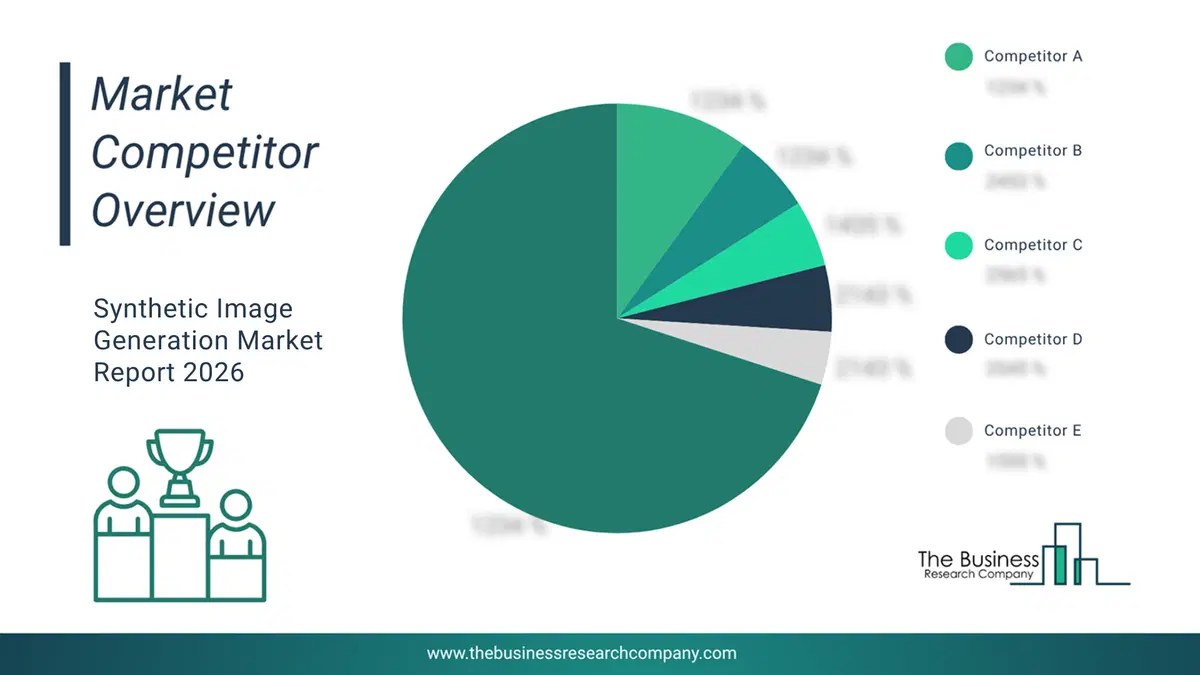
This chart is for illustrative purposes; the full report includes a detailed competitor analysis and comprehensive overview of the top 10 companies in the market.
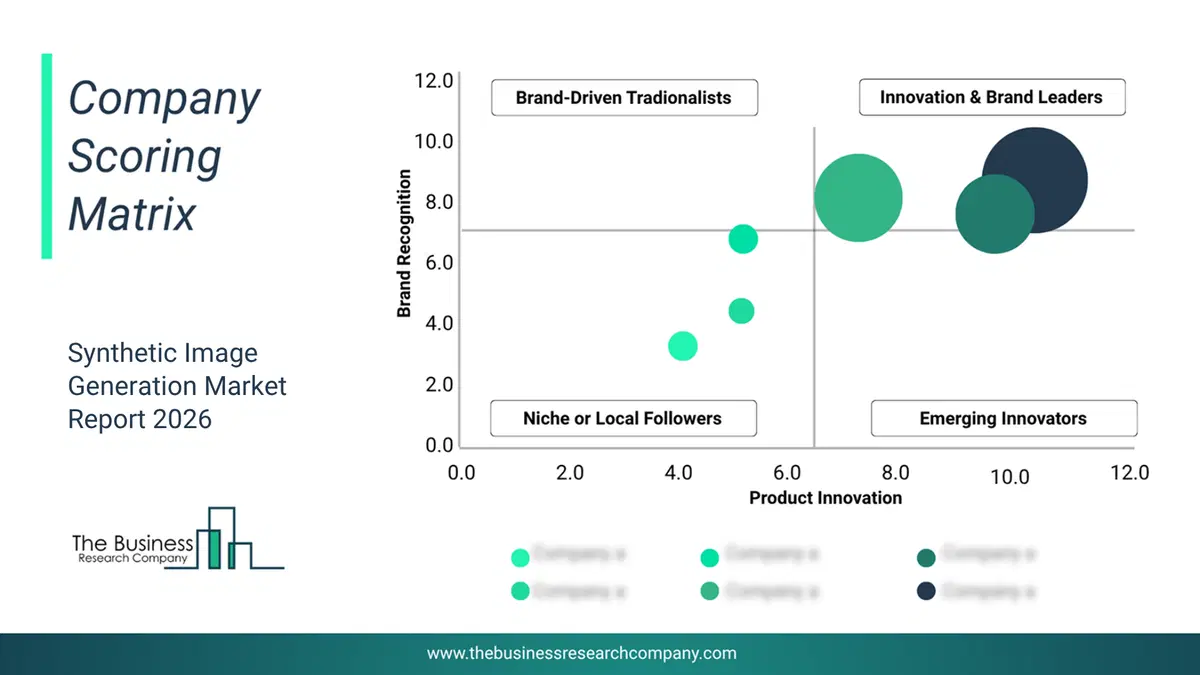
This chart maps companies by product innovation and brand strength, with bubble size indicating relative revenue, helping identify market leaders, challengers, and niche players. This is an illustrative chart; the full report provides a complete and accurate competitive analysis.
Global Synthetic Image Generation Market Trends and Insights
Major companies operating in the synthetic image generation market are focusing on developing advanced solutions, such as standalone generative AI services, web‑based and app‑based image generators, to expand user access and adoption beyond traditional creative platforms. Standalone generative AI services are digital tools that allow users to create synthetic images from text prompts without requiring integration into complex software, enabling individual creators and small businesses to generate high-quality visuals independently. For instance, in 2023, Meta Platforms Inc., a US-based social technology company, launched Imagine with Meta, a standalone web‑based AI image generator that produces high-resolution images from text prompts, offers multiple image outputs per request, and supports accessible web interfaces for wide public use. This launch demonstrates the trend of increasing availability and usability of synthetic image generation tools for a broader audienceWhat Are Latest Mergers And Acquisitions In The Synthetic Image Generation Market?
In February 2024, Jasper, a US‑based provider of AI content generation tools, acquired Clipdrop from Stability AI for an undisclosed amount. With this acquisition, Jasper seeks to enhance its enterprise AI offerings by integrating Clipdrop’s AI‑powered photo and image generation capabilities, expanding its suite of creative AI solutions for business customers. Clipdrop is a France‑based artificial intelligence‑enabled image generation and editing platform used by millions of users globally.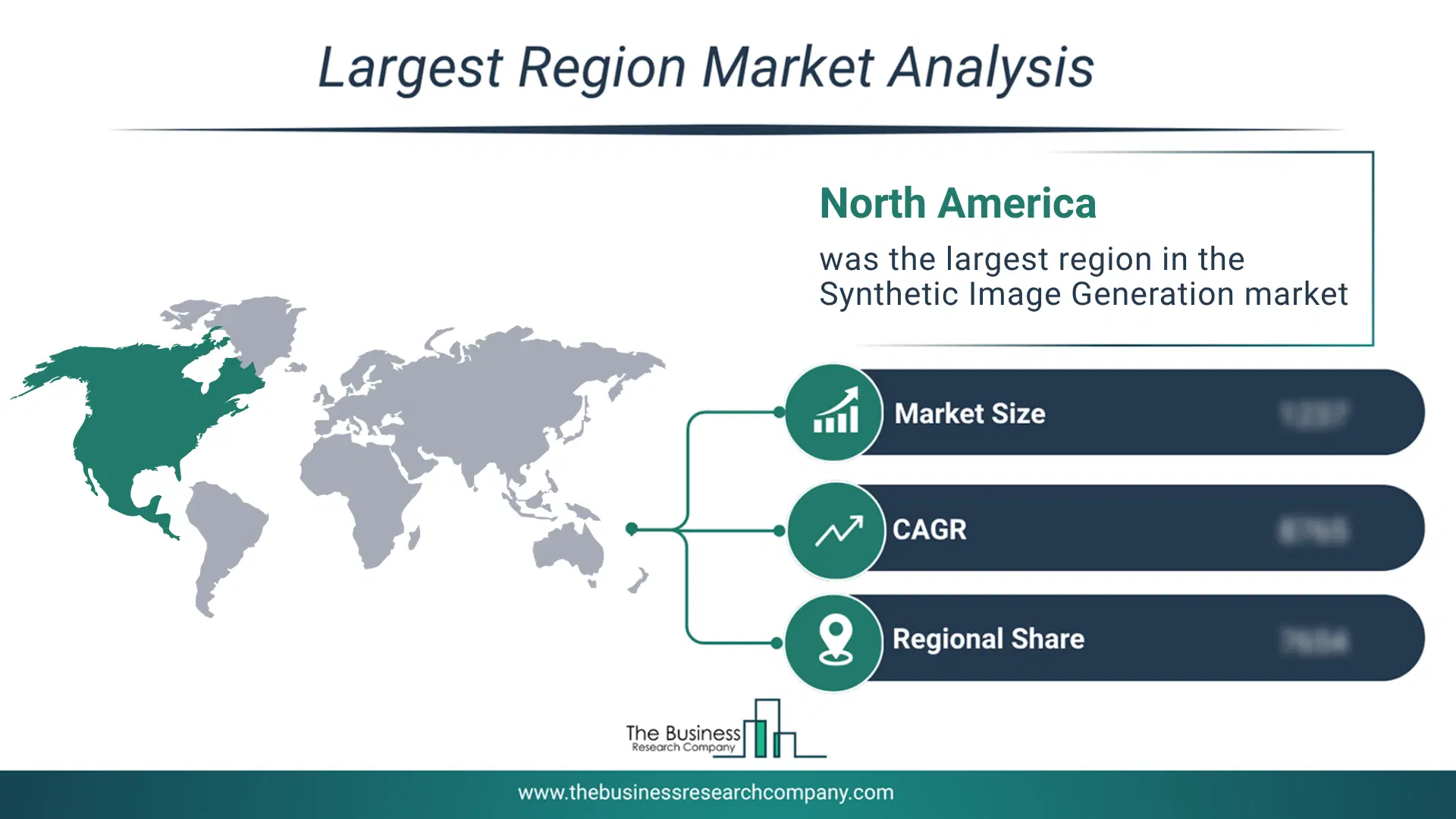
Regional Insights
North America was the largest region in the synthetic image generation market in 2025. Asia-Pacific is expected to be the fastest-growing region in the forecast period. The regions covered in this market report are Asia-Pacific, South East Asia, Western Europe, Eastern Europe, North America, South America, Middle East, Africa. The countries covered in this market report are Australia, Brazil, China, France, Germany, India, Indonesia, Japan, Taiwan, Russia, South Korea, UK, USA, Canada, Italy, Spain.What Defines the Synthetic Image Generation Market?
The synthetic image generation market consists of revenues earned by entities by providing services such as artificial intelligence (AI) -based image synthesis, generative design solutions, deep learning image rendering, and computer-generated imagery platforms. The market value includes the value of related goods sold by the service provider or included within the service offering. The synthetic image generation market includes sales of image generation software, cloud-based rendering platforms, neural network models, and artificial intelligence (AI) training datasets for image synthesis. Values in this market are ‘factory gate’ values, that is, the value of goods sold by the manufacturers or creators of the goods, whether to other entities (including downstream manufacturers, wholesalers, distributors, and retailers) or directly to end customers. The value of goods in this market includes related services sold by the creators of the goods.How is Market Value Defined and Measured?
The market value is defined as the revenues that enterprises gain from the sale of goods and/or services within the specified market and geography through sales, grants, or donations in terms of the currency (in USD unless otherwise specified). The revenues for a specified geography are consumption values that are revenues generated by organizations in the specified geography within the market, irrespective of where they are produced. It does not include revenues from resales along the supply chain, either further along the supply chain or as part of other products.
This chart presents market attractiveness based on a quantitative evaluation of growth, competition, strategic alignment, and risk, offering a clear view of opportunity areas for decision-making. This chart is for illustrative purposes; the full report contains the complete analysis.

This chart highlights the Total Addressable Market (TAM) by estimating the maximum revenue opportunity using an assumption-driven approach, supporting strategic planning and opportunity sizing across markets. The chart is illustrative; the full report provides a more comprehensive analysis.
What Key Data and Analysis Are Included in the Synthetic Image Generation Market Report 2026?
The synthetic image generation market research report is one of a series of new reports from The Business Research Company that provides market statistics, including industry global market size, regional shares, competitors with the market share, detailed market segments, market trends and opportunities, and any further data you may need to thrive in the synthetic image generation industry. The market research report delivers a complete perspective of everything you need, with an in-depth analysis of the current and future state of the industry.Synthetic Image Generation Market Report Forecast Analysis
| Report Attribute | Details |
|---|---|
| Market Size Value In 2026 | $2.92 billion |
| Revenue Forecast In 2030 | $6.75 billion |
| Growth Rate | CAGR of 23.3% from 2026 to 2030 |
| Base Year For Estimation | 2025 |
| Actual Estimates/Historical Data | 2020-2025 |
| Forecast Period | 2026 - 2030 |
| Market Representation | Revenue in USD Billion and CAGR from 2026 to 2030 |
| Segments Covered | Technology, Quality Level, End Use |
| Regional Scope | Asia-Pacific, Western Europe, Eastern Europe, North America, South America, Middle East, Africa |
| Country Scope | The Countries Covered In This Market Report Are Australia, Brazil, China, France, Germany, India, Indonesia, Japan, Taiwan, Russia, South Korea, Uk, Usa, Canada, Italy, Spain. |
| Key Companies Profiled | Google LLC, Meta Platforms Inc., NVIDIA Corporation, Runway AI Inc., Adobe Inc., OpenAI Inc., Canva Pty Ltd, PicsArt Inc., Lightricks Ltd., Hugging Face Inc., Pika Labs Inc., Leonardo Interactive Pty Ltd, Stability AI Ltd., Luma AI Inc., Krea AI Inc., Ideogram AI Inc., Replicate Inc., Generated Photos Inc., Midjourney Inc., Prodia Inc., Flux Labs Inc., DeepAI Inc. |
| Customization Scope | Request for Customization |
| Pricing And Purchase Options | Explore Purchase Options |