
Synthetic Latex Polymers Market Report 2026
Global Outlook – By Type (Styrene Acrylic, Styrene Butadiene, Acrylic, Vinyl Acetate Copolymer, Polyvinyl Acetate, Vinyl Acetate Ethylene, Other Types ), By Application (Paints And Coating, Adhesives And Sealants, Nonwovens, Carpets, Paper And Paperboard, Other Applications), By End-Use (Construction Sector, Textile Industry, Other End-User Industries) – Market Size, Trends, Strategies, and Forecast to 2030
Synthetic Latex Polymers Market Overview
• Synthetic Latex Polymers market size has reached to $34.71 billion in 2025 • Expected to grow to $45.55 billion in 2030 at a compound annual growth rate (CAGR) of 5.5% • Growth Driver: Surge In Construction Activity Propels Growth In The Synthetic Latex Polymers Market • Market Trend: Advancements in the Synthetic Latex Polymers Through Architectural Coatings • Asia-Pacific was the largest region in 2025 and Asia-Pacific is the fastest growing region.What Is Covered Under Synthetic Latex Polymers Market?
Synthetic latex polymers refer to a synthetic substitute for natural latex generated by combining the petrochemical chemicals styrene and butadiene to form SBR (styrene-butadiene rubber). The main types of synthetic latex polymers are styrene acrylic, styrene-butadiene, acrylic, vinyl acetate copolymer, polyvinyl acetate, vinyl acetate ethylene, and others. Styrene acrylic refers to a styrene-modified acrylate-based copolymer emulsion that can significantly increase alkali resistance and water resistance. The various applications involved are paints and coating, adhesives and sealants, nonwovens, carpets, paper and paperboard, and others that are used in the construction sector, automotive industry, electronics sector, textile industry, healthcare sector, and other end-user industries.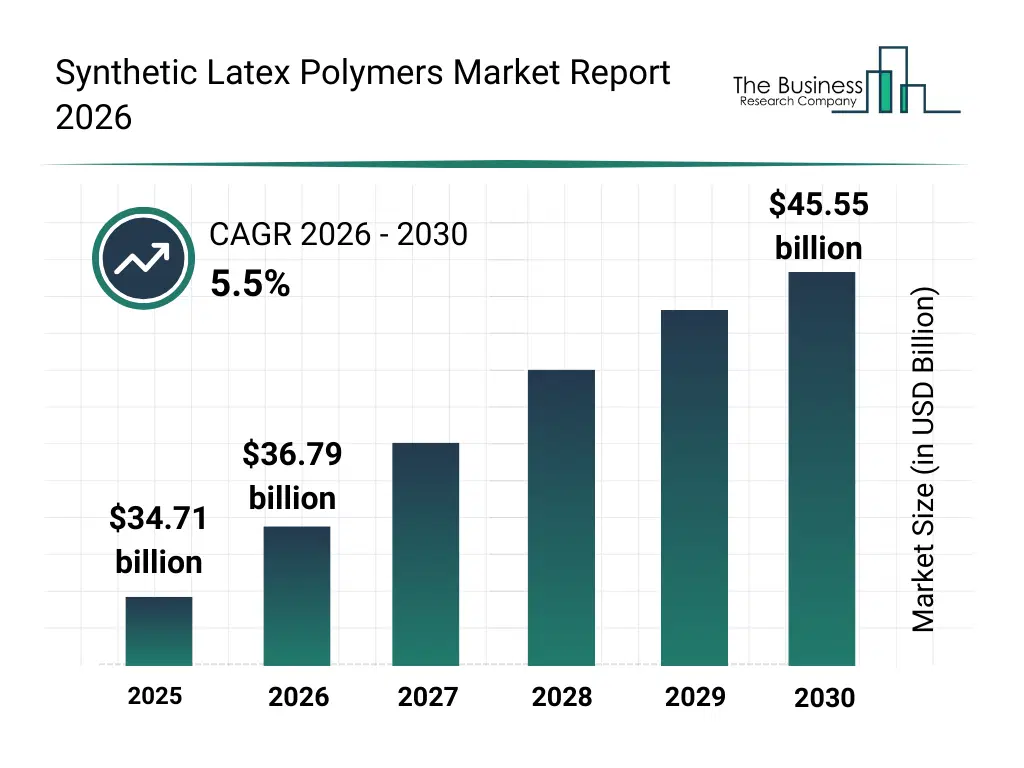
What Is The Synthetic Latex Polymers Market Size and Share 2026?
The synthetic latex polymers market size has grown strongly in recent years. It will grow from $34.71 billion in 2025 to $36.79 billion in 2026 at a compound annual growth rate (CAGR) of 6.0%. The growth in the historic period can be attributed to expansion of construction activities, growth in paints and coatings demand, rising use of synthetic rubber in automotive applications, increased availability of petrochemical feedstocks, growth of paper and packaging industries.What Is The Synthetic Latex Polymers Market Growth Forecast?
The synthetic latex polymers market size is expected to see strong growth in the next few years. It will grow to $45.55 billion in 2030 at a compound annual growth rate (CAGR) of 5.5%. The growth in the forecast period can be attributed to increasing demand for eco-friendly polymers, rising adoption in automotive lightweight materials, expansion of infrastructure development, growing focus on high-durability coatings, increasing investments in specialty latex development. Major trends in the forecast period include increasing adoption of water-based and low-voc latex formulations, rising demand for high-performance styrene butadiene latexes, growing use in sustainable construction materials, expansion of latex applications in nonwovens, enhanced focus on polymer performance optimization.
Global Synthetic Latex Polymers Market Segmentation
1) By Type: Styrene Acrylic, Styrene Butadiene, Acrylic, Vinyl Acetate Copolymer, Polyvinyl Acetate, Vinyl Acetate Ethylene, Other Types 2) By Application: Paints And Coating, Adhesives And Sealants, Nonwovens, Carpets, Paper And Paperboard, Other Applications 3) By End-Use: Construction Sector, Textile Industry, Other End-User Industries Subsegments: 1) By Styrene Acrylic Latex Polymers: Pure Styrene–Acrylic Latex, Self-Crosslinking Styrene Acrylic Latex, Low-VOC Or APEO-Free Styrene Acrylic Latex, High-Solids Styrene Acrylic Latex 2) By Styrene Butadiene (SBR) Latex Polymers: Carboxylated Styrene Butadiene Latex (XSBR), Non-Carboxylated Styrene Butadiene Latex, Cold-Polymerized SBR Latex, Hot-Polymerized SBR Latex 3) By Acrylic Latex Polymers: Pure Acrylic Latex, Self-Crosslinking Acrylic Latex, Core–Shell Acrylic Latex, Functional Acrylic Latex (Hydroxyl / Carboxyl Functional) 4) By Vinyl Acetate Copolymer Latex: Vinyl Acetate–Acrylic Copolymer Latex, Vinyl Acetate–Ethylene Copolymer Latex (VAE), Vinyl Acetate–Versatic Ester (VeoVa) Latex, Vinyl Acetate–Maleate Copolymer Latex 5) By Polyvinyl Acetate (PVAc) Latex: Homopolymer PVAc Latex, Self-Crosslinking PVAc Latex, Plasticized PVAc Latex, Modified PVAc Latex (Improved Water Resistance) 6) By Vinyl Acetate Ethylene (VAE) Latex: Low-Ethylene Content VAE Latex, Medium-Ethylene Content VAE Latex, High-Ethylene Content VAE Latex, Redispersible VAE Latex Systems 7) By Other Synthetic Latex Types: Nitrile Butadiene Latex (NBR), Chloroprene Latex, Polyurethane (PU) Latex, Silicone-Modified Latex, Hybrid Latex SystemsWhat Is The Driver Of The Synthetic Latex Polymers Market?
Increasing construction activity is expected to propel the growth of the synthetic latex polymers market going forward. Construction activities refer to activities that are incidental to the construction, dismantling, assembly, alteration, installation, or equipping of buildings, structures, roadways, or their appurtenances. Synthetic latex polymers are used in construction products like paints and coatings, adhesives and sealants, and more to improve the elastomer property, bind, and avoid cracking. For instance, in July 2023, according to Australian Bureau of Statistics, an Australian-based government administration, in the March quarter of 2023, the total number of dwellings under construction rose by 1.3% to reach 240,813 units. This figure surpasses the prior record of 240,065 units set in the March 2022 quarter. Therefore, increasing construction activities are driving the growth of the synthetic latex polymers industry.Key Players In The Global Synthetic Latex Polymers Market
Major companies operating in the synthetic latex polymers market are BASF SE, Dow Inc., Arkema SA, Trinseo plc, Synthomer plc, Celanese Corporation, Wacker Chemie AG, Nippon Shokubai Co. Ltd., DIC Corporation, LG Chem Ltd., Saudi Basic Industries Corporation, Versalis S.p.A., Mallard Creek Polymers, Jubilant Industries Ltd., Zhejiang Wynca Chemical Group Co. Ltd., Sinopec Group, PetroChina Company Limited, China Petroleum & Chemical Corporation, Asahi Kasei Corporation, Sumitomo Chemical Co. Ltd.
This chart is for illustrative purposes; the full report includes a detailed competitor analysis and comprehensive overview of the top 10 companies in the market.
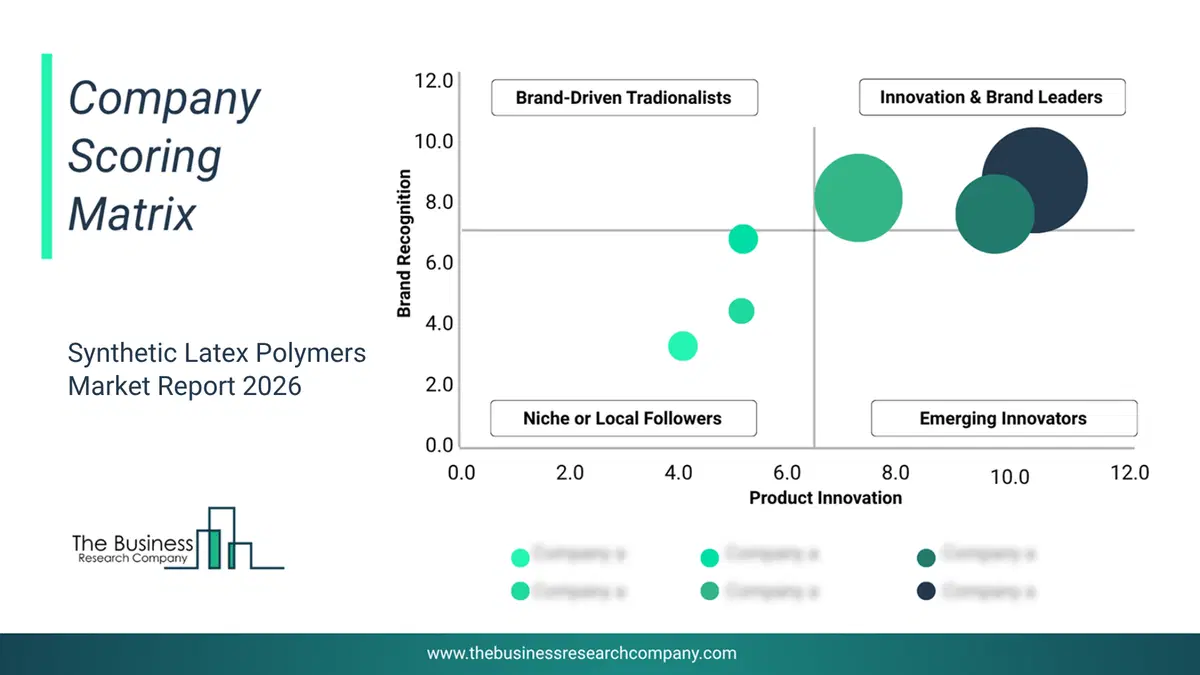
This chart maps companies by product innovation and brand strength, with bubble size indicating relative revenue, helping identify market leaders, challengers, and niche players. This is an illustrative chart; the full report provides a complete and accurate competitive analysis.
Global Synthetic Latex Polymers Market Trends and Insights
Major companies operating in the synthetic latex polymers market are focusing on the development of innovative products such as architectural coating, which allows for strong hiding with easy touch-up and provides long-lasting protection against wear and tear of substrates. Architectural coating refers to a type of paint or coating specifically formulated for buildings and structures for both interior and exterior surfaces to protect them from environmental factors and deterioration. For instance, in March 2024, Trinseo S.A., a US-based materials company specializing in latex binders, launched LIGOS C 9484, a vinyl-acrylic latex binder that is designed for architectural coatings and elastomer applications that provides strong hiding and smooth leveling while offering excellent washability and easy touch-up, making coated surfaces more durable across a range of finishes from flat to semi-gloss. Additionally, it also offers formulation flexibility for a variety of pigments, enabling manufacturers to create customized coatings that meet specific performance and aesthetic requirements.What Are Latest Mergers And Acquisitions In The Synthetic Latex Polymers Market?
In April 2023, Teknor Apex, a US-based Chemicals company, acquired Nu-Pro Polymers for undisclosed amount. This acquisition Teknor Apex aim is to enhance its sustainability initiatives and expand its product offerings in the flexible PVC market. Nu-Pro Polymers is a US-based Polymer supplier company, manufacture PVC recycle content based compounds with diverse technical specifications regarding hardness, specific gravity, and colors.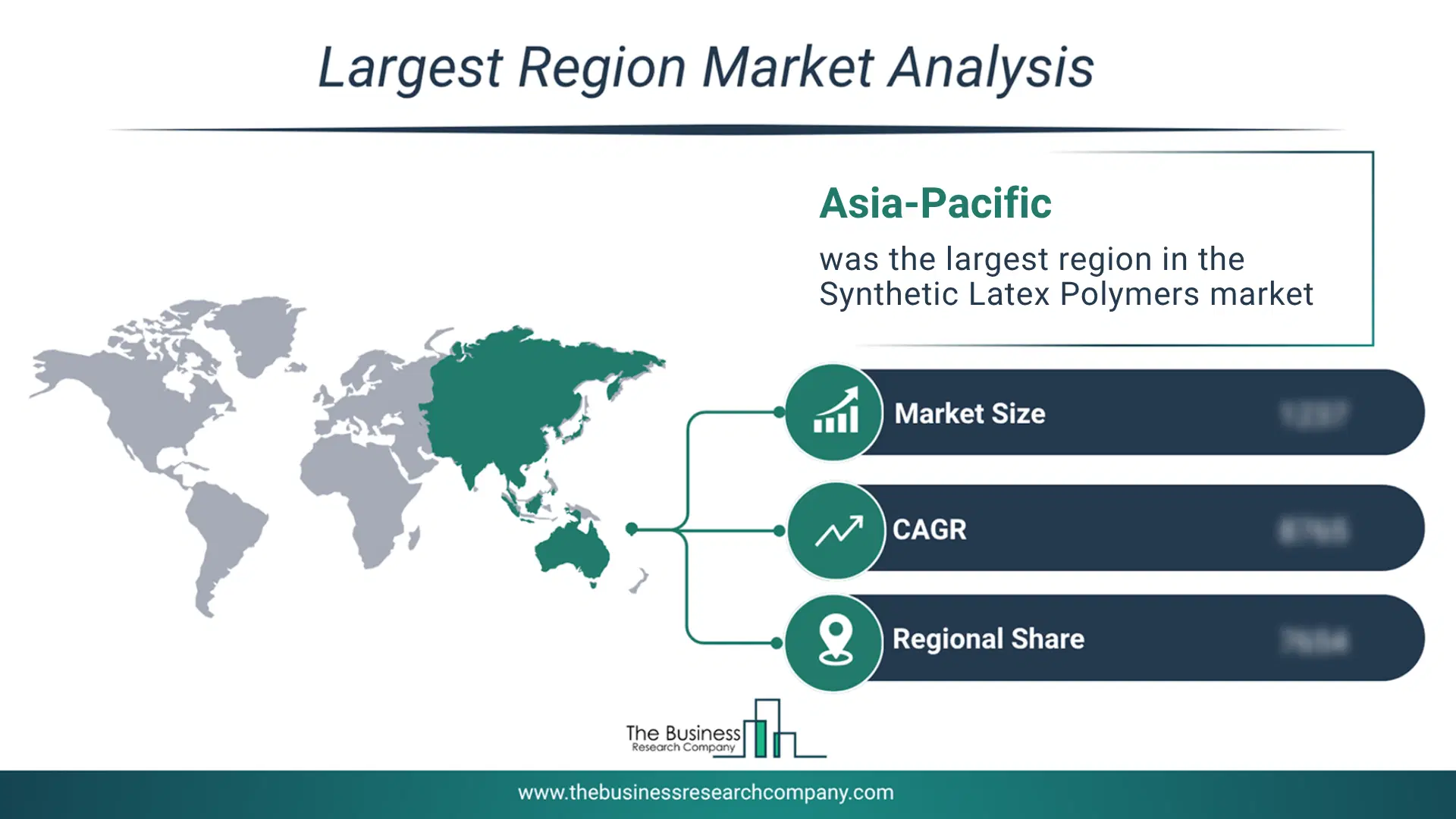
Regional Insights
Asia-Pacificc was the largest region in the synthetic latex polymers market share in 2025. Asia-Pacific is expected to be the fastest-growing region in the forecast period. The regions covered in this market report are Asia-Pacific, South East Asia, Western Europe, Eastern Europe, North America, South America, Middle East, Africa The countries covered in this market report are Australia, Brazil, China, France, Germany, India, Indonesia, Japan, Taiwan, Russia, South Korea, UK, USA, Canada, Italy, SpainWhat Defines the Synthetic Latex Polymers Market?
The synthetic latex polymers market consists of sales of synthetic rubbers and synthetic latex such as carboxylate styrene-butadiene latex, nitrile latex, and high styrene rubber. Values in this market are ‘factory gate’ values, that is the value of goods sold by the manufacturers or creators of the goods, whether to other entities (including downstream manufacturers, wholesalers, distributors and retailers) or directly to end customers. The value of goods in this market includes related services sold by the creators of the goods.How is Market Value Defined and Measured?
The market value is defined as the revenues that enterprises gain from the sale of goods and/or services within the specified market and geography through sales, grants, or donations in terms of the currency (in USD unless otherwise specified). The revenues for a specified geography are consumption values that are revenues generated by organizations in the specified geography within the market, irrespective of where they are produced. It does not include revenues from resales along the supply chain, either further along the supply chain or as part of other products.
This chart presents market attractiveness based on a quantitative evaluation of growth, competition, strategic alignment, and risk, offering a clear view of opportunity areas for decision-making. This chart is for illustrative purposes; the full report contains the complete analysis.

This chart highlights the Total Addressable Market (TAM) by estimating the maximum revenue opportunity using an assumption-driven approach, supporting strategic planning and opportunity sizing across markets. The chart is illustrative; the full report provides a more comprehensive analysis.
What Key Data and Analysis Are Included in the Synthetic Latex Polymers Market Report 2026?
The synthetic latex polymers market research report is one of a series of new reports from The Business Research Company that provides market statistics, including industry global market size, regional shares, competitors with the market share, detailed market segments, market trends and opportunities, and any further data you may need to thrive in the synthetic latex polymers industry. The market research report delivers a complete perspective of everything you need, with an in-depth analysis of the current and future state of the industry.Synthetic Latex Polymers Market Report Forecast Analysis
| Report Attribute | Details |
|---|---|
| Market Size Value In 2026 | $36.79 billion |
| Revenue Forecast In 2030 | $45.55 billion |
| Growth Rate | CAGR of 6.0% from 2026 to 2030 |
| Base Year For Estimation | 2025 |
| Actual Estimates/Historical Data | 2020-2025 |
| Forecast Period | 2026 - 2030 |
| Market Representation | Revenue in USD Billion and CAGR from 2026 to 2030 |
| Segments Covered | Type, Application, End-Use |
| Regional Scope | Asia-Pacific, Western Europe, Eastern Europe, North America, South America, Middle East, Africa |
| Country Scope | The countries covered in this market report are Australia, Brazil, China, France, Germany, India, Indonesia, Japan, Taiwan, Russia, South Korea, UK, USA, Canada, Italy, Spain |
| Key Companies Profiled | BASF SE, Dow Inc., Arkema SA, Trinseo plc, Synthomer plc, Celanese Corporation, Wacker Chemie AG, Nippon Shokubai Co. Ltd., DIC Corporation, LG Chem Ltd., Saudi Basic Industries Corporation, Versalis S.p.A., Mallard Creek Polymers, Jubilant Industries Ltd., Zhejiang Wynca Chemical Group Co. Ltd., Sinopec Group, PetroChina Company Limited, China Petroleum & Chemical Corporation, Asahi Kasei Corporation, Sumitomo Chemical Co. Ltd. |
| Customization Scope | Request for Customization |
| Pricing And Purchase Options | Explore Purchase Options |