
Synthetic Media Software Market Report 2026
Global Outlook – By Component (Software, Services), By Deployment Type (On-Premise, Cloud-Based), By Technology (Deep Learning, Natural Language Processing, Generative Adversarial Networks, Computer Vision), By Application (Content Creation, Advertising, Gaming, Film Production6) By End Use Industry (Entertainment, Education, Marketing, Healthcare) – Market Size, Trends, Strategies, and Forecast to 2030
Synthetic Media Software Market Overview
• Synthetic Media Software market size has reached to $4.6 billion in 2025 • Expected to grow to $9.54 billion in 2030 at a compound annual growth rate (CAGR) of 15.8% • Growth Driver: Surge In Demand For Scalable Digital Content Creation Fueling The Growth Of The Market Due To Rapidly Increasing Content Needs And The Need For High-volume, Efficient Production • Market Trend: Deep Learning Powers Scalable, Personalized Video Ads With AI Avatars • North America was the largest region in 2025 and Asia-Pacific is the fastest growing region.What Is Covered Under Synthetic Media Software Market?
Synthetic media software refers to digital tools that use artificial intelligence to create or modify media content, such as images, videos, audio, and text that appear realistic but are artificially generated. These solutions leverage technologies such as generative AI, deep learning, and neural networks to produce customizable content at scale. It helps to enable efficient content creation, personalization, and creative experimentation. The main components of synthetic media software are software and services. Software refers to platforms and tools that leverage artificial intelligence to generate, manipulate, or enhance digital media content automatically. These solutions are offered through different deployment types, including on-premise and cloud-based implementations. They are built on advanced technologies, such as deep learning, natural language processing, generative adversarial networks, and computer vision, and are used across various applications, including content creation, advertising, gaming, and film production. They cater to multiple end-use industries, such as entertainment, education, marketing, and healthcare.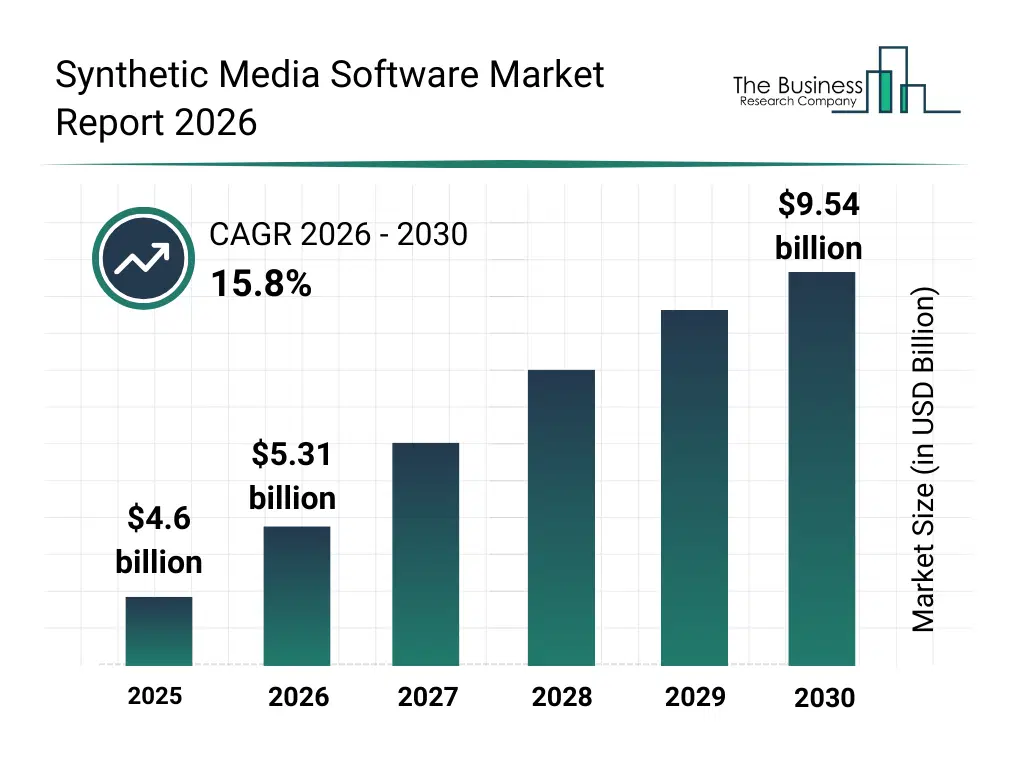
What Is The Synthetic Media Software Market Size and Share 2026?
The synthetic media software market size has grown rapidly in recent years. It will grow from $4.6 billion in 2025 to $5.31 billion in 2026 at a compound annual growth rate (CAGR) of 15.5%. The growth in the historic period can be attributed to growth in digital content demand, expansion of creator economy platforms, historic advances in deep learning models, rising social media media production, increased cloud creative tools usage.What Is The Synthetic Media Software Market Growth Forecast?
The synthetic media software market size is expected to see rapid growth in the next few years. It will grow to $9.54 billion in 2030 at a compound annual growth rate (CAGR) of 15.8%. The growth in the forecast period can be attributed to rising enterprise use of generative media, expansion of virtual content production, growing demand for personalized marketing content, higher adoption in gaming and film, increasing AI creative automation. Major trends in the forecast period include AI generated multimodal content tools, realistic voice and video synthesis platforms, deepfake detection and verification software, personalized synthetic content engines, real time generative media APIs.
Global Synthetic Media Software Market Segmentation
1) By Component: Software; Services 2) By Deployment Type: On-Premise; Cloud-Based 3) By Technology: Deep Learning; Natural Language Processing; Generative Adversarial Networks; Computer Vision 4) By Application: Content Creation; Advertising; Gaming; Film Production 6) By End Use Industry: Entertainment; Education; Marketing; Healthcare Subsegments: 1) By Software: Text Generation Software; Image Generation Software; Audio Synthesis Software; Video Generation Software; Media Editing And Enhancement Software; Multimodal Content Creation Software 2) By Services: Consulting And Advisory Services; System Integration Services; Custom Content Development Services; Training And Support Services; Maintenance And Upgradation Services; Managed Synthetic Media ServicesWhat Is The Driver Of The Synthetic Media Software Market?
The growing demand for scalable digital content creation is expected to propel the growth of the synthetic media software market going forward. Scalable digital content creation refers to the ability to rapidly generate, customize, and distribute large volumes of high-quality digital content using automated and AI-driven technologies across multiple platforms and audiences. This demand is driven by rapidly increasing content requirements, as marketers require faster, higher-volume production to keep pace with expanding audience engagement. Synthetic media software plays a central role in scalable digital content creation by using AI to automate, personalize, and multiply content production without a linear increase in time or cost. For instance, in June 2025, according to Adobe’s 2025 research involving over 1,600 global marketers, 96% reported an increase in content demand, with 62% experiencing a fivefold or greater increase and 71% expecting content demand to grow more than five times by 2027. Therefore, the growing demand for scalable digital content creation is a key driver of growth in the synthetic media software industry.Key Players In The Global Synthetic Media Software Market
Major companies operating in the synthetic media software market are Midjourney Inc., ElevenLabs Inc., Synthesia Limited, Stability AI, De-Identification Ltd., Voicemod S.L., DeepBrain AI Inc., VEED Limited, Descript, Colossyan AI, Hour One, Resemble AI, AI Playground Inc., Kaedim Inc., Hyperhuman S.R.L., Deep Art AI GmbH, Kyber Corp, Luma AI Inc., Pika Labs, HeyGen Inc., Genmo Inc., WellSaid Labs Inc., LOVO Inc., Rephrase.AI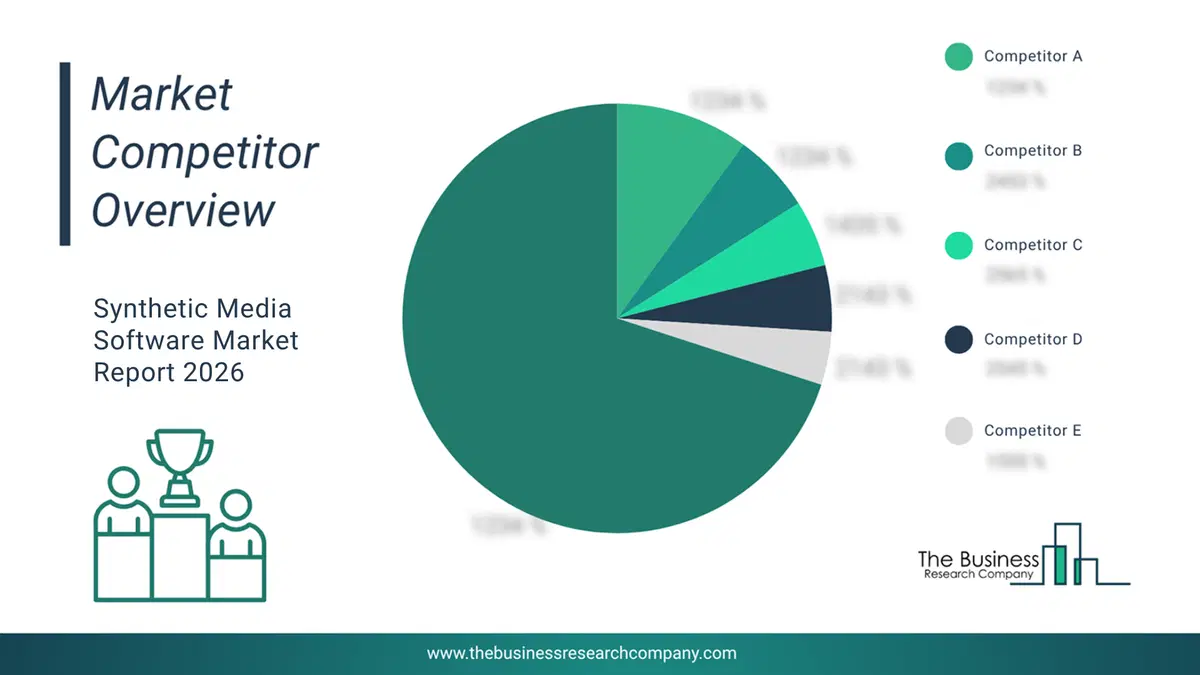
This chart is for illustrative purposes; the full report includes a detailed competitor analysis and comprehensive overview of the top 10 companies in the market.
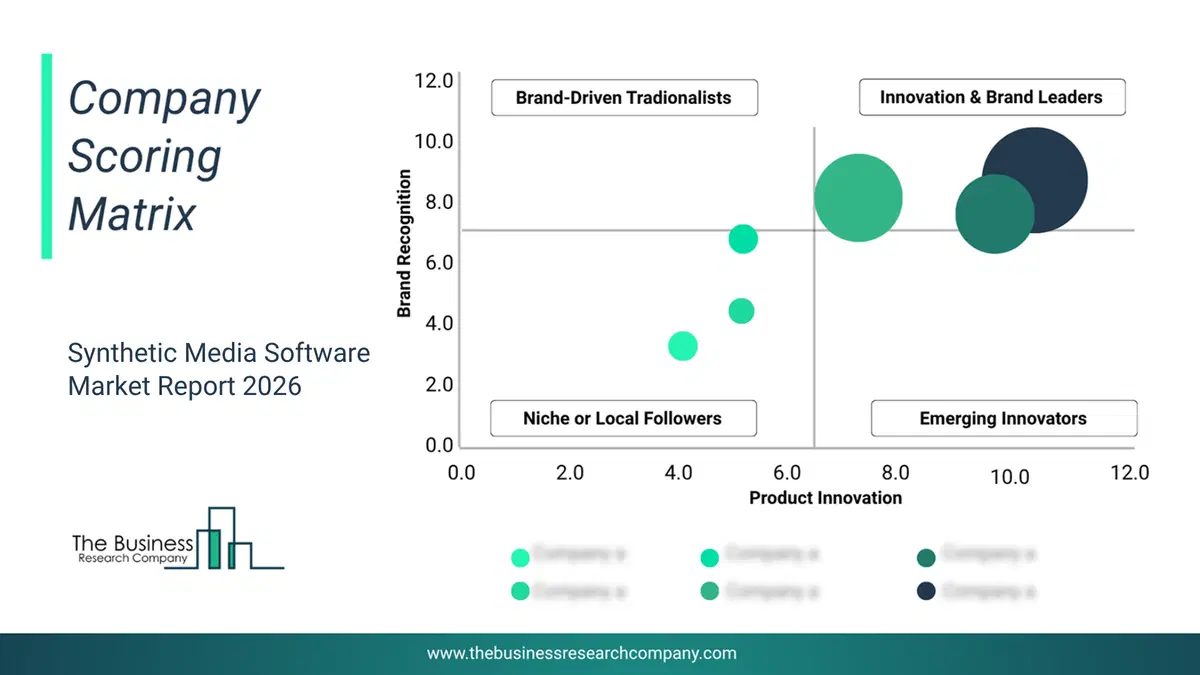
This chart maps companies by product innovation and brand strength, with bubble size indicating relative revenue, helping identify market leaders, challengers, and niche players. This is an illustrative chart; the full report provides a complete and accurate competitive analysis.
Global Synthetic Media Software Market Trends and Insights
Major companies operating in the synthetic media software market are focusing on developing innovative solutions, such as artificial intelligence-driven automated video generation platforms, to meet the rising demand for scalable, cost-efficient content creation enabled by advancements in deep learning–based media generation technologies. These platforms leverage deep neural networks and generative models to produce high-quality videos, dynamic avatars, and synthetic scenes from simple inputs such as text, images, or URLs, offering functionality that goes far beyond traditional video production workflows that rely on cameras, studios, and extensive post-production editing. For instance, in September 2025, DeepBrain AI, a US-based generative artificial intelligence company, launched Automated UGC Ad Videos, an innovative synthetic media solution that uses its artificial intelligence Studio platform to generate product-use videos with lifelike artificial intelligence avatars from just a single product image or a product page URL, eliminating the need for physical filming and reducing both time and production costs. The platform’s key features include Product Avatar, which creates scenes with customizable artificial intelligence characters interacting with items in realistic ways, and Product-to-Video, which automatically crafts optimized promotional videos tailored for short-form social platforms, enabling brands to rapidly produce multiple ad variants for testing and deployment.What Are Latest Mergers And Acquisitions In The Synthetic Media Software Market?
In August 2024, Magnet Forensics Inc., a Canada-based provider of digital investigation software, acquired Medex Forensics Inc. for an undisclosed amount. With this acquisition, Magnet Forensics aimed to enhance its technological capabilities in deepfake detection and synthetic media authentication by integrating advanced video integrity and generative AI detection technologies into its digital forensics platform. Medex Forensics Inc. is a Canada-based provider of video authentication software that specializes in detecting manipulated, AI-generated, and synthetic media content to ensure the integrity and reliability of digital video evidence.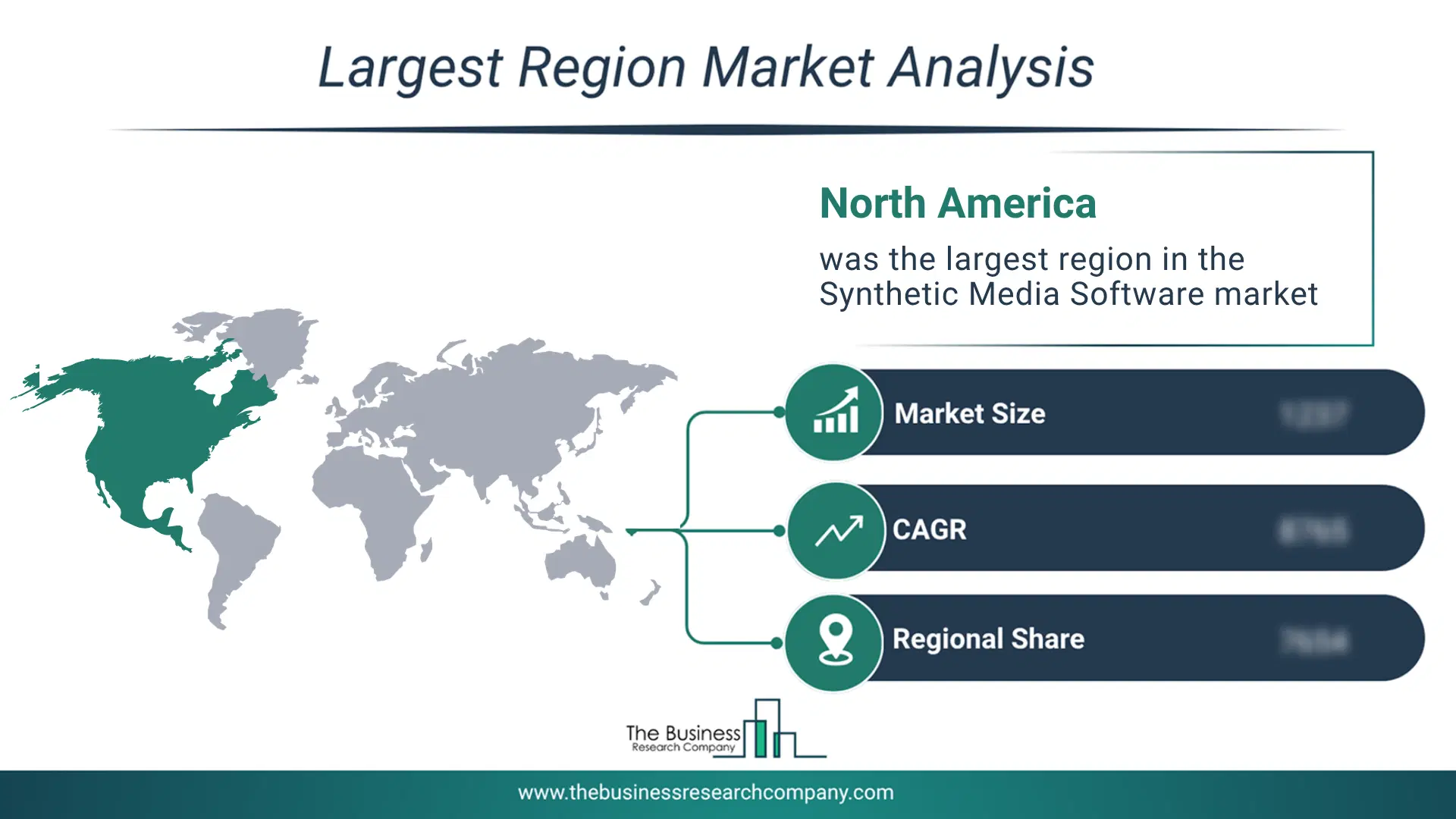
Regional Insights
North America was the largest region in the synthetic media software market in 2025. Asia-Pacific is expected to be the fastest-growing region in the forecast period. The regions covered in this market report are Asia-Pacific, South East Asia, Western Europe, Eastern Europe, North America, South America, Middle East, Africa. The countries covered in this market report are Australia, Brazil, China, France, Germany, India, Indonesia, Japan, Taiwan, Russia, South Korea, UK, USA, Canada, Italy, Spain.What Defines the Synthetic Media Software Market?
The synthetic media software market includes revenues earned by entities through artificial intelligence model training and customization, deepfake creation and detection services, voice and image synthesis services, and licensing and subscription support. The market value includes the value of related goods sold by the service provider or included within the service offering. Only goods and services traded between entities or sold to end consumers are included.How is Market Value Defined and Measured?
The market value is defined as the revenues that enterprises gain from the sale of goods and/or services within the specified market and geography through sales, grants, or donations in terms of the currency (in USD unless otherwise specified). The revenues for a specified geography are consumption values that are revenues generated by organizations in the specified geography within the market, irrespective of where they are produced. It does not include revenues from resales along the supply chain, either further along the supply chain or as part of other products.
This chart presents market attractiveness based on a quantitative evaluation of growth, competition, strategic alignment, and risk, offering a clear view of opportunity areas for decision-making. This chart is for illustrative purposes; the full report contains the complete analysis.

This chart highlights the Total Addressable Market (TAM) by estimating the maximum revenue opportunity using an assumption-driven approach, supporting strategic planning and opportunity sizing across markets. The chart is illustrative; the full report provides a more comprehensive analysis.
What Key Data and Analysis Are Included in the Synthetic Media Software Market Report 2026?
The synthetic media software market research report is one of a series of new reports from The Business Research Company that provides market statistics, including industry global market size, regional shares, competitors with the market share, detailed market segments, market trends and opportunities, and any further data you may need to thrive in the synthetic media software industry. The market research report delivers a complete perspective of everything you need, with an in-depth analysis of the current and future state of the industry.Synthetic Media Software Market Report Forecast Analysis
| Report Attribute | Details |
|---|---|
| Market Size Value In 2026 | $5.31 billion |
| Revenue Forecast In 2030 | $9.54 billion |
| Growth Rate | CAGR of 15.8% from 2026 to 2030 |
| Base Year For Estimation | 2025 |
| Actual Estimates/Historical Data | 2020-2025 |
| Forecast Period | 2026 - 2030 |
| Market Representation | Revenue in USD Billion and CAGR from 2026 to 2030 |
| Segments Covered | Component, Deployment Type, Technology, Application, End Use Industry |
| Regional Scope | Asia-Pacific, Western Europe, Eastern Europe, North America, South America, Middle East, Africa |
| Country Scope | The Countries Covered In This Market Report Are Australia, Brazil, China, France, Germany, India, Indonesia, Japan, Taiwan, Russia, South Korea, Uk, Usa, Canada, Italy, Spain. |
| Key Companies Profiled | Midjourney Inc., ElevenLabs Inc., Synthesia Limited, Stability AI, De-Identification Ltd., Voicemod S.L., DeepBrain AI Inc., VEED Limited, Descript, Colossyan AI, Hour One, Resemble AI, AI Playground Inc., Kaedim Inc., Hyperhuman S.R.L., Deep Art AI GmbH, Kyber Corp, Luma AI Inc., Pika Labs, HeyGen Inc., Genmo Inc., WellSaid Labs Inc., LOVO Inc., Rephrase.AI |
| Customization Scope | Request for Customization |
| Pricing And Purchase Options | Explore Purchase Options |