
Synthetic Pretraining Data For Large Language Models (LLMs) Market Report 2026
Global Outlook – By Data Type (Text, Code, Multimodal, Domain-Specific, Other Data Types), By Source (Proprietary, Open Source, Third-Party), By Deployment Mode (Cloud, On-Premises), By Application (Model Training, Model Evaluation, Data Augmentation, Other Applications), By End-User (Technology Companies, Research Institutes, Enterprises, Other End-Users) – Market Size, Trends, Strategies, and Forecast to 2030
Synthetic Pretraining Data For Large Language Models (LLMs) Market Overview
• Synthetic Pretraining Data For Large Language Models (LLMs) market size has reached to $1.72 billion in 2025 • Expected to grow to $6.69 billion in 2030 at a compound annual growth rate (CAGR) of 31.3% • Growth Driver: Rising Need For Privacy-Safe And Non-Sensitive Training Data Fueling The Growth Of The Market Due To Increasing Data Breaches And Stricter Data Protection Regulations • Market Trend: Advancements in Cloud-Based Pretraining Data Pipelines Addressing Data Scarcity and Enabling Trillion-Scale Model Training • North America was the largest region in 2025 and Asia-Pacific is the fastest growing region.What Is Covered Under Synthetic Pretraining Data For Large Language Models (LLMs) Market?
Synthetic pretraining data for large language models refers to artificially generated textual and linguistic datasets created using algorithms and generative systems to train large language models at scale. It is designed to simulate real-world language patterns while enhancing data diversity, coverage, and availability. this data helps improve model performance, generalization, and safety while reducing dependence on sensitive or limited real-world data sources. The main data types of synthetic pretraining data for large language models include text, code, multimodal, domain-specific, and other data types. Text data refers to structured or unstructured textual content generated or curated to train large language models for improved language understanding and generation. These solutions are sourced from proprietary, open source, and third-party datasets, and are deployed through cloud and on-premises models depending on organizational infrastructure and requirements. The various applications involved are model training, model evaluation, data augmentation, and other applications and they are used by several end users such as technology companies, research institutes, enterprises, and others.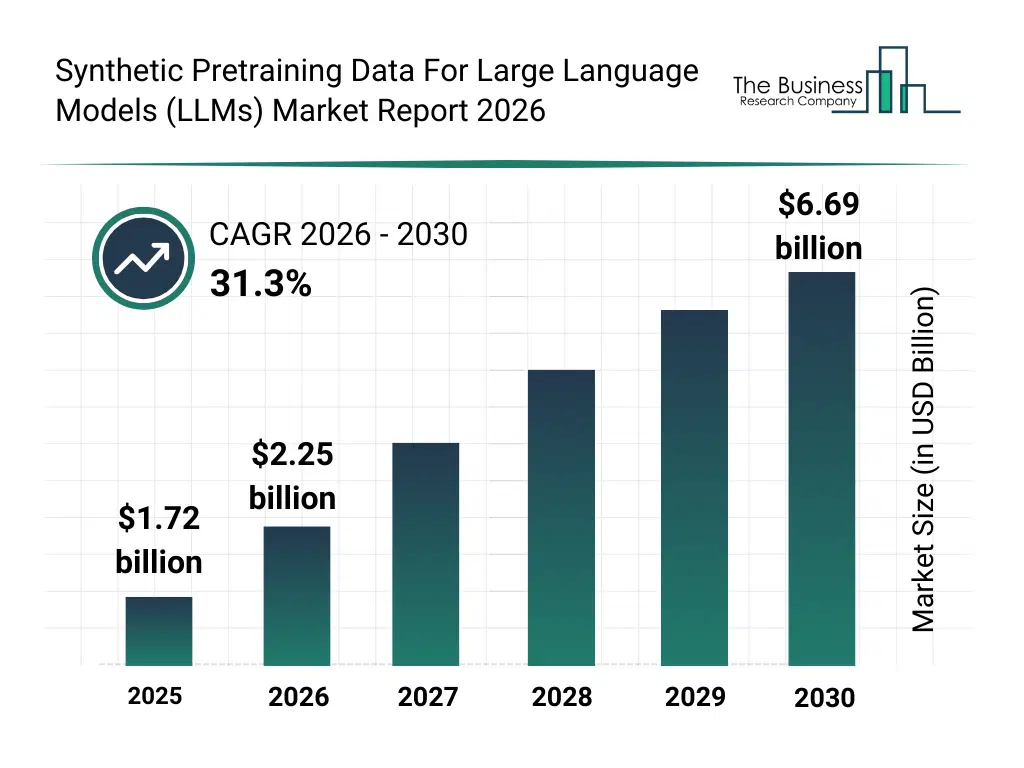
What Is The Synthetic Pretraining Data For Large Language Models (LLMs) Market Size and Share 2026?
The synthetic pretraining data for large language models (llms) market size has grown exponentially in recent years. It will grow from $1.72 billion in 2025 to $2.25 billion in 2026 at a compound annual growth rate (CAGR) of 31.1%. The growth in the historic period can be attributed to limited availability of labeled text data, data privacy restrictions, historic NLP dataset shortages, growth in large model training needs, rising data licensing costs.What Is The Synthetic Pretraining Data For Large Language Models (LLMs) Market Growth Forecast?
The synthetic pretraining data for large language models (llms) market size is expected to see exponential growth in the next few years. It will grow to $6.69 billion in 2030 at a compound annual growth rate (CAGR) of 31.3%. The growth in the forecast period can be attributed to expansion of foundation model development, rising need for safe training datasets, increasing multilingual model demand, higher regulatory data compliance needs, growth in domain tuned LLMs. Major trends in the forecast period include domain specific synthetic text corpora, privacy safe training data generation, multilingual synthetic dataset platforms, bias controlled synthetic data pipelines, automated data augmentation frameworks.
Global Synthetic Pretraining Data For Large Language Models (LLMs) Market Segmentation
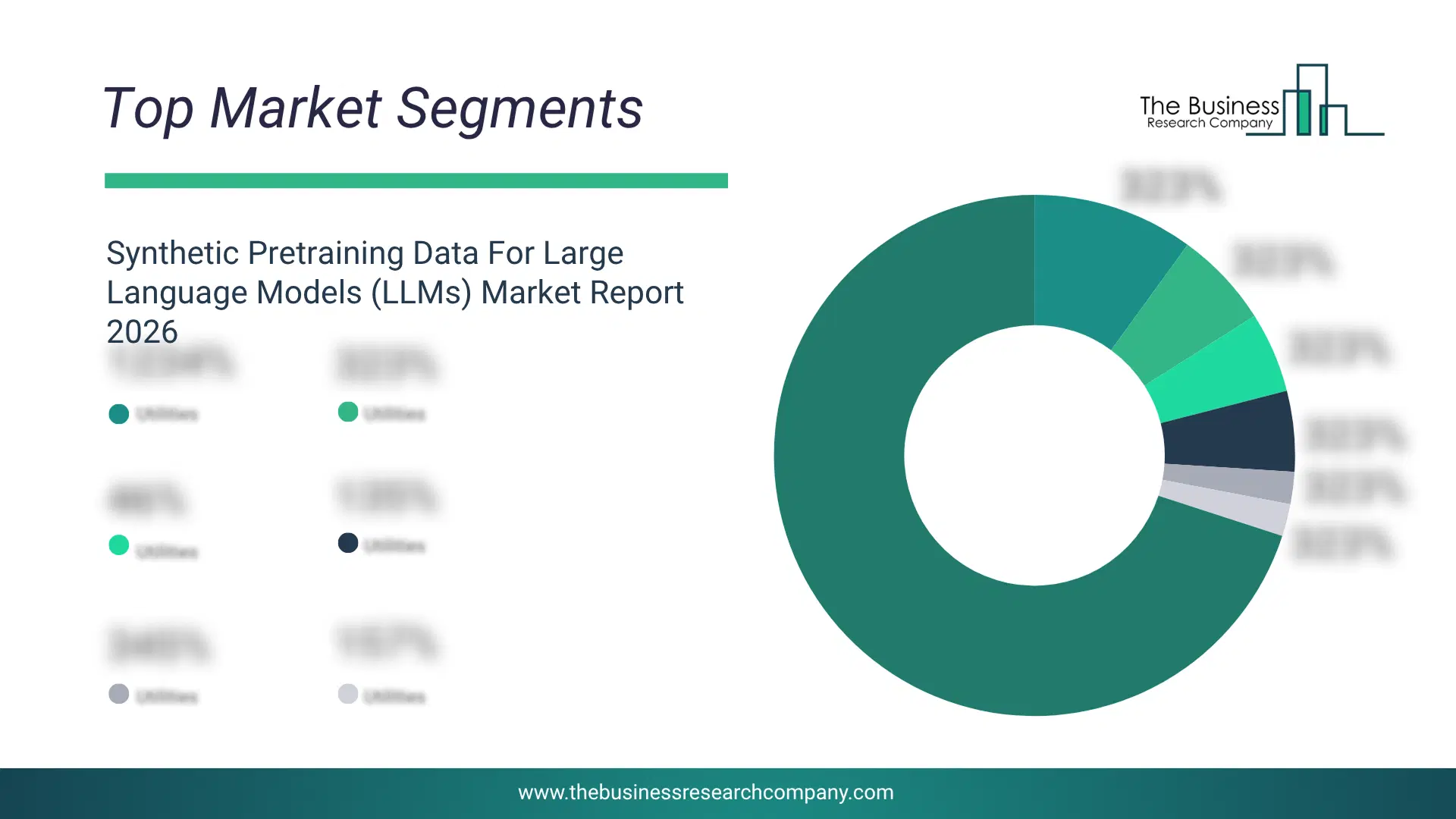
1) By Data Type: Text; Code; Multimodal; Domain-Specific; Other Data Types 2) By Source: Proprietary; Open Source; Third-Party 3) By Deployment Mode: Cloud; On-Premises 4) By Application: Model Training; Model Evaluation; Data Augmentation; Other Applications 5) By End-User: Technology Companies; Research Institutes; Enterprises; Other End-Users Subsegments: 1) By Text: Natural Language Documents; Conversational Text Data; Structured Text Records; Unstructured Text Content 2) By Code: Programming Language Scripts; Software Development Instructions; Algorithmic Logic Code; Source Code Repositories 3) By Multimodal: Text And Image Data; Text And Audio Data; Text And Video Data; Integrated Multiformat Content 4) By Domain-Specific: Healthcare Industry Data; Financial Services Data; Legal And Regulatory Data; Manufacturing And Industrial Data 5) By Other Data Types: Tabular Data Records; Log And Event Data; Simulated Scenario Data; Annotated Metadata ContentWhat Is The Driver Of The Synthetic Pretraining Data For Large Language Models (LLMs) Market?
The rising need for privacy-safe and non-sensitive training data is expected to drive the growth of the synthetic pretraining data market for large language models (LLMs). Need for privacy-safe and non-sensitive training data reflects the increasing pressure on organizations to safeguard personal and sensitive information such as health records, financial data, and personally identifiable information during AI model training and fine-tuning processes. Demand for privacy-safe training data is increasing as organizations respond to a growing number of data breaches and increasingly stringent data protection regulations, which limit the use of real-world sensitive datasets in AI development. Synthetic pretraining data addresses these challenges by replacing real personal or proprietary information with artificially generated datasets that preserve relevant statistical and semantic characteristics without containing identifiable or sensitive content. For instance, in September 2025, Perforce Software, Inc., a U.S.-based software development company, reported that approximately 60% of organizations experienced data breaches or data theft across software development, AI, and analytics environments, representing an 11% year-over-year increase. This trend highlights the growing risks associated with using real-world data for AI training and reinforces the demand for privacy-preserving alternatives. Therefore, the rising need for privacy-safe and non-sensitive training data is driving the growth of the synthetic pretraining data for large language models (LLMs) industry.Key Players In The Global Synthetic Pretraining Data For Large Language Models (LLMs) Market
Major companies operating in the synthetic pretraining data for large language models (llms) market are Amazon Web Services Inc., NVIDIA Corporation, IBM Research, Microsoft Research, OpenAI Inc., Databricks Inc., Anthropic PBC, Cohere Inc., Innodata Inc., AI21 Labs Ltd., Hugging Face Inc., Snorkel AI Inc., Gretel Labs Inc., Meta Platforms Inc., Aleph Alpha GmbH, Bitext Innovations S.L., SuperAnnotate AI Inc., Google LLC, Syntheticus Inc., MOSTLY AI Solutions MP GmbH, YData LDA, Diveplane Corporation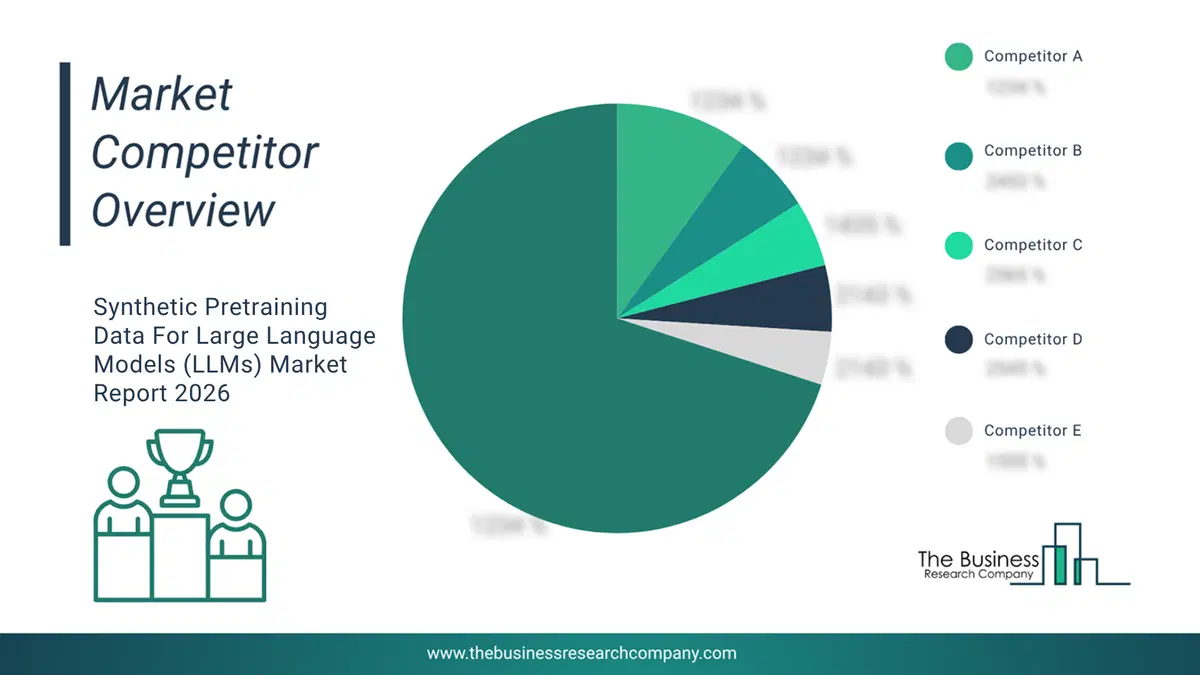
This chart is for illustrative purposes; the full report includes a detailed competitor analysis and comprehensive overview of the top 10 companies in the market.
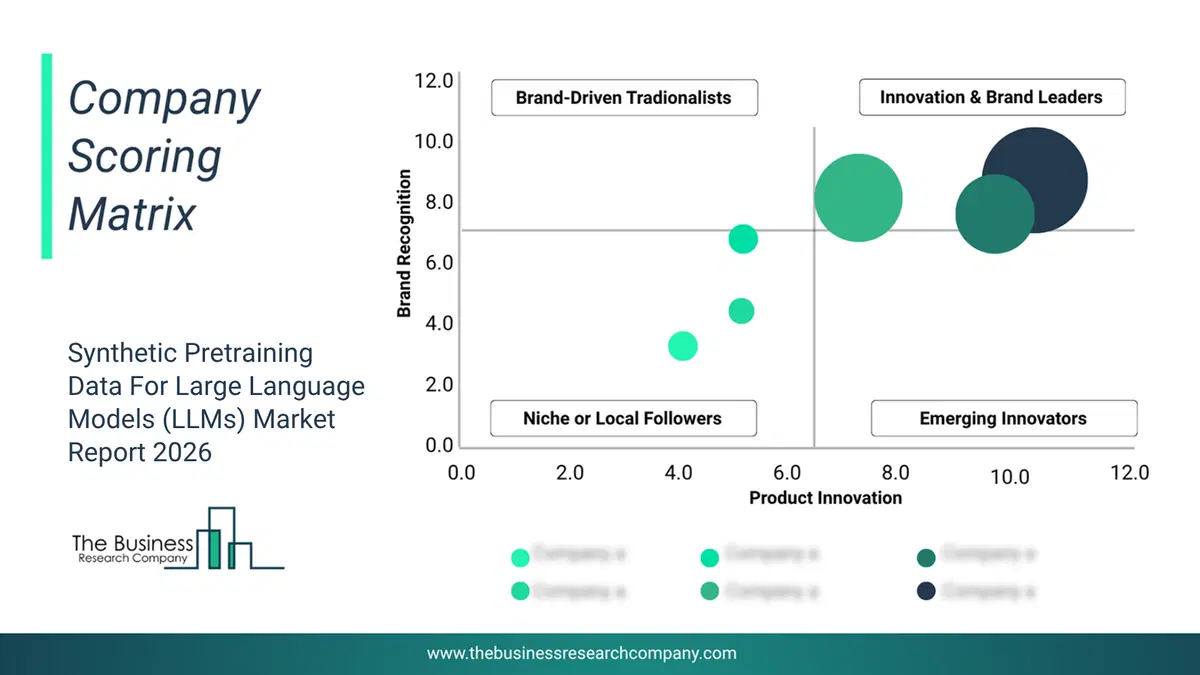
This chart maps companies by product innovation and brand strength, with bubble size indicating relative revenue, helping identify market leaders, challengers, and niche players. This is an illustrative chart; the full report provides a complete and accurate competitive analysis.
Global Synthetic Pretraining Data For Large Language Models (LLMs) Market Trends and Insights
Major companies operating in the synthetic pretraining data for large language models (LLMs) market are focusing on advancements in cloud-based pretraining data pipelines that combine synthetic data generation with large-scale data curation and quality-aware optimization to address data scarcity, improve model performance, and support trillion-parameter model training. Cloud-based synthetic pretraining data pipelines integrate artificially generated high-quality datasets with curated proprietary and domain-specific data to enhance the efficiency and effectiveness of LLM pretraining beyond traditional web-scale sources. For instance, in August 2025, DatologyAI, a US-based venture-backed AI startup company, introduced BeyondWeb, an advanced data curation and training optimization platform designed to extend large language model training beyond conventional web datasets. BeyondWeb emphasizes large-scale synthetic data integration, automated data valuation, and quality-aware filtering to identify and prioritize high-value training data. These capabilities enable improved model generalization, robustness, and training efficiency at extreme scale, supporting trillion-parameter model pretraining without proportional increases in computational cost.What Are Latest Mergers And Acquisitions In The Synthetic Pretraining Data For Large Language Models (LLMs) Market?
In March 2025, NVIDIA Corporation, a US-based provider of graphics processing units, accelerated computing platforms, artificial intelligence hardware, and software solutions, acquired Gretel Labs, Inc. for an undisclosed amount. With this acquisition, NVIDIA aimed to strengthen its AI and data ecosystem by enhancing its synthetic data generation capabilities, supporting privacy-preserving data workflows, and improving the training, testing, and validation of large-scale AI models across industries. Gretel Labs, Inc. is a US-based provider of synthetic data generation platforms and privacy-enhancing technologies that enable organizations to safely create, share, and utilize high-quality artificial datasets for machine learning and analytics.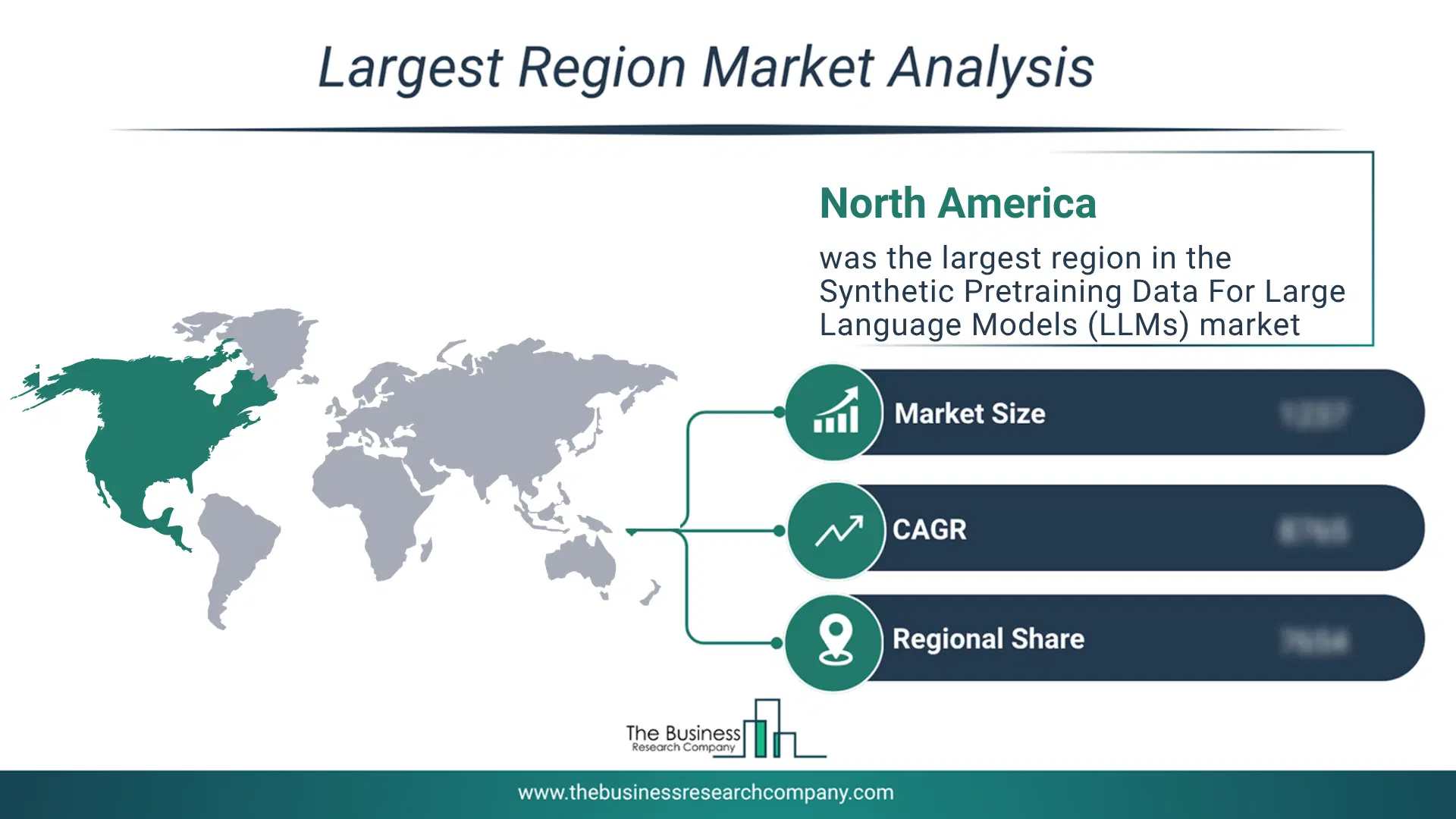
Regional Insights
North America was the largest region in the synthetic pretraining data for large language models (LLMs) market in 2025. Asia-Pacific is expected to be the fastest-growing region in the forecast period. The regions covered in this market report are Asia-Pacific, South East Asia, Western Europe, Eastern Europe, North America, South America, Middle East, Africa. The countries covered in this market report are Australia, Brazil, China, France, Germany, India, Indonesia, Japan, Taiwan, Russia, South Korea, UK, USA, Canada, Italy, Spain.What Defines the Synthetic Pretraining Data For Large Language Models (LLMs) Market?
The synthetic pretraining data for large language models market consists of revenues earned by entities by providing services such as synthetic data generation services, domain-specific data simulation services, data augmentation services, synthetic text corpus design services, multilingual synthetic data creation services, bias mitigation and fairness services, data validation and quality assurance services, model pretraining support services, custom synthetic dataset development services and compliance and privacy preservation services. The market value includes the value of related goods sold by the service provider or included within the service offering. The synthetic pretraining data for large language models market also includes sales of synthetic text data platforms, pretraining dataset libraries, synthetic data generation software, multilingual synthetic data engines, domain-specific synthetic data packages, data augmentation toolkits, bias-controlled synthetic corpora, privacy-safe training datasets, automated synthetic data pipelines and large language model pretraining datasets. values in this market are ‘factory gate’ values, that is the value of goods sold by the manufacturers or creators of the goods, whether to other entities (including downstream manufacturers, wholesalers, distributors and retailers) or directly to end customers. The value of goods in this market includes related services sold by the creators of the goods.How is Market Value Defined and Measured?
The market value is defined as the revenues that enterprises gain from the sale of goods and/or services within the specified market and geography through sales, grants, or donations in terms of the currency (in USD unless otherwise specified). The revenues for a specified geography are consumption values that are revenues generated by organizations in the specified geography within the market, irrespective of where they are produced. It does not include revenues from resales along the supply chain, either further along the supply chain or as part of other products.
This chart presents market attractiveness based on a quantitative evaluation of growth, competition, strategic alignment, and risk, offering a clear view of opportunity areas for decision-making. This chart is for illustrative purposes; the full report contains the complete analysis.

This chart highlights the Total Addressable Market (TAM) by estimating the maximum revenue opportunity using an assumption-driven approach, supporting strategic planning and opportunity sizing across markets. The chart is illustrative; the full report provides a more comprehensive analysis.
What Key Data and Analysis Are Included in the Synthetic Pretraining Data For Large Language Models (LLMs) Market Report 2026?
The synthetic pretraining data for large language models (llms) market research report is one of a series of new reports from The Business Research Company that provides market statistics, including industry global market size, regional shares, competitors with the market share, detailed market segments, market trends and opportunities, and any further data you may need to thrive in the synthetic pretraining data for large language models (llms) industry. The market research report delivers a complete perspective of everything you need, with an in-depth analysis of the current and future state of the industry.Synthetic Pretraining Data For Large Language Models (LLMs) Market Report Forecast Analysis
| Report Attribute | Details |
|---|---|
| Market Size Value In 2026 | $2.25 billion |
| Revenue Forecast In 2030 | $6.69 billion |
| Growth Rate | CAGR of 31.3% from 2026 to 2030 |
| Base Year For Estimation | 2025 |
| Actual Estimates/Historical Data | 2020-2025 |
| Forecast Period | 2026 - 2030 |
| Market Representation | Revenue in USD Billion and CAGR from 2026 to 2030 |
| Segments Covered | Data Type, Source, Deployment Mode, Application, End-User |
| Regional Scope | Asia-Pacific, Western Europe, Eastern Europe, North America, South America, Middle East, Africa |
| Country Scope | The Countries Covered In This Market Report Are Australia, Brazil, China, France, Germany, India, Indonesia, Japan, Taiwan, Russia, South Korea, Uk, Usa, Canada, Italy, Spain. |
| Key Companies Profiled | Amazon Web Services Inc., NVIDIA Corporation, IBM Research, Microsoft Research, OpenAI Inc., Databricks Inc., Anthropic PBC, Cohere Inc., Innodata Inc., AI21 Labs Ltd., Hugging Face Inc., Snorkel AI Inc., Gretel Labs Inc., Meta Platforms Inc., Aleph Alpha GmbH, Bitext Innovations S.L., SuperAnnotate AI Inc., Google LLC, Syntheticus Inc., MOSTLY AI Solutions MP GmbH, YData LDA, Diveplane Corporation |
| Customization Scope | Request for Customization |
| Pricing And Purchase Options | Explore Purchase Options |