
Synthetic Surfactants Market Report 2026
Global Outlook – By Type (Anionic Surfactants, Non Ionic Surfactants, Cationic Surfactants, Amphoteric Surfactants), By Source (Petroleum Based, Oleochemical Based, Other Sources), By Form (Liquid, Powder, Paste Or Gel), By Distribution Channel (Direct Sales, Distributors And Wholesalers, Online Channels), By Application (Personal Care And Cosmetics, Household Cleaning, Laundry Detergents, Industrial Cleaning, Agriculture, Food Processing, Oil And Gas Enhanced Oil Recovery, Textiles, Paper And Pulp) – Market Size, Trends, Strategies, and Forecast to 2030
Synthetic Surfactants Market Overview
• Synthetic Surfactants market size has reached to $51.79 billion in 2025 • Expected to grow to $69.86 billion in 2030 at a compound annual growth rate (CAGR) of 6.1% • Growth Driver: Surge In Consumption Of Personal Care And Cosmetics Products Fueling The Growth Of The Market Due To Rising Self-care And Grooming Demand • Market Trend: Innovations In Ultra-High-Purity Injectable Surfactant Systems Enhance Stability And Performance In Biopharmaceutical Formulations • Asia-Pacific was the largest region and fastest growing region.What Is Covered Under Synthetic Surfactants Market?
Synthetic Surfactants are chemically engineered surface-active compounds that lower surface and interfacial tension between substances. They are extensively used to enhance wetting, emulsification, foaming, and dispersion, thereby improving cleaning effectiveness, formulation stability, and the overall performance of consumer and industrial products. The main types of synthetic surfactants include anionic surfactants, non ionic surfactants, cationic surfactants, and amphoteric surfactants. Anionic surfactants refer to surface-active agents with negatively charged hydrophilic groups that provide excellent detergency, foaming, emulsification, and wetting performance across a wide range of formulations. These surfactants are produced from petroleum based, oleochemical based, and other sources and are available in liquid, powder, and paste or gel forms. They are distributed through direct sales, distributors and wholesalers, and online channels and find application in personal care and cosmetics, household cleaning, laundry detergents, industrial cleaning, agriculture, food processing, oil and gas enhanced oil recovery, textiles, and paper and pulp.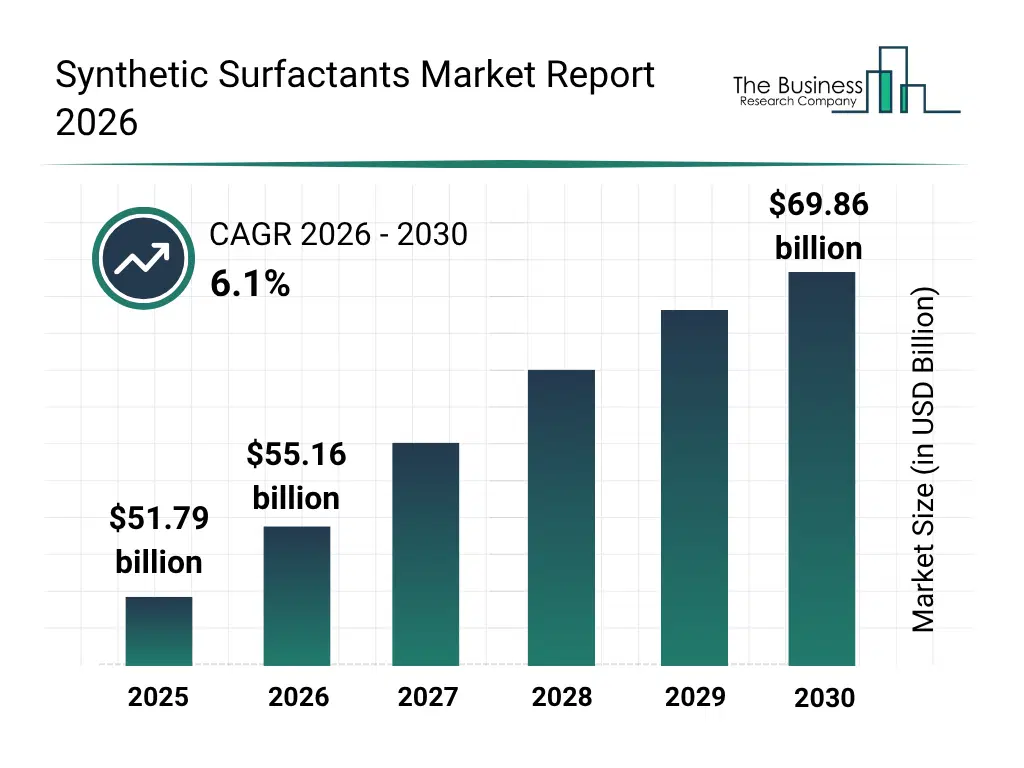
What Is The Synthetic Surfactants Market Size and Share 2026?
The synthetic surfactants market size has grown strongly in recent years. It will grow from $51.79 billion in 2025 to $55.16 billion in 2026 at a compound annual growth rate (CAGR) of 6.5%. The growth in the historic period can be attributed to increasing demand for cleaning and personal care products, growth of household and industrial cleaning applications, rising adoption of surfactants in consumer product formulations, expanding chemical manufacturing activities, growing demand for effective emulsification and dispersion solutions.What Is The Synthetic Surfactants Market Growth Forecast?
The synthetic surfactants market size is expected to see strong growth in the next few years. It will grow to $69.86 billion in 2030 at a compound annual growth rate (CAGR) of 6.1%.The growth in the forecast period can be attributed to increasing demand for sustainable and environmentally friendly surfactant solutions, rising adoption of specialty surfactants in advanced formulations, growing development of high efficiency cleaning products, expanding applications across personal care and industrial sectors, increasing demand for renewable source based surfactant production. Major trends in the forecast period include increasing adoption of bio based and sustainable surfactant alternatives, growing development of high performance surfactant formulations, rising demand for mild and skin friendly surfactant solutions, increasing focus on specialty surfactants for industrial applications, growing utilization of advanced surfactant blends for enhanced formulation performance.
Global Synthetic Surfactants Market Segmentation
2) By Source: Petroleum Based, Oleochemical Based, Other Sources 3) By Form: Liquid, Powder, Paste Or Gel 4) By Distribution Channel: Direct Sales, Distributors And Wholesalers, Online Channels 5) By Application: Personal Care And Cosmetics, Household Cleaning, Laundry Detergents, Industrial Cleaning, Agriculture, Food Processing, Oil And Gas Enhanced Oil Recovery, Textiles, Paper And Pulp Subsegments: 1) By Anionic Surfactants: Sodium Alkyl Sulfates, Alkyl Ether Sulfates, Linear Alkylbenzene Sulfonates, Alkyl Ether Carboxylates, Fatty Acid Soaps, Alkyl Phosphate Esters 2) By Non Ionic Surfactants: Fatty Alcohol Ethoxylate, Alkylphenol Ethoxylates, Alkyl Polyglucosides, Sorbitan Esters, Polyoxyethylene Esters, Amine Oxides 3) By Cationic Surfactants: Quaternary Ammonium Compounds, Alkyl Amines, Esterquats, Imidazolinium Compounds, Alkyl Pyridinium Salts 4) By Amphoteric Surfactants: Betaines, Amphoacetates, Amphopropionates, Imidazoline Derivatives, Amino Acid Based SurfactantsWhat Is The Driver Of The Synthetic Surfactants Market?
The growing consumption of personal care and cosmetic products is expected to drive the growth of the synthetic surfactants market going forward. Personal care and cosmetics products refer to items used for personal hygiene, grooming, skin care, and enhancing physical appearance. The growing consumption of personal care and cosmetic products is driven by increasing consumer focus on self-care and appearance enhancement, as these products support hygiene, grooming, and aesthetic improvement in daily life. Synthetic surfactants help personal care and cosmetic products by acting as effective cleansing and foaming agents that remove dirt and oil while enhancing texture, spreadability, and product performance. For instance, in September 2024, according to the U.S. Bureau of Labor Statistics, a US-based government agency that collects and analyzes data on labor economics and price changes, consumer spending on personal care products and services increased from $866 in 2022 to $950 in 2023, reflecting a rise of $84. Therefore, the growing consumption of personal care and cosmetic products is driving the growth of the synthetic surfactants industry.Key Players In The Global Synthetic Surfactants Market
Major companies operating in the synthetic surfactants market are BASF SE, Dow Inc., SABIC, LyondellBasell Industries N.V., Evonik Industries AG, Huntsman Corporation, Arkema S.A., Solvay S.A., Nouryon Chemicals B.V., Wilmar International Limited, Croda International Plc, Clariant AG, Kao Corporation, Stepan Company, Innospec Inc., Zanyu Technology Group Co. Ltd., Galaxy Surfactants Limited, Lion Corporation, India Glycols Limited, Pilot Chemical Company, Colonial Chemical Inc., Procter & Gamble, Unilever
This chart is for illustrative purposes; the full report includes a detailed competitor analysis and comprehensive overview of the top 10 companies in the market.
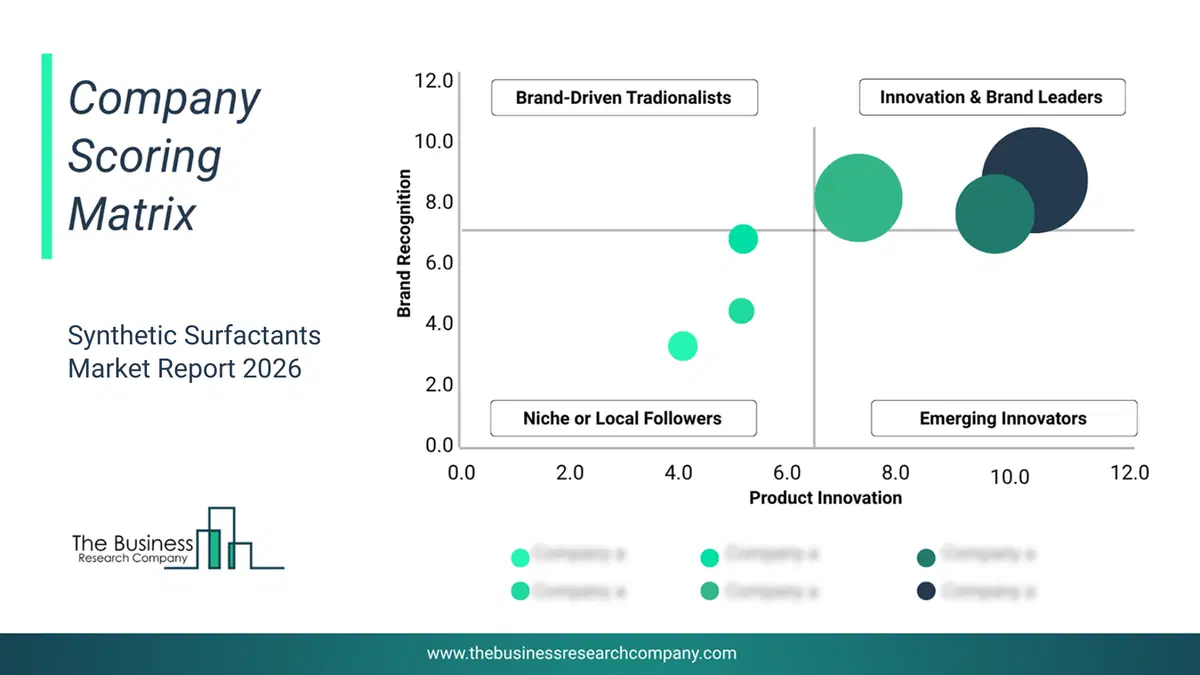
This chart maps companies by product innovation and brand strength, with bubble size indicating relative revenue, helping identify market leaders, challengers, and niche players. This is an illustrative chart; the full report provides a complete and accurate competitive analysis.
Global Synthetic Surfactants Market Trends and Insights
Major companies operating in the synthetic surfactants market are focusing on developing innovations in high-performance, low-dose surfactant formulations, such as ultra-high-purity injectable surfactant systems, to improve protein stability, reduce interfacial stress, and enhance the solubilization efficiency of hydrophobic active pharmaceutical ingredients while maintaining performance at lower concentration levels. Ultra-high-purity injectable surfactant systems refer to highly refined, pharmaceutical-grade synthetic surfactants designed with tightly controlled molecular composition and extremely low impurity levels to ensure safety, stability, and predictable interfacial performance in sensitive drug formulations such as injectables and biologics within the synthetic surfactant context. For instance, in September 2025, Evonik Industries AG, a Germany-based specialty chemicals company, launched MaxiPure Polysorbate 80 to enhance the performance and sustainability of household and laundry cleaning formulations by providing a high-purity, bio-based emulsifier for detergents and cleaning products. The product features more than 98 percent oleic acid content to ensure high compositional consistency, supports protein stability and viral inactivation in injectable biologics, and complies with Ph. Eur., USP, JP, and CP monographs to meet global regulatory standards for parenteral drug manufacturing.What Are Latest Mergers And Acquisitions In The Synthetic Surfactants Market?
In October 2023, Coast Southwest, Inc., a US-based specialty chemical distribution and ingredient technology company, acquired a surfactant plant from Lubrizol Corporation for an undisclosed amount. Through this acquisition, Coast Southwest aimed to strengthen its surfactant manufacturing capabilities, support its geographic and functional expansion strategy, improve its value chain position, and enhance its competitiveness in the surfactants market. The Lubrizol Corporation is a US-based specialty chemicals company that manufactures and supplies synthetic surfactants for personal care, home care, and industrial cleaning applications.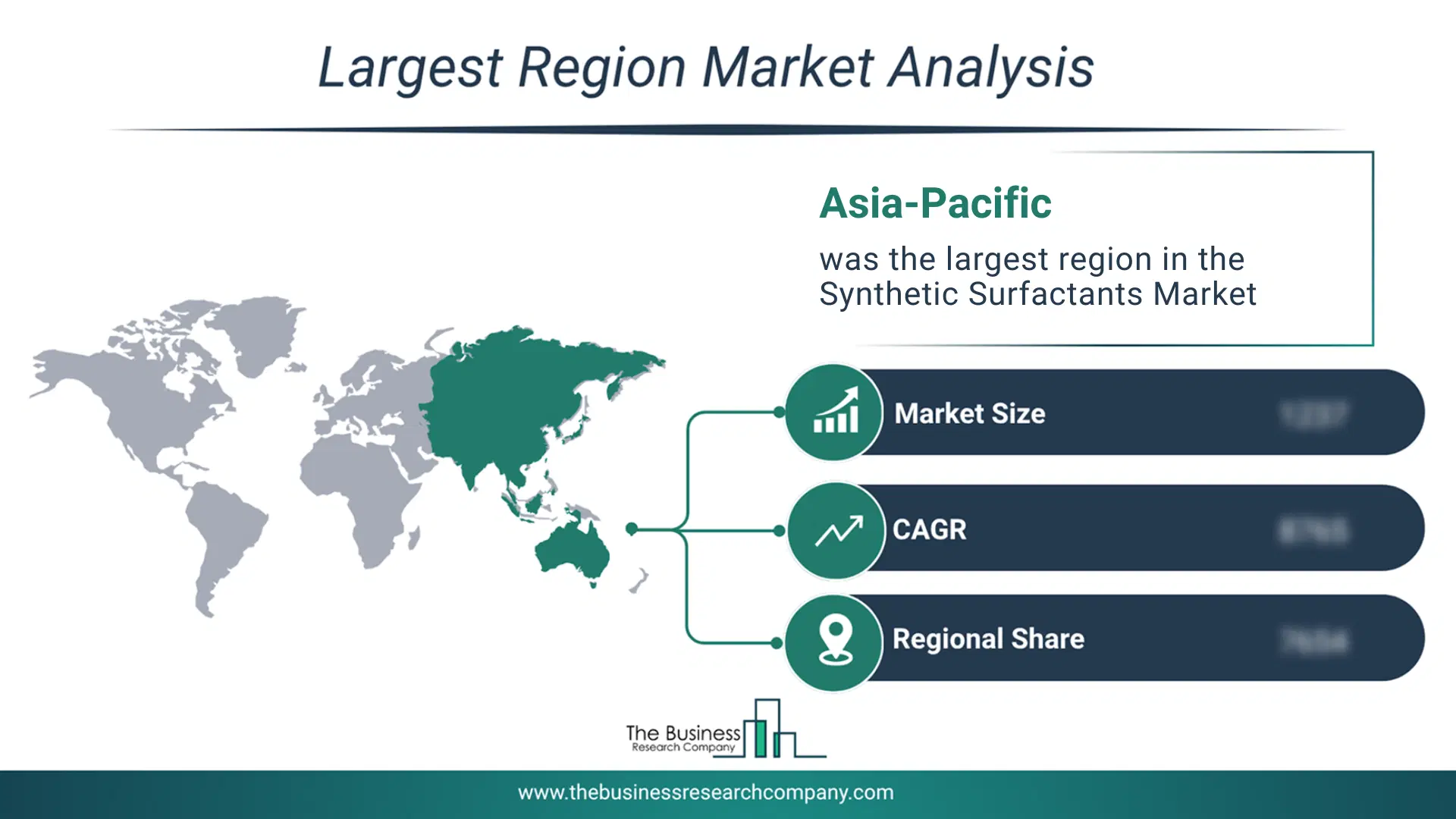
Regional Outlook/Insights
Asia-Pacific was the largest region in the synthetic surfactants market in 2025. Asia-Pacific is expected to be the fastest-growing region in the forecast period. The regions covered in this market report are Asia-Pacific, South East Asia, Western Europe, Eastern Europe, North America, South America, Middle East, Africa. The countries covered in this market report are Australia, Brazil, China, France, Germany, India, Indonesia, Japan, Taiwan, Russia, South Korea, UK, USA, Canada, Italy, Spain.What Defines the Synthetic Surfactants Market?
The synthetic surfactants market consists of sales of linear alkylbenzene sulfonate, alcohol ethoxylates, sodium lauryl sulfate, sodium laureth sulfate, and alkyl ether sulfates. Values in this market are ‘factory gate’ values, that is, the value of goods sold by the manufacturers or creators of the goods, whether to other entities (including downstream manufacturers, wholesalers, distributors and retailers) or directly to end customers. The value of goods in this market includes related services sold by the creators of the goods.How is Market Value Defined and Measured?
The market value is defined as the revenues that enterprises gain from the sale of goods and/or services within the specified market and geography through sales, grants, or donations in terms of the currency (in USD unless otherwise specified). The revenues for a specified geography are consumption values that are revenues generated by organizations in the specified geography within the market, irrespective of where they are produced. It does not include revenues from resales along the supply chain, either further along the supply chain or as part of other products.
This chart presents market attractiveness based on a quantitative evaluation of growth, competition, strategic alignment, and risk, offering a clear view of opportunity areas for decision-making. This chart is for illustrative purposes; the full report contains the complete analysis.

This chart highlights the Total Addressable Market (TAM) by estimating the maximum revenue opportunity using an assumption-driven approach, supporting strategic planning and opportunity sizing across markets. The chart is illustrative; the full report provides a more comprehensive analysis.
What Key Data and Analysis Are Included in the Synthetic Surfactants Market Report 2026?
The synthetic surfactants market research report is one of a series of new reports from The Business Research Company that provides synthetic surfactants market statistics, including synthetic surfactants industry global market size, regional shares, competitors with a synthetic surfactants market share, detailed synthetic surfactants market segments, market trends and opportunities, and any further data you may need to thrive in the synthetic surfactants industry. This synthetic surfactants market research report delivers a complete perspective of everything you need, with an in-depth analysis of the current and future scenario of the industry.Synthetic Surfactants Market Report Forecast Analysis
| Report Attribute | Details |
|---|---|
| Market Size Value In 2026 | $55.16 billion |
| Revenue Forecast In 2030 | $69.86 billion |
| Growth Rate | CAGR of 6.1% from 2026 to 2030 |
| Base Year For Estimation | 2025 |
| Actual Estimates/Historical Data | 2020-2025 |
| Forecast Period | 2026 - 2030 |
| Market Representation | Revenue in USD Billion and CAGR from 2026 to 2030 |
| Segments Covered | Type, Source, Form, Distribution Channel, Application |
| Regional Scope | Asia-Pacific, Western Europe, Eastern Europe, North America, South America, Middle East, Africa |
| Country Scope | The countries covered in the report are Australia, Brazil, China, France, Germany, India, Indonesia, Japan, Taiwan, Russia, South Korea, UK, USA, Canada, Italy, Spain. |
| Key Companies Profiled | BASF SE, Dow Inc., SABIC, LyondellBasell Industries N.V., Evonik Industries AG, Huntsman Corporation, Arkema S.A., Solvay S.A., Nouryon Chemicals B.V., Wilmar International Limited, Croda International Plc, Clariant AG, Kao Corporation, Stepan Company, Innospec Inc., Zanyu Technology Group Co. Ltd., Galaxy Surfactants Limited, Lion Corporation, India Glycols Limited, Pilot Chemical Company, Colonial Chemical Inc., Procter & Gamble, Unilever |
| Customization Scope | Request for Customization |
| Pricing And Purchase Options | Explore Purchase Options |