
Synthetic Tabular Data Generation Software Market Report 2026
Global Outlook – By Component (Software, Services), By Deployment Mode (On-Premises, Cloud-Based), By Enterprise Size (Large Enterprises, Small And Medium Enterprises), By Application (Data Augmentation, Machine Learning And AI Model Training, Data Privacy And Security, Testing And Quality Assurance (QA), Other Applications), By End-User (Banking, Financial Services, Insurance (BFSI), Healthcare, Retail And E-commerce, IT And Telecommunications, Government, Manufacturing, Other End-Users) – Market Size, Trends, Strategies, and Forecast to 2030
Synthetic Tabular Data Generation Software Market Overview
• Synthetic Tabular Data Generation Software market size has reached to $0.76 billion in 2025 • Expected to grow to $2.89 billion in 2030 at a compound annual growth rate (CAGR) of 30.7% • Growth Driver: Increasing Adoption Of Cloud Computing Fueling The Growth Of The Market Due To Scalable, Privacy-Compliant Datasets Enabling Efficient AI/ML And Large-Scale Analytics • Market Trend: Synthetic Data Tools Reduce Manual Effort And Compliance Risks • North America was the largest region in 2025 and Asia-Pacific is the fastest growing region.What Is Covered Under Synthetic Tabular Data Generation Software Market?
Synthetic tabular data generation software refers to digital tools that create artificial yet statistically accurate tabular datasets that mirror the structure and patterns of real-world data. It uses advanced machine learning and probabilistic models to replicate relationships, distributions, and trends found in original datasets. This software enables safe data sharing, improves model training, and supports analysis without exposing sensitive or restricted information. The main components of the synthetic tabular data generation software include software and services. Software refers to specialized artificial intelligence driven platforms designed to generate high-quality synthetic tabular datasets that statistically mirror real-world structured data while eliminating the risk of exposing sensitive or personally identifiable information. The deployment mode, including on-premises and cloud-based, and the enterprise size, covering large enterprises and small and medium enterprises. There are application, synthetic tabular data generation software is used for data augmentation, machine learning and ai model training, data privacy and security, testing and quality assurance (qa), and others, and the end-users include banking, financial services, and insurance (bfsi), healthcare, retail and e-commerce; it and telecommunications; government; manufacturing; and others.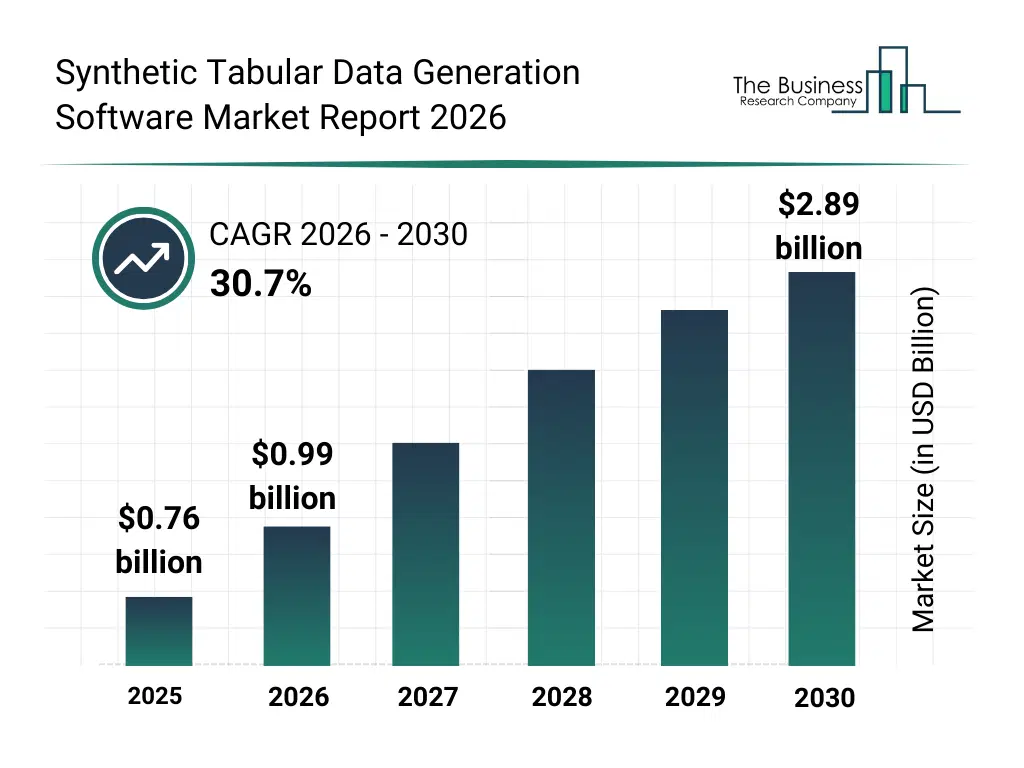
What Is The Synthetic Tabular Data Generation Software Market Size and Share 2026?
The synthetic tabular data generation software market size has grown exponentially in recent years. It will grow from $0.76 billion in 2025 to $0.99 billion in 2026 at a compound annual growth rate (CAGR) of 30.9%. The growth in the historic period can be attributed to increasing demand for privacy-preserving data, growing need for large-scale data simulation, rising adoption of ai and ml, expansion of data-driven decision making, and increasing regulatory compliance requirements.What Is The Synthetic Tabular Data Generation Software Market Growth Forecast?
The synthetic tabular data generation software market size is expected to see exponential growth in the next few years. It will grow to $2.89 billion in 2030 at a compound annual growth rate (CAGR) of 30.7%. The growth in the forecast period can be attributed to growing adoption of synthetic data in enterprises, increasing focus on data security and privacy, rising investments in ai and machine learning, expansion of healthcare and financial data analytics, and increasing demand for efficient data augmentation. Major trends in the forecast period include technology advancements in ai and ml models, innovations in data anonymization techniques, developments in cloud-based synthetic data platforms, research and developments in algorithmic data generation, and continuous improvements in data quality and utility.
Global Synthetic Tabular Data Generation Software Market Segmentation
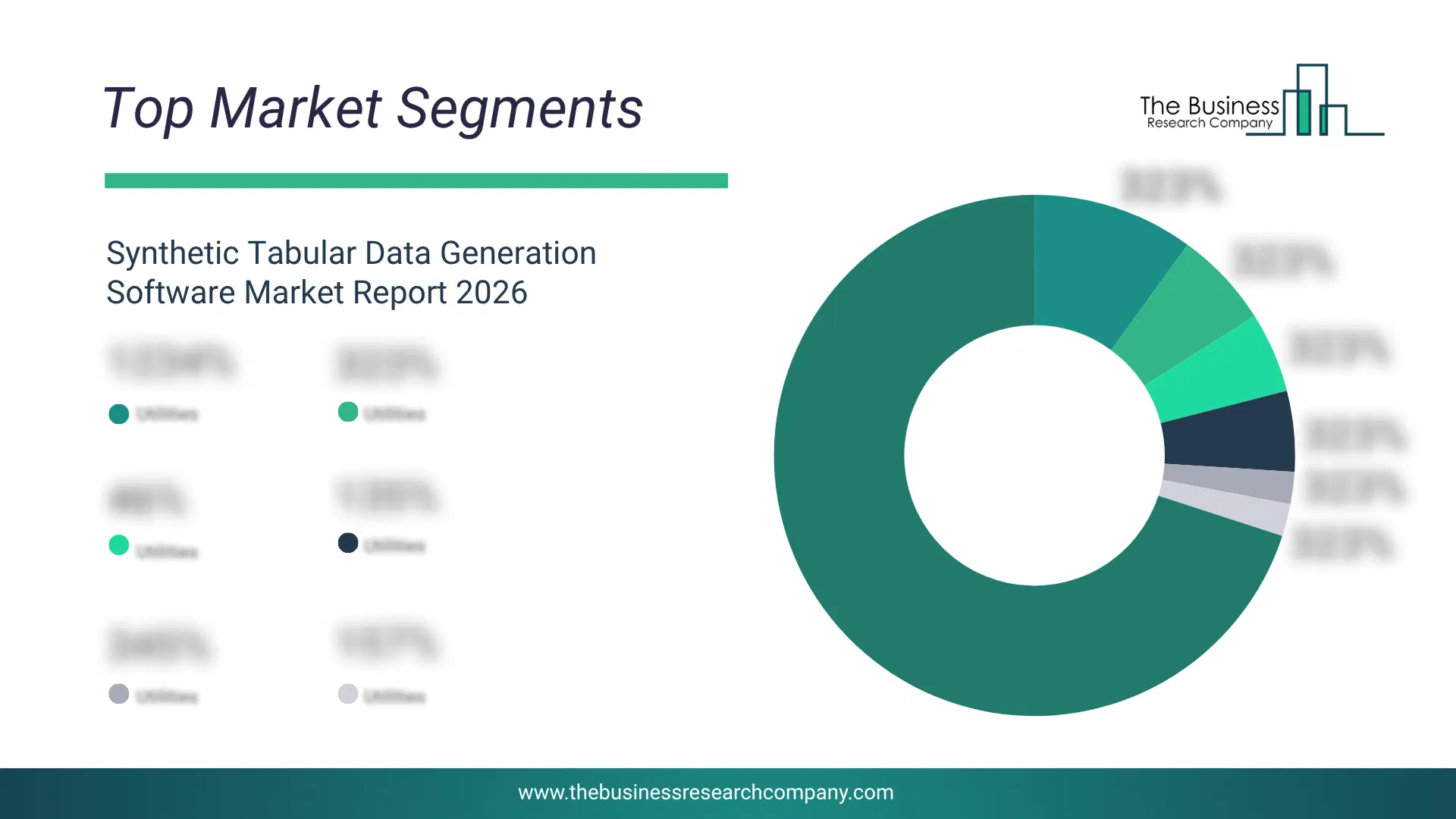
1) By Component: Software, Services 2) By Deployment Mode: On-Premises, Cloud-Based 3) By Enterprise Size: Large Enterprises, Small And Medium Enterprises 4) By Application: Data Augmentation, Machine Learning And AI Model Training, Data Privacy And Security, Testing And Quality Assurance (QA), Other Applications 5) By End-User: Banking, Financial Services, Insurance (BFSI), Healthcare, Retail And E-commerce, IT And Telecommunications, Government, Manufacturing, Other End-Users Subsegments: 1) By Software: Data Modeling, Data Masking, Data Augmentation, Data Synthesis 2) By Services: Consulting, Implementation, Support And Maintenance, TrainingWhat Is The Driver Of The Synthetic Tabular Data Generation Software Market?
The increasing adoption of cloud computing is expected to propel the growth of the synthetic tabular data generation software market going forward. Cloud computing refers to the delivery of computing resources such as servers, storage, databases, networking, software, and analytics over the internet to offer faster innovation, flexible resources, and economies of scale. The adoption of cloud computing is driven by scalability, as they allow businesses to easily adjust computing resources based on demand and reduce infrastructure costs. Synthetic tabular data generation software enhances cloud computing ecosystems by providing scalable, privacy-compliant datasets, making them ideal for multi-tenant environments and large-scale analytics. They reduce data preparation effort by enabling quick and accurate synthetic dataset creation, improving AI/ML model development and overall cloud efficiency. For instance, in December 2023, according to Eurostat, a Luxembourg-based government organization, 45.2% of enterprises across the European Union purchased cloud computing services, with 77.6% of large enterprises, 59% of medium-sized enterprises, and 41.7% of small businesses adopting cloud services. Therefore, the increasing adoption of cloud computing is driving the growth of the synthetic tabular data generation software industry.Key Players In The Global Synthetic Tabular Data Generation Software Market
Major companies operating in the synthetic tabular data generation software market are Amazon Web Services Inc., Microsoft Corporation, International Business Machines Corporation, NVIDIA Corporation, Databricks Inc., Sogeti, K2View Ltd., Datagen Technologies Ltd., Anonos Inc., Tonic.ai Inc., Mostly AI Solutions MP GmbH, OneView Inc., MDClone Ltd., Facteus Inc., Synthesized Ltd., GenRocket Inc., YData Inc., Betterdata Pte. Ltd., Aindo S.p.A., Syntho B.V.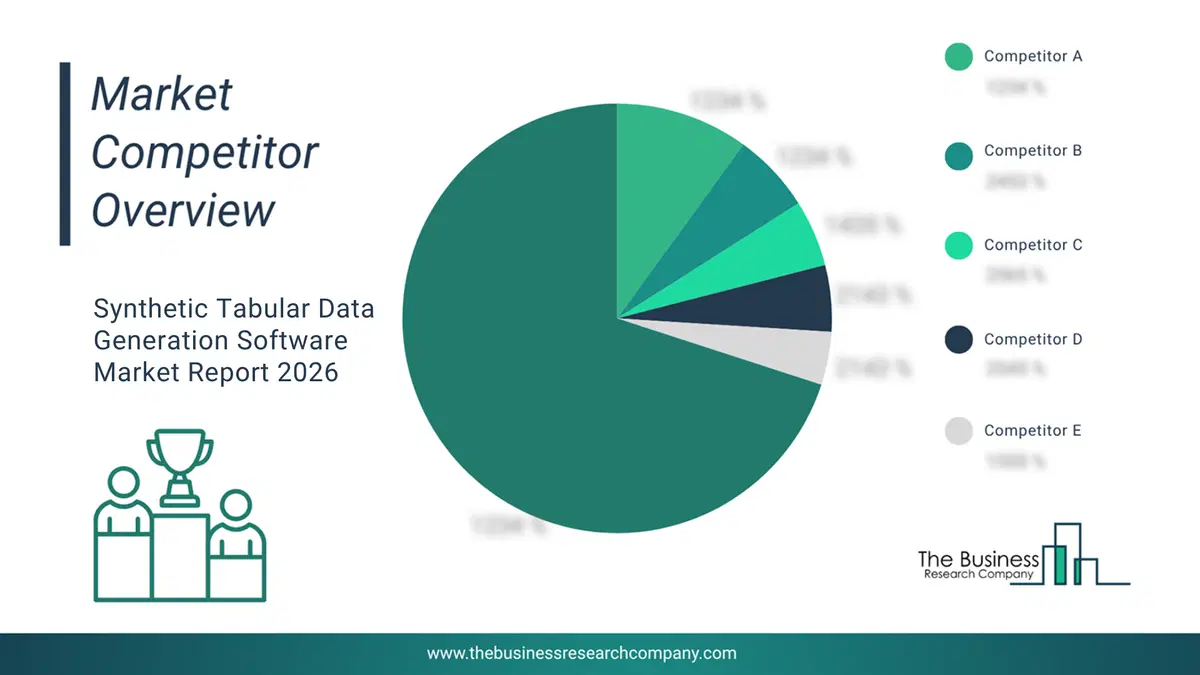
This chart is for illustrative purposes; the full report includes a detailed competitor analysis and comprehensive overview of the top 10 companies in the market.
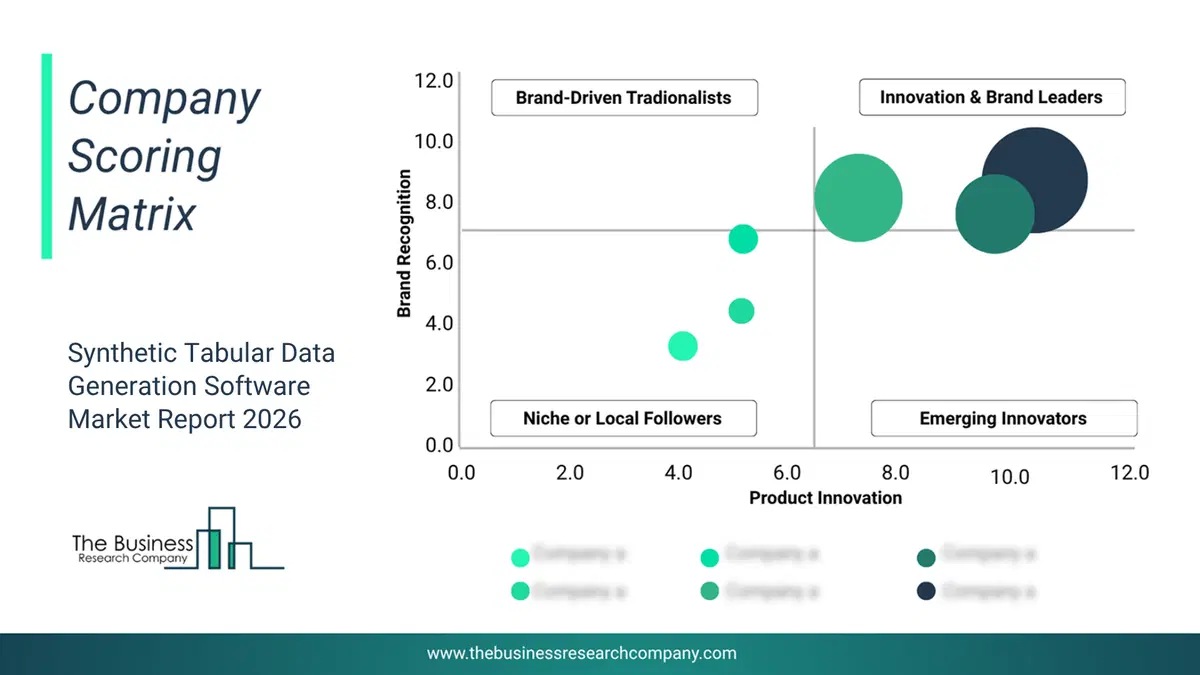
This chart maps companies by product innovation and brand strength, with bubble size indicating relative revenue, helping identify market leaders, challengers, and niche players. This is an illustrative chart; the full report provides a complete and accurate competitive analysis.
Global Synthetic Tabular Data Generation Software Market Trends and Insights
Major companies operating in the synthetic tabular data generation software market are focusing on developing advanced solutions, such as synthetic data management platforms, to boost data utility, enhance privacy compliance, and reduce the manual effort and risks associated with real data use. Synthetic data management platforms refer to integrated systems that automate the creation, governance, and deployment of statistically representative artificial data that mimics real datasets without exposing sensitive information. For instance, in October 2023, K2view, an Israel-based enterprise data management company, launched the K2view Synthetic Data Management Solution. It is a comprehensive platform that generates business-purpose synthetic data for non-production environments, featuring patented entity-based generation that maintains the integrity of complex business relationships across millions of records. It includes automated data discovery and classification, enabling seamless alignment with specific data privacy regulations and testing needs without manual intervention. It also incorporates data subsetting and referential integrity preservation, accelerating development cycles and reducing compliance risk for enterprises in regulated industries.What Are Latest Mergers And Acquisitions In The Synthetic Tabular Data Generation Software Market?
In November 2024, SAS Institute, a US-based provider of analytics and AI software, acquired the principal software assets of Hazy Ltd. for an undisclosed amount. With this acquisition, SAS aims to integrate Hazy’s synthetic-data capabilities into its analytics stack to enable customers to create privacy-preserving synthetic datasets for production analytics, testing, and governance. Hazy Ltd. is a UK-based provider of synthetic tabular data generation software that creates privacy-preserving synthetic tabular datasets to mirror real data distributions for safe analytics and model development.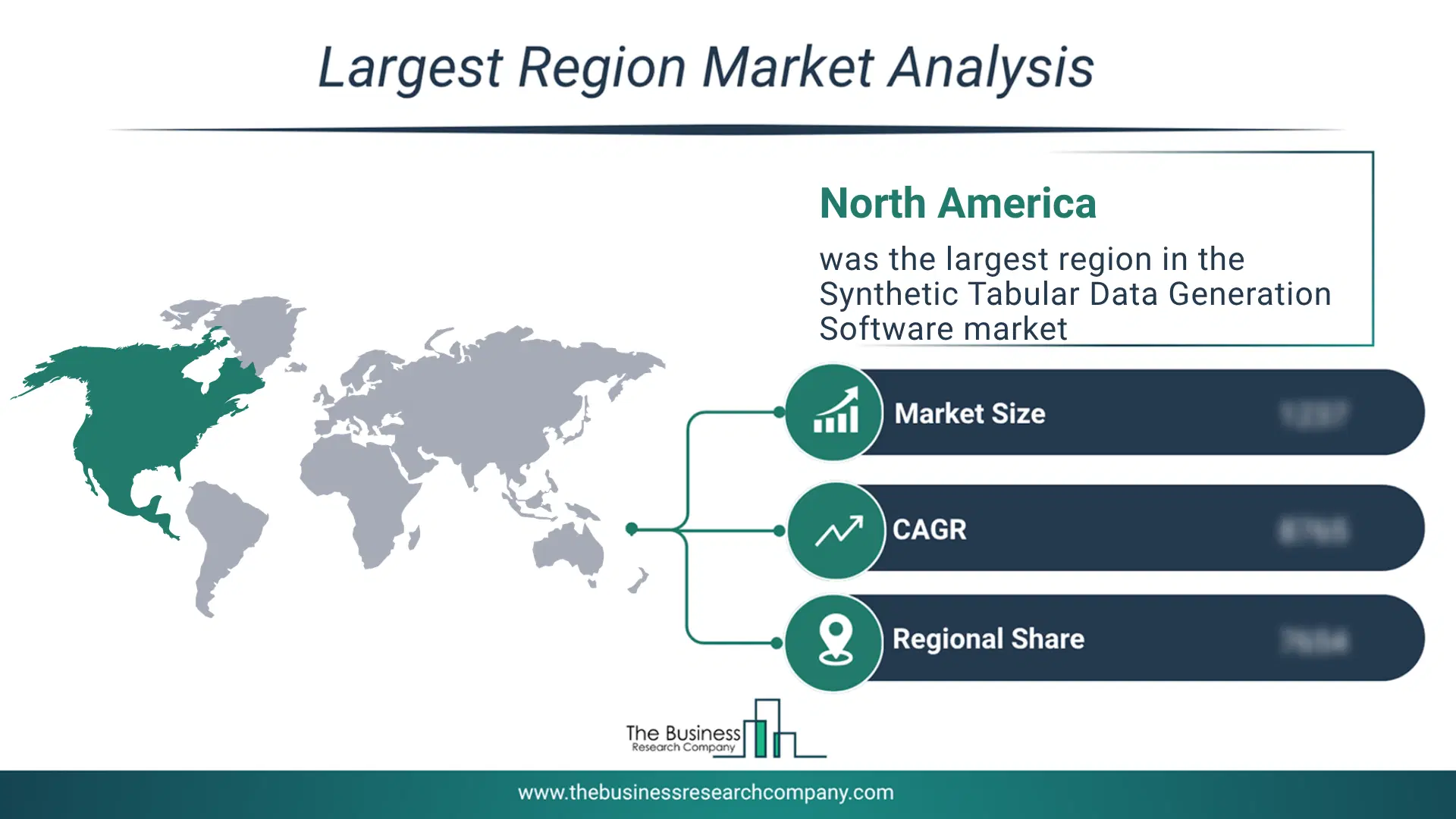
Regional Insights
North America was the largest region in the synthetic tabular data generation software market in 2025. Asia-Pacific is expected to be the fastest-growing region in the forecast period. The regions covered in this market report are Asia-Pacific, South East Asia, Western Europe, Eastern Europe, North America, South America, Middle East, Africa. The countries covered in this market report are Australia, Brazil, China, France, Germany, India, Indonesia, Japan, Taiwan, Russia, South Korea, UK, USA, Canada, Italy, Spain.What Defines the Synthetic Tabular Data Generation Software Market?
The synthetic tabular data generation software market consists of revenues earned by entities by providing services such as model training services, data validation services, software integration services, technical support services. The market value includes the value of related goods sold by the service provider or included within the service offering. The synthetic tabular data generation software market includes sales of laptops, servers, storage devices, networking equipment, data processing hardware. Values in this market are ‘factory gate’ values, that is, the value of goods sold by the manufacturers or creators of the goods, whether to other entities (including downstream manufacturers, wholesalers, distributors, and retailers) or directly to end customers. The value of goods in this market includes related services sold by the creators of the goods.How is Market Value Defined and Measured?
The market value is defined as the revenues that enterprises gain from the sale of goods and/or services within the specified market and geography through sales, grants, or donations in terms of the currency (in USD unless otherwise specified). The revenues for a specified geography are consumption values that are revenues generated by organizations in the specified geography within the market, irrespective of where they are produced. It does not include revenues from resales along the supply chain, either further along the supply chain or as part of other products.
This chart presents market attractiveness based on a quantitative evaluation of growth, competition, strategic alignment, and risk, offering a clear view of opportunity areas for decision-making. This chart is for illustrative purposes; the full report contains the complete analysis.

This chart highlights the Total Addressable Market (TAM) by estimating the maximum revenue opportunity using an assumption-driven approach, supporting strategic planning and opportunity sizing across markets. The chart is illustrative; the full report provides a more comprehensive analysis.
What Key Data and Analysis Are Included in the Synthetic Tabular Data Generation Software Market Report 2026?
The synthetic tabular data generation software market research report is one of a series of new reports from The Business Research Company that provides market statistics, including industry global market size, regional shares, competitors with the market share, detailed market segments, market trends and opportunities, and any further data you may need to thrive in the synthetic tabular data generation software industry. The market research report delivers a complete perspective of everything you need, with an in-depth analysis of the current and future state of the industry.Synthetic Tabular Data Generation Software Market Report Forecast Analysis
| Report Attribute | Details |
|---|---|
| Market Size Value In 2026 | $0.99 billion |
| Revenue Forecast In 2030 | $2.89 billion |
| Growth Rate | CAGR of 30.7% from 2026 to 2030 |
| Base Year For Estimation | 2025 |
| Actual Estimates/Historical Data | 2020-2025 |
| Forecast Period | 2026 - 2030 |
| Market Representation | Revenue in USD Billion and CAGR from 2026 to 2030 |
| Segments Covered | Component, Deployment Mode, Enterprise Size, Application, End-User |
| Regional Scope | Asia-Pacific, Western Europe, Eastern Europe, North America, South America, Middle East, Africa |
| Country Scope | The Countries Covered In This Market Report Are Australia, Brazil, China, France, Germany, India, Indonesia, Japan, Taiwan, Russia, South Korea, Uk, Usa, Canada, Italy, Spain. |
| Key Companies Profiled | Amazon Web Services Inc., Microsoft Corporation, International Business Machines Corporation, NVIDIA Corporation, Databricks Inc., Sogeti, K2View Ltd., Datagen Technologies Ltd., Anonos Inc., Tonic.ai Inc., Mostly AI Solutions MP GmbH, OneView Inc., MDClone Ltd., Facteus Inc., Synthesized Ltd., GenRocket Inc., YData Inc., Betterdata Pte. Ltd., Aindo S.p.A., Syntho B.V. |
| Customization Scope | Request for Customization |
| Pricing And Purchase Options | Explore Purchase Options |