
System Integration Services Market Report 2026
Global Outlook – By Service Type (Infrastructure Integration Services, Enterprise Application Integration Services), By Integration Component (Hardware Integration Service, Software Integration Service), By Industry Vertical (IT And Telecommunication, Defenses And security, BFSI, Oil And Gas, Healthcare, Transportation, Retail, Food And Beverages) – Market Size, Trends, Strategies, and Forecast to 2030
System Integration Services Market Overview
• System Integration Services market size has reached to $532.42 billion in 2025 • Expected to grow to $714.46 billion in 2030 at a compound annual growth rate (CAGR) of 6% • Growth Driver: Digital Transformation Driving Growth in System Integration Services Market • Market Trend: System Integration Service Companies Embrace Joint Generative AI Center for Market Profitability • Asia-Pacific was the largest region in 2025 and North America is the fastest growing region.Market Gains By 2030 – Top Opportunities By Segment
Market Gain identifies the most promising market opportunities by highlighting the segments or products expected to generate the highest incremental revenue growth over the next five years.
What Is Covered Under System Integration Services Market?
System integration services refer to the process of connecting different systems and components to ensure they function as one whole and seamlessly communicate with each other. This is typically achieved through various integration methods, such as point-to-point, vertical, star, horizontal, and common data format integration. The system integration services types are infrastructure integration services, enterprise application integration services, and consulting services. Infrastructure integration services refer to the process of integrating physical components, such as hardware, networking solutions, data centers, cloud services, and IoT devices, into a cohesive system it include various industry verticals such as information technology and telecommunication, defenses and security, banking, financial services and insurance (BFSI), oil and gas, healthcare, transportation, retail, food and beverages, and it has different service outlooks which are hardware integration service, and software integration service.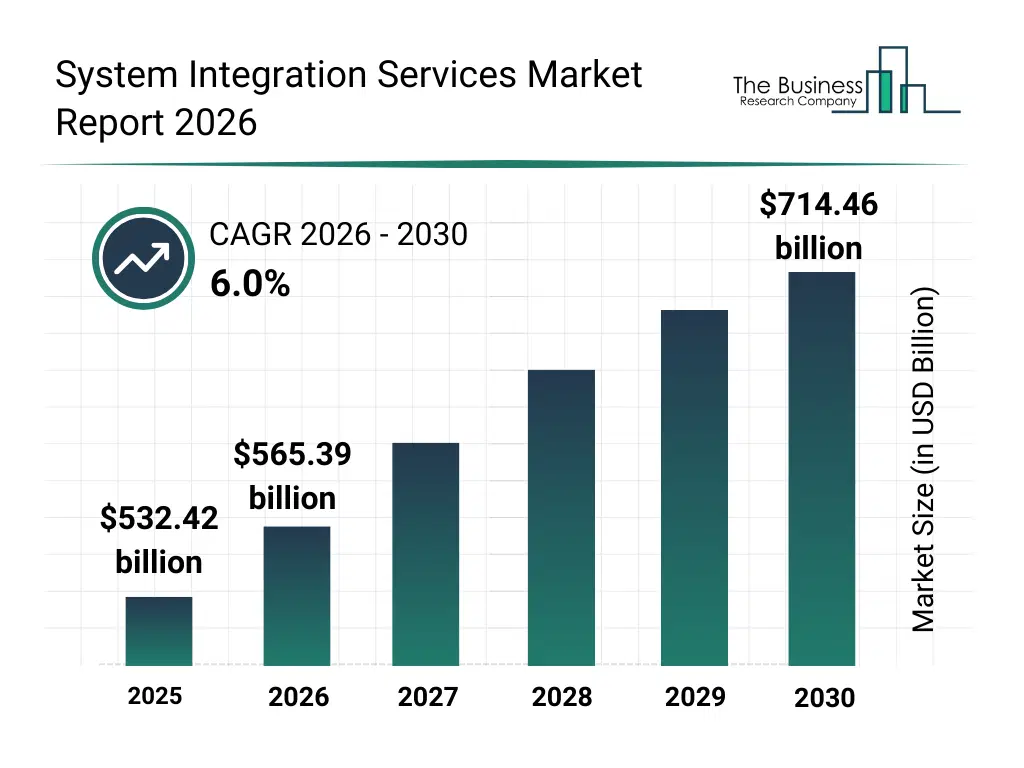
What Is The System Integration Services Market Size and Share 2026?
The system integration services market size has grown strongly in recent years. It will grow from $532.42 billion in 2025 to $565.39 billion in 2026 at a compound annual growth rate (CAGR) of 6.2%. The growth in the historic period can be attributed to increasing enterprise digitization initiatives, expansion of heterogeneous IT environments, growing adoption of enterprise applications, rising need for data consistency, availability of standardized integration tools.What Is The System Integration Services Market Growth Forecast?
The system integration services market size is expected to see strong growth in the next few years. It will grow to $714.46 billion in 2030 at a compound annual growth rate (CAGR) of 6.0%. The growth in the forecast period can be attributed to increasing investments in cloud-native integration platforms, rising demand for real-time analytics integration, expansion of industry-specific integration services, growing focus on cybersecurity-led integration, wider adoption of low-code integration solutions. Major trends in the forecast period include increasing demand for hybrid integration architectures, rising adoption of cloud and api-based integration, growing focus on real-time data interoperability, expansion of middleware and platform-based integration, enhanced emphasis on secure system connectivity.
Global System Integration Services Market Segmentation
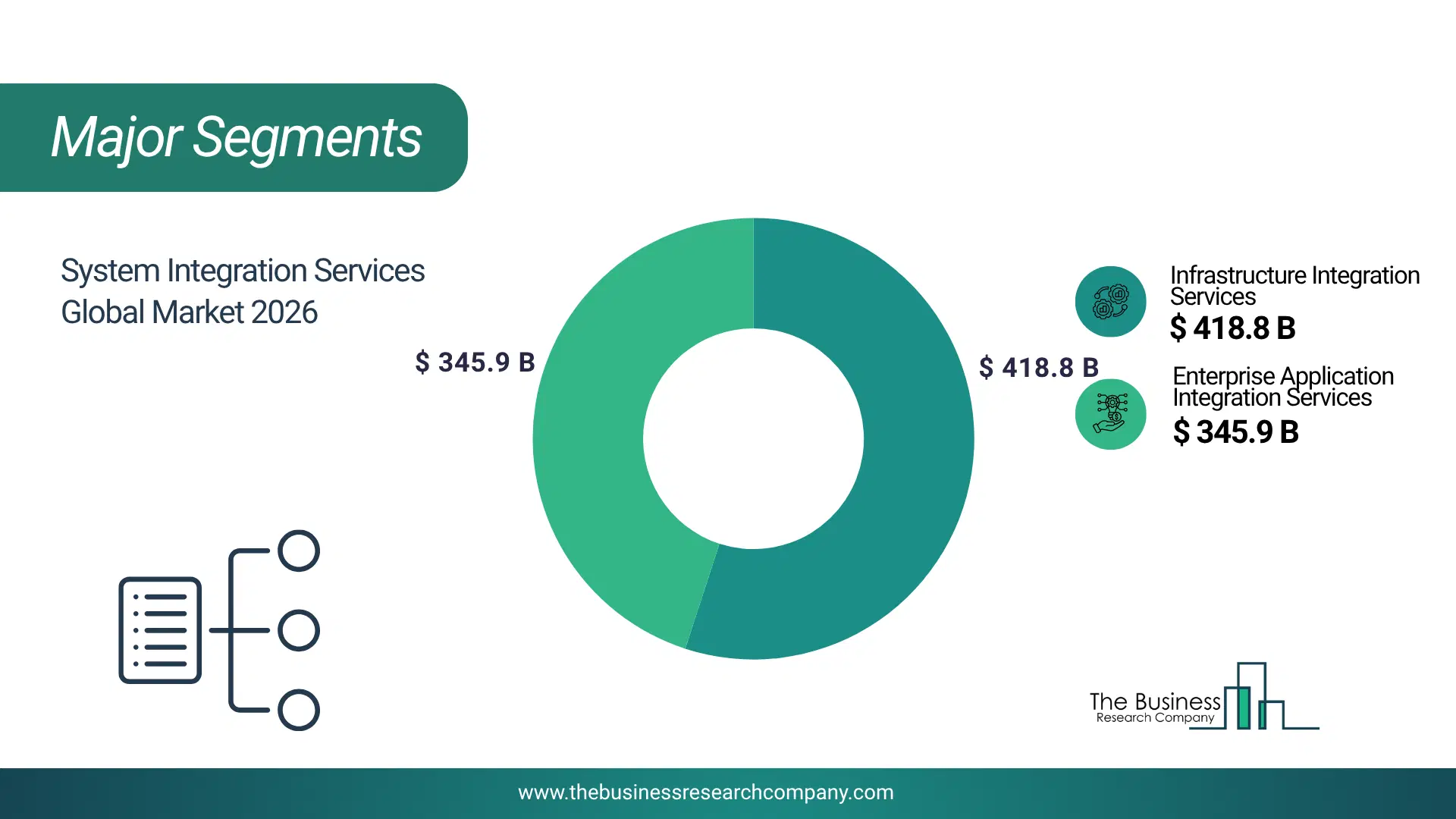
1) By Service Type: Infrastructure Integration Services, enterprise application integration Services 2) By Integration Component: Hardware Integration Service, Software Integration Service 3) By Industry Vertical: IT And Telecommunication, Defenses And security, BFSI, Oil And Gas, Healthcare, Transportation, Retail, Food And Beverages Subsegments: 1) By Infrastructure Integration Services: Network Integration, Cloud Integration, Data Center Integration 2) By Enterprise Application Integration Services: Application Development And Integration, Middleware Integration, API Management The top segments in the system integration services market will be: • Infrastructure Integration Services will reach $418.76 billion by 2030. • Enterprise Application Integration Services will reach $345.89 billion by 2030.What Is The Driver Of The System Integration Services Market?
The increasing adoption of digital transformation strategies is expected to propel the growth of the system integration services market going forward. Digital transformation strategies refer to a set of initiatives and plans that organizations undertake to leverage digital technologies and adapt their operations, processes, and business models to meet the evolving demands of the digital age. Digital transformation is helpful for system integration services as it integrates digital technology into all business areas, fundamentally changing how the business operates and delivers value. System integration plays a critical role in the digital transformation journey by linking separate modules, processes, and data systems to work in a unified manner, thereby reducing costs, eliminating redundancy, and improving productivity and efficiency. For instance, in September 2025, according to the Digital Regulation Platform, a Switzerland-based knowledge-sharing initiative, 30 % of countries globally have progressed to an advanced national digital policy, legal and governance framework stage for digital transformation strategies. Therefore, the increasing adoption of digital transformation strategies are driving the growth of the system integration services industry.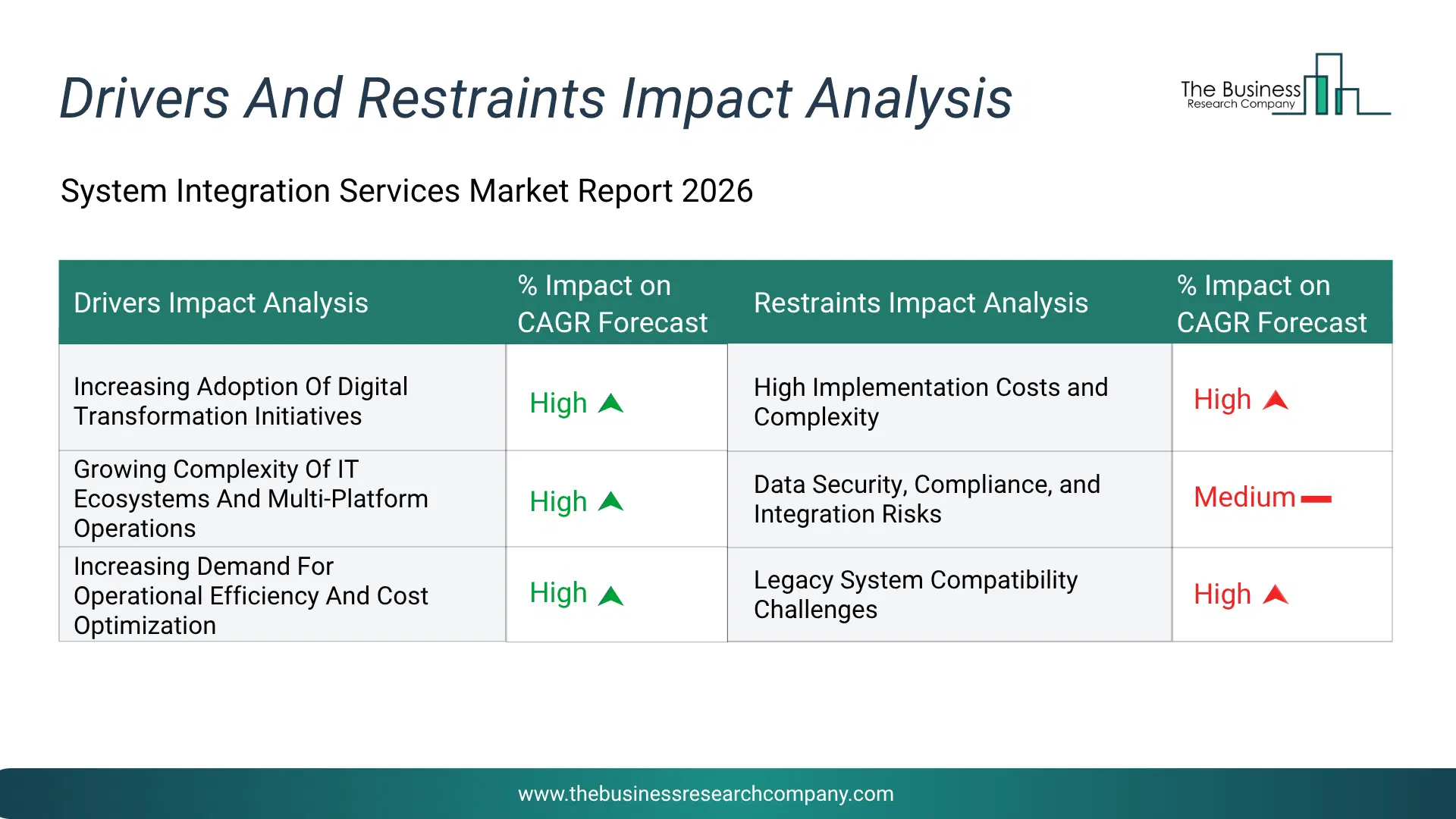
Infographic Chart Showing Key Market Drivers Analysis And Restraints For System Integration Services Market
The chart presents an impact analysis of key drivers and restraints, quantifying their relative influence on the market's growth rate and helping assess the balance between growth enablers and limiting factors. This chart offers a high-level perspective; the full report contains more detailed insights.
How Will The Drivers Impact Growth In The Global System Integration Services Market?
• Increasing Adoption Of Digital Transformation Initiatives (High) – During the forecast period, the increasing adoption of digital transformation initiatives is expected to become a key growth driver for the system integration services market by 2030. Organizations across industries are increasingly adopting digital transformation initiatives to enhance operational efficiency, customer experience, and business agility. System integration services play a critical role in connecting disparate it systems, applications, and data platforms, enabling seamless workflows and real -time decision -making. Cloud migration, erp deployment, iot integration, and ai -powered solutions rely on robust integration services to ensure interoperability and data consistency. As enterprises continue to modernize their it infrastructure, demand for comprehensive system integration services grows steadily, acting as a primary driver for market expansion. • Growing Complexity Of IT Ecosystems And Multi-Platform Operations (High) – During the forecast period, the growing complexity of it ecosystems and multi-platform operations is expected to emerge as a major factor driving the expansion of the system integration services market by 2030. The increasing complexity of enterprise it environments, driven by multi-cloud adoption, hybrid infrastructures, and diverse software applications, fuels the need for professional system integration. Organizations require services that can integrate legacy systems with modern platforms, ensuring data synchronization, security, and seamless workflow management. Multi-platform environments in sectors such as banking, healthcare, manufacturing, and telecom necessitate specialized integration expertise, which accelerates the adoption of system integration services. The rising complexity of it ecosystems directly drives market demand for expert integration solutions. • Increasing Demand For Operational Efficiency And Cost Optimization (High) – During the forecast period, the increasing demand for operational efficiency and cost optimization is expected to act as a key growth catalyst for the system integration services market by 2030. System integration services enable enterprises to streamline operations, reduce manual processes, and optimize it and business workflows. By centralizing data management, automating repetitive tasks, and enabling interoperability across platforms, organizations can achieve cost savings and improved resource allocation. Enhanced visibility into business processes and real-time analytics provided by integrated systems supports strategic decision-making. The demand for operational efficiency, cost optimization, and faster time-to-market continues to drive growth in the system integration services market globally.How Will The Restraints Impact Growth In The Global System Integration Services Market?
• High Implementation Costs and Complexity (High) – During the forecast period, the deploying large-scale system integration projects often involves significant capital investment, skilled workforce requirements, and sophisticated technology infrastructure. Organizations, particularly smes, may face challenges in affording integration solutions, leading to slower adoption. Complex projects with multiple vendors and legacy systems increase the risk of delays, cost overruns, and technical issues. These high implementation costs and complexity act as a restraint, particularly in regions with budget-constrained enterprises. • Data Security, Compliance, and Integration Risks (Medium) – During the forecast period, the integrating multiple it systems exposes organizations to potential cybersecurity risks, data breaches, and compliance challenges. Sensitive data transferred across platforms must adhere to industry regulations and privacy laws, such as gdpr, hipaa, or sector-specific standards. Security vulnerabilities, system downtime, or errors during integration can disrupt business operations and increase operational risks. These concerns act as a significant restraint, particularly for enterprises in highly regulated sectors like finance, healthcare, and government. • Legacy System Compatibility Challenges (High) – During the forecast period, the legacy system compatibility challenges act as a restraint for the system integration services market by making it difficult to connect modern applications with older, outdated infrastructure still used by many enterprises. These legacy systems often lack standardized interfaces and require extensive customization or middleware solutions to enable integration. This increases project complexity, implementation time, and overall costs. Additionally, the risk of system failures or data inconsistencies during integration further discourages organizations from upgrading. As a result, enterprises delay or limit integration initiatives, slowing market growth.Key Players In The Global System Integration Services Market
Major companies operating in the system integration services market are Microsoft Corporation, Dell Technologies, Deloitte, Accenture plc, International Business Machines Corporation, Cisco, Oracle Corporation, BAE Systems Plc, Hewlett Packard Enterprise, Tata Consultancy Services (TCS), Fujitsu Limited, Capgemini, Cognizant, Infosys, DXC Technology, HCL Tech, Atos, Wipro, CGI Inc, MuleSoft, Celigo, Work Horse Integration, Workato, Itrasition, Jitterbit, Snaplogic, Tray.io, Aspire Systems, DocInfusion, Flowgear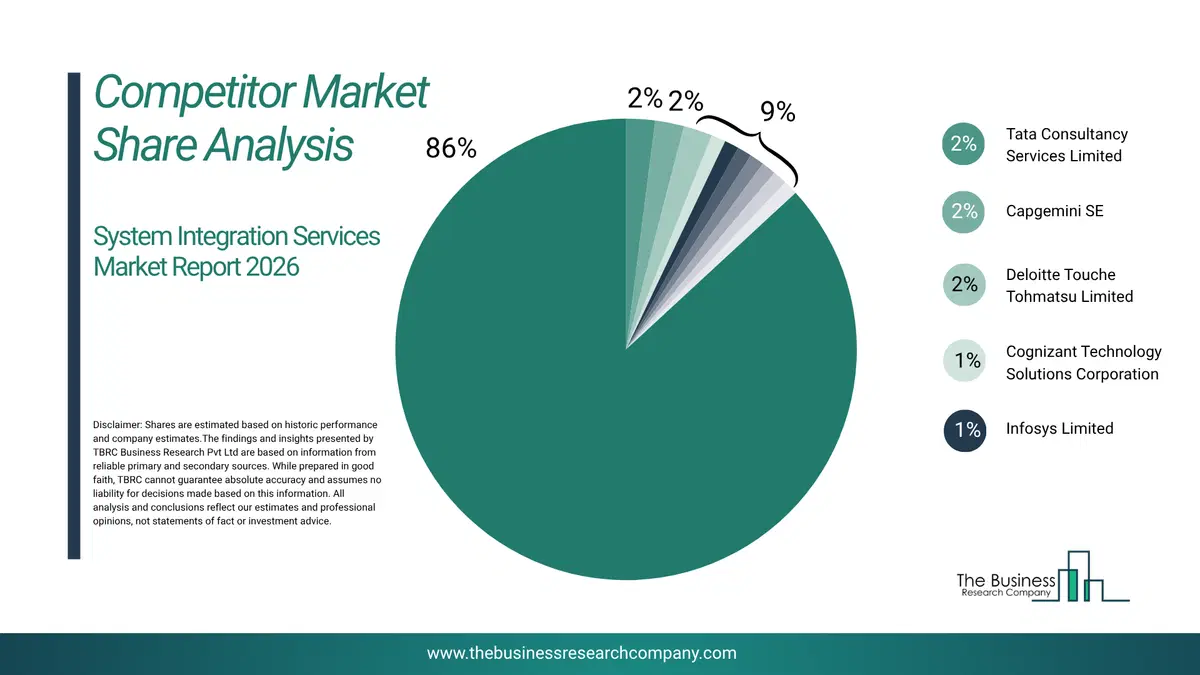
This chart is for illustrative purposes; the full report includes a detailed competitor analysis and comprehensive overview of the top 10 companies in the market.
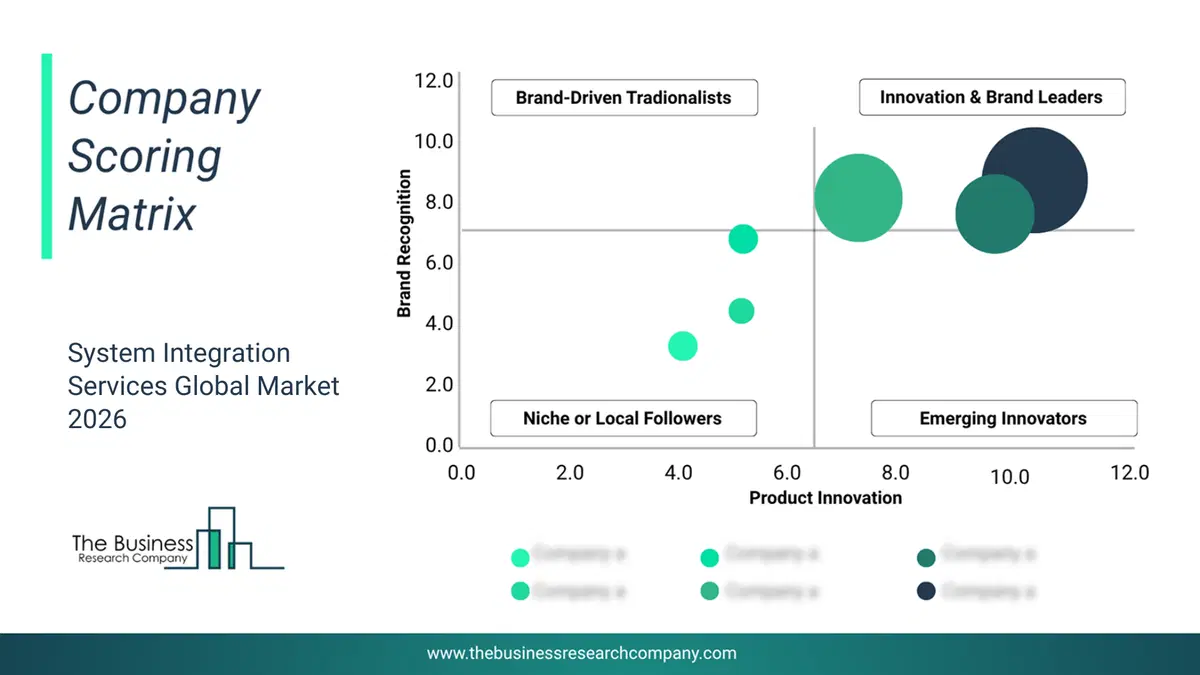
This chart maps companies by product innovation and brand strength, with bubble size indicating relative revenue, helping identify market leaders, challengers, and niche players. This is an illustrative chart; the full report provides a complete and accurate competitive analysis.
Global System Integration Services Market Trends and Insights
Major companies operating in the system integration service market are innovating emerging technologies such as the Joint Generative AI Center to increase their profitability in the market. Joint Generative AI Center is a system integration service that helps enterprises leverage generative potential. For instance, in December 2023, Accenture PLC, an Ireland-based information technology company, launched a joint generative AI center of excellence to improve operations and create new lines of business. The center aims to provide industry technical knowledge and product resources to build and scale applications using Google Cloud's generative AI portfolio, including tensor processing units (TPUs), graphics processing units (GPUs), and Google AI hypercomputes for quick training, tuning, and serving of AI models. This will provide AI-managed services to scale generative AI, including deploying Gemini, Google’s newest and most capable model.What Are Latest Mergers And Acquisitions In The System Integration Services Market?
In December 2023, MDS System, a US-based service and production company, acquired SmplID for an undisclosed amount. Through this acquisition, MDS aims to strengthen its digital transformation and IAM capabilities, enhancing security, streamlining user experiences, and broadening service offerings to meet the evolving digital needs of diverse sectors. SmplID is a US-based service provider specializing in IAM, privileged access management (PAM), and governance solutions.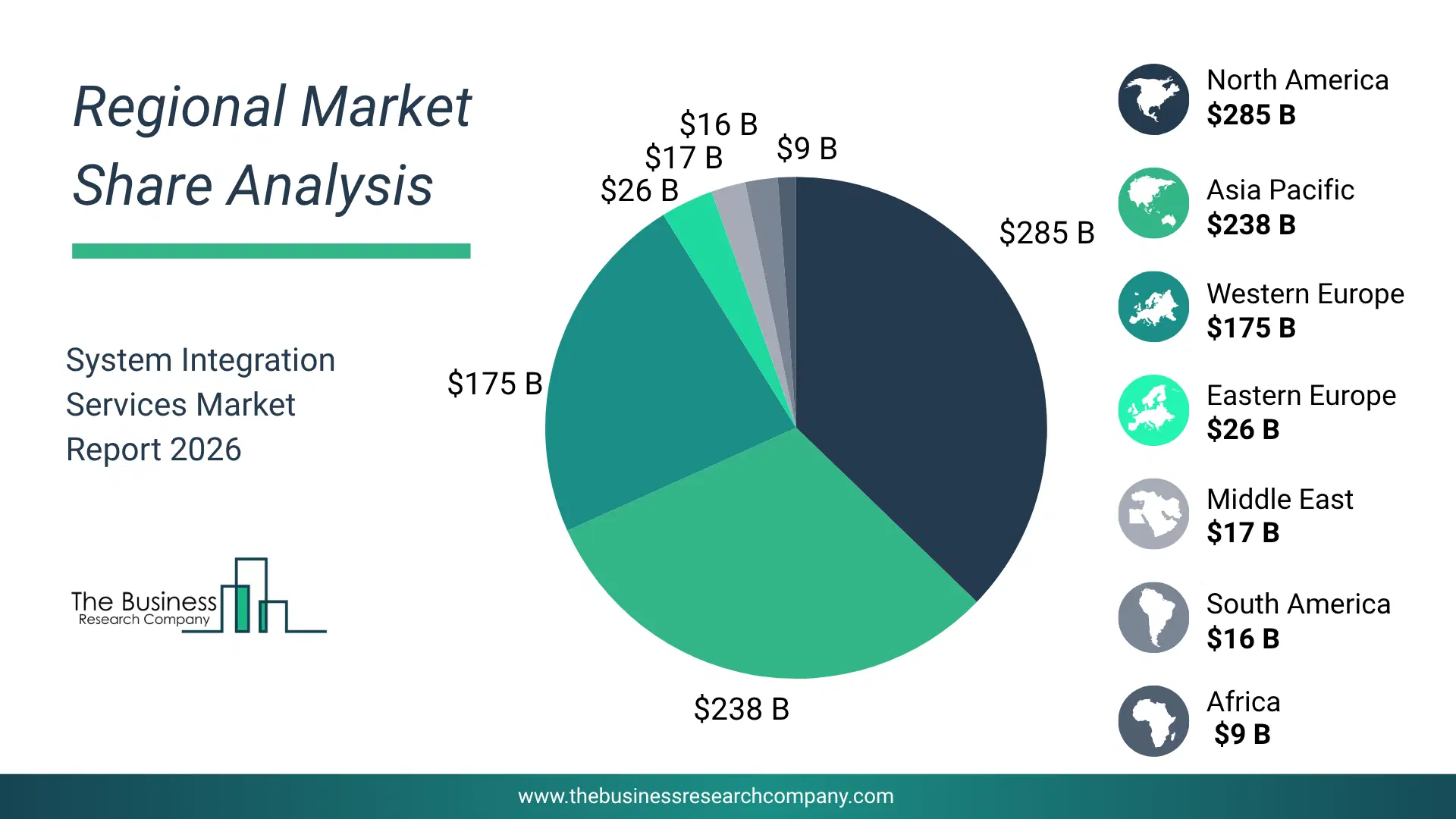
Regional Insights
Asia-Pacific was the largest region in the system integration services market in 2025. North America is expected to be the fastest-growing region in the forecast period. The regions covered in this market report are Asia-Pacific, South East Asia, Western Europe, Eastern Europe, North America, South America, Middle East, Africa. The countries covered in this market report are Australia, Brazil, China, France, Germany, India, Indonesia, Japan, Taiwan, Russia, South Korea, UK, USA, Canada, Italy, Spain.What Defines the System Integration Services Market?
The system integration services market consists of revenues earned by entities by providing services such as requirements analysis, system design, custom software development, hardware integration, and software integration. The market value includes the value of related goods sold by the service provider or included within the service offering. The system integration services market also includes sales of enterprise application integration (EAI), cloud integration, and business process integration (BPI).Values in this market are ‘factory gate’ values, that is the value of goods sold by the manufacturers or creators of the goods, whether to other entities (including downstream manufacturers, wholesalers, distributors and retailers) or directly to end customers. The value of goods in this market includes related services sold by the creators of the goods.How is Market Value Defined and Measured?
The market value is defined as the revenues that enterprises gain from the sale of goods and/or services within the specified market and geography through sales, grants, or donations in terms of the currency (in USD unless otherwise specified). The revenues for a specified geography are consumption values that are revenues generated by organizations in the specified geography within the market, irrespective of where they are produced. It does not include revenues from resales along the supply chain, either further along the supply chain or as part of other products.
This chart presents market attractiveness based on a quantitative evaluation of growth, competition, strategic alignment, and risk, offering a clear view of opportunity areas for decision-making. This chart is for illustrative purposes; the full report contains the complete analysis.

This chart highlights the Total Addressable Market (TAM) by estimating the maximum revenue opportunity using an assumption-driven approach, supporting strategic planning and opportunity sizing across markets. The chart is illustrative; the full report provides a more comprehensive analysis.
What Key Data and Analysis Are Included in the System Integration Services Market Report 2026?
The system integration services market research report is one of a series of new reports from The Business Research Company that provides market statistics, including industry global market size, regional shares, competitors with the market share, detailed market segments, market trends and opportunities, and any further data you may need to thrive in the system integration services industry. The market research report delivers a complete perspective of everything you need, with an in-depth analysis of the current and future state of the industry.System Integration Services Market Report Forecast Analysis
| Report Attribute | Details |
|---|---|
| Market Size Value In 2026 | $565.39 billion |
| Revenue Forecast In 2030 | $714.46 billion |
| Growth Rate | CAGR of 6.2% from 2026 to 2030 |
| Base Year For Estimation | 2025 |
| Actual Estimates/Historical Data | 2020-2025 |
| Forecast Period | 2026 - 2030 |
| Market Representation | Revenue in USD Billion and CAGR from 2026 to 2030 |
| Segments Covered | Service Type, Integration Component, Industry Vertical |
| Regional Scope | Asia-Pacific, Western Europe, Eastern Europe, North America, South America, Middle East, Africa |
| Country Scope | The countries covered in the report are Australia, Brazil, China, France, Germany, India, Indonesia, Japan, Taiwan, Russia, South Korea, UK, USA, Canada, Italy, Spain. |
| Key Companies Profiled | Microsoft Corporation, Dell Technologies, Deloitte, Accenture plc, International Business Machines Corporation, Cisco, Oracle Corporation, BAE Systems Plc, Hewlett Packard Enterprise, Tata Consultancy Services (TCS), Fujitsu Limited, Capgemini, Cognizant, Infosys, DXC Technology, HCL Tech, Atos, Wipro, CGI Inc, MuleSoft, Celigo, Work Horse Integration, Workato, Itrasition, Jitterbit, Snaplogic, Tray.io, Aspire Systems, DocInfusion, Flowgear |
| Customization Scope | Request for Customization |
| Pricing And Purchase Options | Explore Purchase Options |