

Tall Oil Fatty Acid Market Report 2026
Global Outlook – By Product (Oleic Acid, Linoleic Acid, Other Products), By Application (Dimer Acid, Alkyd Resin, Fatty Acid Ester, Other Applications), By End User (Soaps And Detergents, Plastic Additives, Coatings, Lubricants, Fuel Additives, Other End Users) – Market Size, Trends, Strategies, and Forecast to 2030
Tall Oil Fatty Acid Market Overview
• Tall Oil Fatty Acid market size has reached to $1.17 billion in 2025 • Expected to grow to $1.67 billion in 2030 at a compound annual growth rate (CAGR) of 7.4% • Growth Driver: Biofuel's Drives Tall Oil Fatty Acid Market • Market Trend: Technological Advancements Redefine The Tall Oil Fatty Acid Market • North America was the largest region in 2025 and Asia-Pacific is the fastest growing region.What Is Covered Under Tall Oil Fatty Acid Market?
Tall oil fatty acid (also known as liquid rosin or tallow) is a light-colored tall oil fatty acid obtained by fractional distilling crude tall oil. It is obtained from crude tall oil, a by-product of the Kraft paper pulping process, and is used where long-chain fatty acids are required, such as in soaps and detergents, lubricants, fuel additives, paints and coatings, and plastics. The main product types of tall oil fatty acids are oleic acid, linoleic acid, and others. Oleic acid is a type of fatty acid found in a variety of animal and vegetable fats and oils and is used in varied industries, including lubricants, detergents, surfactants, coatings, and sealants. Linoleic acid is an essential fatty acid found mostly in plant oils and is used in making soaps, emulsifiers, and quick-drying oils. The different applications of tall oil fatty acid include dimer acid, alkyd resin, fatty acid ester, and others and are implemented in various sectors such as soaps and detergents, plastic additives, coatings, lubricants, fuel additives, and others.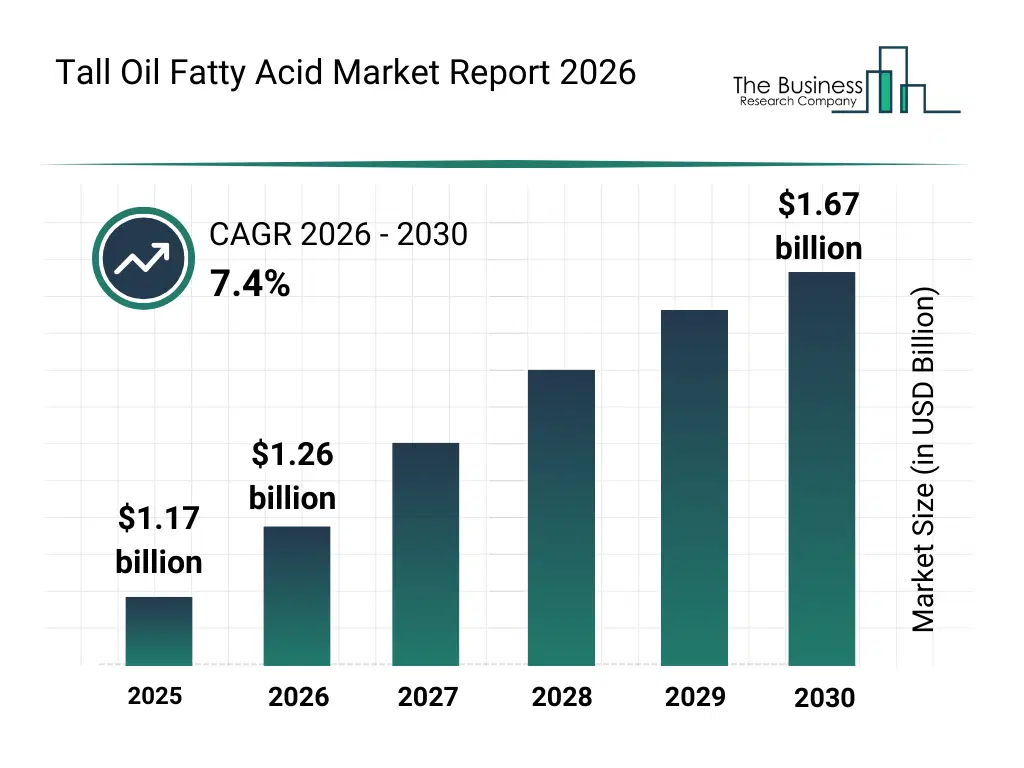
What Is The Tall Oil Fatty Acid Market Size and Share 2026?
The tall oil fatty acid market size has grown strongly in recent years. It will grow from $1.17 billion in 2025 to $1.26 billion in 2026 at a compound annual growth rate (CAGR) of 7.8%. The growth in the historic period can be attributed to expansion of kraft pulp production, growth of soap and detergent manufacturing, increasing use of fatty acids in coatings, rising demand for bio-based lubricants, availability of crude tall oil feedstock.What Is The Tall Oil Fatty Acid Market Growth Forecast?
The tall oil fatty acid market size is expected to see strong growth in the next few years. It will grow to $1.67 billion in 2030 at a compound annual growth rate (CAGR) of 7.4%. The growth in the forecast period can be attributed to increasing demand for renewable chemicals, rising adoption of bio-based plastic additives, expansion of sustainable fuel additives, growing investments in green chemistry, increasing focus on fossil-free raw materials. Major trends in the forecast period include increasing use of bio-based fatty acids, rising demand in lubricant formulations, growing application in coatings and resins, expansion of renewable chemical feedstocks, enhanced focus on green additives.
Global Tall Oil Fatty Acid Market Segmentation
1) By Product: Oleic Acid, Linoleic Acid, Other Products 2) By Application: Dimer Acid, Alkyd Resin, Fatty Acid Ester, Other Applications 3) By End User: Soaps And Detergents, Plastic Additives, Coatings, Lubricants, Fuel Additives, Other End Users Subsegments: 1) By Oleic Acid: Industrial Applications, Personal Care Products 2) By Linoleic Acid: Nutritional Supplements, Cosmetics And Skincare 3) By Other Products: Stearic Acid, Unsaturated Fatty Acids, Fatty AlcoholsWhat Is The Driver Of The Tall Oil Fatty Acid Market?
The increase in demand for tall oil-based biofuel is expected to drive the growth of the tall oil fatty acid market in the coming years. Tall oil is a byproduct of the pulp and paper industry that is often used to produce biofuels. The tall oil-based biofuel is used in various products such as pharmaceuticals, paints and coatings, lubricants, soaps, detergents, and additives and helps in reducing greenhouse gas emissions and increasing the reusability of used materials. For instance, September 2024, according to international Energy Agency (IEA), France-based, autonomous intergovernmental organization the demand for tall oil is projected to rise to 900 kb/d in 2024, up from 2.1 mb/d last year, bringing total demand close to 103 mb/d, while an additional increase of 950 kb/d is anticipated in 2025, though growth remains modest. Therefore, the increase in tall oil-based biofuel is expected to boost the growth of the tall oil fatty acid industry.Key Players In The Global Tall Oil Fatty Acid Market
Major companies operating in the tall oil fatty acid market are Forchem Oy, Harima Chemicals Group Inc., Georgia-Pacific LLC, Eastman Chemical Company, Lascaray S.A., Chemical Associates Inc., Pine Chemical Group Oy, Pasand Speciality Chemicals Limited, DIC Corporation, Allnex Belgium SA, BASF SE, Reichhold LLC, Sinopec Baling Company Limited, Eternal Materials Co. Ltd., Ingevity Corporation, Arizona Chemical Ltd., Ataman Kimya AS, Foreverest Resources Ltd., G.C. Rutteman & Co. B.V., Kraton Corporation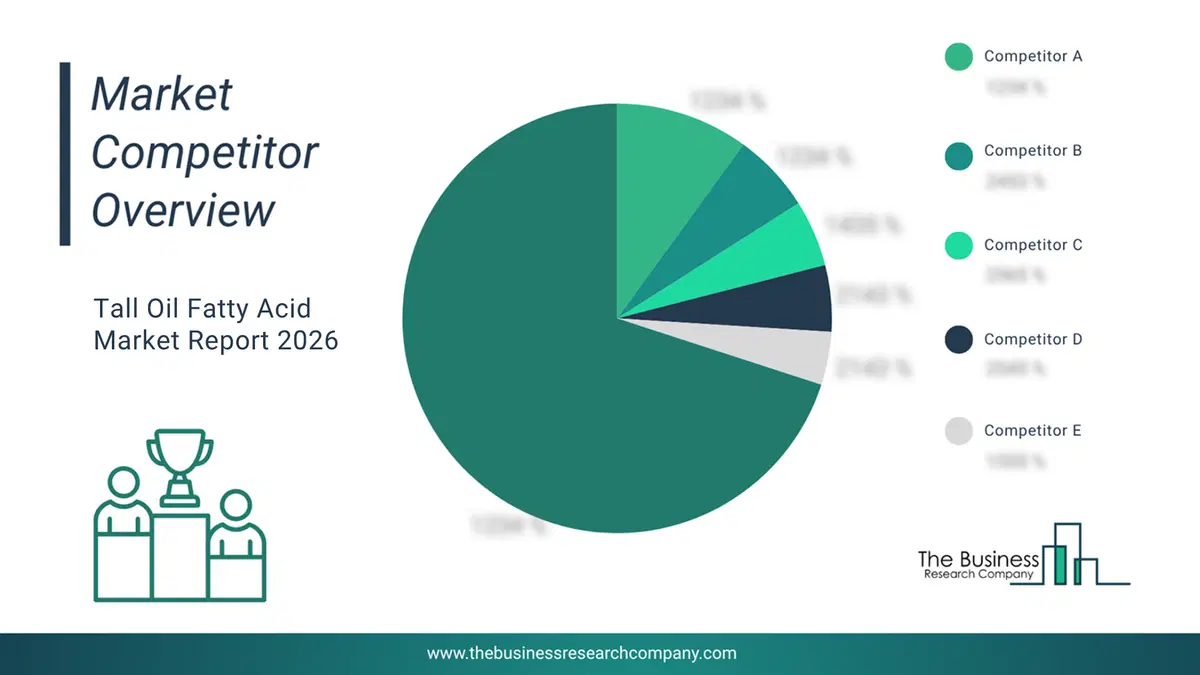
This chart is for illustrative purposes; the full report includes a detailed competitor analysis and comprehensive overview of the top 10 companies in the market.
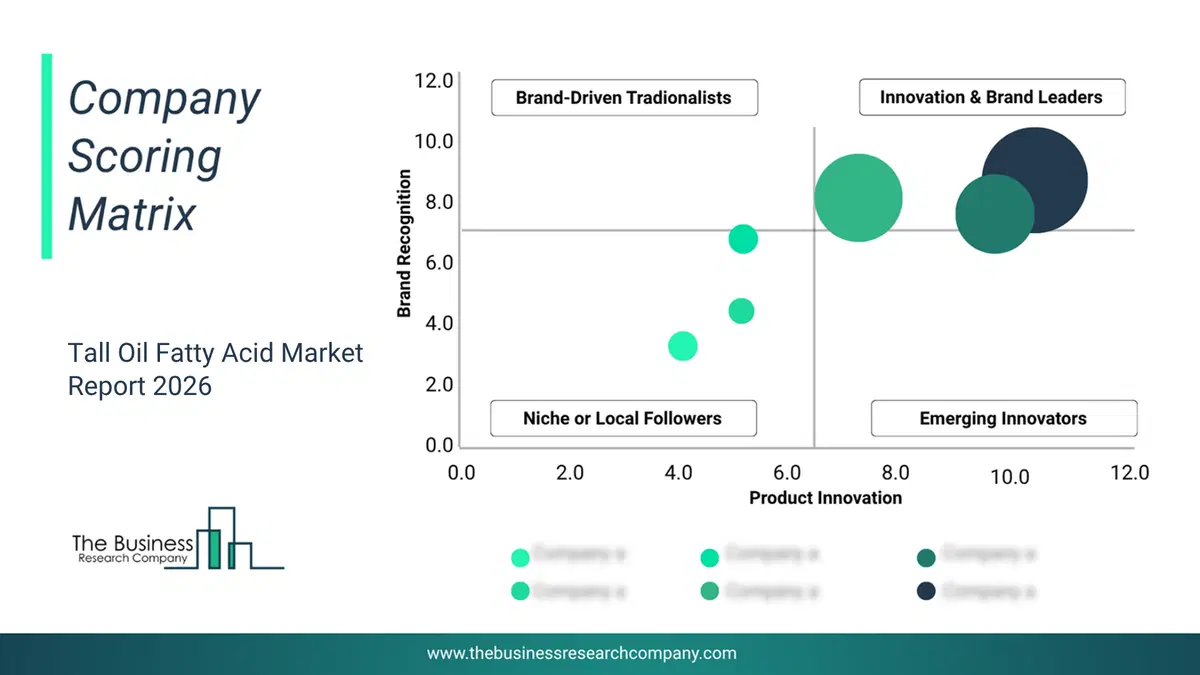
This chart maps companies by product innovation and brand strength, with bubble size indicating relative revenue, helping identify market leaders, challengers, and niche players. This is an illustrative chart; the full report provides a complete and accurate competitive analysis.
Global Tall Oil Fatty Acid Market Trends and Insights
Major companies operating in the tall oil fatty acid market are focusing on developing advanced solutions to improve product performance, sustainability, and application versatility. These technological advancements include innovations in bio-based polymer integration, high-performance resins, and eco-friendly processing methods that reduce carbon footprint while maintaining functionality. For instance, in June 2024, according to a Tech UK a UK trade association representing the UK technology sector, the UK tech sector is home to 171 unicorns and has a market valuation of $1.1 trillion, making it the foremost tech ecosystem in Europe. In 2023, UK tech startups secured $21.3 billion in funding, with most investments concentrated in Greater London, followed by the East of England and the South-East.What Are Latest Mergers And Acquisitions In The Tall Oil Fatty Acid Market?
In March 2024, Henkel Adhesive Technologies, a Germany-based adhesives, sealants, and coatings company, entered a strategic multi-year supply agreement with Kraton Corporation. Through this partnership, Henkel aims to enhance its sustainable adhesive and packaging solutions by integrating Kraton’s high-performance biobased tackifiers derived from tall oil fatty acids, supporting reduced carbon footprint and improved material performance. Kraton Corporation is a U.S.-based company that supplies bio-based polymers and resins globally across adhesives, packaging, automotive, and consumer-goods applications.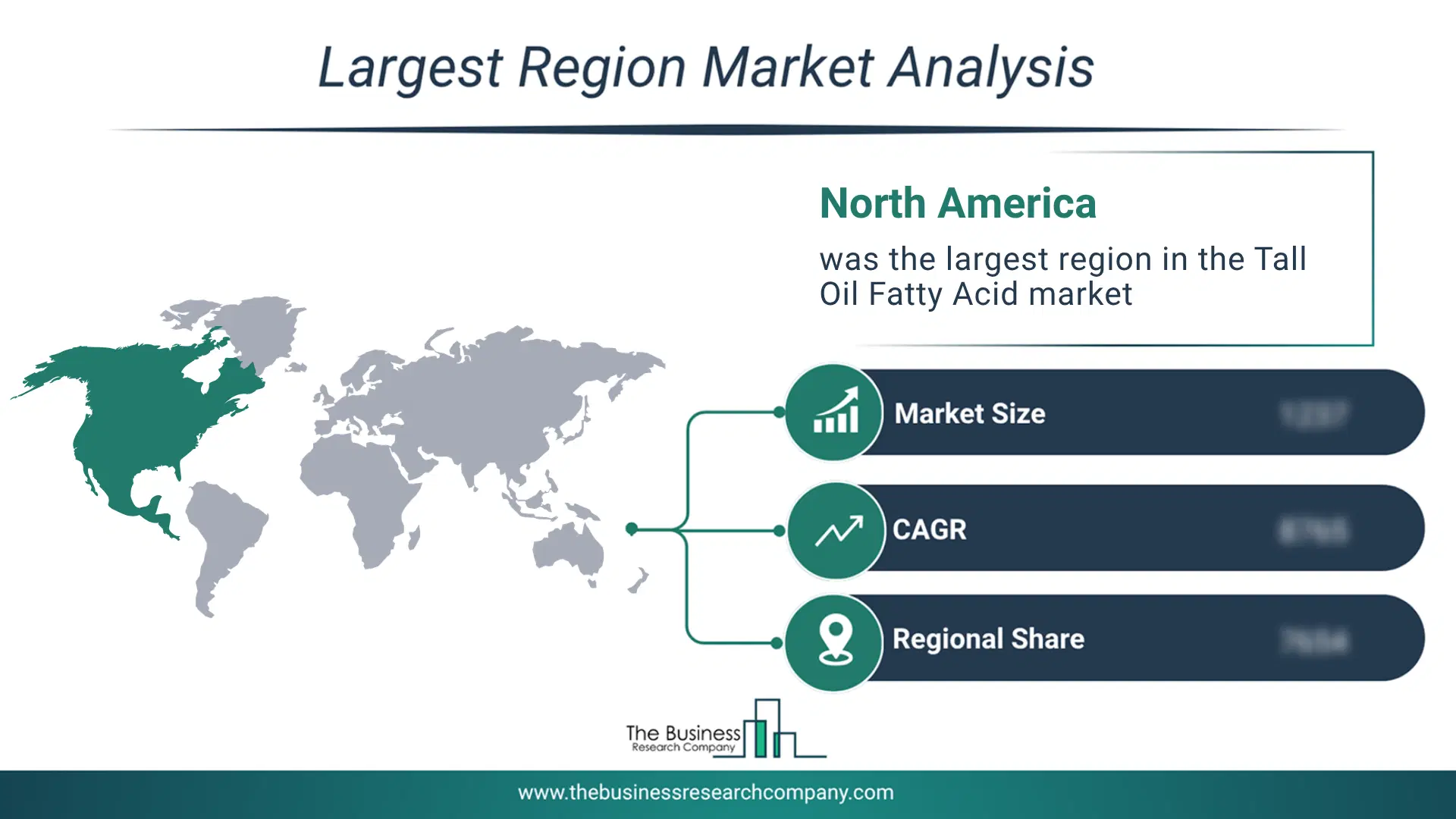
Regional Insights
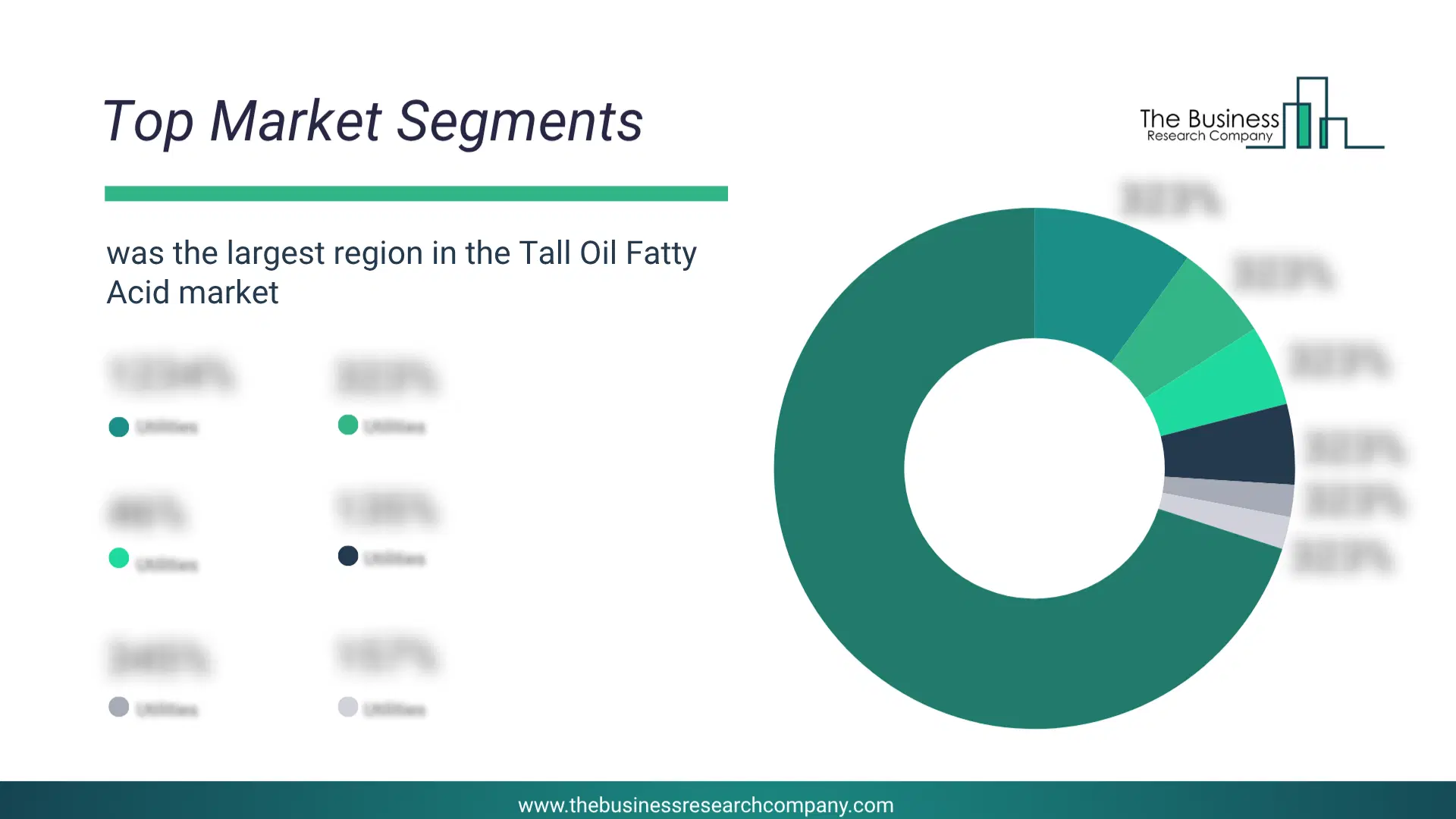
North America was the largest region in the tall oil fatty acid market in 2025. Asia-Pacific is expected to be the fastest-growing region in the forecast period. The regions covered in this market report are Asia-Pacific, South East Asia, Western Europe, Eastern Europe, North America, South America, Middle East, Africa The countries covered in this market report are Australia, Brazil, China, France, Germany, India, Indonesia, Japan, Taiwan, Russia, South Korea, UK, USA, Canada, Italy, SpainWhat Defines the Tall Oil Fatty Acid Market?
The tall oil fatty acid market consists of sales of stearic acid and maleic acid. Values in this market are ‘factory gate’ values, that is, the value of goods sold by the manufacturers or creators of the goods, whether to other entities (including downstream manufacturers, wholesalers, distributors, and retailers) or directly to end customers. The value of goods in this market includes related services sold by the creators of the goods.How is Market Value Defined and Measured?
The market value is defined as the revenues that enterprises gain from the sale of goods and/or services within the specified market and geography through sales, grants, or donations in terms of the currency (in USD unless otherwise specified). The revenues for a specified geography are consumption values that are revenues generated by organizations in the specified geography within the market, irrespective of where they are produced. It does not include revenues from resales along the supply chain, either further along the supply chain or as part of other products.
This chart presents market attractiveness based on a quantitative evaluation of growth, competition, strategic alignment, and risk, offering a clear view of opportunity areas for decision-making. This chart is for illustrative purposes; the full report contains the complete analysis.

This chart highlights the Total Addressable Market (TAM) by estimating the maximum revenue opportunity using an assumption-driven approach, supporting strategic planning and opportunity sizing across markets. The chart is illustrative; the full report provides a more comprehensive analysis.
What Key Data and Analysis Are Included in the Tall Oil Fatty Acid Market Report 2026?
The tall oil fatty acid market research report is one of a series of new reports from The Business Research Company that provides market statistics, including industry global market size, regional shares, competitors with the market share, detailed market segments, market trends and opportunities, and any further data you may need to thrive in the tall oil fatty acid industry. The market research report delivers a complete perspective of everything you need, with an in-depth analysis of the current and future state of the industry.Tall Oil Fatty Acid Market Report Forecast Analysis
| Report Attribute | Details |
|---|---|
| Market Size Value In 2026 | $1.26 billion |
| Revenue Forecast In 2030 | $1.67 billion |
| Growth Rate | CAGR of 7.8% from 2026 to 2030 |
| Base Year For Estimation | 2025 |
| Actual Estimates/Historical Data | 2020-2025 |
| Forecast Period | 2026 - 2030 |
| Market Representation | Revenue in USD Billion and CAGR from 2026 to 2030 |
| Segments Covered | Product, Application, End User |
| Regional Scope | Asia-Pacific, Western Europe, Eastern Europe, North America, South America, Middle East, Africa |
| Country Scope | The countries covered in this market report are Australia, Brazil, China, France, Germany, India, Indonesia, Japan, Taiwan, Russia, South Korea, UK, USA, Canada, Italy, Spain |
| Key Companies Profiled | Forchem Oy, Harima Chemicals Group Inc., Georgia-Pacific LLC, Eastman Chemical Company, Lascaray S.A., Chemical Associates Inc., Pine Chemical Group Oy, Pasand Speciality Chemicals Limited, DIC Corporation, Allnex Belgium SA, BASF SE, Reichhold LLC, Sinopec Baling Company Limited, Eternal Materials Co. Ltd., Ingevity Corporation, Arizona Chemical Ltd., Ataman Kimya AS, Foreverest Resources Ltd., G.C. Rutteman & Co. B.V., Kraton Corporation |
| Customization Scope | Request for Customization |
| Pricing And Purchase Options | Explore Purchase Options |