
Tay-Sachs Disease Treatment Market Report 2026
Global Outlook – By Treatment (Medication, Respiratory Care, Physical Therapy ), By Mode Of Administration (Injectable, Oral, Other Mode Of Administration), By End-Users (Hospitals, Homecare, Specialty Clinics) - Market Size, Trends, And Global Forecast 2026-2035
Tay-Sachs Disease Treatment Market Overview
• Tay-Sachs Disease Treatment market size has reached to $2.45 billion in 2025 • Expected to grow to $3.45 billion in 2030 at a compound annual growth rate (CAGR) of 7% • Growth Driver: Rising Genetic Disease Prevalence Driving Advances In Treatment And Research • Market Trend: Advancements In Clinical Trials For Genetic Disease Treatment • North America was the largest region in 2025 and Asia-Pacific is the fastest growing region.What Is Covered Under Tay-Sachs Disease Treatment Market?
Tay-sachs disease treatment refers to therapeutic approaches aimed at managing or curing this rare genetic disorder caused by a deficiency of the enzyme hexosaminidase A (Hex-A). Current efforts include experimental gene therapy, substrate reduction therapy, and supportive care to alleviate symptoms. The main treatments of tay-sachs disease are medication, respiratory care, and physical therapy. Medication involves using prescribed drugs to alleviate symptoms, slow disease progression, or enhance patient comfort. It addresses pain, seizures, muscle stiffness, and related complications. The modes of administration include injectable, oral, and other methods and are utilized in hospitals, homecare settings, and specialty clinics.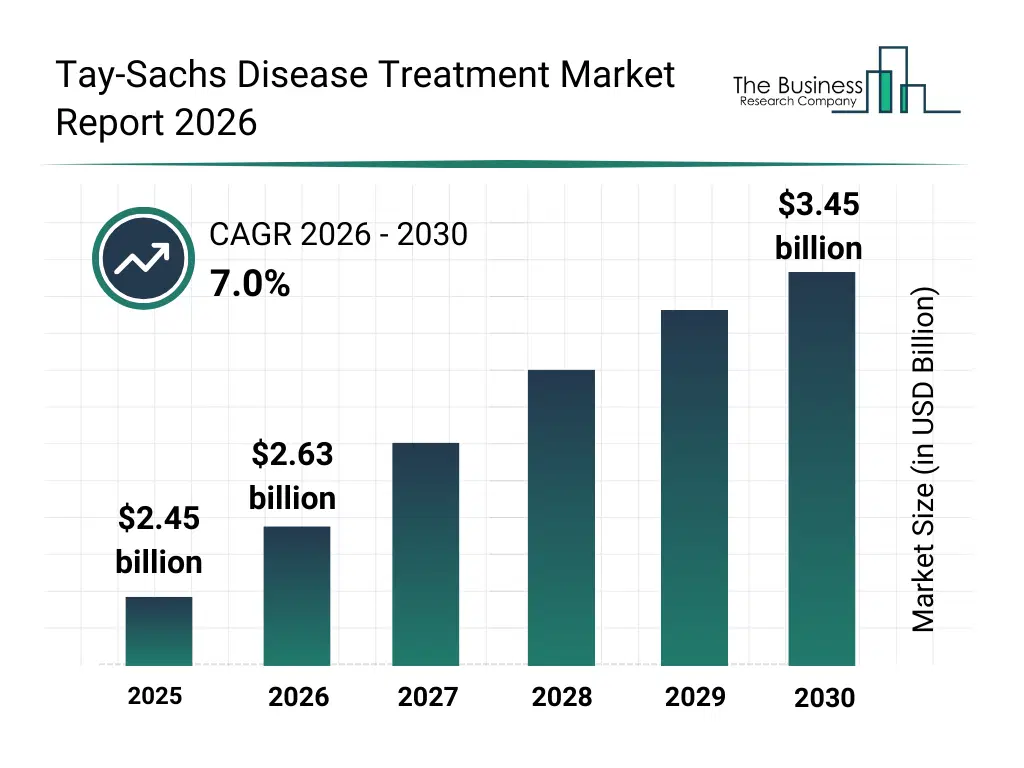
What Is The Tay-Sachs Disease Treatment Market Size and Share 2026?
The tay-sachs disease treatment market size has grown strongly in recent years. It will grow from $2.45 billion in 2025 to $2.63 billion in 2026 at a compound annual growth rate (CAGR) of 7.3%. The growth in the historic period can be attributed to improved genetic screening capabilities, increased awareness of rare genetic disorders, expansion of pediatric neurology care, availability of supportive treatment options, growth of orphan drug research programs.What Is The Tay-Sachs Disease Treatment Market Growth Forecast?
The tay-sachs disease treatment market size is expected to see strong growth in the next few years. It will grow to $3.45 billion in 2030 at a compound annual growth rate (CAGR) of 7.0%. The growth in the forecast period can be attributed to increasing clinical trials for gene-based therapies, rising regulatory support for orphan drugs, growing use of precision medicine in rare diseases, expansion of patient advocacy initiatives, increasing investment in advanced biotechnologies. Major trends in the forecast period include increasing focus on gene therapy development, expansion of enzyme replacement research, growing use of substrate reduction therapies, rising investment in rare disease drug development, enhanced supportive care protocols.
Global Tay-Sachs Disease Treatment Market Segmentation
1) By Treatment: Medication, Respiratory Care, Physical Therapy 2) By Mode Of Administration: Injectable, Oral, Other Mode Of Administration 3) By End-Users: Hospitals, Homecare, Specialty Clinics Subsegments: 1) By Medication: Antiepileptic Drugs, Miglustat, Supportive Symptomatic Medications 2) By Respiratory Care: Mechanical Ventilation, Airway Clearance Therapy, Oxygen Therapy 3) By Physical Therapy: Motor Function Exercises, Hydrotherapy, Assistive Mobility DevicesWhat Is The Driver Of The Tay-Sachs Disease Treatment Market?
The growing prevalence of genetic diseases is expected to drive the tay-sachs disease treatment market going forward. A genetic disease refers to a disorder caused by abnormalities in an individual's DNA, which may be inherited or occur due to spontaneous mutations. Genetic diseases are rising due to advanced diagnostics, increased awareness, environmental factors, and higher mutation rates from delayed parenthood and lifestyle changes. The growing prevalence of genetic diseases highlights the need for advancements in tay-sachs disease treatment, driving research in gene therapy, enzyme replacement, and early diagnostics. For instance, in October 2024, according to Cystic Fibrosis Trust, a UK-based charity dedicated to supporting people with cystic fibrosis, in 2022, around 11,148 cystic fibrosis (a genetic disorder) patients were registered, and this number grew to 11,318 in 2023, reflecting a 1.5% increase in patient registrations year over year. Therefore, the growing prevalence of genetic diseases will drive the tay-sachs disease treatment industry.Key Players In The Global Tay-Sachs Disease Treatment Market
Major companies operating in the tay-sachs disease treatment market are Pfizer Inc., Sanofi S.A., Novartis AG, Takeda Pharmaceutical Company Limited, Regeneron Pharmaceuticals Inc., Biogen Inc., Vertex Pharmaceuticals Incorporated, BioMarin Pharmaceutical Inc., Sarepta Therapeutics Inc., Ultragenyx Pharmaceutical Inc., Amicus Therapeutics Inc., Spark Therapeutics Inc., Rocket Pharmaceuticals Inc., RegenxBio Inc., Forge Biologics Inc., Passage Bio Inc., Protalix BioTherapeutics Inc., Orchard Therapeutics plc, Affinia Therapeutics Inc., IntraBio Inc., Taysha Gene Therapies Inc.Global Tay-Sachs Disease Treatment Market Trends and Insights
Major companies operating in the tay-sachs disease treatment market are concentrating on creating innovative treatments, including conducting clinical trials, to explore innovative therapies such as gene therapy, enzyme replacement, and small-molecule drugs for improved patient outcomes. A clinical trial refers to a research study that evaluates the safety, effectiveness, and potential side effects of medical treatments, drugs, or procedures in humans. For instance, in July 2024, IntraBio Inc., a US-based biopharmaceutical company, announced that it had received US Food and Drug Administration (FDA) approval for its Investigational New Drug (IND) Application to conduct a clinical trial (IB1001-202) for IB1001, targeting GM2 Gangliosidosis (Tay-Sachs and Sandhoff Disease). The trial is taking place in the U.S., UK, Germany, and Spain, aiming to address these fatal neurodegenerative disorders that currently have no approved treatments. IntraBio's chairman emphasized the urgency of developing effective therapies for these debilitating diseases.What Are Latest Mergers And Acquisitions In The Tay-Sachs Disease Treatment Market?
In June 2023, New Hope Research Foundation Inc., a US-based non-profit research foundation, partnered with Forge Biologics Inc. to advance its innovative gene therapy, NHR01, into Phase I/II clinical trials for patients with Tay-Sachs disease and GM2 gangliosidosis. Forge Biologics is a US-based biotechnology company that specializes in gene therapy contract manufacturing and clinical-stage therapeutics.Regional Outlook
North America was the largest region in the tay-sachs disease treatment market in 2025. Asia-Pacific is expected to be the fastest-growing region in the forecast period. The regions covered in this market report are Asia-Pacific, South East Asia, Western Europe, Eastern Europe, North America, South America, Middle East, Africa. The countries covered in this market report are Australia, Brazil, China, France, Germany, India, Indonesia, Japan, Taiwan, Russia, South Korea, UK, USA, Canada, Italy, Spain.What Defines the Tay-Sachs Disease Treatment Market?
The tay-sachs disease treatment market consists of revenues earned by providing services such as respiratory care, physical therapy, genetic counseling, and home care services. The market value includes the value of related goods sold by the service provider or included within the service offering. The tay-sachs disease treatment market includes sales of anticonvulsants, gene therapy products, supportive care products, and diagnostic tools. Values in this market are ‘factory gate’ values, that is, the value of goods sold by the manufacturers or creators of the goods, whether to other entities (including downstream manufacturers, wholesalers, distributors, and retailers) or directly to end customers. The value of goods in this market includes related services sold by the creators of the goods.How is Market Value Defined and Measured?
The market value is defined as the revenues that enterprises gain from the sale of goods and/or services within the specified market and geography through sales, grants, or donations in terms of the currency (in USD unless otherwise specified). The revenues for a specified geography are consumption values that are revenues generated by organizations in the specified geography within the market, irrespective of where they are produced. It does not include revenues from resales along the supply chain, either further along the supply chain or as part of other products.What Key Data and Analysis Are Included in the Tay-Sachs Disease Treatment Market Report 2026?
The tay-sachs disease treatment market research report is one of a series of new reports from The Business Research Company that provides market statistics, including industry global market size, regional shares, competitors with the market share, detailed market segments, market trends and opportunities, and any further data you may need to thrive in the tay-sachs disease treatment industry. The market research report delivers a complete perspective of everything you need, with an in-depth analysis of the current and future state of the industry.Tay-Sachs Disease Treatment Market Report Forecast Analysis
| Report Attribute | Details |
|---|---|
| Market Size Value In 2026 | $2.63 billion |
| Revenue Forecast In 2035 | $3.45 billion |
| Growth Rate | CAGR of 7.3% from 2026 to 2035 |
| Base Year For Estimation | 2025 |
| Actual Estimates/Historical Data | 2020-2025 |
| Forecast Period | 2026 - 2030 - 2035 |
| Market Representation | Revenue in USD Billion and CAGR from 2026 to 2035 |
| Segments Covered | Treatment, Mode Of Administration, End-Users |
| Regional Scope | Asia-Pacific, Western Europe, Eastern Europe, North America, South America, Middle East, Africa |
| Country Scope | The countries covered in the report are Australia, Brazil, China, France, Germany, India, ... |
| Key Companies Profiled | Pfizer Inc., Sanofi S.A., Novartis AG, Takeda Pharmaceutical Company Limited, Regeneron Pharmaceuticals Inc., Biogen Inc., Vertex Pharmaceuticals Incorporated, BioMarin Pharmaceutical Inc., Sarepta Therapeutics Inc., Ultragenyx Pharmaceutical Inc., Amicus Therapeutics Inc., Spark Therapeutics Inc., Rocket Pharmaceuticals Inc., RegenxBio Inc., Forge Biologics Inc., Passage Bio Inc., Protalix BioTherapeutics Inc., Orchard Therapeutics plc, Affinia Therapeutics Inc., IntraBio Inc., Taysha Gene Therapies Inc. |
| Customization Scope | Request for Customization |
| Pricing And Purchase Options | Explore Purchase Options |