
Technical Mortar Market Report 2026
Global Outlook – By Product Type (Cement-Based Mortar, Gypsum-Based Mortar, Polymer-Modified Mortar, Epoxy-Based Mortar, Other Product Types), By Functionality (Load-Bearing Mortar, Non-Load-Bearing Mortar, Waterproofing Mortar, Insulating Mortar, Fire-Resistant Mortar), By Application (Flooring, Plastering, Bricklaying, Tiling, Concrete Repair), By End-User Industry (Construction, Infrastructure Development, Residential Buildings, Commercial Buildings, Industrial Buildings) – Market Size, Trends, Strategies, and Forecast to 2030
Technical Mortar Market Overview
• Technical Mortar market size has reached to $4.1 billion in 2025 • Expected to grow to $5.51 billion in 2030 at a compound annual growth rate (CAGR) of 6% • Growth Driver: Rising Construction And Infrastructure Development Fueling Market Growth Due To Megaproject Demand And Superior Performance Requirements • Market Trend: Innovations In Mortar Technology Revolutionize Construction Through 3D Printing Applications • Asia-Pacific was the largest region in 2025.What Is Covered Under Technical Mortar Market?
Technical mortar refers to specially formulated mortar products designed for specific construction or repair applications that require enhanced performance characteristics beyond ordinary mortar. These mortars often possess high strength, chemical resistance, thermal insulation, or improved adhesion, tailored to meet technical or specialized needs in building, restoration, or industrial projects. The main types of products in technical mortar are cement-based mortar, gypsum-based mortar, polymer-modified mortar, epoxy-based mortar, and others. Cement-based mortar is a combination of cement, sand, and water used to bond construction materials such as bricks and stones together. It serves multiple functionalities, such as load-bearing mortar, non-load-bearing mortar, waterproofing mortar, insulating mortar, and fire-resistant mortar. Applications span across flooring, plastering, bricklaying, tiling, and concrete repair. This type of mortar caters to a wide range of end users, including construction, infrastructure development, residential buildings, commercial buildings, and industrial buildings.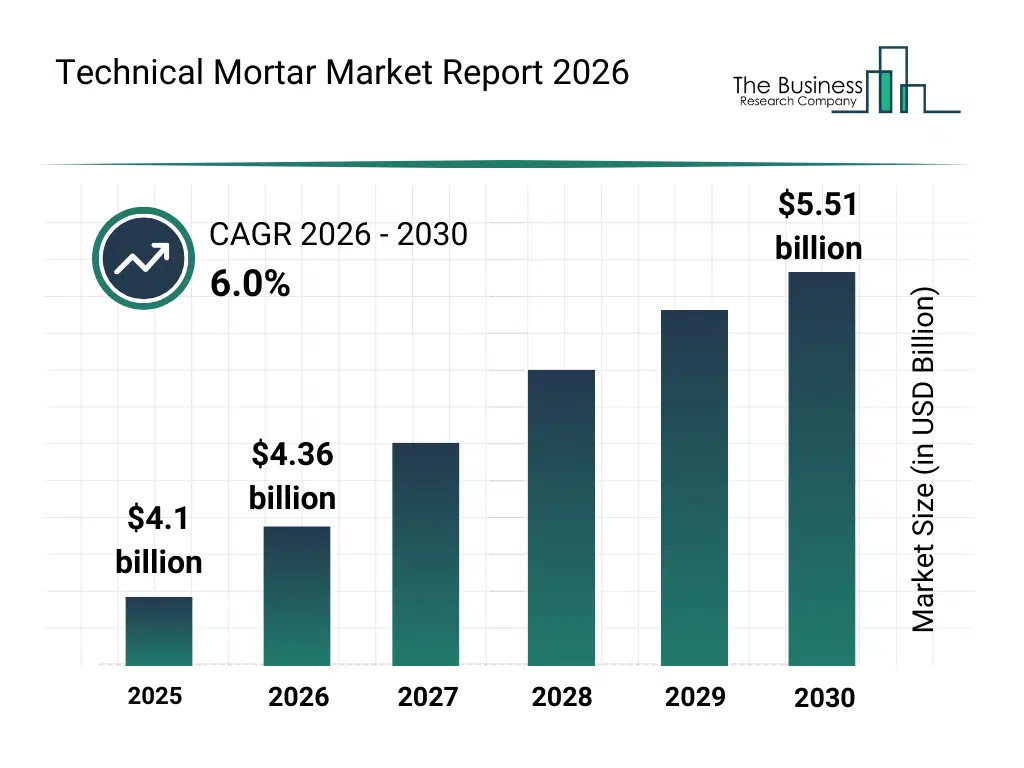
What Is The Technical Mortar Market Size and Share 2026?
The technical mortar market size has grown strongly in recent years. It will grow from $4.1 billion in 2025 to $4.36 billion in 2026 at a compound annual growth rate (CAGR) of 6.3%. The growth in the historic period can be attributed to rising demand for high-performance repair mortars, growing adoption of chemical-resistant mortars in industrial projects, increasing use of waterproofing and insulating mortars, expansion of fire-resistant mortars in safety-critical structures, rising preference for polymer-modified and epoxy-based mortars.What Is The Technical Mortar Market Growth Forecast?
The technical mortar market size is expected to see strong growth in the next few years. It will grow to $5.51 billion in 2030 at a compound annual growth rate (CAGR) of 6.0%. The growth in the forecast period can be attributed to rising investments in infrastructure development, increasing demand for waterproofing and fire-resistant solutions, growth in industrial and commercial construction projects, adoption of advanced polymer-modified mortar technologies, focus on long-lasting and low-maintenance construction materials. Major trends in the forecast period include rising demand for high-performance repair mortars, growing adoption of chemical-resistant mortars in industrial projects, increasing use of waterproofing and insulating mortars, expansion of fire-resistant mortars in safety-critical structures, rising preference for polymer-modified and epoxy-based mortars.
Global Technical Mortar Market Segmentation
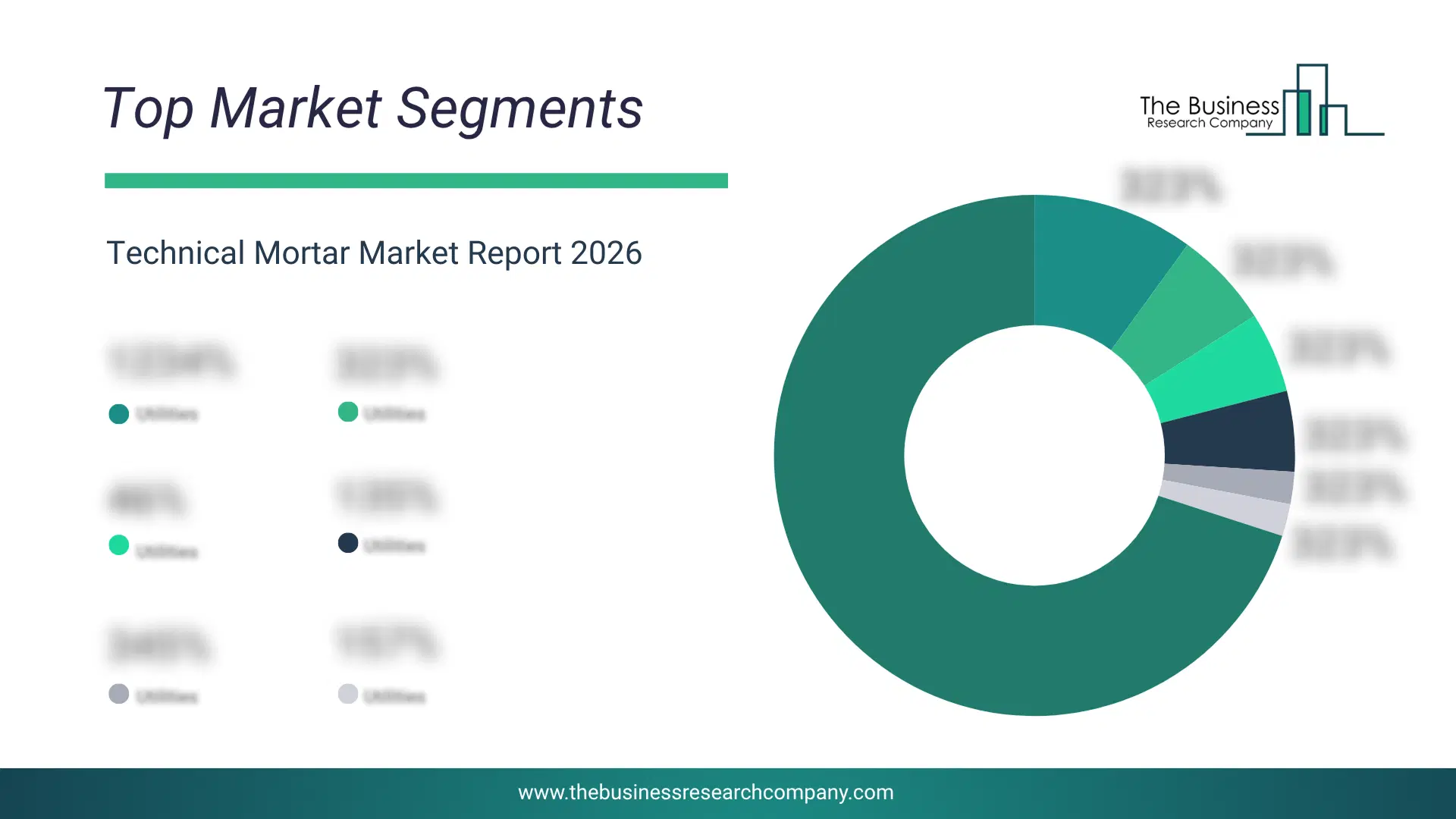
1) By Product Type: Cement-Based Mortar, Gypsum-Based Mortar, Polymer-Modified Mortar, Epoxy-Based Mortar, Other Product Types 2) By Functionality: Load-Bearing Mortar, Non-Load-Bearing Mortar, Waterproofing Mortar, Insulating Mortar, Fire-Resistant Mortar 3) By Application: Flooring, Plastering, Bricklaying, Tiling, Concrete Repair 4) By End-User Industry: Construction, Infrastructure Development, Residential Buildings, Commercial Buildings, Industrial Buildings Subsegments: 1) By Cement-Based Mortar: Tile Adhesive Mortar, Repair Mortar, Grout Mortar, Masonry Mortar 2) By Gypsum-Based Mortar: Gypsum Plaster, Gypsum Tile Adhesive, Self-Leveling Gypsum Mortar 3) By Polymer-Modified Mortar: Polymer-Modified Tile Adhesives, Polymer-Modified Repair Mortar, Polymer-Modified Grouts, Waterproofing Mortar 4) By Epoxy-Based Mortar: Epoxy Tile Adhesives, Epoxy Grouts, Epoxy Repair Mortar, Chemical-Resistant Mortar 5) By Other Product Types: Fire-Resistant Mortar, Insulating Mortar, Acoustic Mortar, High-Temperature MortarWhat Is The Driver Of The Technical Mortar Market?
The rising construction and infrastructure development is expected to propel the growth of the technical mortar market going forward. Construction and infrastructure refer to the planning, building, and maintaining essential physical structures and facilities such as roads, bridges, buildings, and utilities that support economic growth and everyday life. The rise in construction and infrastructure development is due to increasing government investments in transportation projects to improve connectivity and support economic growth. Technical mortar is used in construction and infrastructure, offering superior bonding, durability, and protection properties, making it essential for masonry work, concrete repairs, and waterproofing in buildings, bridges, and other critical structures. For instance, in July 2025, according to the Office for National Statistics, a UK-based government department, total general government investment in infrastructure increased by 2.2% to reach £28.9 ($33.91) billion in current prices in 2024, compared with the previous year. Therefore, rising construction and infrastructure development are driving the growth of the technical mortar industry.Key Players In The Global Technical Mortar Market
Major companies operating in the technical mortar market report are BASF SE, Compagnie de Saint-Gobain S.A., Holcim Limited, Henkel AG & Co. KGaA, CEMEX S.A.B. de C.V., Sika AG, MAPEI S.p.A., H.B. Fuller Company, Bostik SA, The Quikrete Companies LLC, Pidilite Industries Limited, Ardex GmbH, IVAS Industria Vernici S.p.A., Zhejiang Taizheng Construction Material Co. Ltd., Cementos Capa S.A. de C.V., Laticrete International Inc., Buzzi Unicem S.p.A., The Euclid Chemical Company, W. R. Meadows Inc., Remmers Gruppe AG, Garon Products Inc., USL Group (Pty) Ltd.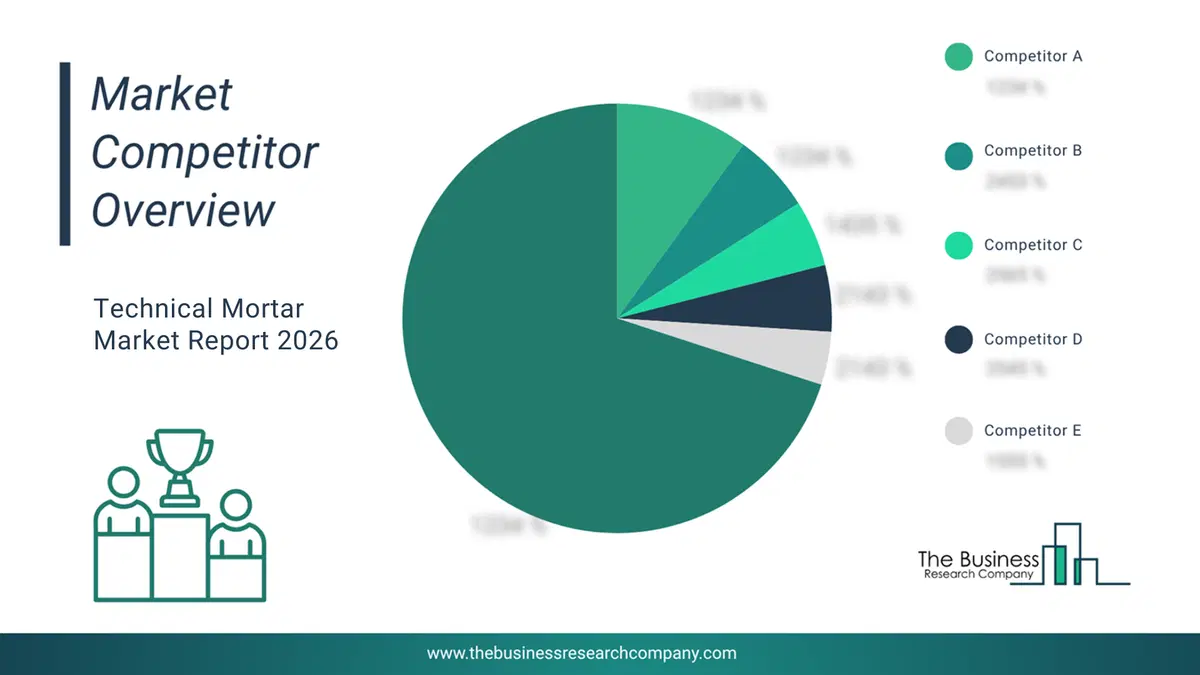
This chart is for illustrative purposes; the full report includes a detailed competitor analysis and comprehensive overview of the top 10 companies in the market.
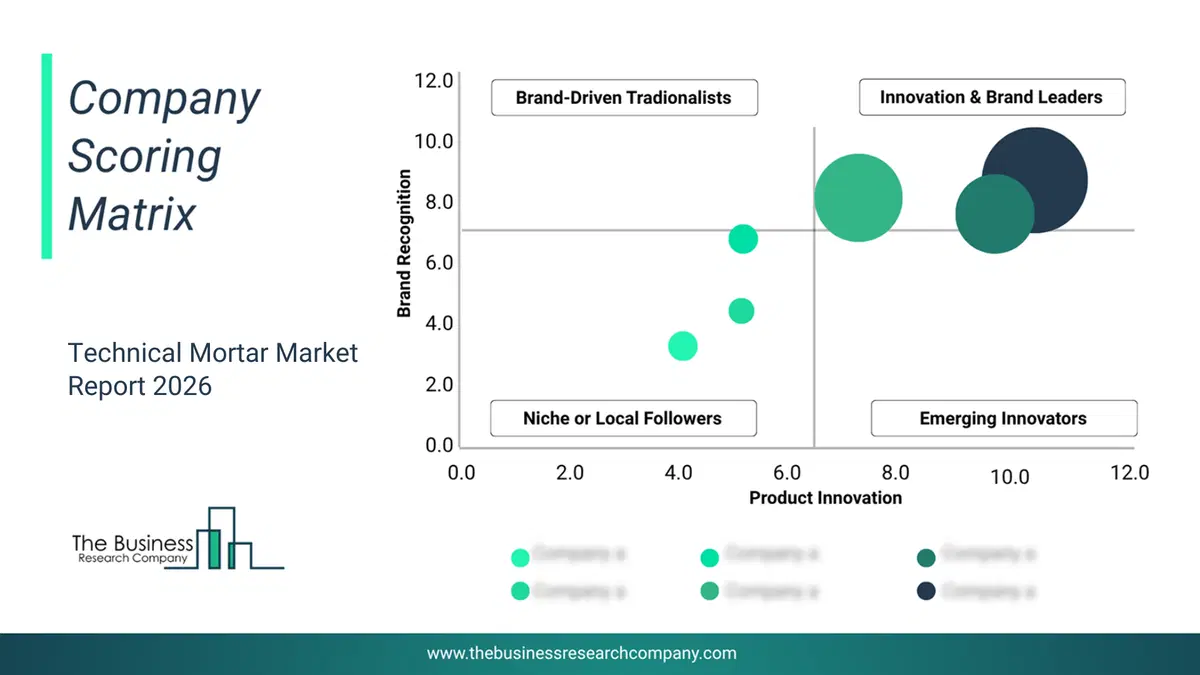
This chart maps companies by product innovation and brand strength, with bubble size indicating relative revenue, helping identify market leaders, challengers, and niche players. This is an illustrative chart; the full report provides a complete and accurate competitive analysis.
Global Technical Mortar Market Trends and Insights
Major companies operating in the technical mortar market are focusing on developing innovative mortar technology solutions, such as specialized 3D-printing mortar formulations, to enhance construction efficiency and reduce material wastage in complex architectural and infrastructure projects. 3D-printing mortar formulations refer to specially designed mortar mixes with enhanced flowability, quick setting, and strong layer adhesion, enabling automated layer-by-layer construction in 3D concrete printing applications. For instance, in January 2025, Holcim Group, a Switzerland-based building material company, launched Tector 3D Mortar, specifically designed for 3D printing in construction, developed in partnership with local machine maker Teknix. Composed of cement, sand, and specialized additives, Tector 3D Mortar enables the 3D printing of full-scale building components, promoting local innovation and manufacturing capabilities despite offering less strength than traditional cement. It allows for material efficiency by placing material only where needed, eliminating the need for formwork and enabling design freedom and faster construction.What Are Latest Mergers And Acquisitions In The Technical Mortar Market?
In February 2025, Compagnie de Saint-Gobain S.A., a France-based light and sustainable construction company, acquired Fosroc International Limited for an undisclosed amount. Through this acquisition, Saint-Gobain aims to bolster its global presence in the construction chemicals sector, particularly in Asia and emerging markets, by integrating Fosroc’s strong brand, product portfolio, and regional reach. Fosroc International Limited is a UK-based manufacturer and supplier of high-performance construction chemicals, including technical mortars.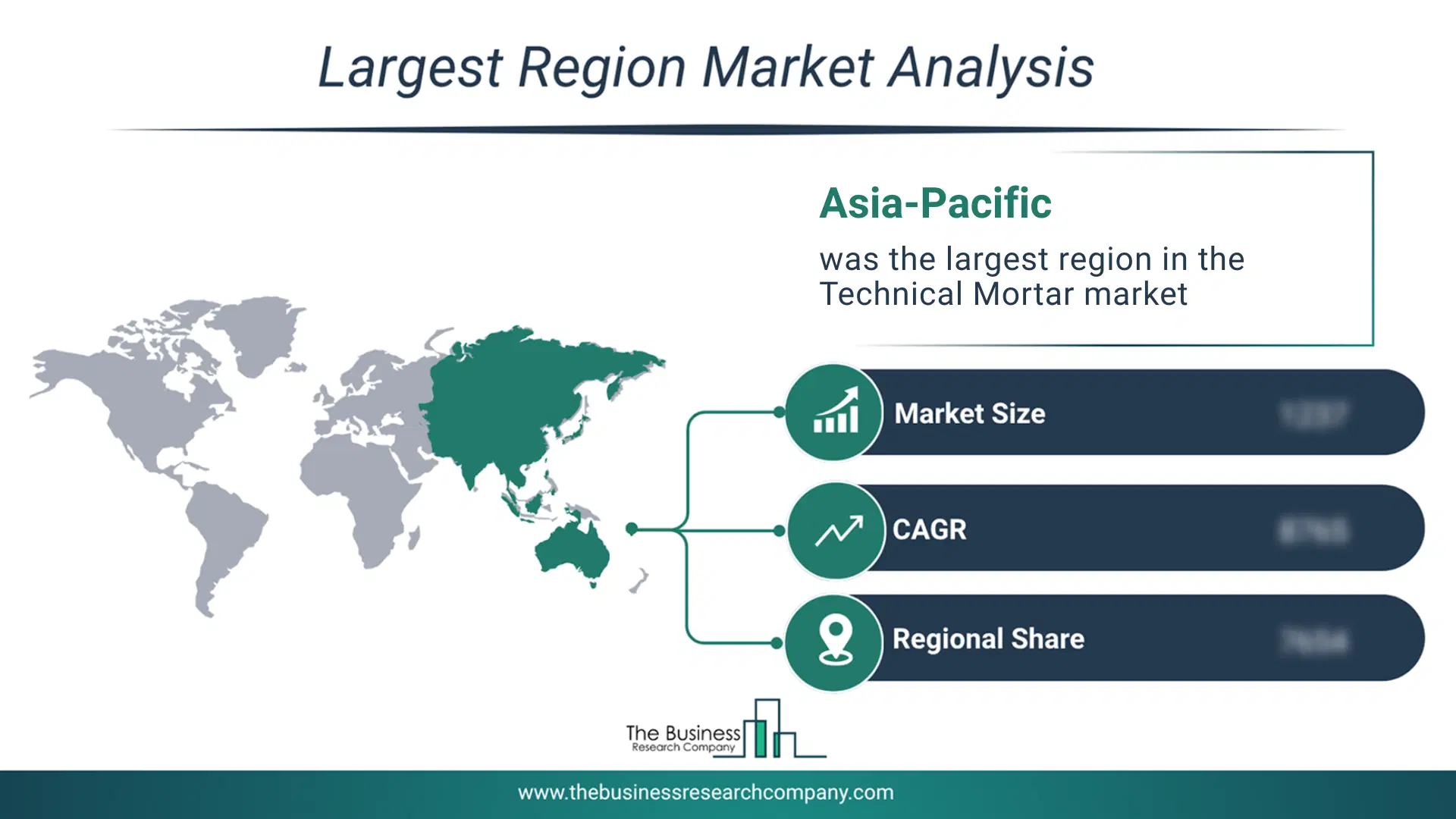
Regional Outlook
Asia-Pacific was the largest region in the technical mortar market in 2025. The regions covered in the technical mortar market are Asia-Pacific, South East Asia, Western Europe, Eastern Europe, North America, South America, Middle East, Africa. The countries covered in the technical mortar market are Australia, Brazil, China, France, Germany, India, Indonesia, Japan, Taiwan, Russia, South Korea, UK, USA, Canada, Italy, Spain.What Defines the Technical Mortar Market?
The technical mortar market consists of sales of lime-based mortar, fire-resistant mortar, self-leveling mortar, fast-setting mortar, anchoring mortar, waterproof mortar, and thermal insulation mortar. Values in this market are ‘factory gate’ values, that is the value of goods sold by the manufacturers or creators of the goods, whether to other entities (including downstream manufacturers, wholesalers, distributors and retailers) or directly to end customers. The value of goods in this market includes related services sold by the creators of the goods.How is Market Value Defined and Measured?
The market value is defined as the revenues that enterprises gain from the sale of goods and/or services within the specified market and geography through sales, grants, or donations in terms of the currency (in USD unless otherwise specified). The revenues for a specified geography are consumption values that are revenues generated by organizations in the specified geography within the market, irrespective of where they are produced. It does not include revenues from resales along the supply chain, either further along the supply chain or as part of other products.
This chart presents market attractiveness based on a quantitative evaluation of growth, competition, strategic alignment, and risk, offering a clear view of opportunity areas for decision-making. This chart is for illustrative purposes; the full report contains the complete analysis.

This chart highlights the Total Addressable Market (TAM) by estimating the maximum revenue opportunity using an assumption-driven approach, supporting strategic planning and opportunity sizing across markets. The chart is illustrative; the full report provides a more comprehensive analysis.
What Key Data and Analysis Are Included in the Technical Mortar Market Report 2026?
The technical mortar market research report is one of a series of new reports from The Business Research Company that provides market statistics, including Market Report 2026?global market size, regional shares, competitors with the market share, detailed market segments, market trends and opportunities, and any further data you may need to thrive in the technical mortar Market Report 2026? The market research report delivers a complete perspective of everything you need, with an in-depth analysis of the current and future state of the Market Report 2026?Technical Mortar Market Report Forecast Analysis
| Report Attribute | Details |
|---|---|
| Market Size Value In 2026 | $4.36 billion |
| Revenue Forecast In 2030 | $5.51 billion |
| Growth Rate | CAGR of 6.3% from 2026 to 2030 |
| Base Year For Estimation | 2025 |
| Actual Estimates/Historical Data | 2020-2025 |
| Forecast Period | 2026 - 2030 |
| Market Representation | Revenue in USD Billion and CAGR from 2026 to 2030 |
| Segments Covered | Product Type, Functionality, Application, End-User Industry |
| Regional Scope | Asia-Pacific, Western Europe, Eastern Europe, North America, South America, Middle East, Africa |
| Country Scope | The countries covered in the report are Australia, Brazil, China, France, Germany, India, Indonesia, Japan, Taiwan, Russia, South Korea, UK, USA, Canada, Italy, Spain. |
| Key Companies Profiled | BASF SE, Compagnie de Saint-Gobain S.A., Holcim Limited, Henkel AG & Co. KGaA, CEMEX S.A.B. de C.V., Sika AG, MAPEI S.p.A., H.B. Fuller Company, Bostik SA, The Quikrete Companies LLC, Pidilite Industries Limited, Ardex GmbH, IVAS Industria Vernici S.p.A., Zhejiang Taizheng Construction Material Co. Ltd., Cementos Capa S.A. de C.V., Laticrete International Inc., Buzzi Unicem S.p.A., The Euclid Chemical Company, W. R. Meadows Inc., Remmers Gruppe AG, Garon Products Inc., USL Group (Pty) Ltd. |
| Customization Scope | Request for Customization |
| Pricing And Purchase Options | Explore Purchase Options |