
Telecom Equipment Market Report 2026
Global Outlook – By Type (Network Communication Equipment, Mobile Communication Device, Optical Communication Equipment), By Component (Hardware, Software), By Technology (2G, 3G, 4G LTE, 5G), By Infrastructure (Wired, Wireless), By End-User (Banking, Financial Services And Insurance (BFSI), Retail, Information Technology And Telecommunication, Media And Entertainment, Healthcare, Military And Defense, Consumer Electronics, Other End Users) – Market Size, Trends, Strategies, and Forecast to 2030
Telecom Equipment Market Overview
• Telecom Equipment market size has reached to $673.95 billion in 2025 • Expected to grow to $849.22 billion in 2030 at a compound annual growth rate (CAGR) of 4.7% • Growth Driver: Explosive Growth In Mobile Telecommunications Fuels Surge In Telecom Equipment Market • Market Trend: Unveils Next-Gen Software For Enhanced 5G Connectivity • North America was the largest region in 2025 and Asia-Pacific is the fastest growing region.Market Gains By 2030 – Top Opportunities By Segment
Market Gain identifies the most promising market opportunities by highlighting the segments or products expected to generate the highest incremental revenue growth over the next five years.
What Is Covered Under Telecom Equipment Market?
Telecom equipment refers to the hardware and telecom related devices used in telecommunications networks to transmit, receive, and process data and voice signals. It facilitates connectivity by enabling the transmission of voice, data, and multimedia over various communication channels over long distances, enabling individuals, businesses, and organizations to connect with each other locally, nationally, and globally. The main types of telecom equipment include network communication equipment, mobile communication devices, and optical communication equipment. Network communication equipment encompasses routers, switches, and modems, enabling the seamless exchange of data across interconnected devices and networks. The components include hardware and software integrated with technologies such as 2G and 3G, 4G LTE, and 5G in wired and wireless infrastructure used by end users such as banking, financial services, and insurance (BFSI), retail, information technology and telecommunication, media and entertainment, healthcare, military and defense, consumer electronics, and others.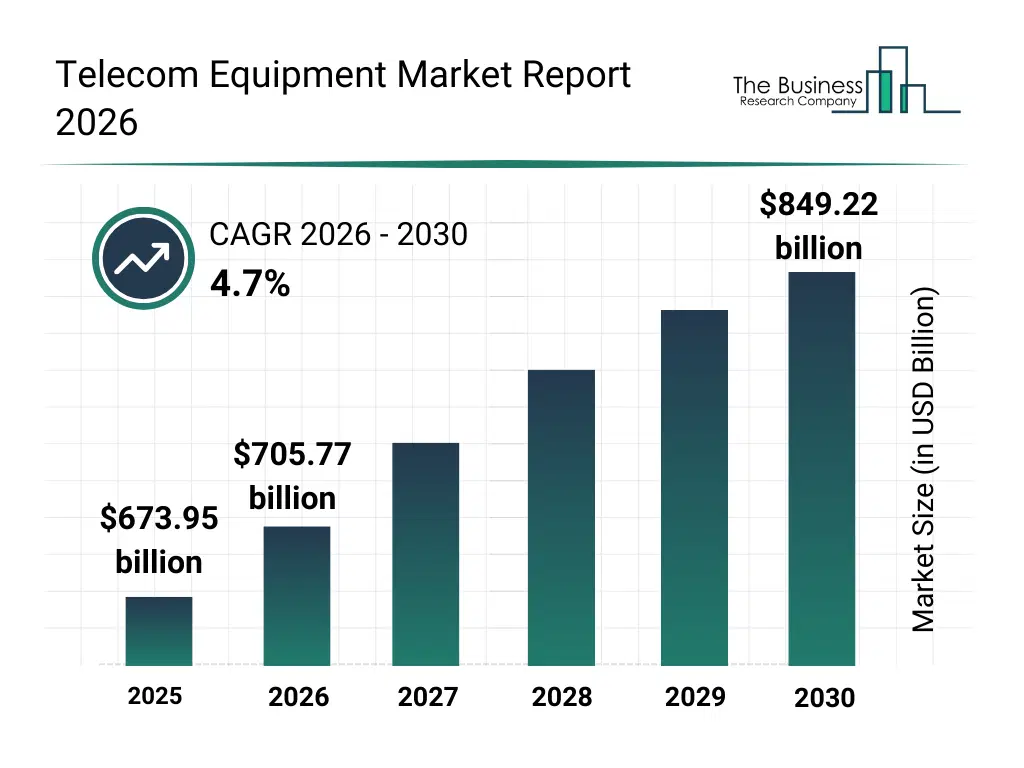
What Is The Telecom Equipment Market Size and Share 2026?
The telecom equipment market size has grown steadily in recent years. It will grow from $673.95 billion in 2025 to $705.77 billion in 2026 at a compound annual growth rate (CAGR) of 4.7%. The growth in the historic period can be attributed to expansion of mobile communication networks, growth of internet penetration, rising demand for high-speed data services, investments in telecom infrastructure modernization, widespread adoption of smartphones.What Is The Telecom Equipment Market Growth Forecast?
The telecom equipment market size is expected to see steady growth in the next few years. It will grow to $849.22 billion in 2030 at a compound annual growth rate (CAGR) of 4.7%. The growth in the forecast period can be attributed to increasing rollout of advanced wireless technologies, rising investments in fiber optic networks, expansion of private enterprise networks, growing adoption of edge computing infrastructure, increasing focus on sustainable telecom equipment. Major trends in the forecast period include increasing deployment of 5G network infrastructure, rising demand for optical communication equipment, growing integration of AI in network management, expansion of wireless broadband technologies, enhanced focus on energy-efficient telecom hardware.
Global Telecom Equipment Market Segmentation
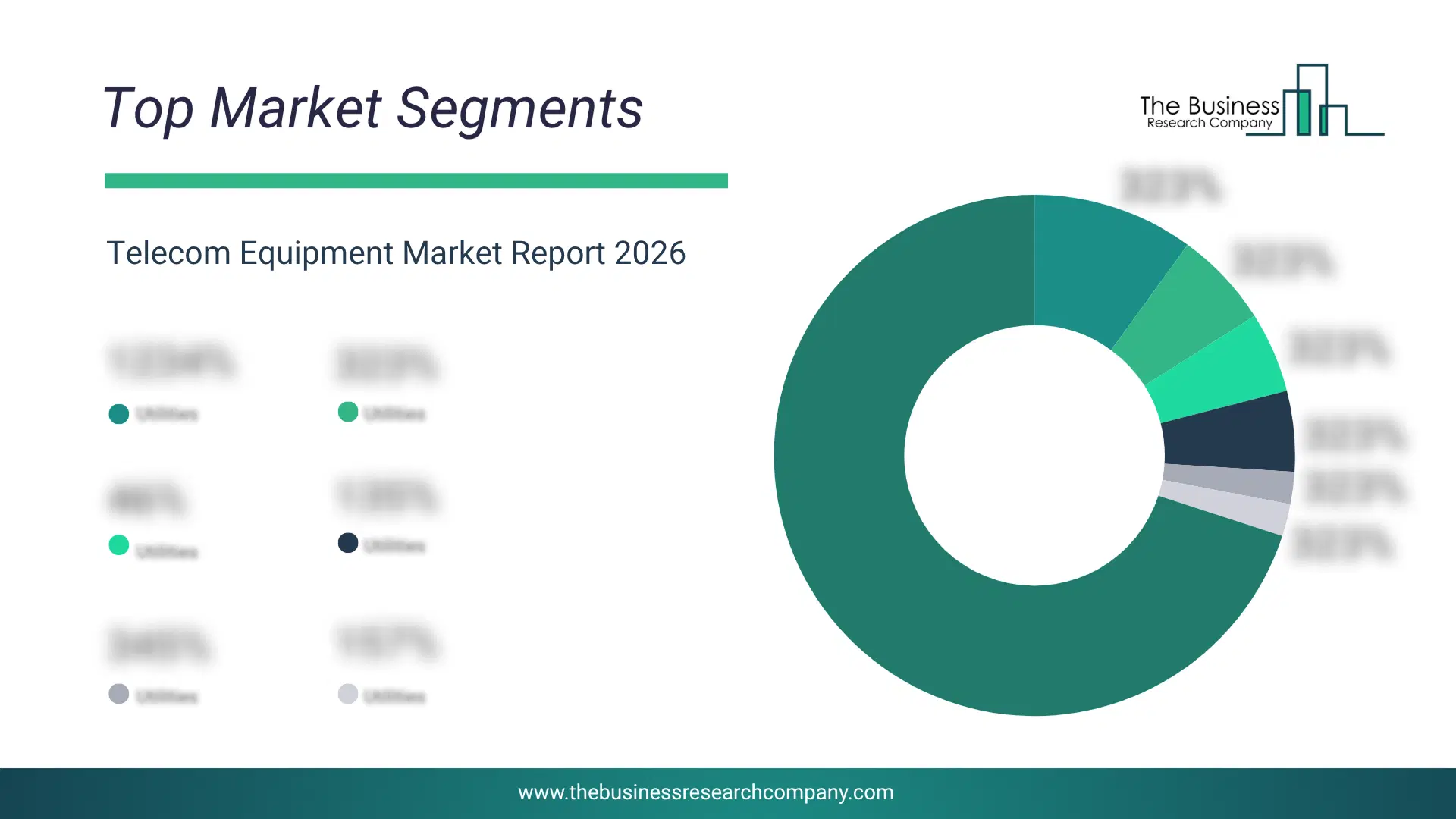
1) By Type: Network Communication Equipment, Mobile Communication Device, Optical Communication Equipment 2) By Component: Hardware, Software 3) By Technology: 2G, 3G, 4G LTE, 5G 4) By Infrastructure: Wired, Wireless 5) By End-User: Banking, Financial Services And Insurance (BFSI), Retail, Information Technology And Telecommunication, Media And Entertainment, Healthcare, Military And Defense, Consumer Electronics, Other End Users Subsegments: 1) By Network Communication Equipment: Routers and Switches, Modems and Gateways, Base Stations and Network Nodes, Network Infrastructure Equipment 2) By Mobile Communication Device: Smartphones, Feature Phones, Tablets and Mobile Hotspots 3) By Optical Communication Equipment: Optical Fiber and Cables, Optical Transceivers and Amplifiers, Optical Switches, Dense Wavelength Division Multiplexing (DWDM) Equipment The top segments in the telecom equipment market will be: • Network Communication Equipment will reach $395.3 Billion by 2030. • Mobile Communication Device will reach $276.71 Billion by 2030. • Optical Communication Equipment will reach $173.93 Billion by 2030.What Is The Driver Of The Telecom Equipment Market?
The growing mobile telecommunications business is expected to propel the growth of the telecom equipment market going forward. Mobile telecommunication refers to transmitting voice, data, and multimedia over a wireless network, allowing users to communicate and access information. The increased connectivity needs, smartphone adoption, and the expansion of digital services drive the growing demand for mobile telecommunications. Mobile telecommunications businesses leverage telecom equipment to expand their network infrastructure, improve service quality, and meet increasing customer demand for reliable, high-speed mobile communication services. For instance, in February 2025, according to PricewaterhouseCoopers, a UK-based professional services network, global telecom industry revenue grew 4.3% in 2023 to reach US$1.1 trillion. Therefore, the growing mobile telecommunications business is driving the growth of the telecom equipment industry.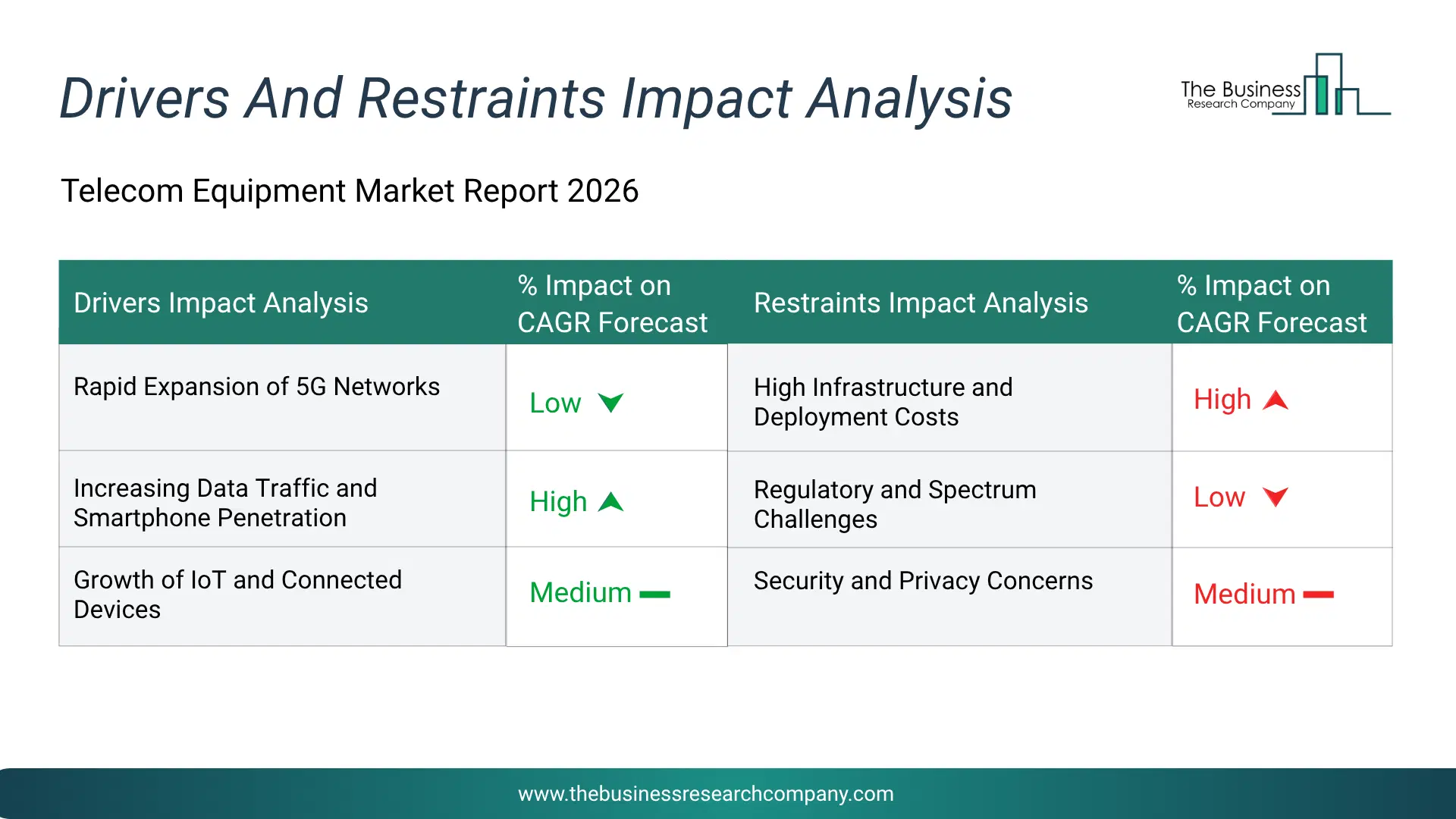
Infographic Chart Showing Key Market Drivers Analysis And Restraints For Telecom Equipment Market
The chart presents an impact analysis of key drivers and restraints, quantifying their relative influence on the market's growth rate and helping assess the balance between growth enablers and limiting factors. This chart offers a high-level perspective; the full report contains more detailed insights.
How Will The Drivers Impact Growth In The Global Telecom Equipment Market?
• Rapid Expansion of 5G Networks (Low) – During the forecast period, the rapid expansion of 5G networks is expected to become a key growth driver for the telecom equipment market by 2030. Telecom operators are heavily investing in 5G base stations, small cells, and advanced radio access network equipment to support ultra-fast connectivity and low-latency communication. The deployment of 5G infrastructure is enabling enhanced mobile broadband services, industrial automation, and real-time digital applications across multiple sectors. Equipment manufacturers are therefore focusing on developing high-capacity and energy-efficient network solutions to meet evolving connectivity requirements. This transition toward advanced wireless communication infrastructure is reinforcing strong market expansion. • Increasing Data Traffic and Smartphone Penetration (High) – During the forecast period, the increasing data traffic and smartphone penetration are expected to emerge as major factors driving the expansion of the telecom equipment market by 2030. Rising consumption of video streaming, cloud-based applications, and digital communication services is significantly increasing global network traffic volumes. At the same time, growing smartphone adoption across developing economies is accelerating demand for upgraded wireless infrastructure and high-speed broadband equipment. Telecom providers are expanding network capacity and modernizing communication systems to ensure uninterrupted connectivity and improved user experience. • Growth of IoT and Connected Devices (Medium) – During the forecast period, the growth of IoT and connected devices is expected to act as a key growth catalyst for the telecom equipment market by 2030. The increasing adoption of smart home systems, connected industrial equipment, wearable devices, and intelligent transportation solutions is driving demand for reliable and scalable communication networks. Telecom equipment providers are developing advanced routers, gateways, and edge networking solutions capable of supporting massive device connectivity and real-time data exchange. Additionally, enterprises are investing in intelligent network infrastructure to improve automation, monitoring, and operational efficiency. As connected ecosystems continue to expand globally, the need for advanced telecom equipment is expected to rise steadily.How Will The Restraints Impact Growth In The Global Telecom Equipment Market?
• High Infrastructure and Deployment Costs (Low) – During the forecast period, the one of the major restraints in the telecom equipment market is the high cost associated with network deployment and upgrades. Building telecom infrastructure, especially for 5G, requires substantial investment in spectrum, equipment, and installation. Small and mid-sized telecom operators often struggle with capital expenditure requirements. Additionally, maintenance and operational costs add to the financial burden. These high costs can delay network expansion, particularly in developing regions. As a result, adoption of advanced telecom equipment may be slower in cost-sensitive markets. • Regulatory and Spectrum Challenges (High) – During the forecast period, the telecom equipment deployment is heavily influenced by government regulations and spectrum allocation policies. Complex regulatory frameworks, licensing requirements, and compliance standards can slow down market growth. Delays in spectrum auctions or inconsistent policies across regions create uncertainty for telecom operators. Furthermore, geopolitical tensions and restrictions on certain equipment vendors can disrupt supply chains. These regulatory challenges often hinder timely infrastructure development. Consequently, they act as a barrier to smooth market expansion. • Security and Privacy Concerns (Medium) – During the forecast period, the increasing cybersecurity threats pose a significant challenge to the telecom equipment market. As networks become more complex and interconnected, the risk of data breaches and cyberattacks rises. Telecom equipment must meet stringent security standards, which increases design and operational complexity. Concerns over data privacy and network vulnerabilities can lead to stricter regulations and reduced adoption of certain technologies. Enterprises and governments are cautious when selecting equipment vendors due to potential security risks. These factors can slow down deployment and create trust-related barriers in the market.Key Players In The Global Telecom Equipment Market
Major companies operating in the telecom equipment market are Huawei Technologies Co. Ltd., Telefonaktiebolaget LM Ericsson, Nokia Corporation, ZTE Corporation, Samsung Electronics Co. Ltd., Cisco Systems Inc., Fujitsu Limited, NEC Corporation, Ciena Corporation, Juniper Networks Inc., CommScope Holding Co Inc., Adtran Inc., Ribbon Communications Inc., Ceragon Networks Ltd., Extreme Networks Inc., Mavenir Systems Inc., Infinera Corporation, Calix Inc., Arista Networks Inc., Cambium Networks Corporation, Baicells Technologies Co. Ltd., SIA Mikrotik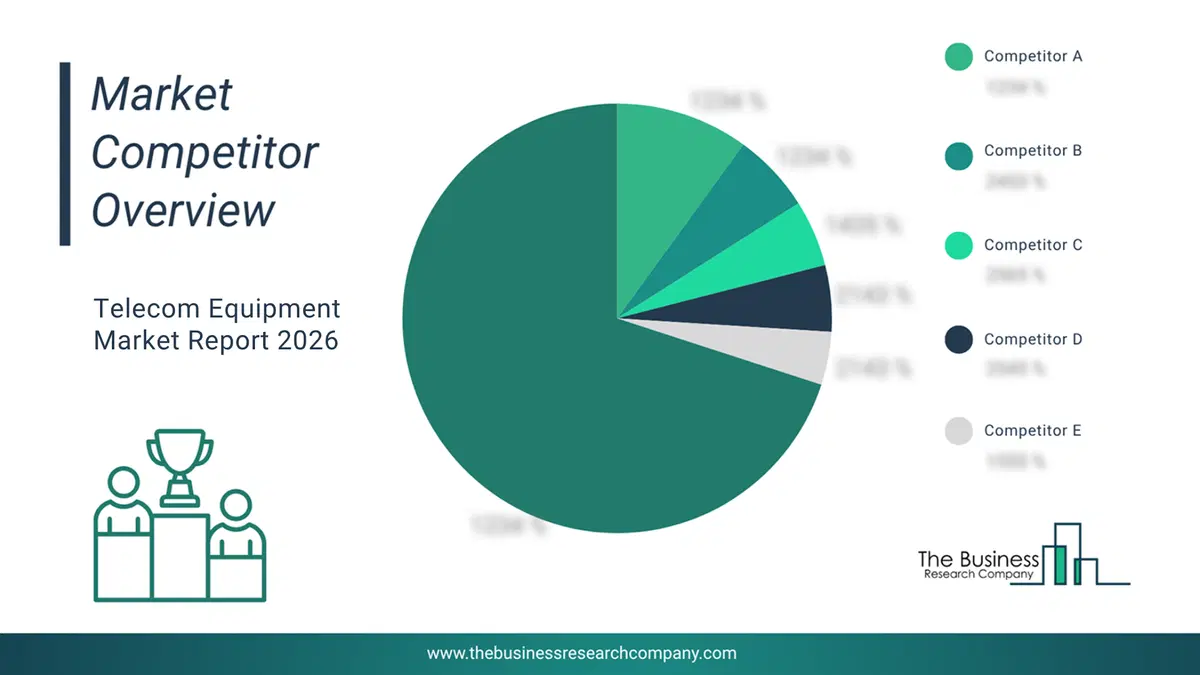
This chart is for illustrative purposes; the full report includes a detailed competitor analysis and comprehensive overview of the top 10 companies in the market.
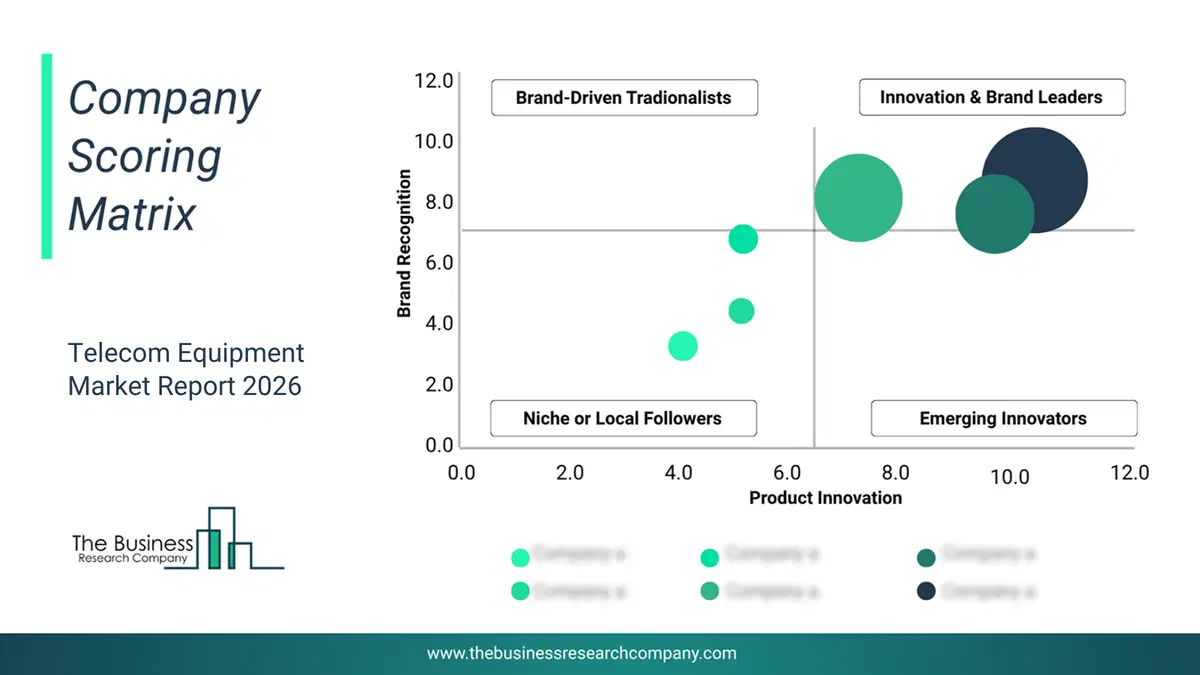
This chart maps companies by product innovation and brand strength, with bubble size indicating relative revenue, helping identify market leaders, challengers, and niche players. This is an illustrative chart; the full report provides a complete and accurate competitive analysis.
Global Telecom Equipment Market Trends and Insights
Major companies operating in the telecom equipment market focus on technological innovation, such as software automation, to enhance network capabilities and performance. It streamlines repetitive tasks, improving efficiency and reducing manual effort in diverse industries. For instance, in October 2023, Telefonaktiebolaget LM Ericsson, a Sweden-based networking and telecommunications company, launched a cutting-edge software toolkit to enhance 5G standalone network capabilities, facilitating premium services with distinct connectivity. This toolkit is designed to cater to experience-based connectivity with high demands on throughput, reliability, and latency. It empowers communications service providers (CSPs) to deliver use cases that require high-performance levels, such as lag-free mobile cloud gaming, video conferencing, live broadcasting, remote-controlled machines/vehicles, public safety services, and extended reality applications. The software toolkit offers enhanced features for massive multiple-input multiple-output (MIMO), advanced radio access network slicing, time-critical communication, and 5G core.What Are Latest Mergers And Acquisitions In The Telecom Equipment Market?
In August 2023, Jio Platforms Limited, an India-based company that provides end-to-end enterprise-business 5G services across radio, cloud, core, and automation with OSS/BSS solutions, acquired Mimosa Networks Inc. for $60 million. The acquisition will enable Jio Platforms, home to RIL's telecom venture Reliance Jio, to enhance its 5G and broadband offerings by incorporating Mimosa's point-to-point and point-to-multi-point products. Mimosa Networks, Inc., is a US-based manufacturer of telecommunication equipment.Regional Insights
North America was the largest region in the telecom equipment market in 2025. Asia-Pacific is expected to be the fastest-growing region in the forecast period. The regions covered in this market report are Asia-Pacific, South East Asia, Western Europe, Eastern Europe, North America, South America, Middle East, Africa. The countries covered in this market report are Australia, Brazil, China, France, Germany, India, Indonesia, Japan, Taiwan, Russia, South Korea, UK, USA, Canada, Italy, Spain.What Defines the Telecom Equipment Market?
The telecom equipment market consists of sales of antennas, multiplexers and demultiplexers, and modems. Values in this market are ‘factory gate’ values, that is the value of goods sold by the manufacturers or creators of the goods, whether to other entities (including downstream manufacturers, wholesalers, distributors and retailers) or directly to end customers. The value of goods in this market includes related services sold by the creators of the goods.How is Market Value Defined and Measured?
The market value is defined as the revenues that enterprises gain from the sale of goods and/or services within the specified market and geography through sales, grants, or donations in terms of the currency (in USD unless otherwise specified). The revenues for a specified geography are consumption values that are revenues generated by organizations in the specified geography within the market, irrespective of where they are produced. It does not include revenues from resales along the supply chain, either further along the supply chain or as part of other products.
This chart presents market attractiveness based on a quantitative evaluation of growth, competition, strategic alignment, and risk, offering a clear view of opportunity areas for decision-making. This chart is for illustrative purposes; the full report contains the complete analysis.

This chart highlights the Total Addressable Market (TAM) by estimating the maximum revenue opportunity using an assumption-driven approach, supporting strategic planning and opportunity sizing across markets. The chart is illustrative; the full report provides a more comprehensive analysis.
What Key Data and Analysis Are Included in the Telecom Equipment Market Report 2026?
The telecom equipment market research report is one of a series of new reports from The Business Research Company that provides market statistics, including industry global market size, regional shares, competitors with the market share, detailed market segments, market trends and opportunities, and any further data you may need to thrive in the telecom equipment industry. The market research report delivers a complete perspective of everything you need, with an in-depth analysis of the current and future state of the industry.Telecom Equipment Market Report Forecast Analysis
| Report Attribute | Details |
|---|---|
| Market Size Value In 2026 | $705.77 billion |
| Revenue Forecast In 2030 | $849.22 billion |
| Growth Rate | CAGR of 4.7% from 2026 to 2030 |
| Base Year For Estimation | 2025 |
| Actual Estimates/Historical Data | 2020-2025 |
| Forecast Period | 2026 - 2030 |
| Market Representation | Revenue in USD Billion and CAGR from 2026 to 2030 |
| Segments Covered | Type, Component, Technology, Infrastructure, End-User |
| Regional Scope | Asia-Pacific, Western Europe, Eastern Europe, North America, South America, Middle East, Africa |
| Country Scope | The countries covered in the report are Australia, Brazil, China, France, Germany, India, Indonesia, Japan, Taiwan, Russia, South Korea, UK, USA, Canada, Italy, Spain. |
| Key Companies Profiled | Huawei Technologies Co. Ltd., Telefonaktiebolaget LM Ericsson, Nokia Corporation, ZTE Corporation, Samsung Electronics Co. Ltd., Cisco Systems Inc., Fujitsu Limited, NEC Corporation, Ciena Corporation, Juniper Networks Inc., CommScope Holding Co Inc., Adtran Inc., Ribbon Communications Inc., Ceragon Networks Ltd., Extreme Networks Inc., Mavenir Systems Inc., Infinera Corporation, Calix Inc., Arista Networks Inc., Cambium Networks Corporation, Baicells Technologies Co. Ltd., SIA Mikrotik |
| Customization Scope | Request for Customization |
| Pricing And Purchase Options | Explore Purchase Options |