
Telecom Network Infrastructure Market Report 2026
Global Outlook – By Component (Product, Service), By Connectivity Technology (2G, 3G, 4G Or LTE, 5G), By End Users (Telecom Operators, Enterprises) – Market Size, Trends, Strategies, and Forecast to 2035
Telecom Network Infrastructure Market Overview
• Telecom Network Infrastructure market size has reached to $102.93 billion in 2025 • Expected to grow to $147.43 billion in 2030 at a compound annual growth rate (CAGR) of 7.3% • Growth Driver: Anticipated Surge In Telecom Network Infrastructure Market Driven By Rollout And Expansion Of 5G Networks • Market Trend: Technological Advancements Propel Innovation In The Telecom Network Infrastructure Market • Asia-Pacific was the largest region in 2025.What Is Covered Under Telecom Network Infrastructure Market?
Telecom network infrastructure refers to the network of nodes connected by cables that make up telecom infrastructure, consisting of towers, and equipment. These are used to transmit audio, video, and data messages from an originating node to a destination node. The major components of telecom network infrastructure are products and services. A product refers to any commodity, both durable and nondurable, sold to fulfill a customer's need or want. Products including telecom towers, active and passive network equipment, and data centers are used to provide optimum coverage. Major connectivity technologies are 2G, 3G, 4G or LTE, and 5G. It is used by major groups of end-users, such as telecom operators and enterprises.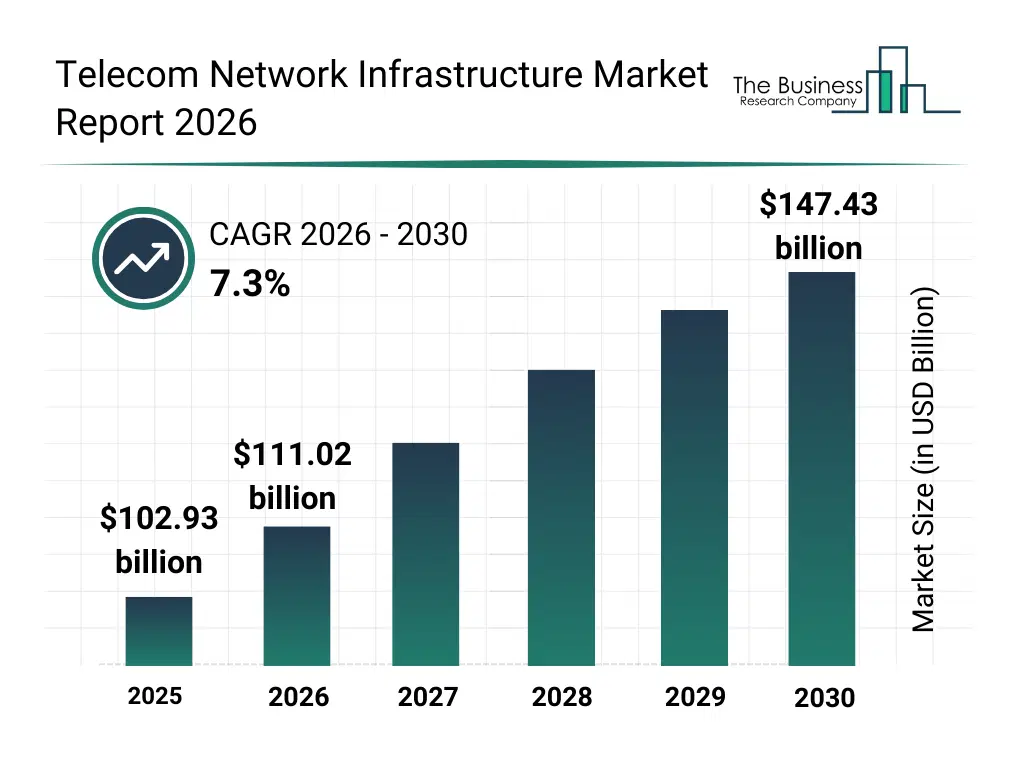
What Is The Telecom Network Infrastructure Market Size and Share 2026?
The telecom network infrastructure market size has grown strongly in recent years. It will grow from $102.93 billion in 2025 to $111.02 billion in 2026 at a compound annual growth rate (CAGR) of 7.9%. The growth in the historic period can be attributed to growth in mobile data consumption, expansion of broadband connectivity, early rollout of LTE networks, increasing smartphone penetration, demand for reliable network coverage.What Is The Telecom Network Infrastructure Market Growth Forecast?
The telecom network infrastructure market size is expected to see strong growth in the next few years. It will grow to $147.43 billion in 2030 at a compound annual growth rate (CAGR) of 7.3%. The growth in the forecast period can be attributed to accelerated 5G adoption, rising IoT device connectivity, increased demand for low latency networks, investments in smart city infrastructure, expansion of enterprise private networks. Major trends in the forecast period include 5G network expansion, fiber optic infrastructure deployment, network virtualization technologies, small cell network installations, automated network optimization solutions.
Global Telecom Network Infrastructure Market Segmentation
1) By Component: Product, Service 2) By Connectivity Technology: 2G, 3G, 4G Or LTE, 5G 3) By End Users: Telecom Operators, Enterprises Subsegments: 1) By Product: Routers, Switches, Base Stations, Antennas, Network Cables, Fiber Optic Components 2) By Service: Network Design And Consulting, Installation And Integration Services, Maintenance And Support Services, Managed Services, Network Optimization ServicesWhat Is The Driver Of The Telecom Network Infrastructure Market?
The rollout and expansion of 5G networks is expected to propel the growth of the telecom network infrastructure market going forward. The rollout and expansion of 5G networks entail deploying the latest generation of mobile telecommunications, 5G, which succeeds 4G/LTE, offering advanced standards for faster speeds, lower latency, and increased capacity. The rollout and expansion of 5G networks generate a ripple effect across the entire telecom ecosystem, driving substantial investment in infrastructure, fostering technological advancements, and creating new opportunities for growth in the telecom network infrastructure. For instance, in May 2025, according to Ericsson, a Sweden-based telecommunications company, 5G mobile subscriptions are projected to grow from 1.62 billion in 2023 to 6.29 billion by 2030. Therefore, the rollout and expansion of 5G networks will drive the growth of the telecom network infrastructure industry.Key Players In The Global Telecom Network Infrastructure Market
Major companies operating in the telecom network infrastructure market are Nokia Corporation; Fujitsu Limited; Cisco Systems Inc.; Ciena Corporation; CommScope Holding Company Inc.; Huawei Technologies Co Ltd; NEC Corporation; Samsung Electronics Co Ltd; Altiostar Networks Inc.; Juniper Networks Inc.; Telefonaktiebolaget LM Ericsson; ZTE Corporation; Affirmed Networks; Ascendis Communications; Cambium Networks; Fujitsu Network Communications Inc.; Samsung Networks; Ericsson Networks; Huawei NetworksGlobal Telecom Network Infrastructure Market Trends and Insights
Major companies operating in the telecom network infrastructure market are focusing on technological innovations, such as 5G network expansion and edge computing integration, to enhance connectivity, reduce latency, and support the growing demand for data-intensive applications across industries. A Managed Fibre Network (MFN) is a service where a provider takes full responsibility for the design, installation, and ongoing management of a fibre optic network, allowing businesses to benefit from high-speed connectivity without handling the technical or operational aspects themselves. For instance, in October 2024, EXA Infrastructure, a UK-based company that offers digital infrastructure launched its Managed Fibre Network (MFN) service to address demands for increased connectivity and shorter service delivery times. MFN provides the benefits of dark fibre and equipment ownership, including the highest levels of scalability at the lowest unit economics, without incurring the associated administration and technical and operational resourcing costs of in-house delivery. EXA Infrastructure’s MFN offering enables companies to fill network gaps, connect data centres and cable landing stations, and rapidly scale into markets quickly and effortlessly.What Are Latest Mergers And Acquisitions In The Telecom Network Infrastructure Market?
In July 2024, Accenture, an Ireland-based professional services and technology company, acquired Fibermind for an undisclosed amount. Through this acquisition, Accenture aims to strengthen its telecom network infrastructure portfolio by integrating Fibermind’s engineering and deployment expertise, enhancing its capacity to deliver large-scale fiber and 5G rollout projects across Europe. Fibermind is an Italy-based network services firm specializing in fiber deployment and 5G mobile infrastructure.Regional Insights
Asia-Pacific was the largest region in the telecom network infrastructure market in 2025. The regions covered in this market report are Asia-Pacific, South East Asia, Western Europe, Eastern Europe, North America, South America, Middle East, Africa. The countries covered in this market report are Australia, Brazil, China, France, Germany, India, Indonesia, Japan, Taiwan, Russia, South Korea, UK, USA, Canada, Italy, SpainWhat Defines the Telecom Network Infrastructure Market?
The telecom network infrastructure market consists of revenues earned by entities by providing infrastructure services for the telephone landline network, the mobile network, cable TV networks, or the internet. The market value includes the value of related goods sold by the service provider or included within the service offering. The telecom network infrastructure market also includes sales of telephone wires, cables (including submarine cables), satellites, and microwaves. Values in this market are ‘factory gate’ values, that is the value of goods sold by the manufacturers or creators of the goods, whether to other entities (including downstream manufacturers, wholesalers, distributors and retailers) or directly to end customers. The value of goods in this market includes related services sold by the creators of the goods.How is Market Value Defined and Measured?
The market value is defined as the revenues that enterprises gain from the sale of goods and/or services within the specified market and geography through sales, grants, or donations in terms of the currency (in USD unless otherwise specified). The revenues for a specified geography are consumption values that are revenues generated by organizations in the specified geography within the market, irrespective of where they are produced. It does not include revenues from resales along the supply chain, either further along the supply chain or as part of other products.What Key Data and Analysis Are Included in the Telecom Network Infrastructure Market Report 2026?
The telecom network infrastructure market research report is one of a series of new reports from The Business Research Company that provides market statistics, including industry global market size, regional shares, competitors with the market share, detailed market segments, market trends and opportunities, and any further data you may need to thrive in the telecom network infrastructure industry. The market research report delivers a complete perspective of everything you need, with an in-depth analysis of the current and future state of the industry.Telecom Network Infrastructure Market Report Forecast Analysis
| Report Attribute | Details |
|---|---|
| Market Size Value In 2026 | $111.02 billion |
| Revenue Forecast In 2035 | $147.43 billion |
| Growth Rate | CAGR of 7.9% from 2026 to 2035 |
| Base Year For Estimation | 2025 |
| Actual Estimates/Historical Data | 2020-2025 |
| Forecast Period | 2026 - 2030 - 2035 |
| Market Representation | Revenue in USD Billion and CAGR from 2026 to 2035 |
| Segments Covered | Component, Connectivity Technology, End Users |
| Regional Scope | Asia-Pacific, Western Europe, Eastern Europe, North America, South America, Middle East, Africa |
| Country Scope | The countries covered in the report are Australia, Brazil, China, France, Germany, India, ... |
| Key Companies Profiled | Nokia Corporation; Fujitsu Limited; Cisco Systems Inc.; Ciena Corporation; CommScope Holding Company Inc.; Huawei Technologies Co Ltd; NEC Corporation; Samsung Electronics Co Ltd; Altiostar Networks Inc.; Juniper Networks Inc.; Telefonaktiebolaget LM Ericsson; ZTE Corporation; Affirmed Networks; Ascendis Communications; Cambium Networks; Fujitsu Network Communications Inc.; Samsung Networks; Ericsson Networks; Huawei Networks |
| Customization Scope | Request for Customization |
| Pricing And Purchase Options | Explore Purchase Options |