

Telehealth Software Market Report 2026
Global Outlook – By Component (Software, Services), By Deployment (Cloud-Based, On-Premises), By End User (Healthcare Providers, Healthcare Payers And Patients) - Market Size, Trends, And Global Forecast 2026-2030
Telehealth Software Market Overview
• Telehealth Software market size has reached to $11.25 billion in 2025 • Expected to grow to $23.56 billion in 2030 at a compound annual growth rate (CAGR) of 15.4% • Growth Driver: The Telehealth Software Market Surge Driven by Escalating Chronic Disease Prevalence • Market Trend: AI-Driven Telehealth Advancements Transforming Personalized Remote Diagnosis And Treatment Delivery • North America was the largest region in 2025 and Asia-Pacific is the fastest growing region.Market Gains By 2030 – Top Opportunities By Segment
Market Gain identifies the most promising market opportunities by highlighting the segments or products expected to generate the highest incremental revenue growth over the next five years.
What Is Covered Under Telehealth Software Market?
Telehealth software refers to digital platforms and solutions that enable remote healthcare services and consultations. Telehealth software enables healthcare clinicians to electronically prescribe medications, deliver prescriptions directly to pharmacies, and monitor medication adherence for patients. The main types of telehealth software components are software and services. Software refers to digital solutions designed to facilitate remote healthcare delivery, enabling virtual consultations, remote monitoring, and patient engagement. It can be deployed in the cloud and on-premises by various end-users, such as healthcare providers, healthcare payers, and patients.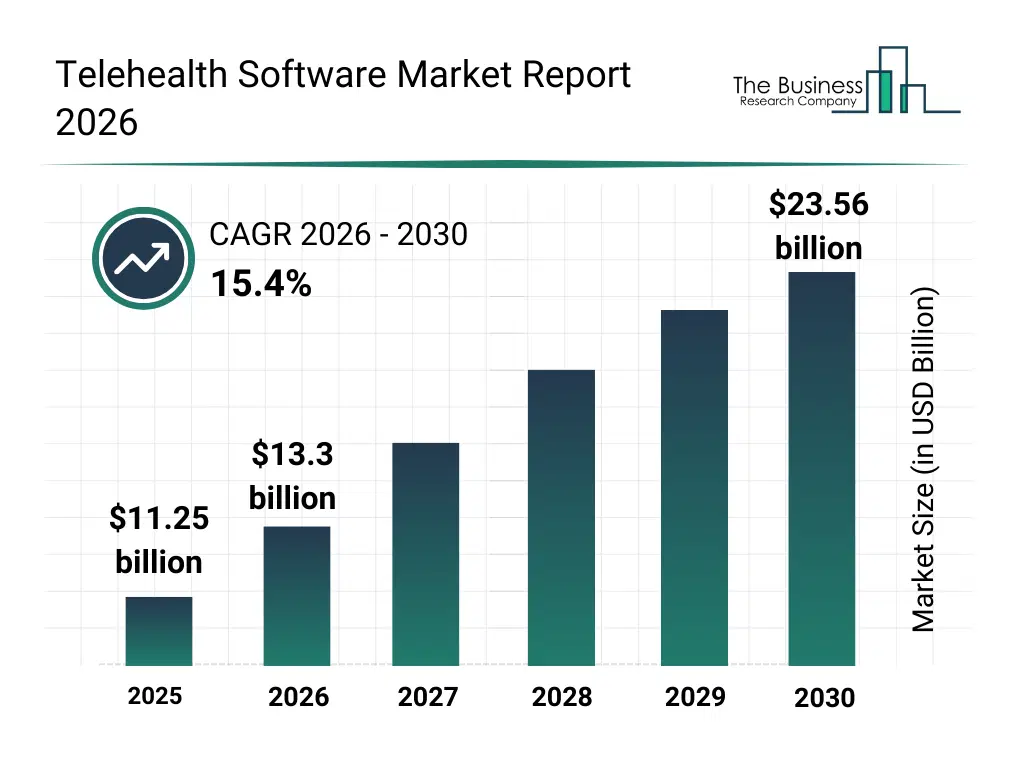
What Is The Telehealth Software Market Size and Share 2026?
The telehealth software market size has grown rapidly in recent years. It will grow from $11.25 billion in 2025 to $13.3 billion in 2026 at a compound annual growth rate (CAGR) of 18.2%. The growth in the historic period can be attributed to increasing digitization of healthcare workflows, rising adoption of electronic prescribing systems, expansion of cloud computing in healthcare, growing need for care coordination tools, improvements in healthcare data interoperability.What Is The Telehealth Software Market Growth Forecast?
The telehealth software market size is expected to see rapid growth in the next few years. It will grow to $23.56 billion in 2030 at a compound annual growth rate (CAGR) of 15.4%. The growth in the forecast period can be attributed to increasing investments in AI-driven healthcare software, rising demand for remote chronic disease management, expansion of value-based care models, growing focus on cybersecurity compliance, increasing integration of telehealth software with clinical systems. Major trends in the forecast period include increasing adoption of integrated telehealth software platforms, rising use of AI-based clinical decision support tools, growing demand for medication adherence monitoring solutions, expansion of cloud-based telehealth applications, enhanced focus on secure health data management.
Global Telehealth Software Market Segmentation
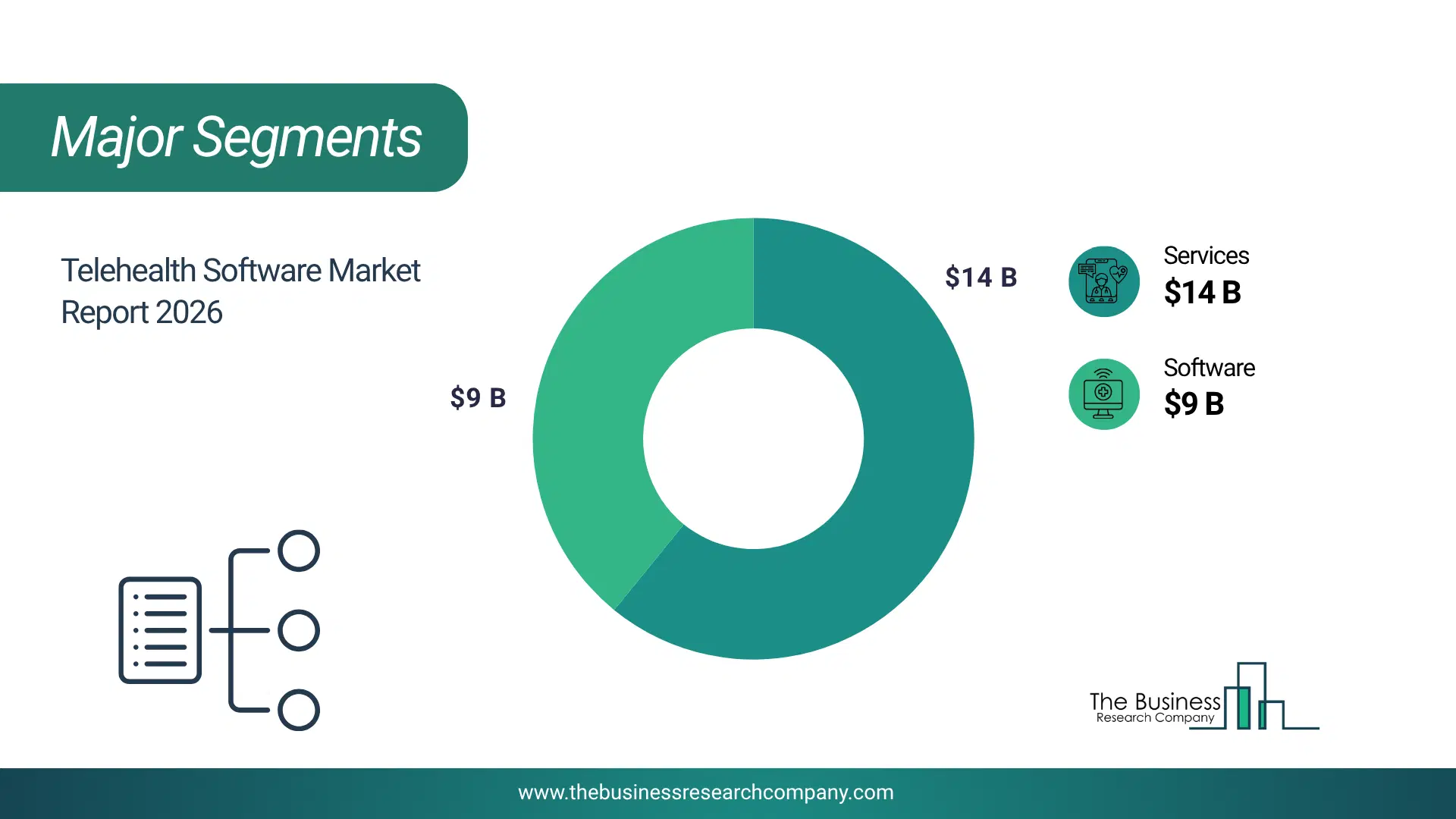
1) By Component: Software, Services 2) By Deployment: Cloud-Based, On-Premises 3) By End User: Healthcare Providers, Healthcare Payers And Patients Subsegments: 1) By Software: Telemedicine Software, Remote Patient Monitoring Software, Video Conferencing Software, Electronic Health Record (EHR) Integration Software, Clinical Decision Support Software, mHealth Applications, Patient Portals, Appointment Scheduling Software 2) By Services: Telehealth Consulting Services, Telehealth Integration Services, Managed Services, Training And Support Services, Maintenance Services The top segments in the telehealth software market will be: • Services will reach $14.4 Billion by 2030. • Software will reach $9.07 Billion by 2030.What Is The Driver Of The Telehealth Software Market?
The growing prevalence of chronic diseases is expected to propel the growth of the telehealth software market going forward. Chronic diseases refer to long-lasting conditions characterized by persistent or recurring symptoms that typically require ongoing management and treatment. Chronic diseases are growing due to factors such as aging populations, tobacco and alcohol use, and a lack of access to healthcare. Telehealth software facilitates the management of chronic diseases by offering remote access to healthcare services, allowing patients to receive regular monitoring and consultations without the need for in-person visits. This accessibility promotes early detection, continuous care, and patient empowerment, ultimately contributing to better management and outcomes for individuals with chronic conditions. For instance, in June 2023, the Institute for Health Metrics and Evaluation, a US-based public health research institute, reported that over half a billion people globally were living with diabetes. This number is expected to more than double, reaching 1.3 billion people by 2050. Therefore, the growing prevalence of chronic diseases is driving the growth of the telehealth software industry.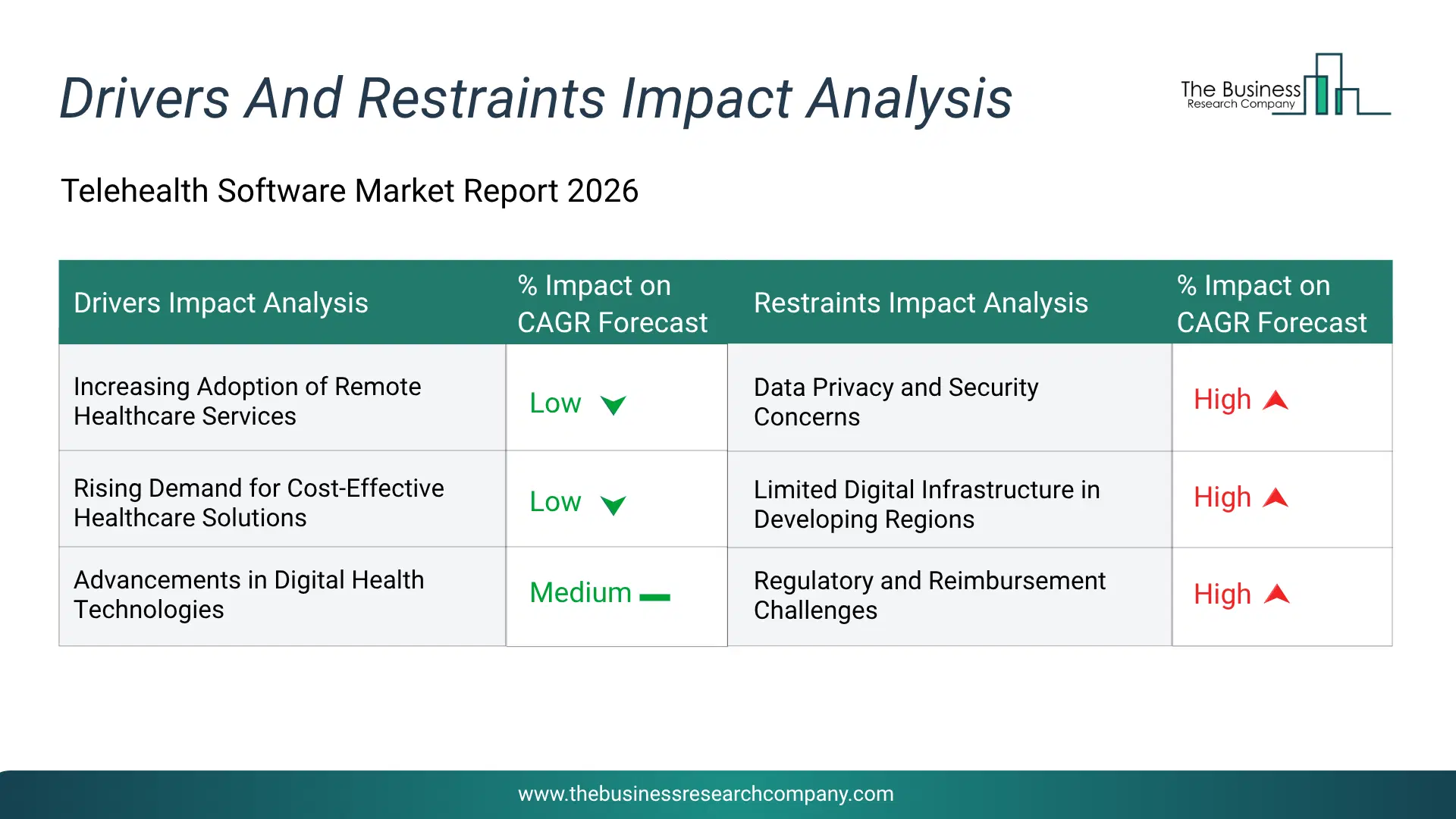
Infographic Chart Showing Key Market Drivers Analysis And Restraints For Telehealth Software Market
The chart presents an impact analysis of key drivers and restraints, quantifying their relative influence on the market's growth rate and helping assess the balance between growth enablers and limiting factors. This chart offers a high-level perspective; the full report contains more detailed insights.
How Will The Drivers Impact Growth In The Global Telehealth Software Market?
• Increasing Adoption of Remote Healthcare Services (Low) – During the forecast period, the increasing adoption of remote healthcare services is expected to become a key growth driver for the telehealth software market by 2030. Healthcare providers and patients are rapidly embracing virtual consultation platforms to improve accessibility and convenience, particularly in underserved and rural areas. The shift toward home-based care models and continuous remote monitoring is reducing the dependency on in-person visits while enhancing care continuity. Healthcare systems are also expanding telehealth capabilities to manage chronic diseases and post-acute care more efficiently. This growing reliance on remote healthcare services is reinforcing long-term market expansion. • Rising Demand for Cost-Effective Healthcare Solutions (Low) – During the forecast period, the rising demand for cost-effective healthcare solutions is expected to emerge as a major factor driving the expansion of the telehealth software market by 2030. Telehealth platforms significantly reduce operational costs for healthcare providers by minimizing infrastructure requirements and optimizing resource utilization. Patients also benefit from lower consultation costs and reduced travel expenses, making healthcare more affordable and accessible. Payers and healthcare organizations are increasingly focusing on value-based care models that prioritize cost efficiency and improved outcomes. • Advancements in Digital Health Technologies (Medium) – During the forecast period, the advancements in digital health technologies are expected to act as a key growth catalyst for the telehealth software market by 2030. Continuous innovation in areas such as artificial intelligence, wearable health devices, and data analytics is enhancing the capabilities of telehealth platforms. These technologies enable real-time health monitoring, predictive diagnostics, and personalized treatment plans, improving overall care quality. Integration with electronic health records and interoperability across healthcare systems are further strengthening telehealth adoption. As digital health ecosystems evolve, the functionality and scalability of telehealth solutions are expected to expand significantly.How Will The Restraints Impact Growth In The Global Telehealth Software Market?
• Data Privacy and Security Concerns (Low) – During the forecast period, data privacy and security concerns are significantly restricting the growth of the telehealth software market. Increasing risks of data breaches, cybersecurity threats, and strict compliance requirements for patient health information are limiting adoption and increasing the cost of secure platform development and maintenance. • Limited Digital Infrastructure in Developing Regions (Low) – During the forecast period, limited digital infrastructure in developing regions is significantly restricting the growth of the telehealth software market. Inadequate internet connectivity, lack of reliable digital devices, and insufficient healthcare IT systems are hindering the widespread deployment and effective utilization of telehealth solutions. • Regulatory and Reimbursement Challenges (Medium) – During the forecast period, regulatory and reimbursement challenges are significantly restricting the growth of the telehealth software market. Complex and evolving healthcare regulations, along with inconsistent reimbursement policies across regions, are creating uncertainty for providers and limiting large-scale adoption of telehealth platforms.Key Players In The Global Telehealth Software Market
Major companies operating in the telehealth software market are Teladoc Health Inc, American Well Corporation, Cerner Corporation, Allscripts Healthcare LLC, Oracle Corporation, Koninklijke Philips N.V, Zoom Video Communications Inc, Zocdoc Inc, CureMD Healthcare, Vocera Communications Inc, Care Innovations LLC, GlobalMedia Group LLC, Updox LLC, Capsule Technologies Inc, Biotricity Inc, BioTelemetry, Medtronic Inc, Masimo Corporation, Aerotel Medical Systems Ltd, PatientSafe Solutions Inc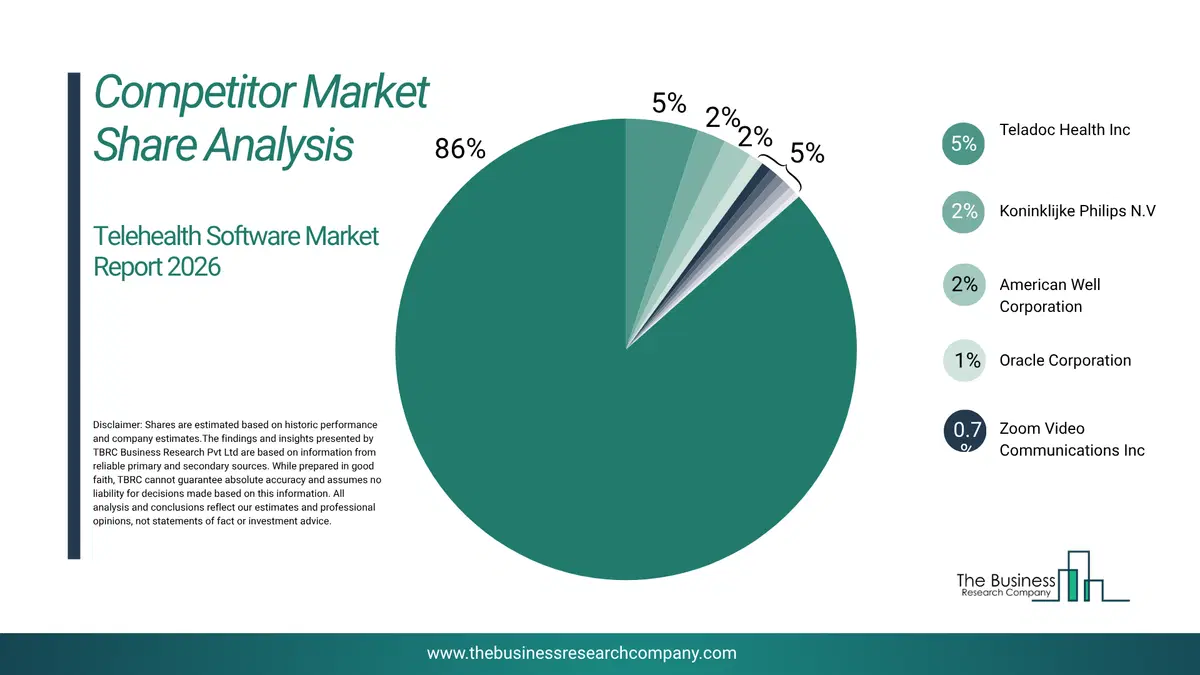
This chart is for illustrative purposes; the full report includes a detailed competitor analysis and comprehensive overview of the top 10 companies in the market.
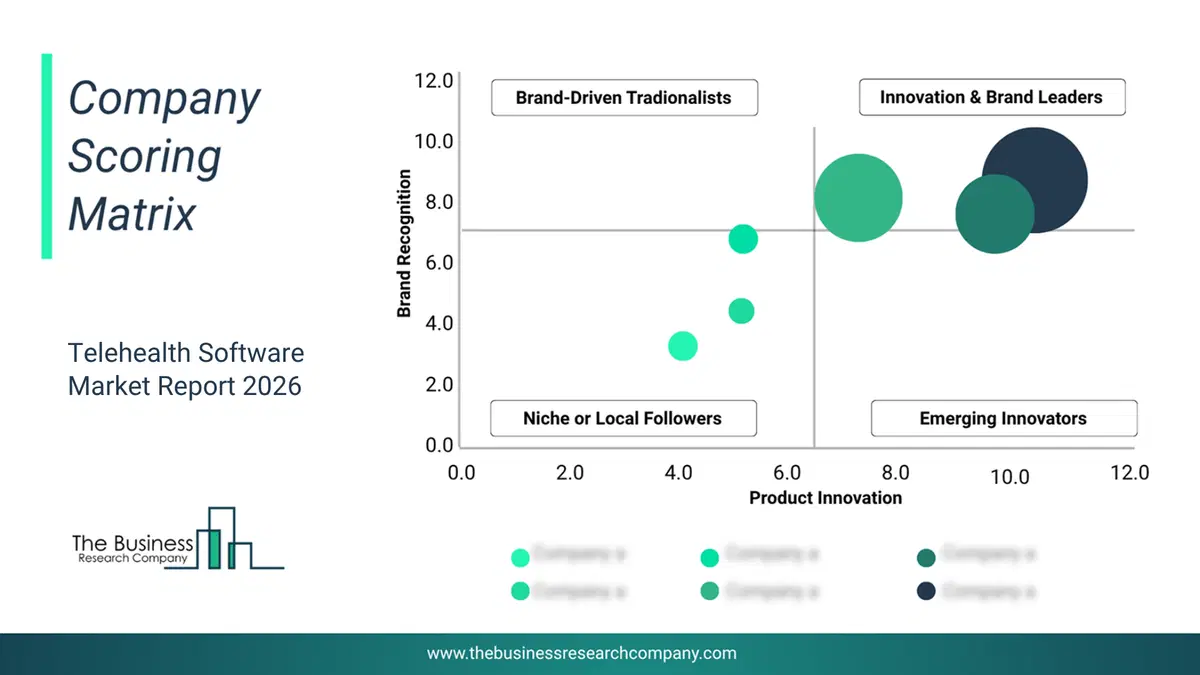
This chart maps companies by product innovation and brand strength, with bubble size indicating relative revenue, helping identify market leaders, challengers, and niche players. This is an illustrative chart; the full report provides a complete and accurate competitive analysis.
Global Telehealth Software Market Trends and Insights
Major companies operating in the telehealth software market are focusing on developing advanced, AI-enabled platforms that deliver personalized, high-efficacy treatments and seamless remote diagnosis. For instance, in November 2025, ODDITY Tech Ltd., an Israel-based technology company, has introduced METHODIQ, a telehealth platform designed to modernize medical care by offering personalized, high-efficacy treatments through online diagnosis. Launching first in dermatology, the platform targets widespread conditions such as acne, eczema and hyperpigmentation, aiming to bridge the gap between ineffective OTC options and costly in-person visits. Built with dermatologists, METHODIQ combines AI-driven skin analysis, computer-vision tracking and a broad portfolio of prescription, OTC and cosmetic products, including proprietary ingredients from ODDITY Labs. With over 100 tailored treatment plans and real-time clinician monitoring, METHODIQ delivers a data-driven, accessible and patient-centered approach, backed by years of research and large-scale consumer studies.What Are Latest Mergers And Acquisitions In The Telehealth Software Market?
In August 2023, Exor N.V., a Netherlands-based diversified investments company, acquired Philips for $2.8 billion. With this acquisition, Exor aims to expand its portfolio by incorporating Philips's expertise in providing telehealth software. Koninklijke Philips N.V. is a Netherlands-based company that offers telehealth solutions.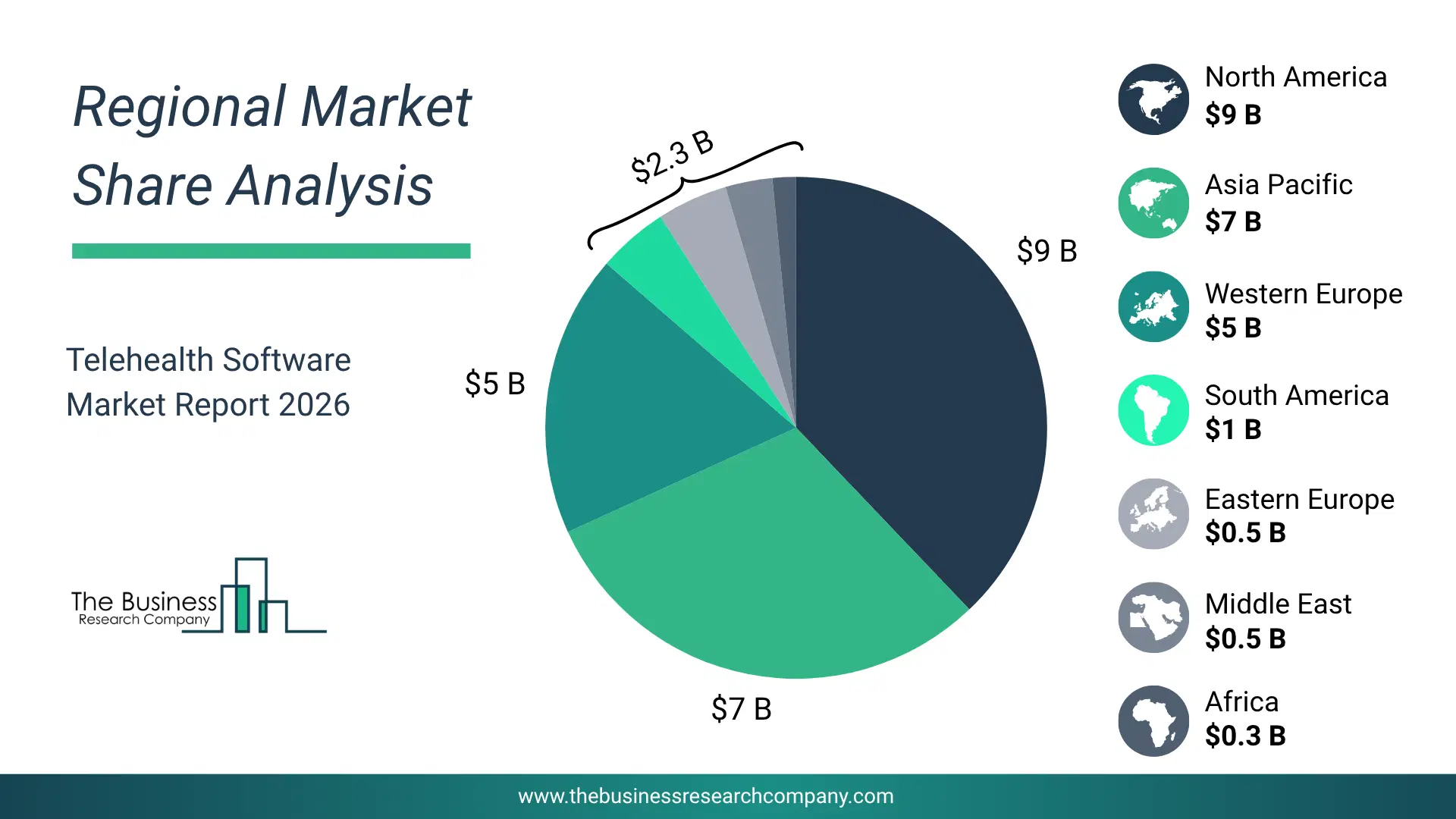
Regional Outlook
North America was the largest region in the telehealth software market in 2025. Asia-Pacific is expected to be the fastest-growing region in the forecast period. The regions covered in this market report are Asia-Pacific, South East Asia, Western Europe, Eastern Europe, North America, South America, Middle East, Africa. The countries covered in this market report are Australia, Brazil, China, France, Germany, India, Indonesia, Japan, Taiwan, Russia, South Korea, UK, USA, Canada, Italy, Spain.What Defines the Telehealth Software Market?
The telehealth software market consists of revenues earned by entities by providing services such as remote prescription services, remote patient monitoring (RPM), teleconsultations, healthcare education and training, teletherapy and behavioral health services, and data analytics and reporting. The market value includes the value of related goods sold by the service provider or included within the service offering. Only goods and services traded between entities or sold to end consumers are included.How is Market Value Defined and Measured?
The market value is defined as the revenues that enterprises gain from the sale of goods and/or services within the specified market and geography through sales, grants, or donations in terms of the currency (in USD unless otherwise specified). The revenues for a specified geography are consumption values that are revenues generated by organizations in the specified geography within the market, irrespective of where they are produced. It does not include revenues from resales along the supply chain, either further along the supply chain or as part of other products.
This chart presents market attractiveness based on a quantitative evaluation of growth, competition, strategic alignment, and risk, offering a clear view of opportunity areas for decision-making. This chart is for illustrative purposes; the full report contains the complete analysis.

This chart highlights the Total Addressable Market (TAM) by estimating the maximum revenue opportunity using an assumption-driven approach, supporting strategic planning and opportunity sizing across markets. The chart is illustrative; the full report provides a more comprehensive analysis.
What Key Data and Analysis Are Included in the Telehealth Software Market Report 2026?
The telehealth software market research report is one of a series of new reports from The Business Research Company that provides market statistics, including industry global market size, regional shares, competitors with the market share, detailed market segments, market trends and opportunities, and any further data you may need to thrive in the telehealth software industry. The market research report delivers a complete perspective of everything you need, with an in-depth analysis of the current and future state of the industry.Telehealth Software Market Report Forecast Analysis
| Report Attribute | Details |
|---|---|
| Market Size Value In 2026 | $13.3 billion |
| Revenue Forecast In 2030 | $23.56 billion |
| Growth Rate | CAGR of 18.2% from 2026 to 2030 |
| Base Year For Estimation | 2025 |
| Actual Estimates/Historical Data | 2020-2025 |
| Forecast Period | 2026 - 2030 |
| Market Representation | Revenue in USD Billion and CAGR from 2026 to 2030 |
| Segments Covered | Component, Deployment, End User |
| Regional Scope | Asia-Pacific, Western Europe, Eastern Europe, North America, South America, Middle East, Africa |
| Country Scope | The countries covered in the report are Australia, Brazil, China, France, Germany, India, Indonesia, Japan, Taiwan, Russia, South Korea, UK, USA, Canada, Italy, Spain. |
| Key Companies Profiled | Teladoc Health Inc, American Well Corporation, Cerner Corporation, Allscripts Healthcare LLC, Oracle Corporation, Koninklijke Philips N.V, Zoom Video Communications Inc, Zocdoc Inc, CureMD Healthcare, Vocera Communications Inc, Care Innovations LLC, GlobalMedia Group LLC, Updox LLC, Capsule Technologies Inc, Biotricity Inc, BioTelemetry, Medtronic Inc, Masimo Corporation, Aerotel Medical Systems Ltd, PatientSafe Solutions Inc |
| Customization Scope | Request for Customization |
| Pricing And Purchase Options | Explore Purchase Options |