
Teleradiology Software Market Report 2026
Global Outlook – By Type (Radiology Information System, Picture Archiving And Communication System (PACS), Vendor Neutral Archive (VNA)), By Deployment (Web-Based, Cloud-Based, On-Premises), By Imaging Technique (X-Ray, Computed Tomography (CT), Magnetic Resonance Imaging (MRI), Ultrasound, Nuclear Imaging, Other Imaging Techniques), By End User (Hospitals, Clinics, Other End Users) - Market Size, Trends, And Global Forecast 2026-2035
Teleradiology Software Market Overview
• Teleradiology Software market size has reached to $3.14 billion in 2025 • Expected to grow to $5.11 billion in 2030 at a compound annual growth rate (CAGR) of 10.2% • Growth Driver: Rising Demand For Remote Healthcare Solutions Driving Growth In The Teleradiology Software Market • Market Trend: Innovative Cloud-Based Solutions Revolutionize Teleradiology • North America was the largest region in 2025 and Asia-Pacific is the fastest growing region.What Is Covered Under Teleradiology Software Market?
Teleradiology software is a specialized type of medical imaging software that enables the transmission, interpretation, and management of radiological images over a network, such as the internet. This technology allows radiologists to view and analyze images remotely, providing a means for timely and efficient diagnosis and consultation. The main teleradiology software types are radiology information systems, picture archiving and communication systems (PACS), and vendor neutral archives (VNA). A radiology information system (RIS) is a specialized software platform used to manage and streamline the workflow, data storage, and communication of radiological imaging and patient information within healthcare facilities. It can be deployed on the web, cloud, and on-premises, and it is used for various imaging techniques such as x-ray, computed tomography (CT), magnetic resonance imaging (MRI), ultrasound, nuclear imaging, and others. It is used by several end users, including hospitals, clinics, and others.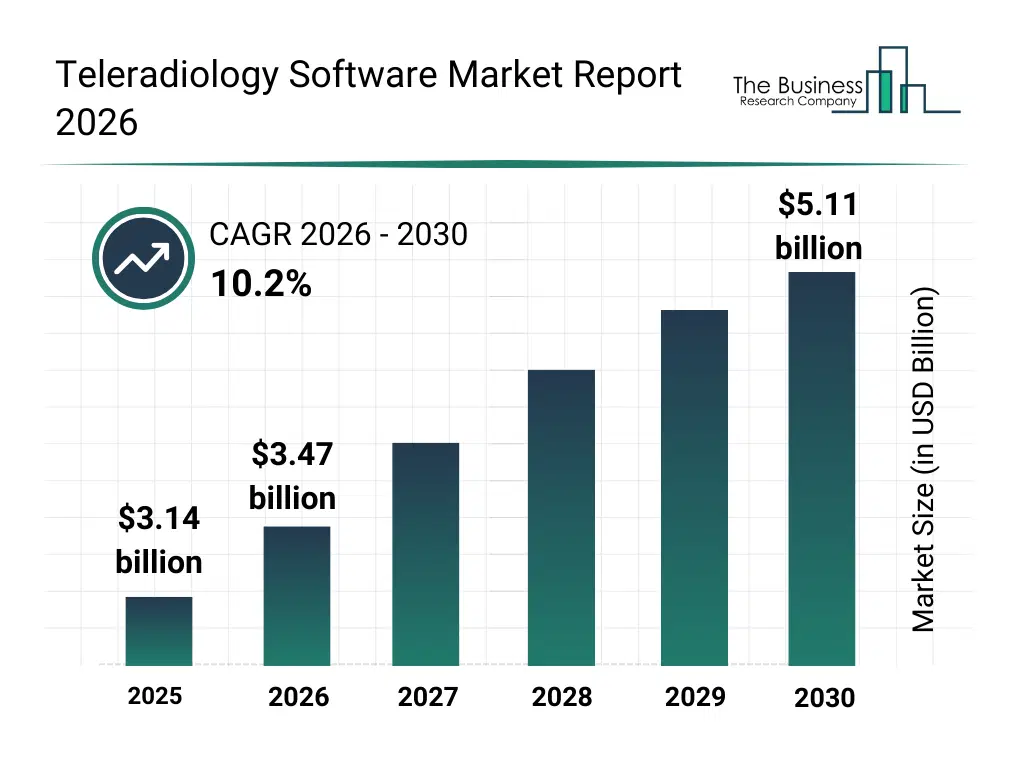
What Is The Teleradiology Software Market Size and Share 2026?
The teleradiology software market size has grown rapidly in recent years. It will grow from $3.14 billion in 2025 to $3.47 billion in 2026 at a compound annual growth rate (CAGR) of 10.5%. The growth in the historic period can be attributed to growth in medical imaging procedure volumes, shortage of radiologists in many regions, expansion of hospital digital infrastructure, increased adoption of pacs solutions, rising need for after-hours radiology services.What Is The Teleradiology Software Market Growth Forecast?
The teleradiology software market size is expected to see rapid growth in the next few years. It will grow to $5.11 billion in 2030 at a compound annual growth rate (CAGR) of 10.2%. The growth in the forecast period can be attributed to increasing demand for rapid diagnostic turnaround, expansion of telehealth and remote diagnostics, rising investments in ai-powered imaging analytics, growing focus on interoperability across healthcare systems, increasing adoption of cloud-native radiology platforms. Major trends in the forecast period include increasing adoption of AI-assisted image interpretation tools, rising use of cloud-based teleradiology platforms, growing integration of pacs and ris systems, expansion of cross-border radiology services, enhanced focus on workflow automation and reporting accuracy.
Global Teleradiology Software Market Segmentation
1) By Type: Radiology Information System, Picture Archiving And Communication System (PACS), Vendor Neutral Archive (VNA) 2) By Deployment: Web-Based, Cloud-Based, On-Premises 3) By Imaging Technique: X-Ray, Computed Tomography (CT), Magnetic Resonance Imaging (MRI), Ultrasound, Nuclear Imaging, Other Imaging Techniques 4) By End User: Hospitals, Clinics, Other End Users Subsegments: 1) By Radiology Information System (RIS): Workflow Management In RIS, Scheduling And Reporting Features, Integration With Electronic Health Records (EHR), Patient Management And Communication Tools 2) By Picture Archiving And Communication System (PACS): Imaging Storage Solutions, Advanced Image Retrieval Features, Integration With Modalities (e.g., MRI, CT), 3D Visualization And Analysis Tools 3) By Vendor Neutral Archive (VNA): Data Management And Storage Solutions, Interoperability Features For Multiple Systems, Long-Term Data Retention Solutions, Secure Access And Sharing CapabilitiesWhat Is The Driver Of The Teleradiology Software Market?
The growing preference for remote healthcare solutions is expected to propel the growth of the teleradiology software market going forward. A remote healthcare solution refers to a range of technologies and services that enable healthcare providers to deliver medical care from a distance. The demand for remote healthcare solutions is due to several factors, such as access to care, pandemic response, and enhanced patient engagement. Teleradiology software supports the expansion of remote healthcare by improving access to radiological services, enhancing diagnostic efficiency, and fostering better collaboration among healthcare providers. For instance, in July 2023, according to the Ministry of Justice, a UK-based government department, the number of individuals fitted with a location monitoring device (GPS) as of 30 June 2023 was 8,028, an increase of 67% from 4,799 as of 30 June 2022. Therefore, the growing preference for remote healthcare solutions is driving the growth of the teleradiology software industry.Key Players In The Global Teleradiology Software Market
Major companies operating in the teleradiology software market are McKesson Corporation, Siemens Healthineers AG, Fujifilm Holdings Corporation, Koninklijke Philips N.V., Cerner Corporation, Carestream Health, VRad (Virtual Radiologic), Evertech Corp., Medsynaptic Pvt. Ltd., NucleusHealth LLC, RamSoft Inc., ONRAD Inc., Teleradiology Solutions, MedWeb, USARAD Holdings Inc., Telerad Tech Private Limited, Radical Imaging LLC, Agfa-Gevaert Group, Impose Technologies Pvt Ltd., OpenRad, Infinitt Healthcare Co. Ltd., Dicom Systems IncGlobal Teleradiology Software Market Trends and Insights
Major companies operating in the teleradiology software market are developing advanced solutions, with cloud-based teleradiology solutions, to offer flexibility, scalability, and remote accessibility. Cloud-based teleradiology solutions are digital platforms that enable radiologists to access, interpret, and share medical imaging remotely via internet-based systems, enhancing flexibility and collaboration in healthcare. For instance, in May 2023, Nandico, an India-based software company, launched cloud-based SaaS PACS designed to improve turnaround time for radiology reports. The cloud-based SaaS PACS system significantly enhances the efficiency of radiology centers and hospitals by providing radiologists with advanced cloud-based tools that will strengthen report turnaround times by 60%. Its superior, user-friendly interface, seamless document integration, and advanced billing system boost productivity and effectiveness. Additionally, the system enables radiologists to collaborate with clinicians or colleagues through its integrated communication features, facilitating better management of emergency cases.What Are Latest Mergers And Acquisitions In The Teleradiology Software Market?
In August 2023, Experity, a US-based healthcare software company, acquired OnePACS for an undisclosed amount. The acquisition bolsters Experity’s position as the top provider of urgent care teleradiology, enhancing its capabilities in on-demand care delivery. OnePACS is a US-based company providing teleradiology software.Regional Outlook
North America was the largest region in the teleradiology Software market in 2025. Asia-Pacific is expected to be the fastest-growing region in the forecast period. The regions covered in this market report are Asia-Pacific, South East Asia, Western Europe, Eastern Europe, North America, South America, Middle East, Africa. The countries covered in this market report are Australia, Brazil, China, France, Germany, India, Indonesia, Japan, Taiwan, Russia, South Korea, UK, USA, Canada, Italy, Spain.What Defines the Teleradiology Software Market?
The teleradiology software market consists of revenues earned by entities by providing services such as image transmission and viewing, diagnostic reporting and consultation services. The market value includes the value of related goods sold by the service provider or included within the service offering. The teleradiology software market also includes sales of image viewer software, speech recognition software, diagnostic workstation hardware and mobile imaging applications. Values in this market are ‘factory gate’ values, that is the value of goods sold by the manufacturers or creators of the goods, whether to other entities (including downstream manufacturers, wholesalers, distributors and retailers) or directly to end customers. The value of goods in this market includes related services sold by the creators of the goods.How is Market Value Defined and Measured?
The market value is defined as the revenues that enterprises gain from the sale of goods and/or services within the specified market and geography through sales, grants, or donations in terms of the currency (in USD unless otherwise specified). The revenues for a specified geography are consumption values that are revenues generated by organizations in the specified geography within the market, irrespective of where they are produced. It does not include revenues from resales along the supply chain, either further along the supply chain or as part of other products.What Key Data and Analysis Are Included in the Teleradiology Software Market Report 2026?
The teleradiology software market research report is one of a series of new reports from The Business Research Company that provides market statistics, including industry global market size, regional shares, competitors with the market share, detailed market segments, market trends and opportunities, and any further data you may need to thrive in the teleradiology software industry. The market research report delivers a complete perspective of everything you need, with an in-depth analysis of the current and future state of the industry.Teleradiology Software Market Report Forecast Analysis
| Report Attribute | Details |
|---|---|
| Market Size Value In 2026 | $3.47 billion |
| Revenue Forecast In 2035 | $5.11 billion |
| Growth Rate | CAGR of 10.5% from 2026 to 2035 |
| Base Year For Estimation | 2025 |
| Actual Estimates/Historical Data | 2020-2025 |
| Forecast Period | 2026 - 2030 - 2035 |
| Market Representation | Revenue in USD Billion and CAGR from 2026 to 2035 |
| Segments Covered | Type, Deployment, Imaging Technique, End User |
| Regional Scope | Asia-Pacific, Western Europe, Eastern Europe, North America, South America, Middle East, Africa |
| Country Scope | The countries covered in the report are Australia, Brazil, China, France, Germany, India, ... |
| Key Companies Profiled | McKesson Corporation, Siemens Healthineers AG, Fujifilm Holdings Corporation, Koninklijke Philips N.V., Cerner Corporation, Carestream Health, VRad (Virtual Radiologic), Evertech Corp., Medsynaptic Pvt. Ltd., NucleusHealth LLC, RamSoft Inc., ONRAD Inc., Teleradiology Solutions, MedWeb, USARAD Holdings Inc., Telerad Tech Private Limited, Radical Imaging LLC, Agfa-Gevaert Group, Impose Technologies Pvt Ltd., OpenRad, Infinitt Healthcare Co. Ltd., Dicom Systems Inc |
| Customization Scope | Request for Customization |
| Pricing And Purchase Options | Explore Purchase Options |