
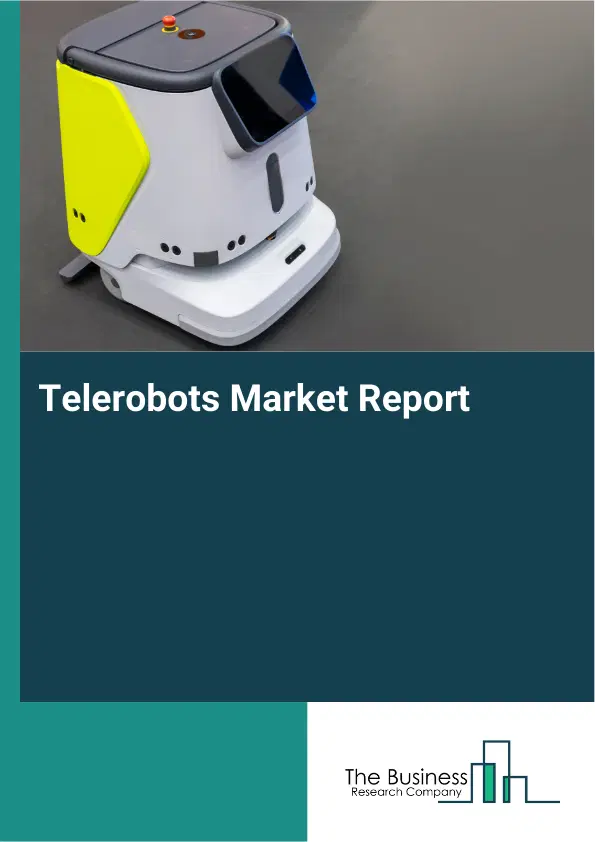
Telerobots Market Report 2026
Global Outlook – By Type (Industrial Telerobots, Medical Telerobots, Military Telerobots), By Component (Sensors, Actuators, Controllers, Communication Systems, Other Components), By Technology (Remote Controlled Robots, Autonomous Control Robots), By End-User (Healthcare Providers, Industrial Manufacturers, Defense And Military Organizations, Research And Space Agencies, Service Providers, Other End-Users) – Market Size, Trends, Strategies, and Forecast to 2030
Telerobots Market Overview
• Telerobots market size has reached to $32.26 billion in 2025 • Expected to grow to $89.97 billion in 2030 at a compound annual growth rate (CAGR) of 22.7% • Growth Driver: Rise In Automation Driving The Growth Of The Market Due To Increasing Demand For Efficiency And Remote Operations • Market Trend: Innovative Robotic Mobility Technologies Driving Growth In The Market Through Enhanced Operational Flexibility • North America was the largest region in 2025.What Is Covered Under Telerobots Market?
Telerobots are robotic systems that are operated remotely by humans to perform tasks in environments that may be unsafe, challenging, or inefficient for direct human intervention. These robots combine teleoperation (remote control) with automation technologies, enabling operators to control the robot's movements and actions through a user interface. They are typically equipped with sensors, cameras, and feedback mechanisms, such as haptic feedback, to provide operators with a sense of touch and visual awareness of the robot's surroundings. The main types of telerobots are industrial telerobots, medical telerobots, military telerobots, service telerobots, and others. Industrial telerobots refer to robots specifically designed for industrial applications that can be remotely controlled or operated through teleoperation. These telerobots are used in environments that are hazardous, difficult to access, or require high precision. They are built using components such as sensors, actuators, controllers, communication systems, and others. These robots operate on technologies such as remote-controlled robots and autonomous control robots and are available in different sizes, including personal assistance robots and compact telepresence robots. The end users are healthcare providers, industrial manufacturers, defense and military organizations, research and space agencies, service providers, and others.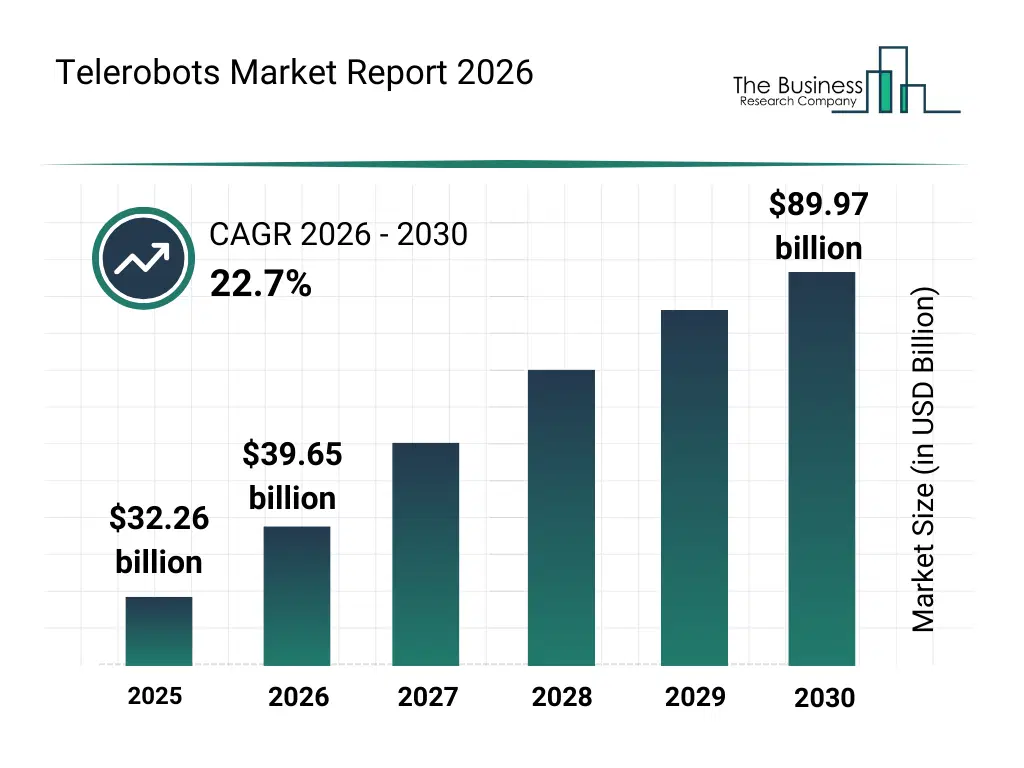
What Is The Telerobots Market Size and Share 2026?
The telerobots market size has grown exponentially in recent years. It will grow from $32.26 billion in 2025 to $39.65 billion in 2026 at a compound annual growth rate (CAGR) of 22.9%. The growth in the historic period can be attributed to defense sector demand for remote operations, growth in industrial automation, increased need for worker safety, adoption in space exploration missions, early deployment in medical teleoperation.What Is The Telerobots Market Growth Forecast?
The telerobots market size is expected to see exponential growth in the next few years. It will grow to $89.97 billion in 2030 at a compound annual growth rate (CAGR) of 22.7%. The growth in the forecast period can be attributed to advancements in AI assisted control systems, expansion of remote healthcare services, rising use in disaster response operations, growth in smart manufacturing facilities, demand for unmanned operations in extreme environments. Major trends in the forecast period include growing deployment in hazardous environments, rising demand for real time remote operations, expansion of telepresence based applications, increased use in inspection and maintenance tasks, focus on enhanced operator feedback systems.Tariff Impact On Telerobots Market
Tariffs have impacted the telerobots market by increasing the cost of imported sensors, actuators, control units, communication modules, and precision electronic components. Industrial, military, and medical telerobots are most affected, particularly in North America, Europe, and Asia Pacific where global supply chains are deeply integrated. Higher system costs have slowed procurement cycles for defense, healthcare, and industrial users while increasing project budgets. At the same time, tariffs have encouraged localized manufacturing, component sourcing diversification, and regional assembly, strengthening domestic robotics ecosystems and supply chain resilience.
Global Telerobots Market Segmentation
1) By Type: Industrial Telerobots, Medical Telerobots, Military Telerobots 2) By Component: Sensors, Actuators, Controllers, Communication Systems, Other Components 3) By Technology: Remote Controlled Robots, Autonomous Control Robots 4) By End-User: Healthcare Providers, Industrial Manufacturers, Defense And Military Organizations, Research And Space Agencies, Service Providers, Other End-Users Subsegments: 1) By Industrial Telerobots: Manufacturing Telerobots, Inspection And Maintenance Telerobots, Hazardous Material Handling Telerobots 2) By Medical Telerobots: Surgical Telerobots, Telepresence Robots, Rehabilitation Telerobots 3) By Military Telerobots: Bomb Disposal Robots, Surveillance And Reconnaissance Robots, Combat Support RobotsWhat Is The Driver Of The Telerobots Market?
The rise in demand for automation is expected to propel the growth of the telerobots market going forward. Automation refers to the use of technology, machines, and systems to perform tasks with minimal human intervention, aimed at improving efficiency, consistency, and precision by automating repetitive or complex processes. Automation reduces human error, which enhances efficiency and accuracy across various processes and leads to consistent quality and faster output in high-demand environments. Automation uses telerobots to remotely perform complex tasks in hazardous or inaccessible environments through precise robotic control. For instance, in April 2024, according to the International Federation of Robotics, a Germany-based professional robotics organization, in 2023, industrial robot installations in the United States increased by 12% compared to the previous year. Therefore, the rising demand for automation is driving growth in the telerobots industry.Key Players In The Global Telerobots Market
Major companies operating in the telerobots market are Intuitive Surgical, Inc., Kraft Telerobotics, Inc., Boston Dynamics, Inc., Sarcos Technology and Robotics Corporation, Teledyne FLIR LLC, QinetiQ Group plc, iRobot Corporation, Endeavor Robotics, Inc., Cybernetix S.A., Oceaneering International, Inc., Saab AB, Northrop Grumman Corporation, General Dynamics Mission Systems, Inc., Lockheed Martin Corporation, L3Harris Technologies, Inc., Kongsberg Gruppen ASA, ECA Group SA, HDT Global, Inc., Robotic Assistance Devices, Inc., Blue Ocean Robotics ApS, Anybots, Inc., InTouch Health, Inc.
This chart is for illustrative purposes; the full report includes a detailed competitor analysis and comprehensive overview of the top 10 companies in the market.
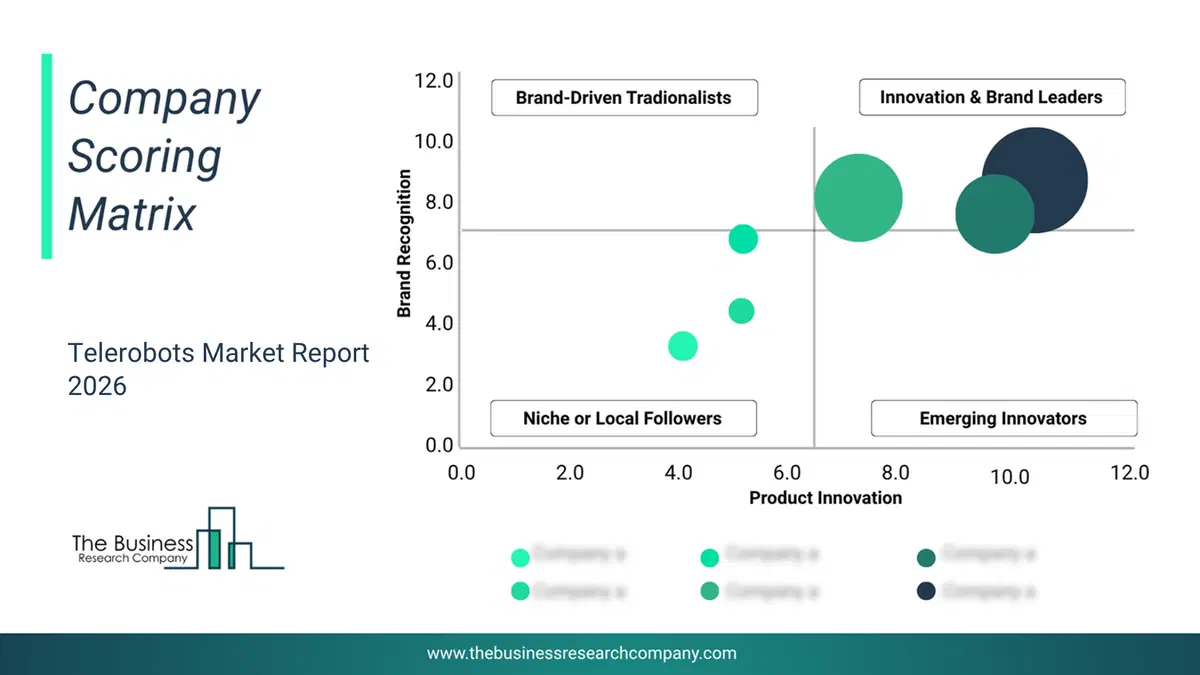
This chart maps companies by product innovation and brand strength, with bubble size indicating relative revenue, helping identify market leaders, challengers, and niche players. This is an illustrative chart; the full report provides a complete and accurate competitive analysis.
Global Telerobots Market Trends and Insights
Major companies operating in the telerobots market are focusing on developing advanced robotic mobility technologies to enhance operational flexibility and precision. Robotic mobility technologies refer to innovations that allow robots to move and navigate autonomously or with minimal human control, enabling them to perform tasks in complex, diverse, and sometimes hazardous environments. For instance, in March 2025, SS Innovations International Inc., an India-based surgical robotics company, launched the SSI Mantra Tele-Sync Mobile Unit (SSI MantraM), a mobile tele-robotic surgery unit. The mobile unit allows surgeons to perform complex surgeries remotely using mobile broadband networks, addressing the shortage of skilled surgeons in rural and remote areas. It enhances operational flexibility by enabling robotic surgical systems to operate in challenging healthcare environments, providing high-quality care with minimal human presence and expanding access to critical surgical services.What Are Latest Mergers And Acquisitions In The Telerobots Market?
In October 2025, Remedy Robotics Inc., a US-based telerobotics company, formed a partnership with Mission Thrombectomy to expand access to thrombectomy procedures for stroke patients. The collaboration aims to improve the availability and delivery of minimally invasive stroke interventions, leveraging advanced telerobotic technologies to enhance patient outcomes, reduce treatment delays, and drive innovation in neurovascular care. Mission Thrombectomy is a US-based medical services provider specializing in stroke intervention and thrombectomy solutions.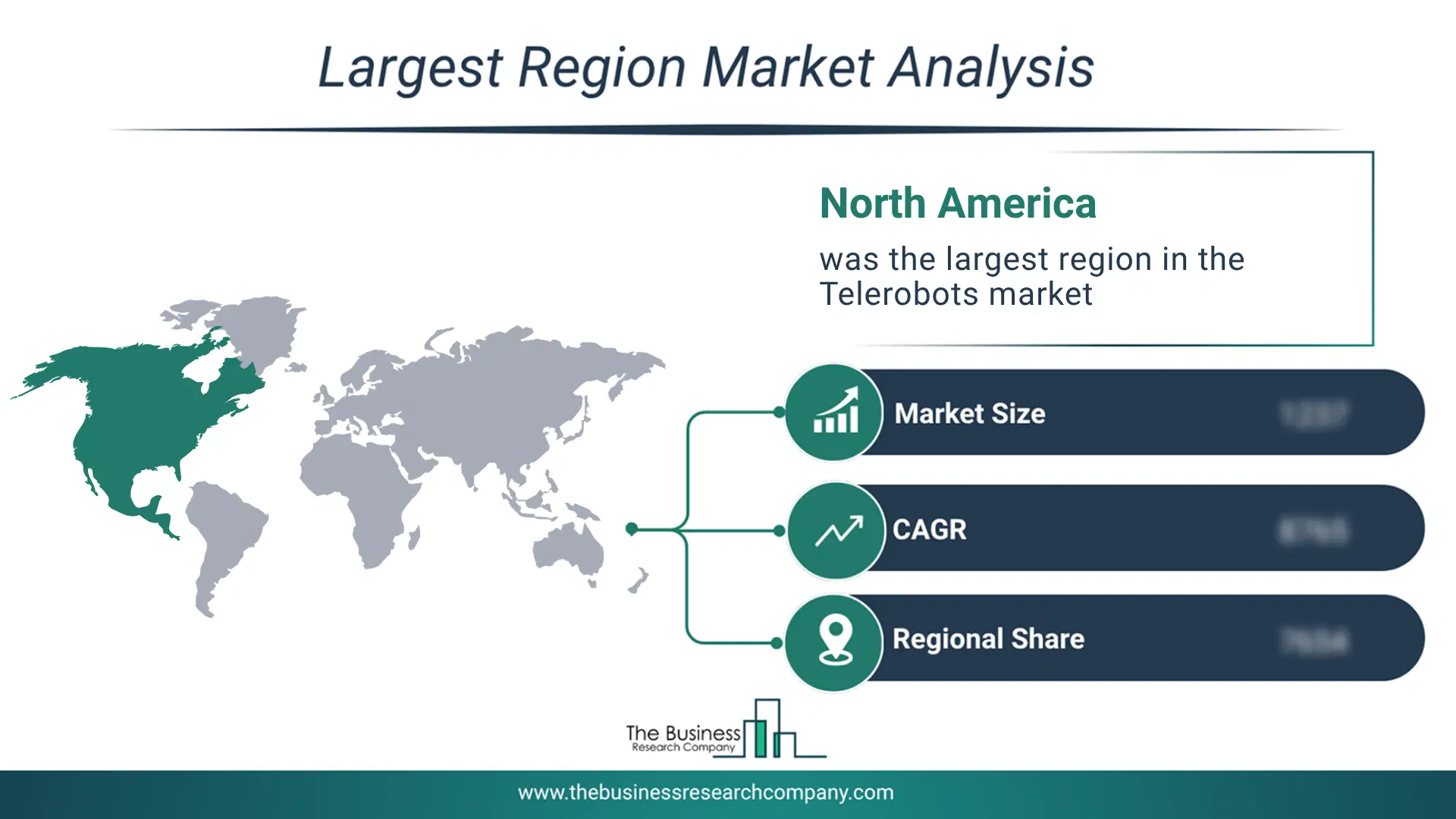
Regional Outlook
North America was the largest region in the telerobots market in 2025. The regions covered in this market report are Asia-Pacific, South East Asia, Western Europe, Eastern Europe, North America, South America, Middle East, Africa The countries covered in this market report are Australia, Brazil, China, France, Germany, India, Indonesia, Japan, Taiwan, Russia, South Korea, UK, USA, Canada, Italy, Spain.What Defines the Telerobots Market?
The telerobots market consists of sales of telepresence robots, surgical telerobots, remote inspection robots, underwater telerobots, disaster response robots, space exploration telerobots, and robotic arms for industrial remote operations. Values in this market are ‘factory gate’ values, that is, the value of goods sold by the manufacturers or creators of the goods, whether to other entities (including downstream manufacturers, wholesalers, distributors, and retailers) or directly to end customers. The value of goods in this market includes related services sold by the creators of the goods.How is Market Value Defined and Measured?
The market value is defined as the revenues that enterprises gain from the sale of goods and/or services within the specified market and geography through sales, grants, or donations in terms of the currency (in USD unless otherwise specified). The revenues for a specified geography are consumption values that are revenues generated by organizations in the specified geography within the market, irrespective of where they are produced. It does not include revenues from resales along the supply chain, either further along the supply chain or as part of other products.
This chart presents market attractiveness based on a quantitative evaluation of growth, competition, strategic alignment, and risk, offering a clear view of opportunity areas for decision-making. This chart is for illustrative purposes; the full report contains the complete analysis.

This chart highlights the Total Addressable Market (TAM) by estimating the maximum revenue opportunity using an assumption-driven approach, supporting strategic planning and opportunity sizing across markets. The chart is illustrative; the full report provides a more comprehensive analysis.
What Key Data and Analysis Are Included in the Telerobots Market Report 2026?
The telerobots market research report is one of a series of new reports from The Business Research Company that provides market statistics, including industry global market size, regional shares, competitors with the market share, detailed market segments, market trends and opportunities, and any further data you may need to thrive in the telerobots industry. The market research report delivers a complete perspective of everything you need, with an in-depth analysis of the current and future state of the industry.Telerobots Market Report Forecast Analysis
| Report Attribute | Details |
|---|---|
| Market Size Value In 2026 | $39.65 billion |
| Revenue Forecast In 2030 | $89.97 billion |
| Growth Rate | CAGR of 22.7% from 2026 to 2030 |
| Base Year For Estimation | 2025 |
| Actual Estimates/Historical Data | 2020-2025 |
| Forecast Period | 2026 - 2030 |
| Market Representation | Revenue in USD Billion and CAGR from 2026 to 2030 |
| Segments Covered | Type, Component, Technology, End-User |
| Regional Scope | Asia-Pacific, Western Europe, Eastern Europe, North America, South America, Middle East, Africa |
| Key Companies Profiled | Intuitive Surgical, Inc., Kraft Telerobotics, Inc., Boston Dynamics, Inc., Sarcos Technology and Robotics Corporation, Teledyne FLIR LLC, QinetiQ Group plc, iRobot Corporation, Endeavor Robotics, Inc., Cybernetix S.A., Oceaneering International, Inc., Saab AB, Northrop Grumman Corporation, General Dynamics Mission Systems, Inc., Lockheed Martin Corporation, L3Harris Technologies, Inc., Kongsberg Gruppen ASA, ECA Group SA, HDT Global, Inc., Robotic Assistance Devices, Inc., Blue Ocean Robotics ApS, Anybots, Inc., InTouch Health, Inc. |
| Customization Scope | Request for Customization |
| Pricing And Purchase Options | Explore Purchase Options |