
Temperature Sensor Market Report 2026
Global Outlook – By Product Type ( Contact Temperature Sensors, Non-Contact Temperature Sensors), By Output ( Digital, Analog), By Connectivity ( Wired, Wireless), By End-User ( Manufacturing Industry, Aerospace Industry, Energy Sector, Electronics Industry, HVAC Industry, Other End-Users) – Market Size, Trends, Strategies, and Forecast to 2030
Temperature Sensor Market Overview
• Temperature Sensor market size has reached to $9.99 billion in 2025 • Expected to grow to $15.33 billion in 2030 at a compound annual growth rate (CAGR) of 9% • Growth Driver: Rise In The Prevalence Of Autonomous Vehicles • Market Trend: Innovations In Temperature And Humidity Sensing For Harsh Environments • Asia-Pacific was the largest region and fastest growing region.What Is Covered Under Temperature Sensor Market?
A temperature sensor is an electronic device that records, monitors, or signals temperature changes by measuring the temperature of its surroundings and converting the input data into electronic data. Temperature sensors are used to take accurate temperature measurement readings. The main types of temperature sensors are contact temperature sensors and non-contact temperature sensors. Contact temperature sensors are electronic devices that need to be kept in physical contact with the substance for being sensed and use conduction mechanisms to monitor temperature changes. They are used to detect a wide range of temperatures. The different outputs include digital, and analog and involve various connectivity types such as wired, and wireless. It is used in several sectors including the manufacturing industry, aerospace industry, energy sector, electronics industry, HVAC industry, and others.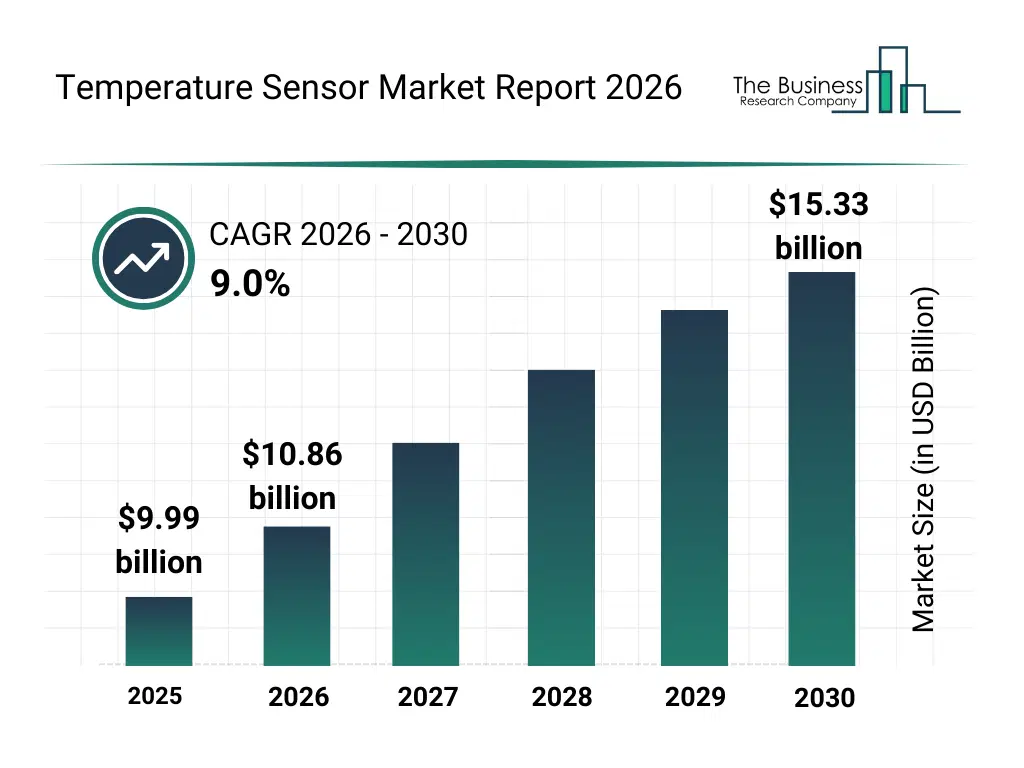
What Is The Temperature Sensor Market Size 2026 And Growth Rate?
The temperature sensor market size has grown strongly in recent years. It will grow from $9.99 billion in 2025 to $10.86 billion in 2026 at a compound annual growth rate (CAGR) of 8.7%. The growth in the historic period can be attributed to rising deployment of thermocouples in industrial systems, early adoption of rtds for precision measurement, increasing usage in hvac systems, growth in automotive thermal sensing, expansion of analog sensor applications.What Is The Temperature Sensor Market Growth Forecast?
The temperature sensor market size is expected to see strong growth in the next few years. It will grow to $15.33 billion in 2030 at a compound annual growth rate (CAGR) of 9.0%. The growth in the forecast period can be attributed to rising demand for wireless temperature sensors, development of compact non-contact sensors, growing integration in smart home ecosystems, expansion of thermal imaging in medical and aerospace, increasing adoption in energy-efficient industrial operations. Major trends in the forecast period include adoption of AI-based temperature monitoring, expansion of IoT-enabled thermal sensing networks, growth of intelligent manufacturing temperature controls, rise of cloud-integrated thermal analytics, development of sustainable low-power sensors.
Global Temperature Sensor Market Segmentation
1) By Product Type: Contact Temperature Sensors, Non-Contact Temperature Sensors 2) By Output: Digital, Analog 3) By Connectivity: Wired, Wireless 4) By End-User: Manufacturing Industry, Aerospace Industry, Energy Sector, Electronics Industry, HVAC Industry, Other End-Users Subsegments: 1) By Contact Temperature Sensors: Thermocouples, Resistance Temperature Detectors (RTDs), Thermistors, Bimetallic Temperature Sensors, Surface Temperature Sensors 2) By Non-Contact Temperature Sensors: Infrared Sensors, Thermal Imaging Cameras, Laser Temperature Sensors, Fiber Optic Temperature SensorsWhat Is The Driver Of The Temperature Sensor Market?
An increase in the prevalence of autonomous vehicles is expected to propel the growth of the temperature sensor market going forward. An autonomous vehicle refers to a motor vehicle that operates without the support of human effort to drive on the road. Automatic vehicles use temperature sensors to keep a measure of vehicle engine temperatures and accordingly switch on the cooling fans to maintain an optimally required engine temperature. This helps to increase the vehicle's performance. For instance, in March 2024, according to the DQS Global, a Germany-based auditing and certification company, the United States is expected to have around 3.5 million autonomous vehicles on its roads by 2025, with this figure projected to increase to 4.5 million by 2030. Therefore, the increase in the prevalence of autonomous vehicles is driving the temperature sensor industry growth during forecast period.Key Players In The Global Temperature Sensor Market
Major companies operating in the temperature sensor market are Siemens AG, NXP Semiconductors N.V., Infineon Technologies AG, Texas Instruments Incorporated, Denso Corporation, Tyco Electronics Ltd Connectivity, Omron Corporation, Sensor Scientific Inc., WIKA Instruments India Pvt. Ltd., Keyence Corporation, Dwyer Instruments Ltd., Standex Electronics Inc., Thermocouple Technology LLC, Kelvin Technologies Inc., Thermo Sensors Corporation, Honeywell International Inc., Endress+Hauser Management AG, Maxim Integrated, Emerson Electric Co., Asea Brown Boveri, Société de Techniques Microélectroniques, Amphenol Advanced Sensors, Sensata Technologies India Pvt. Ltd., Microchip Technology Inc., Omega Engineering Inc., Panasonic Corporation, Fluke Corporation, Danfoss A/S, Tokyo Denki Kagaku Kogyo Kabushiki-gaisha Corporation, Murata Manufacturing Co. Ltd., Vishay Intertechnology Inc., ON Semiconductor Corporation, Analog Devices Inc., Sensirion AG, Melexis NV, Elektronik Gesellschaft mit beschränkter Haftung, Heraeus Holding GmbH, Micro-Epsilon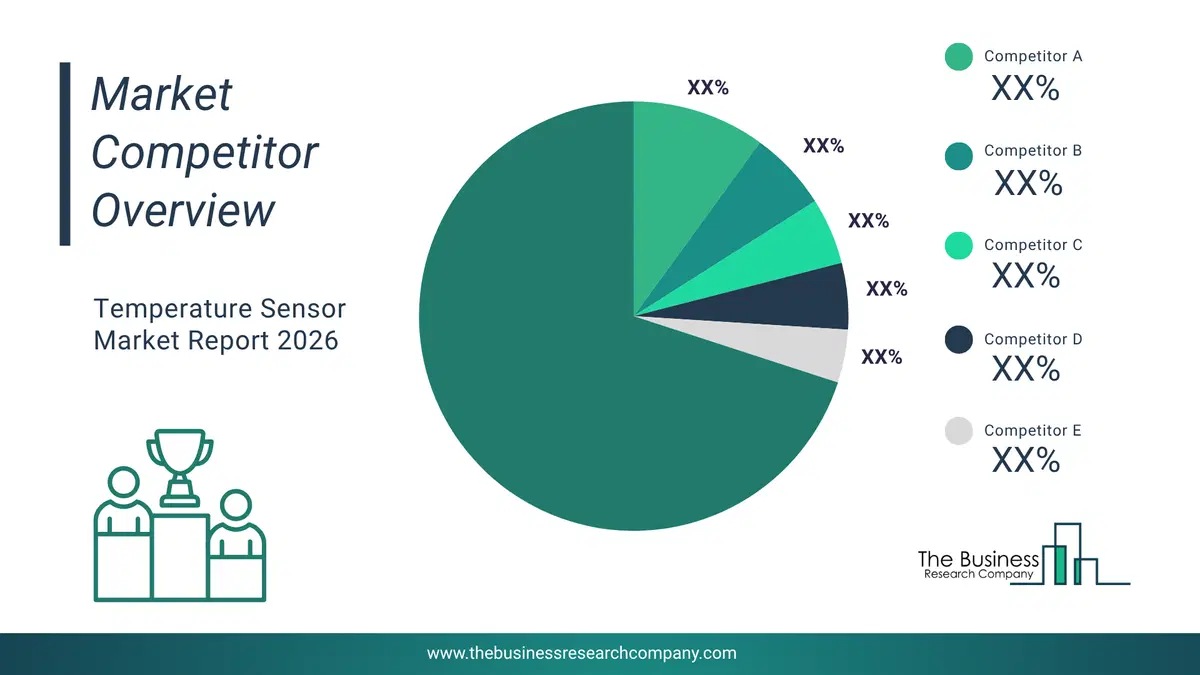
This chart is for illustrative purposes; the full report includes a detailed competitor analysis and comprehensive overview of the top 10 companies in the market.
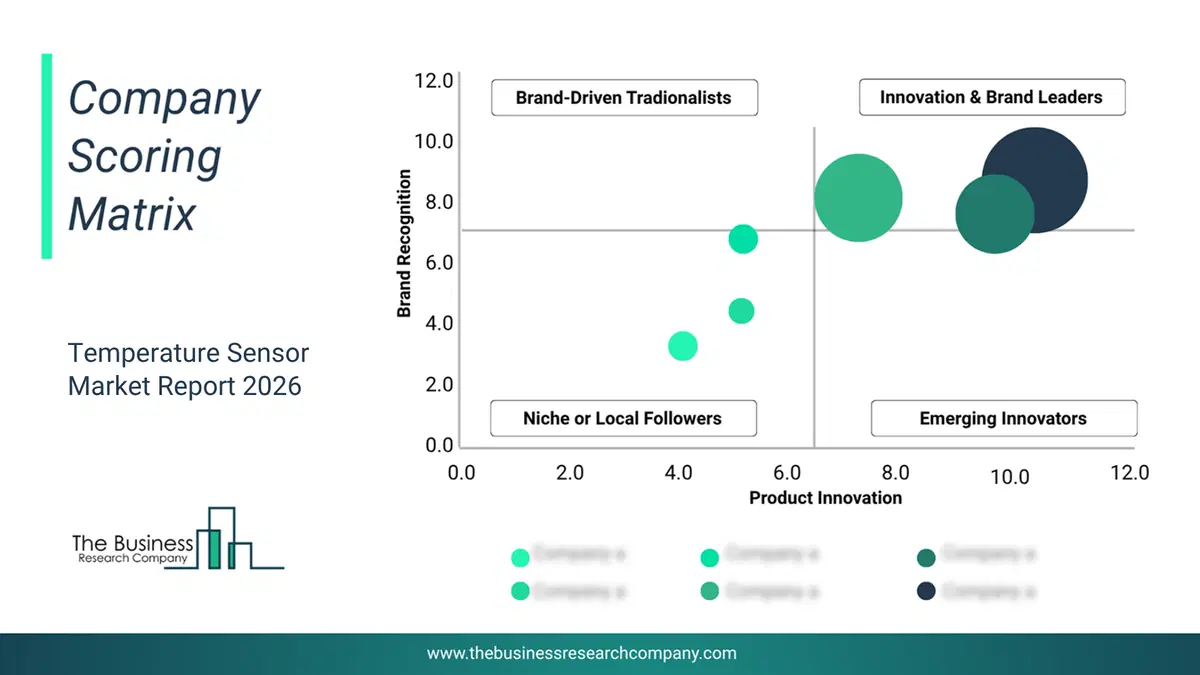
This chart maps companies by product innovation and brand strength, with bubble size indicating relative revenue, helping identify market leaders, challengers, and niche players. This is an illustrative chart; the full report provides a complete and accurate competitive analysis.
Global Temperature Sensor Market Trends and Insights
Major companies operating in the temperature sensor market are focusing on developing innovative solutions such as digital humidity and temperature sensors with protective covers to enhance measurement accuracy, ensure durability in harsh environments, and simplify integration into electronic systems. Digital humidity and temperature sensors refer to devices that combine precise sensing elements with integrated electronics to provide accurate, real-time environmental data in a compact form factor. For instance, in November 2025, Sensirion, a Switzerland-based sensor manufacturer, launched new SHT40-AD1P-R2 and SHT41-AD1P-R2, designed with a removable protective cover for enhanced durability and reliability during handling and deployment in demanding environments. These sensors are designed to deliver reliable readings in challenging conditions while reducing maintenance requirements, making them suitable for applications in industrial automation, HVAC systems, medical devices, and consumer electronics.What Are Latest Mergers And Acquisitions In The Temperature Sensor Market?
In May 2023, SpotSee, a US-based environmental condition monitoring solutions provider, acquired unique temperature indicator technologies and intellectual property from Sensor International, for an undisclosed amount. This acquisition enables the company to offer a comprehensive and effective solution for monitoring temperature and other environmental conditions in various industries. The acquisition will expand SpotSee's temperature surveillance capabilities, which is crucial for its supply chain monitoring services. Sensor International is a Bangladesh-based company that operates in the sensor industry.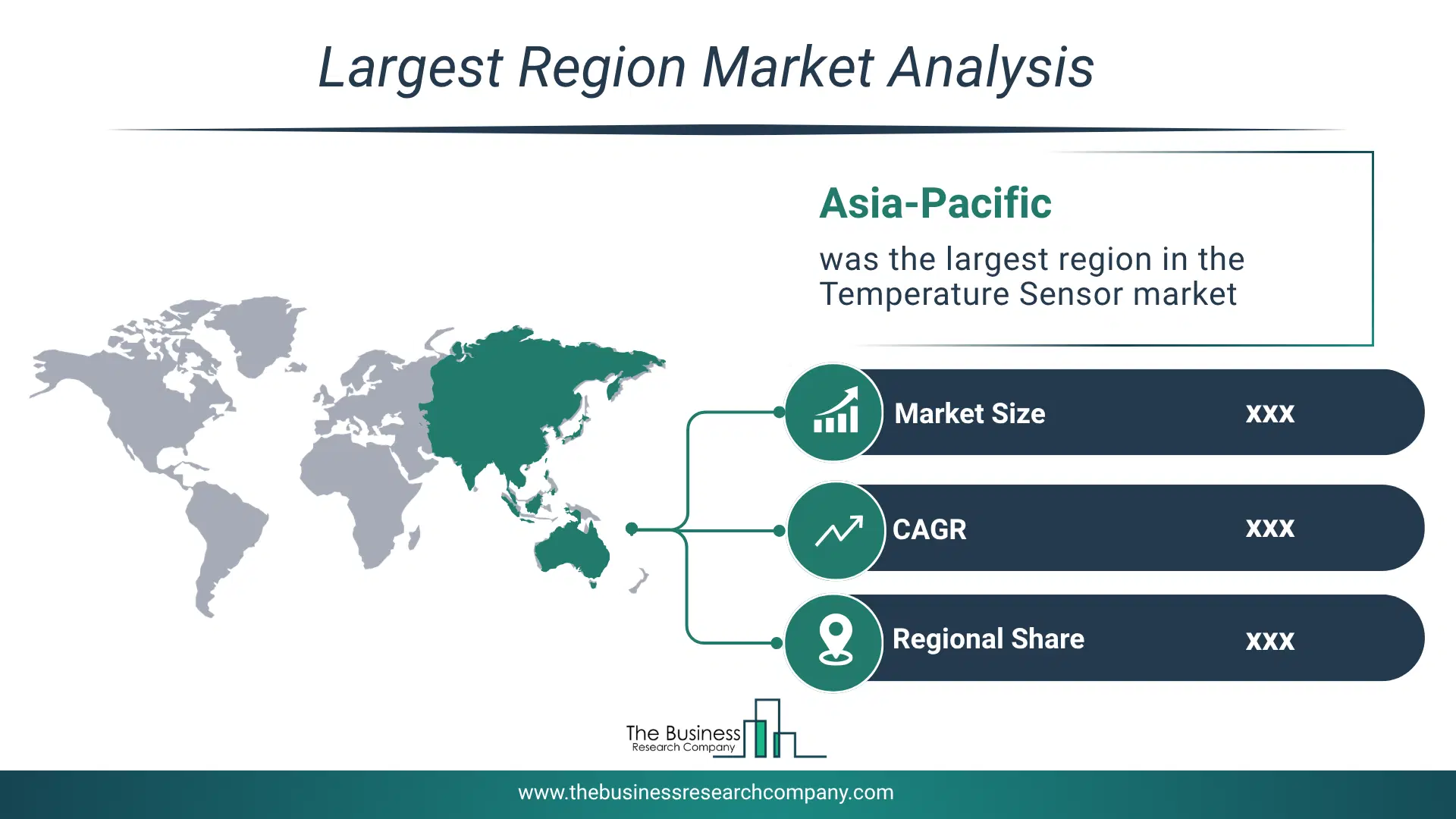
Regional Outlook
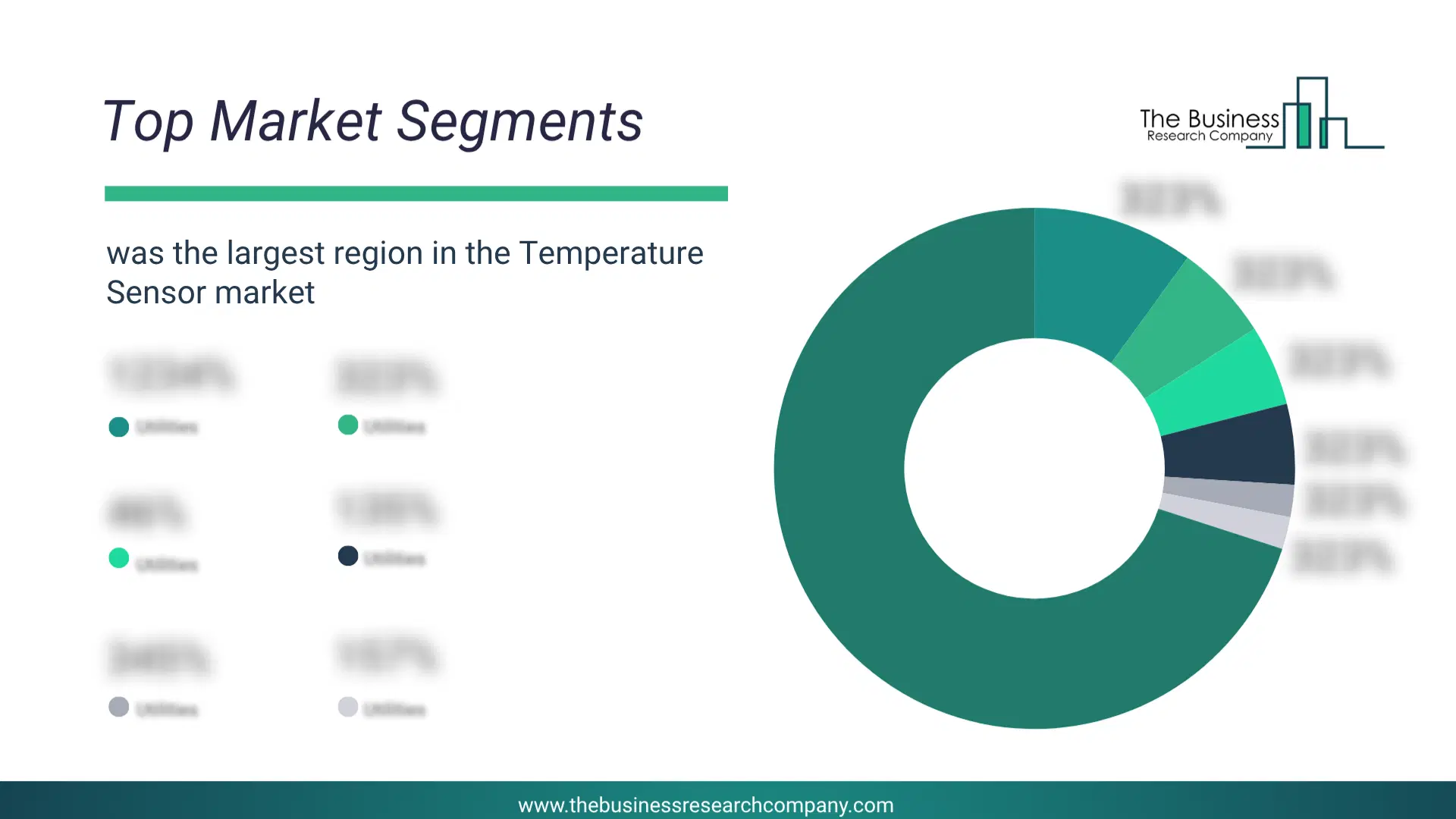
Asia-Pacific was the largest region in the temperature sensor market in 2025. Asia-Pacific is expected to be the fastest-growing region in the forecast period. The regions covered in this market report are Asia-Pacific, South East Asia, Western Europe, Eastern Europe, North America, South America, Middle East, Africa. The countries covered in this market report are Australia, Brazil, China, France, Germany, India, Indonesia, Japan, Taiwan, Russia, South Korea, UK, USA, Canada, Italy, Spain.What Defines the Temperature Sensor Market?
The temperature sensor market consists of sales of contact-type temperature sensors and noncontact-type temperature sensors. Values in this market are ‘factory gate’ values, that is the value of goods sold by the manufacturers or creators of the goods, whether to other entities (including downstream manufacturers, wholesalers, distributors and retailers) or directly to end customers. The value of goods in this market includes related services sold by the creators of the goods.How is Market Value Defined and Measured?
The market value is defined as the revenues that enterprises gain from the sale of goods and/or services within the specified market and geography through sales, grants, or donations in terms of the currency (in USD unless otherwise specified). The revenues for a specified geography are consumption values that are revenues generated by organizations in the specified geography within the market, irrespective of where they are produced. It does not include revenues from resales along the supply chain, either further along the supply chain or as part of other products.
This chart presents market attractiveness based on a quantitative evaluation of growth, competition, strategic alignment, and risk, offering a clear view of opportunity areas for decision-making. This chart is for illustrative purposes; the full report contains the complete analysis.

This chart highlights the Total Addressable Market (TAM) by estimating the maximum revenue opportunity using an assumption-driven approach, supporting strategic planning and opportunity sizing across markets. The chart is illustrative; the full report provides a more comprehensive analysis.
What Key Data and Analysis Are Included in the Temperature Sensor Market Report 2026?
The temperature sensor market research report is one of a series of new reports from The Business Research Company that provides market statistics, including industry global market size, regional shares, competitors with the market share, detailed market segments, market trends and opportunities, and any further data you may need to thrive in the temperature sensor industry. The market research report delivers a complete perspective of everything you need, with an in-depth analysis of the current and future state of the industry.Temperature Sensor Market Report Forecast Analysis
| Report Attribute | Details |
|---|---|
| Market Size Value In 2026 | $10.86 billion |
| Revenue Forecast In 2030 | $15.33 billion |
| Growth Rate | CAGR of 9% from 2026 to 2030 |
| Base Year For Estimation | 2025 |
| Actual Estimates/Historical Data | 2020-2025 |
| Forecast Period | 2026 - 2030 |
| Market Representation | Revenue in USD Billion and CAGR from 2026 to 2030 |
| Segments Covered | Product Type, Output, Connectivity, End-User |
| Regional Scope | Asia-Pacific, Western Europe, Eastern Europe, North America, South America, Middle East, Africa |
| Country Scope | The countries covered in the report are Australia, Brazil, China, France, Germany, India, Indonesia, Japan, Taiwan, Russia, South Korea, UK, USA, Canada, Italy, Spain. |
| Key Companies Profiled | Siemens AG, NXP Semiconductors N.V., Infineon Technologies AG, Texas Instruments Incorporated, Denso Corporation, Tyco Electronics Ltd Connectivity, Omron Corporation, Sensor Scientific Inc., WIKA Instruments India Pvt. Ltd., Keyence Corporation, Dwyer Instruments Ltd., Standex Electronics Inc., Thermocouple Technology LLC, Kelvin Technologies Inc., Thermo Sensors Corporation, Honeywell International Inc., Endress+Hauser Management AG, Maxim Integrated, Emerson Electric Co., Asea Brown Boveri, Société de Techniques Microélectroniques, Amphenol Advanced Sensors, Sensata Technologies India Pvt. Ltd., Microchip Technology Inc., Omega Engineering Inc., Panasonic Corporation, Fluke Corporation, Danfoss A/S, Tokyo Denki Kagaku Kogyo Kabushiki-gaisha Corporation, Murata Manufacturing Co. Ltd., Vishay Intertechnology Inc., ON Semiconductor Corporation, Analog Devices Inc., Sensirion AG, Melexis NV, Elektronik Gesellschaft mit beschränkter Haftung, Heraeus Holding GmbH, Micro-Epsilon |
| Customization Scope | Request for Customization |
| Pricing And Purchase Options | Explore Purchase Options |