

Temporomandibular Joint (TMJ) Implants Market Report 2026
Global Outlook – By Components (Mandibular Components, Fossa Prosthesis, Screws), By Material (Cobalt-Chromium-Molybdenum, Titanium Alloy, Ultra-High Molecular Weight Polyethylene (Uhmwpe), Stainless Steel, Polyether Ether Ketone (PEEK), Other Materials), By Indication (Arthritic Conditions, Ankylosis, Other Indications), By End-User (Hospitals, Dental Clinics, Other End-Users) – Market Size, Trends, Strategies, and Forecast to 2035
Temporomandibular Joint (TMJ) Implants Market Overview
• Temporomandibular Joint (TMJ) Implants market size has reached to $5.6 billion in 2025 • Expected to grow to $7.66 billion in 2030 at a compound annual growth rate (CAGR) of 6.5% • Growth Driver: Increasing Prevalence Of Dental Disorders Driving Growth Of The TMJ Implant • Market Trend: Innovative Solutions With TMJ Arthroplasty System Revolutionizes Care For TMJ Disorders • North America was the largest region in 2025.What Is Covered Under Temporomandibular Joint (TMJ) Implants Market?
Temporomandibular Joint (TMJ) Implants are artificial devices designed to replace part or all of the temporomandibular joint (TMJ), which connects the jawbone to the skull. These implants are typically used in cases where the joint is severely damaged due to conditions such as arthritis, trauma, congenital deformities, or previous unsuccessful surgeries. The main components of temporomandibular joint (TMJ) implants are mandibular components, fossa prostheses, and screws. Mandibular components are parts of the temporomandibular joint (TMJ) implants designed to replace or restore the mandibular (lower jaw) portion of the joint. The various materials include cobalt-chromium-molybdenum, titanium alloy, ultra-high molecular weight polyethylene (UHMWP), aluminum, silicone, and others with various indications such as arthritic conditions, ankylosis, and others. These are used by various end-users such as hospitals, dental clinics, and others.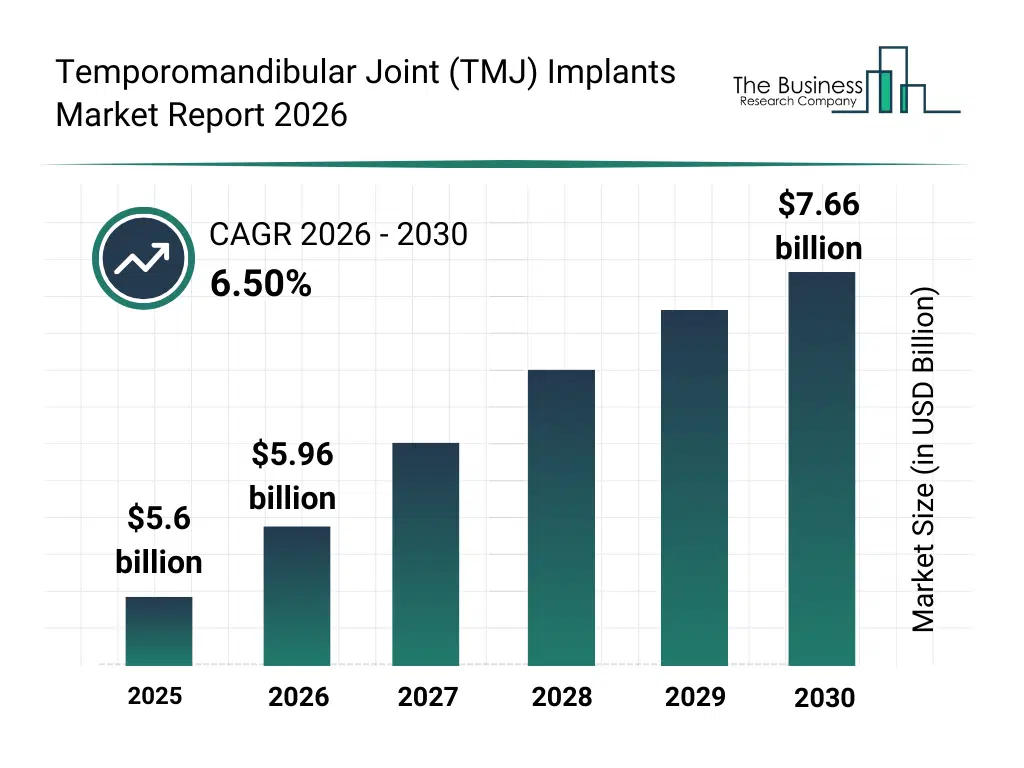
What Is The Temporomandibular Joint (TMJ) Implants Market Size and Share 2026?
The temporomandibular joint (tmj) implants market size has grown strongly in recent years. It will grow from $5.6 billion in 2025 to $5.96 billion in 2026 at a compound annual growth rate (CAGR) of 6.4%. The growth in the historic period can be attributed to increasing prevalence of tmj disorders, expansion of maxillofacial surgical procedures, improvements in implant material science, rising awareness of reconstructive treatment options, availability of specialized surgical expertise.What Is The Temporomandibular Joint (TMJ) Implants Market Growth Forecast?
The temporomandibular joint (tmj) implants market size is expected to see strong growth in the next few years. It will grow to $7.66 billion in 2030 at a compound annual growth rate (CAGR) of 6.5%. The growth in the forecast period can be attributed to increasing adoption of personalized implant solutions, rising investments in advanced oral surgery technologies, expansion of aging population requiring joint reconstruction, growing demand for minimally invasive tmj procedures, increasing integration of digital planning tools in implant surgeries. Major trends in the forecast period include increasing adoption of patient-specific tmj implants, rising use of advanced biocompatible materials, growing demand for customized joint reconstruction solutions, expansion of computer-aided implant design and manufacturing, enhanced focus on long-term implant durability.
Global Temporomandibular Joint (TMJ) Implants Market Segmentation
1) By Components: Mandibular Components, Fossa Prosthesis, Screws 2) By Material: Cobalt-Chromium-Molybdenum, Titanium Alloy, Ultra-High Molecular Weight Polyethylene (Uhmwpe), Stainless Steel, Polyether Ether Ketone (PEEK), Other Materials 3) By Indication: Arthritic Conditions, Ankylosis, Other Indications 4) By End-User: Hospitals, Dental Clinics, Other End-Users Subsegments: 1) By Mandibular Components: Complete Mandibular Prosthesis, Partial Mandibular Prosthesis, Mandibular Condylar Prosthesis 2) By Fossa Prosthesis: Non-Adjustable Fossa Prosthesis, Adjustable Fossa Prosthesis, Anatomical Fossa Prosthesis 3) By Screws: Fixation Screws, Bone Screws, Self-Tapping ScrewsWhat Is The Driver Of The Temporomandibular Joint (TMJ) Implants Market?
The increasing prevalence of dental disorders is expected to propel the growth of the temporomandibular joint (TMJ) implant market going forward. Dental disorders refer to various conditions that affect the teeth, gums, and oral cavity, leading to pain, dysfunction, and other health issues. The increasing prevalence of dental disorders is due to poor oral hygiene, trauma, genetic predispositions, and lifestyle choices. Temporomandibular joint (TMJ) implants offer a transformative solution for individuals suffering from temporomandibular joint disorders, providing targeted relief and improved functionality. These advanced implants are designed to address the underlying issues associated with TMJ dysfunction, enhancing both comfort and quality of life for patients struggling with dental-related joint pain and dysfunction. For instance, in September 2023, according to the National Library Of Medicine, a US-based government agency, the older adult population with periodontal disease is expected to increase by 54.57% in 2050. Additionally, the older adult population with carious teeth is estimated to increase by 62.06% in 2050. Therefore, the increasing prevalence of dental disorders drives the temporomandibular joint (TMJ) implant industry.Key Players In The Global Temporomandibular Joint (TMJ) Implants Market
Major companies operating in the temporomandibular joint (tmj) implants market are Stryker Corporation, Zimmer Biomet Holdings Inc., Materialise NV, Auxein Corporation, Dentsply Sirona, Ortho Baltic, Xilloc Medical B.V., Ortho Max Mfg. Co. Pvt. Ltd., RAOMED, TMJ Concepts Inc., KLS Martin Group, DePuy Synthes CMF, Medartis AG, Acumed LLC, Jeil Medical Corporation, Aesculap Inc., Biomet Microfixation (Zimmer Biomet CMF), Medtronic CMF, Johnson & Johnson DePuy CMF, Sientra Inc.Global Temporomandibular Joint (TMJ) Implants Market Trends and Insights
Major companies operating in the temporomandibular joint (TMJ) implant market are focused on developing innovative solutions such as the TMJ Total Arthroplasty System to enhance the precision of joint reconstruction, improve patient outcomes, and reduce recovery times. The TMJ Total Arthroplasty System is a medical device designed for the surgical treatment of severe temporomandibular joint (TMJ) disorders that offers a viable solution for patients who have not found relief through other methods. For instance, in February 2024, Materialise NV, a Belgium-based 3D printing company, launched its latest solution to treat patients requiring total temporomandibular joint (TMJ) arthroplasty. The system includes predrilling and osteotomy guides made of titanium or polyamide to ensure precise preparation for the implant. It also provides a surgical splint for occlusion control and a TMJ trial implant for the temporal component. TMJ Total Arthroplasty System brings new hope for patients suffering from TMJ disorders requiring total joint replacement. The comprehensive portfolio and seamless integration with other Materialise solutions make it a valuable tool for oral and maxillofacial surgeons.What Are Latest Mergers And Acquisitions In The Temporomandibular Joint (TMJ) Implants Market?
In May 2023, Zimmer Biomet Holdings Inc., a US-based company that manufactures medical devices, acquired OSSIS Corporation for an undisclosed amount. With this acquisition, Zimmer Biomet aimed to strengthen its capabilities in providing innovative implant solutions, including those for temporomandibular joint (TMJ) disorders, and expand its reach in the complex orthopedic and reconstructive surgeries market. OSSIS Corporation is a US-based company that manufactures temporomandibular joint (TMJ) implants.Regional Outlook
North America was the largest region in the temporomandibular joint (TMJ) implants market in 2025. The regions covered in this market report are Asia-Pacific, South East Asia, Western Europe, Eastern Europe, North America, South America, Middle East, Africa. The countries covered in this market report are Australia, Brazil, China, France, Germany, India, Indonesia, Japan, Taiwan, Russia, South Korea, UK, USA, Canada, Italy, SpainWhat Defines the Temporomandibular Joint (TMJ) Implants Market?
The temporomandibular joint (TMJ) implants market consists of sales of prosthetic devices, condylar implants, and bilateral TMJ implants. Values in this market are ‘factory gate’ values, that is the value of goods sold by the manufacturers or creators of the goods, whether to other entities (including downstream manufacturers, wholesalers, distributors and retailers) or directly to end customers. The value of goods in this market includes related services sold by the creators of the goods.How is Market Value Defined and Measured?
The market value is defined as the revenues that enterprises gain from the sale of goods and/or services within the specified market and geography through sales, grants, or donations in terms of the currency (in USD unless otherwise specified). The revenues for a specified geography are consumption values that are revenues generated by organizations in the specified geography within the market, irrespective of where they are produced. It does not include revenues from resales along the supply chain, either further along the supply chain or as part of other products.Temporomandibular Joint (TMJ) Implants Market Report Forecast Analysis
| Report Attribute | Details |
|---|---|
| Market Size Value In 2026 | $5.96 billion |
| Revenue Forecast In 2035 | $7.66 billion |
| Growth Rate | CAGR of 6.4% from 2026 to 2035 |
| Base Year For Estimation | 2025 |
| Actual Estimates/Historical Data | 2020-2025 |
| Forecast Period | 2026 - 2030 - 2035 |
| Market Representation | Revenue in USD Billion and CAGR from 2026 to 2035 |
| Segments Covered | Components, Material, Indication, End-User |
| Regional Scope | Asia-Pacific, Western Europe, Eastern Europe, North America, South America, Middle East, Africa |
| Country Scope | The countries covered in the report are Australia, Brazil, China, France, Germany, India, ... |
| Key Companies Profiled | Stryker Corporation, Zimmer Biomet Holdings Inc., Materialise NV, Auxein Corporation, Dentsply Sirona, Ortho Baltic, Xilloc Medical B.V., Ortho Max Mfg. Co. Pvt. Ltd., RAOMED, TMJ Concepts Inc., KLS Martin Group, DePuy Synthes CMF, Medartis AG, Acumed LLC, Jeil Medical Corporation, Aesculap Inc., Biomet Microfixation (Zimmer Biomet CMF), Medtronic CMF, Johnson & Johnson DePuy CMF, Sientra Inc. |
| Customization Scope | Request for Customization |
| Pricing And Purchase Options | Explore Purchase Options |