

Terahertz Technology Market Report 2026
Global Outlook – By Type ( Terahertz Imaging, Terahertz Spectroscopy, Terahertz Communication), By Technology ( Photoconductive Switching, Quantum Cascade Lasers, Free-Space Electro-Optic Sampling, Fiber-Coupled Terahertz Spectroscopy), By Frequency Range ( Sub-Terahertz (0.1 - 1 THz), Low Terahertz (1 - 3 THz), High Tera hertz (3 - 10 THz)), By Application ( Imaging, Communications, Spectroscopy), By End User ( Laboratory Research, Medical And Healthcare, Defense And Security, Industrial, Telecommunications, Other End Users) – Market Size, Trends, Strategies, and Forecast to 2030
Terahertz Technology Market Overview
• Terahertz Technology market size has reached to $0.84 billion in 2025 • Expected to grow to $1.8 billion in 2030 at a compound annual growth rate (CAGR) of 16.4% • Growth Driver: Rising Demand For Non-Invasive Imaging Driving The Terahertz Technology Market Due To Increasing Adoption In Medical Diagnostics • Market Trend: Innovations Enabling Ultra-High-Speed Wireless Communication And Advanced Imaging • North America was the largest region in 2025 and Asia-Pacific is the fastest growing region.Market Gains By 2030 – Top Opportunities By Segment
Market Gain identifies the most promising market opportunities by highlighting the segments or products expected to generate the highest incremental revenue growth over the next five years.
What Is Covered Under Terahertz Technology Market?
Terahertz technology refers to the use of electromagnetic waves in the terahertz frequency range (0.1 to 10 THz) for applications such as imaging, spectroscopy, and high-speed wireless communication. Terahertz technology is utilized in applications such as non-destructive testing, security screening, biomedical imaging, and high-speed wireless communication by exploiting its ability to penetrate materials and provide spectroscopic information. The main types of terahertz technology are terahertz imaging, terahertz spectroscopy, and terahertz communication. Terahertz imaging is a non-invasive technique that uses terahertz waves to capture high-resolution images of internal structures for applications in healthcare, manufacturing, and security. It includes various technologies such as photoconductive switching, quantum cascade lasers, free-space electro-optic sampling, and fiber-coupled terahertz spectroscopy and operates across different frequency ranges, including sub-terahertz (0.1–1 THz), low terahertz (1–3 THz), high terahertz (3–10 THz), and ultrafast terahertz (10+ THz). These technologies are applied in imaging, communications, and spectroscopy and are used by end users including laboratory research, medical and healthcare, defense and security, industrial, telecommunications, and others.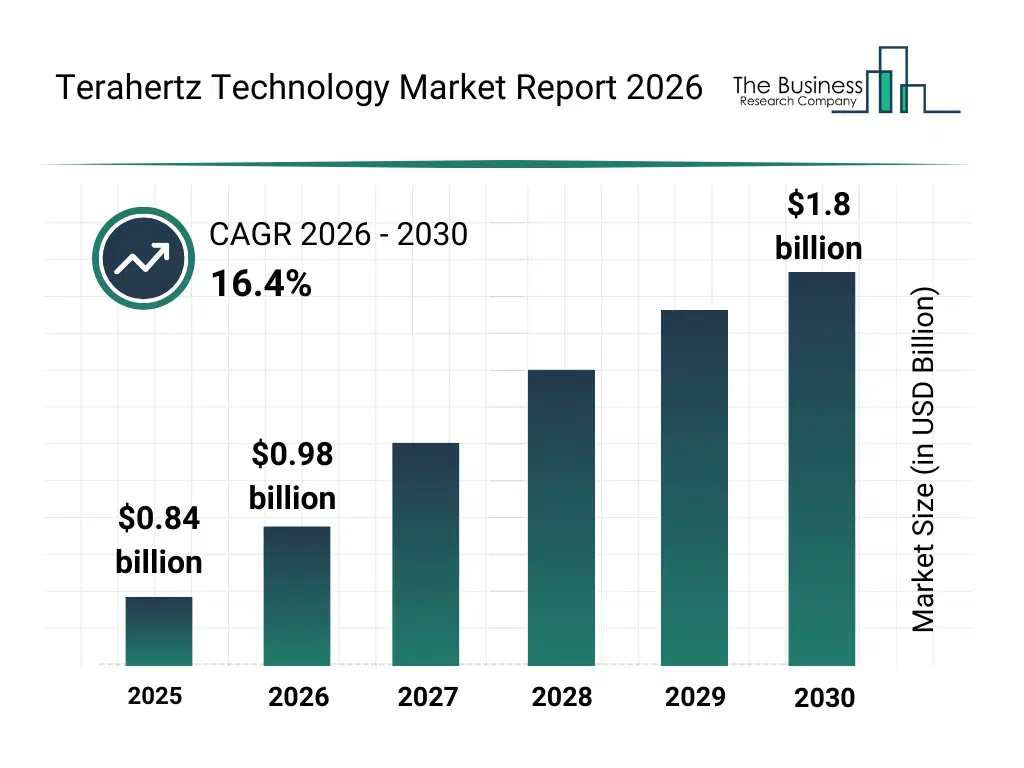
What Is The Terahertz Technology Market Size 2026 And Growth Rate?
The terahertz technology market size has grown rapidly in recent years. It will grow from $0.84 billion in 2025 to $0.98 billion in 2026 at a compound annual growth rate (CAGR) of 16.7%. The growth in the historic period can be attributed to advancements in photonics and semiconductor devices, defense and security screening demand, government funded research programs, growth in laboratory spectroscopy applications, early adoption in non destructive testing.What Is The Terahertz Technology Market Growth Forecast?
The terahertz technology market size is expected to see rapid growth in the next few years. It will grow to $1.8 billion in 2030 at a compound annual growth rate (CAGR) of 16.4%. The growth in the forecast period can be attributed to demand for ultra high speed wireless communication, rising adoption in medical and biomedical imaging, industrial quality inspection automation, development of compact room temperature terahertz sources, commercialization of terahertz communication systems. Major trends in the forecast period include high resolution terahertz imaging systems, miniaturization of terahertz sources and detectors, cost reduction through scalable terahertz components, expansion of non destructive testing applications, integration of terahertz systems with existing rf and photonic platforms.
Global Terahertz Technology Market Segmentation
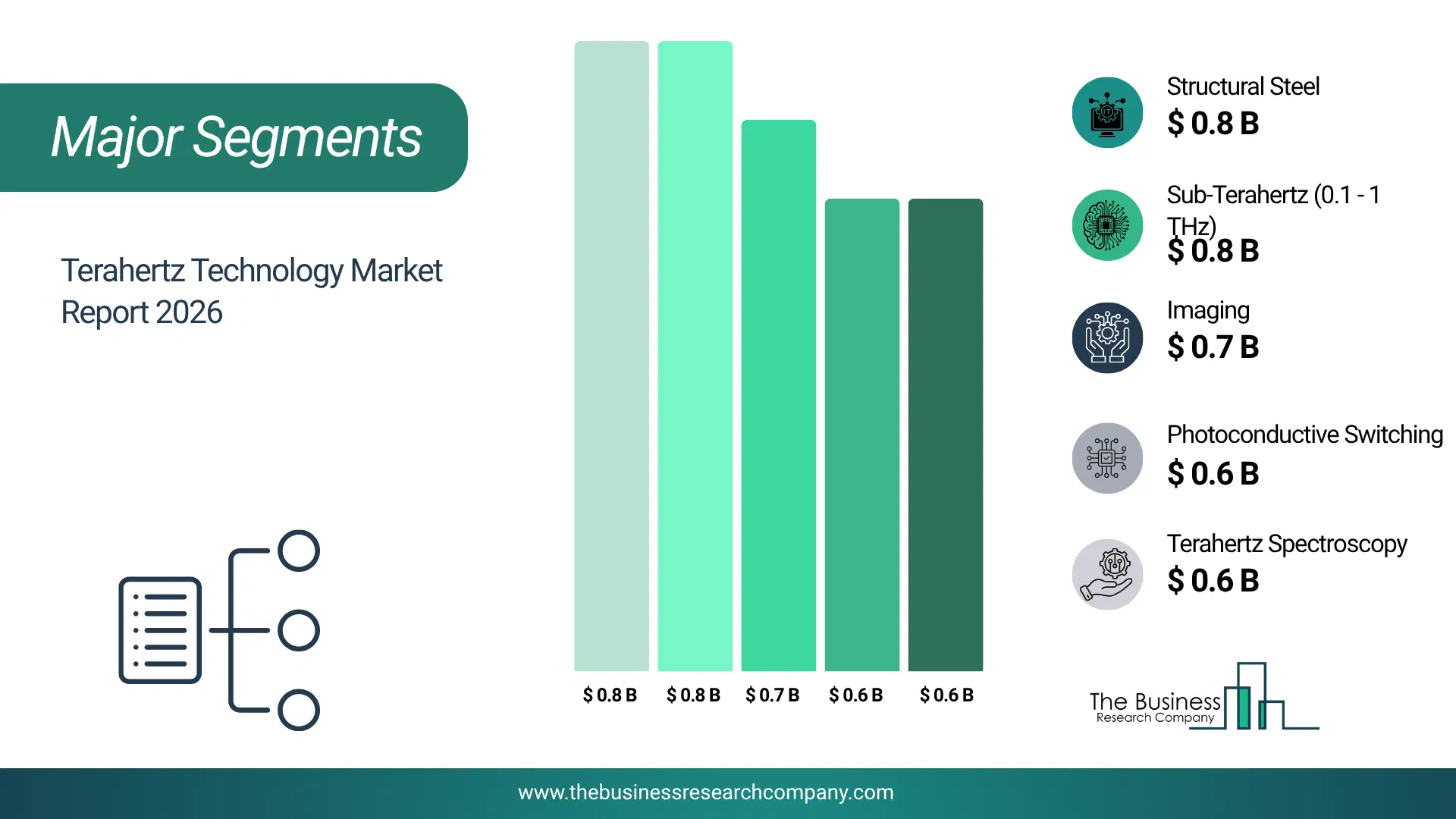
1) By Type: Terahertz Imaging, Terahertz Spectroscopy, Terahertz Communication 2) By Technology: Photoconductive Switching, Quantum Cascade Lasers, Free-Space Electro-Optic Sampling, Fiber-Coupled Terahertz Spectroscopy 3) By Frequency Range: Sub-Terahertz (0.1 - 1 THz), Low Terahertz (1 - 3 THz), High Tera hertz (3 - 10 THz) 4) By Application: Imaging, Communications, Spectroscopy 5) By End User: Laboratory Research, Medical And Healthcare, Defense And Security, Industrial, Telecommunications, Other End Users Subsegments: 1) By Terahertz Imaging: Photoconductive Switching, Quantum Cascade Laser, Free Space Electro Optic Sampling, Fiber Coupled Terahertz Spectroscopy 2) By Terahertz Spectroscopy: Time Domain Spectroscopy, Frequency Domain Spectroscopy, Fourier Transform Spectroscopy 3) By Terahertz Communication: Wireless Communication, Fiber Optic Communication, Satellite Communication The top segments in the terahertz technology market will be: • Terahertz Imaging will reach $837.86 Million by 2030. • Sub-Terahertz (0.1 - 1 THz) will reach $842.66 Million by 2030. • Imaging will reach $774.88 Million by 2030. • Photoconductive Switching will reach $683.8 Million by 2030. • Terahertz Spectroscopy will reach $618.49 Million by 2030.What Is The Driver Of The Terahertz Technology Market?
The rising demand for non-invasive imaging is expected to propel the growth of the terahertz technology market going forward. Non-invasive imaging refers to diagnostic techniques that allow for the visualization and analysis of internal structures without the need for surgical procedures. The growing demand for non-invasive imaging is primarily due to the need for safer diagnostic procedures that minimize patient exposure to harmful radiation or invasive methods while still providing accurate internal imaging. Terahertz technology enables non-invasive imaging by using low-energy electromagnetic waves that can penetrate soft tissues, providing high-resolution internal images without causing harm to the patient, while also allowing for real-time detection of abnormalities and improving early diagnosis of diseases such as cancer and cardiovascular conditions. For instance, in November 2023, according to the National Health Service, a UK-based government department, in the year ending March 2023, England performed 45.0 million imaging tests, representing a 2.2% increase from 44.0 million the previous year. This included diagnostic ultrasonography (ultrasound) with 10.3 million tests, up 1.8%; computerized axial tomography (CT scan) with 7.1 million tests, up 5.5%; and magnetic resonance imaging (MRI) with 4.1 million tests, up 6.2%. Therefore, the rising demand for non-invasive imaging is driving the growth of the terahertz technology industry.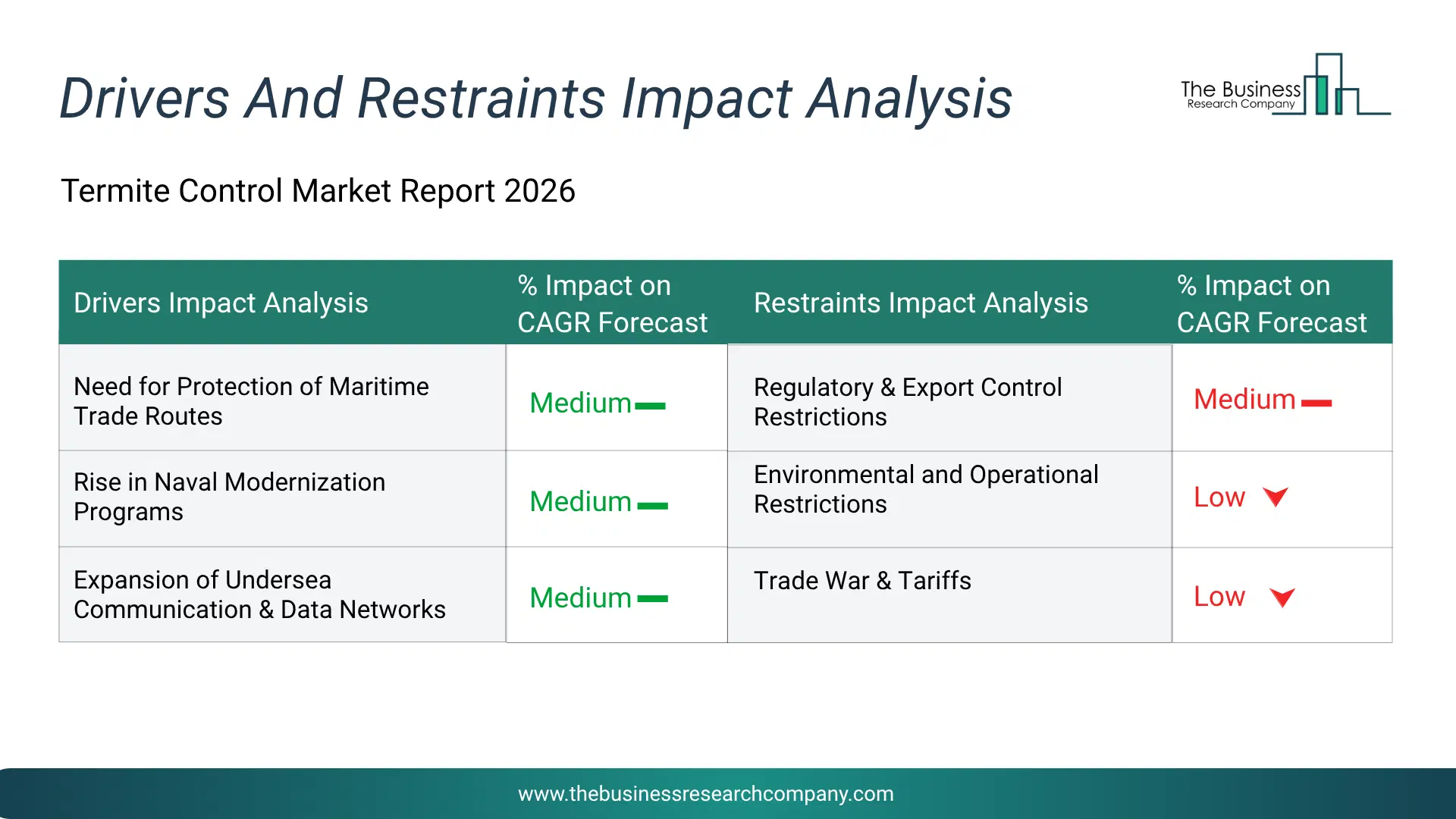
Infographic Chart Showing Key Market Drivers Analysis And Restraints For Terahertz Technology Market
The chart presents an impact analysis of key drivers and restraints, quantifying their relative influence on the market's growth rate and helping assess the balance between growth enablers and limiting factors. This chart offers a high-level perspective; the full report contains more detailed insights.
How Will The Drivers Impact Growth In The Global Terahertz Technology Market?
• Rising telecommunications capital expenditure (Medium) – During the forecast period, the rising telecommunications capital expenditure will become a key driver of growth in the terahertz technology market by 2030. as telecommunications operators increasingly invest in expanding and upgrading network infrastructure to support higher data traffic, improved connectivity and next-generation wireless technologies, elevated capital spending drives demand for advanced high-frequency solutions capable of enabling ultra-fast data transmission and low-latency communication. industry outlooks indicate that major telecom providers are committing substantial capital toward network modernization and capacity expansion initiatives, reflecting a sustained focus on enhancing broadband performance and future-proofing communication networks. as telecom companies deploy more advanced infrastructure and prepare for beyond-5g and future network architectures that require wider bandwidth and higher operating frequencies, the adoption of terahertz technology becomes increasingly important to meet evolving performance requirements, thereby significantly driving demand for terahertz technology solutions during the forecast period. as a result, the rising telecommunications capital expenditure is anticipated to contributing to a 1.6% annual growth in the market. • Semiconductor manufacturing volume growth (Medium) – During the forecast period, the semiconductor manufacturing volume growth will emerge as a major factor driving the expansion of the terahertz technology market by 2030. as semiconductor manufacturers continue to expand production capacities and increase wafer output to meet rising global demand for advanced chips, the growth in manufacturing volumes drives the need for advanced inspection, metrology and process control solutions that can operate at higher frequencies and finer resolutions. industry reports indicate that leading foundries are significantly increasing their production throughput and capacity investments to support next-generation nodes and more complex integrated circuits, reflecting the broader trend toward rapid scaling in semiconductor fabrication. as chipmakers handle larger volumes of wafers and increasingly intricate process flows that demand more precise and non-destructive testing, the adoption of terahertz technology becomes essential for ensuring product quality, yield optimization and process efficiency, thereby significantly driving demand for terahertz technology solutions during the forecast period. consequently, the semiconductor manufacturing volume growth is projected to contributing to a 1.2% annual growth in the market. • Rise in industrial automation (Low) – During the forecast period, the rise in industrial automation within digital manufacturing processes will serve as a major factor driving the expansion of the terahertz technology market by 2030. as manufacturing industries increasingly deploy automated production lines, robotics and smart factory systems to improve efficiency, precision and operational control, the expansion of industrial automation drives demand for advanced sensing, inspection and high-frequency communication technologies capable of supporting real-time monitoring and data transmission. industry indicators show that global demand for industrial robots has more than doubled over the past decade, highlighting the accelerating shift toward automated manufacturing environments worldwide. as factories adopt more complex and interconnected automation systems that require high-resolution imaging, non-destructive testing and rapid data exchange, the integration of terahertz technology becomes increasingly important to enable accurate inspection, process optimization and seamless communication across automated workflows, thereby significantly driving demand for terahertz technology solutions during the forecast period. therefore, this growing rise in industrial automation across digital manufacturing operations is projected to supporting to a 1.0%.annual growth in the market. • Rising demand for high-resolution medical imaging (Low) – During the forecast period, rising demand for high-resolution medical imaging will propel the growth of the terahertz technology market. As healthcare providers and medical researchers increasingly seek imaging solutions that offer greater detail, enhanced tissue characterization and improved diagnostic accuracy, there is growing interest in technologies capable of delivering high-resolution, non-ionizing imaging modalities. Health sector outlooks indicate that demand for advanced diagnostic imaging technologies continues to increase as populations age and the prevalence of chronic diseases rises, reflecting a broader trend toward early detection and precision medicine. As medical facilities and research institutions adopt imaging systems that require finer spatial resolution and better contrast for early diagnosis and treatment planning, the integration of terahertz imaging solutions becomes increasingly important to meet clinical performance requirements, thereby significantly driving demand for terahertz technology solutions during the forecast period. The rising demand for high resolution medical imaging growth contribution during the forecast period in 2025 is 0.8%.How Will The Restraints Impact Growth In The Global Terahertz Technology Market?
• Complex system integration (Medium) – During the forecast period, complex system integration is restraining the growth of the terahertz technology market during the forecast period. terahertz systems require the integration of highly specialized components, including terahertz radiation sources, detectors, signal processing units and control electronics, which must operate seamlessly within a single platform. achieving reliable integration is technically challenging due to issues such as signal attenuation, thermal management, calibration sensitivity and compatibility with existing electronic and optical systems, all of which can increase development complexity and slow deployment timelines. as a result, companies may delay system deployment or restrict application expansion to manage technical risks, thereby restricting the growth of the terahertz technology market during the forecast period. growth affected by complex system integration during the forecast period in 2025 is -0.5%. • Lack of industry standardization (Medium) – During the forecast period, lack of industry standardization is restraining the growth of the terahertz technology market during the forecast period. the terahertz technology ecosystem currently lacks universally accepted standards for frequency allocation, device specifications, testing methodologies and interoperability, which creates uncertainty across product development and deployment stages. this absence of harmonized standards complicates system design, limits cross-vendor compatibility and increases the complexity of integrating terahertz solutions into existing communication, imaging and sensing infrastructures. from an adoption and commercialization standpoint, the lack of clear industry standards can discourage end users and investors who require assurance of long-term reliability, regulatory alignment and interoperability before committing to new technologies. as a result, organizations may delay implementation decisions or restrict large-scale deployment until standardization frameworks mature, thereby restricting the growth of the terahertz technology market during the forecast period. growth affected by lack of industry standardization during the forecast period in 2025 is -0.3%. • Impact Of Trade War And Tariffs (Low) – During the forecast period, impact of trade war and tariff is restraining the growth of the terahertz technology market during the forecast period. escalating trade tensions between major economies have led to export bans and tariff-related restrictions on critical raw materials such as gallium, germanium and antimony, which are essential for semiconductor manufacturing and advanced electronic components used in terahertz systems. these measures disrupt global supply chains and increase procurement complexity, creating challenges for companies dependent on cross-border sourcing of high-purity materials required for terahertz device production. as a result, companies may delay capacity expansion, technology deployment, or commercialization plans to manage trade-related risks, thereby restricting the growth of the terahertz technology market during the forecast period. growth affected by trade war and tariffs across regions during the forecast period in 2025 is -0.2%.Key Players In The Global Terahertz Technology Market
Major companies operating in the terahertz technology market are Canon Inc., Advantest Corporation, Bruker Corporation, Hübner Group, Thorlabs Inc., Daheng New Epoch Technology, Luna Innovations Incorporated, M Squared Lasers Ltd., Virginia Diodes Inc., Gentec Electro-Optics, Menlo Systems GmbH, TeraView Ltd., Neteera Technologies, TeraSense Group Inc., Alpes Lasers SA, Boston Electronics Corporation, TeraLumen Solutions, TYDEX, Batop GmbH, Bakman Technologies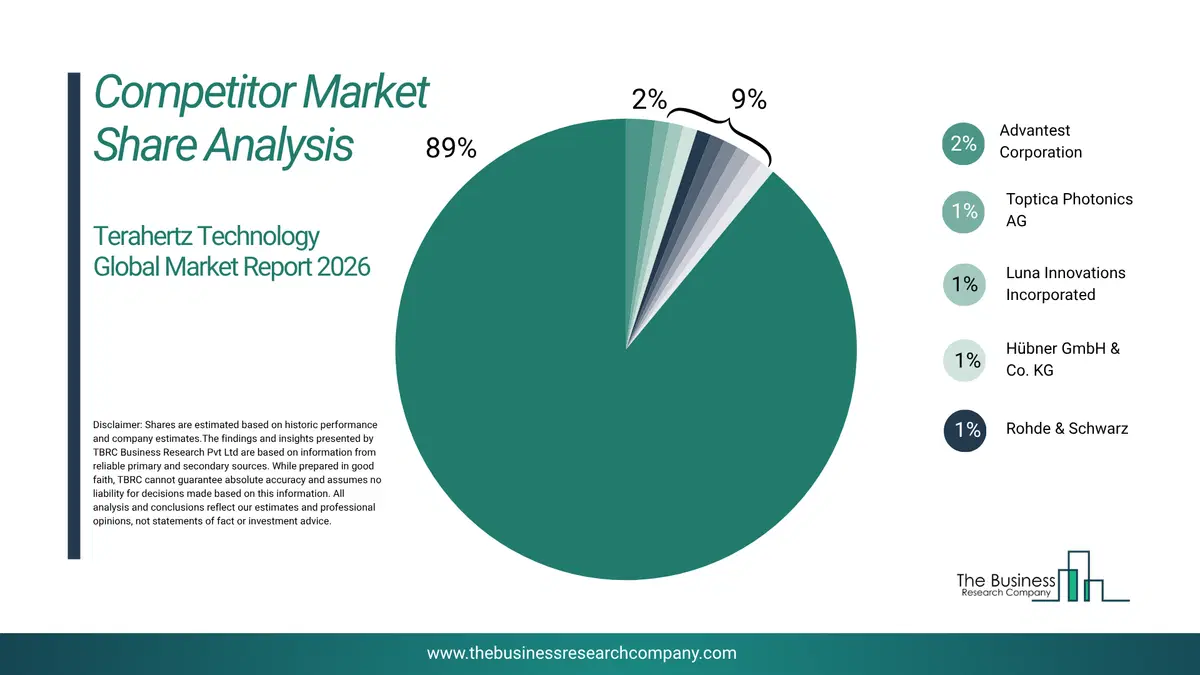
This chart is for illustrative purposes; the full report includes a detailed competitor analysis and comprehensive overview of the top 10 companies in the market.
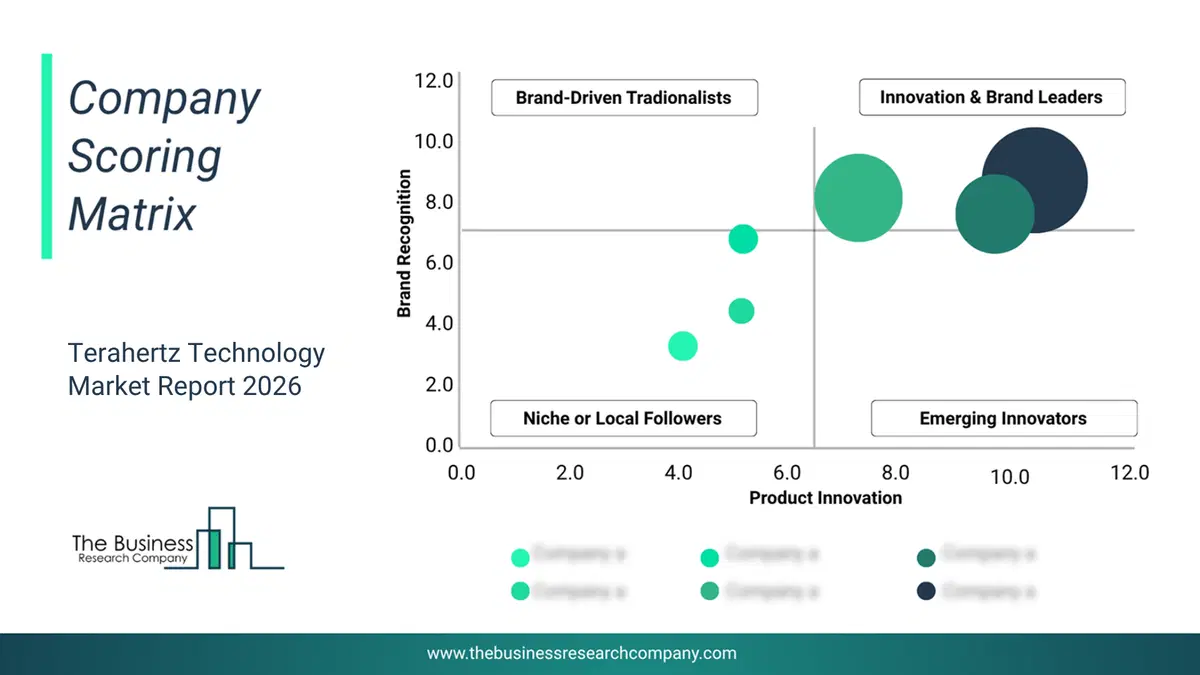
This chart maps companies by product innovation and brand strength, with bubble size indicating relative revenue, helping identify market leaders, challengers, and niche players. This is an illustrative chart; the full report provides a complete and accurate competitive analysis.
Global Terahertz Technology Market Trends and Insights
Major companies operating in the terahertz technology market are focusing on developing innovative solutions such as next-generation 6G data transmission to enable ultra-high-speed wireless communication. Next-generation 6G data transmission refers to the sixth-generation wireless communication technology that provides extremely high-speed, low-latency, and reliable data transfer. It helps by supporting advanced applications such as real-time holographic communication, autonomous vehicles, and massive IoT connectivity, driving demand for terahertz technology. For instance, in January 2023, Canon Inc., a Japan-based multinational technology company, launched a compact terahertz device featuring the world’s highest output among 450 GHz semiconductor devices. This innovative device integrates 36 synchronized active antennas on a single semiconductor chip, achieving approximately 10 times greater output and 20 times higher directivity than conventional devices. Its compact size, about 1000 times smaller than traditional models, enables potential applications in security scanning, next-generation 6G data transmission, and high-speed imaging, all without requiring bulky frequency multipliers or lenses.What Are Latest Mergers And Acquisitions In The Terahertz Technology Market?
In July 2025, TeraView Limited, a UK-based developer of terahertz light equipment, partnered with the Doolim-Yaskawa to enhance automotive paint inspection. With this partnership, TeraView and Doolim-Yaskawa aim to enhance multi-layer paint applications in the Korean automotive industry by combining TeraView’s terahertz technology with Doolim-Yaskawa’s robotics solutions for precise, non-destructive measurement and improved quality control. Doolim‑Yaskawa Co. Ltd. is a Korea-based robotic automation solutions company that offers automated painting, sealing, and production automation systems that enhance productivity and efficiency in manufacturing processes.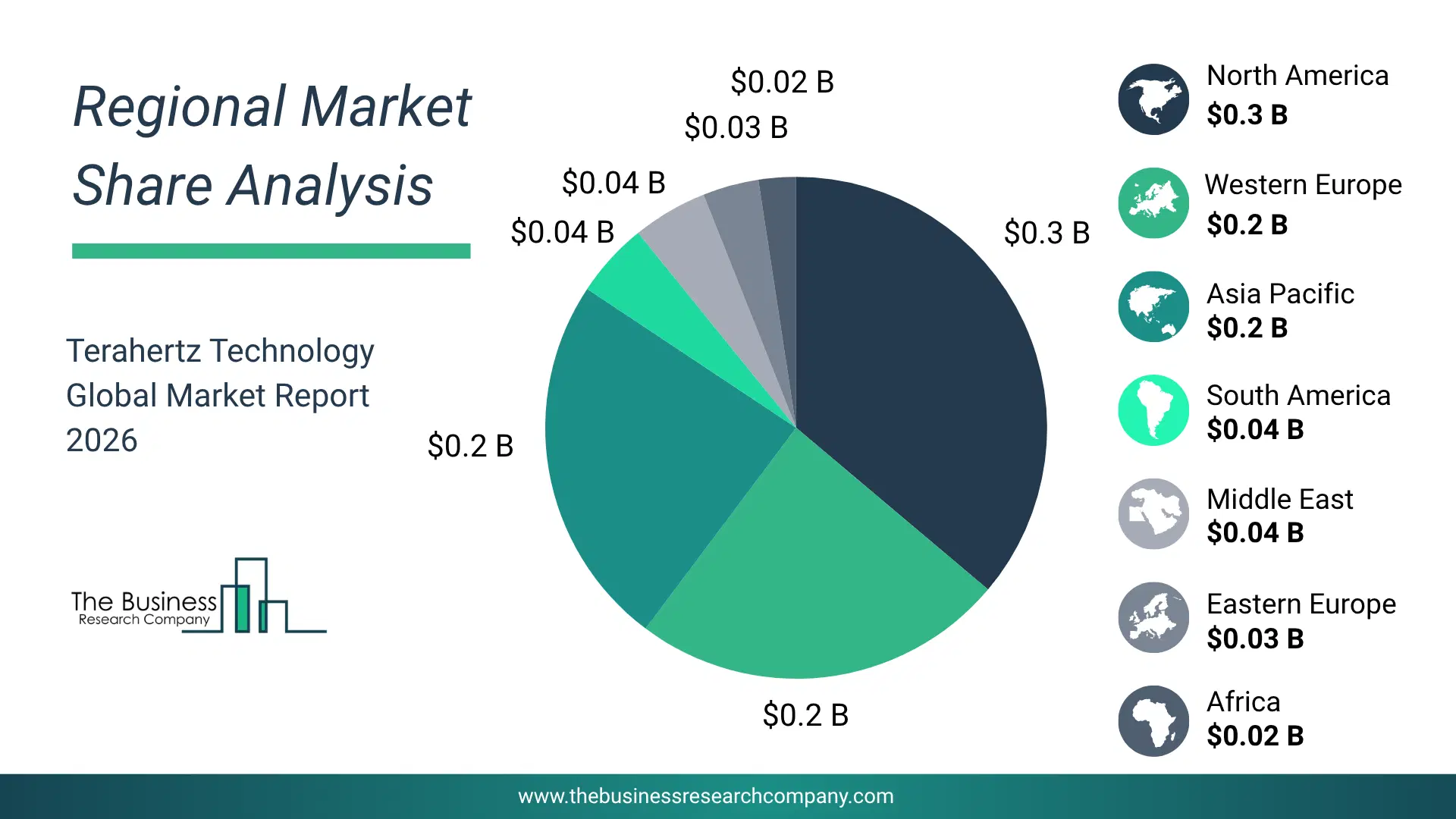
Regional Outlook
North America was the largest region in the terahertz technology market in 2025. Asia-Pacific is expected to be the fastest-growing region in the forecast period. The regions covered in this market report are Asia-Pacific, South East Asia, Western Europe, Eastern Europe, North America, South America, Middle East, Africa. The countries covered in this market report are Australia, Brazil, China, France, Germany, India, Indonesia, Japan, Taiwan, Russia, South Korea, UK, USA, Canada, Italy, Spain.What Defines the Terahertz Technology Market?
The terahertz technology market consists of revenues earned by entities providing services such as material characterization, security screening, biomedical imaging, quality control in manufacturing, and wireless communication testing. The market value includes the value of related goods sold by the service provider or included within the service offering. The terahertz technology market also includes sales of waveguides, beam splitters, modulators, filters, and time-domain spectroscopy (TDS) systems. Values in this market are ‘factory gate’ values, that is the value of goods sold by the manufacturers or creators of the goods, whether to other entities (including downstream manufacturers, wholesalers, distributors and retailers) or directly to end customers. The value of goods in this market includes related services sold by the creators of the goods.How is Market Value Defined and Measured?
The market value is defined as the revenues that enterprises gain from the sale of goods and/or services within the specified market and geography through sales, grants, or donations in terms of the currency (in USD unless otherwise specified). The revenues for a specified geography are consumption values that are revenues generated by organizations in the specified geography within the market, irrespective of where they are produced. It does not include revenues from resales along the supply chain, either further along the supply chain or as part of other products.
This chart presents market attractiveness based on a quantitative evaluation of growth, competition, strategic alignment, and risk, offering a clear view of opportunity areas for decision-making. This chart is for illustrative purposes; the full report contains the complete analysis.

This chart highlights the Total Addressable Market (TAM) by estimating the maximum revenue opportunity using an assumption-driven approach, supporting strategic planning and opportunity sizing across markets. The chart is illustrative; the full report provides a more comprehensive analysis.
What Key Data and Analysis Are Included in the Terahertz Technology Market Report 2026?
The terahertz technology market research report is one of a series of new reports from The Business Research Company that provides market statistics, including industry global market size, regional shares, competitors with the market share, detailed market segments, market trends and opportunities, and any further data you may need to thrive in the terahertz technology industry. The market research report delivers a complete perspective of everything you need, with an in-depth analysis of the current and future state of the industry.Terahertz Technology Market Report 2026 Market Report Forecast Analysis
| Report Attribute | Details |
|---|---|
| Market Size Value In 2026 | $0.98 billion |
| Revenue Forecast In 2030 | $1.8 billion |
| Growth Rate | CAGR of 16.7% from 2026 to 2030 |
| Base Year For Estimation | 2025 |
| Actual Estimates/Historical Data | 2020-2025 |
| Forecast Period | 2026 - 2030 - 2035 |
| Market Representation | Revenue in USD Billion and CAGR from 2026 to 2030 |
| Segments Covered | Type, Technology, Frequency Range, Application, End User |
| Regional Scope | Asia-Pacific, Western Europe, Eastern Europe, North America, South America, Middle East, Africa |
| Country Scope | The countries covered in the report are Australia, Brazil, China, France, Germany, India, Indonesia, Japan, Taiwan, Russia, South Korea, UK, USA, Canada, Italy, Spain. |
| Key Companies Profiled | Canon Inc., Advantest Corporation, Bruker Corporation, Hübner Group, Thorlabs Inc., Daheng New Epoch Technology, Luna Innovations Incorporated, M Squared Lasers Ltd., Virginia Diodes Inc., Gentec Electro-Optics, Menlo Systems GmbH, TeraView Ltd., Neteera Technologies, TeraSense Group Inc., Alpes Lasers SA, Boston Electronics Corporation, TeraLumen Solutions, TYDEX, Batop GmbH, Bakman Technologies |
| Customization Scope | Request for Customization |
| Pricing And Purchase Options | Explore Purchase Options |