
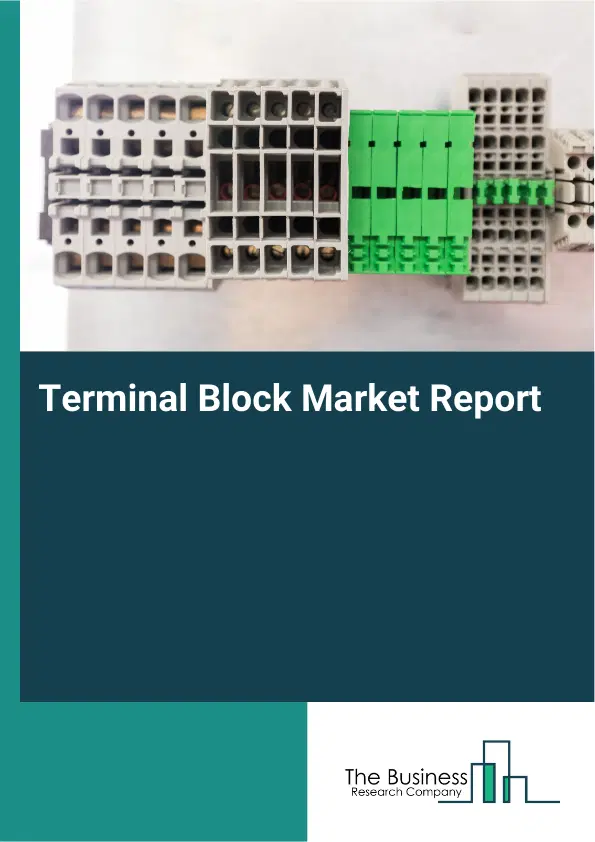
Terminal Block Market Report 2026
Global Outlook – By Type ( Barriers Or Barrier Strips, Sectional Terminal Blocks, PCB Mount Terminal Blocks, Power Terminal Blocks, Other Types), By Function Type ( Single-Level Feed-Through Terminal Blocks, Dual-Level Terminal Blocks, Three-Level Blocks, Ground Circuit Terminals, Fuse Terminal Blocks, Other Functions), By Industry ( Business Equipment, HVAC Systems, Power Supplies, Industrial Controls, Process Control Instruments, Telecom Equipment, Transportation, Other Industries) – Market Size, Trends, Strategies, and Forecast to 2030
Terminal Block Market Overview
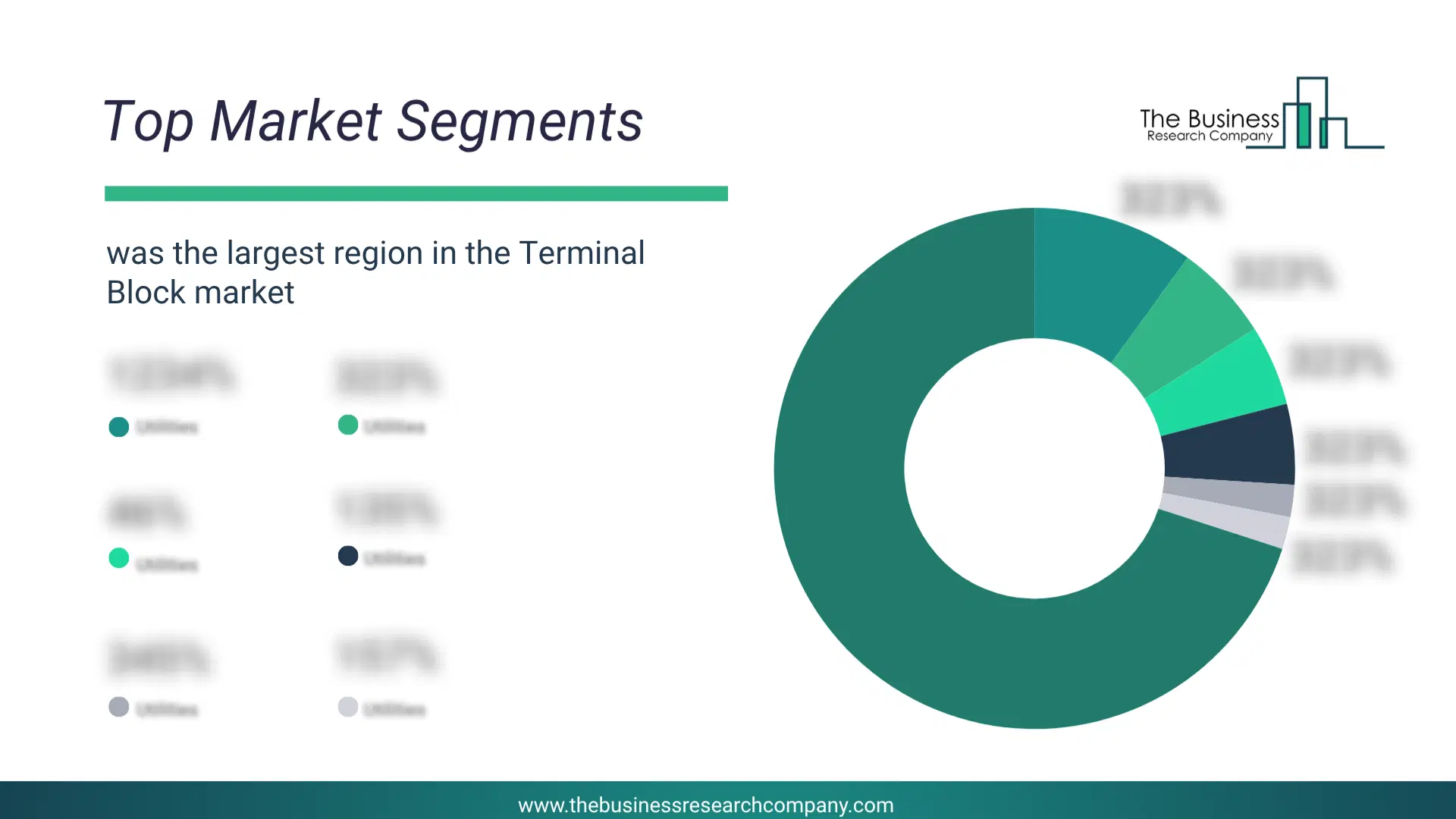
• Terminal Block market size has reached to $4.55 billion in 2025 • Expected to grow to $5.97 billion in 2030 at a compound annual growth rate (CAGR) of 5.6% • Growth Driver: Terminal Blocks In High Demand As Smart Devices Revolutionize Connectivity • Market Trend: SNACompact Terminal Blocks Redefine Compact Performance • Asia-Pacific was the largest region in 2025.Market Gains By 2030 – Top Opportunities By Segment
Market Gain identifies the most promising market opportunities by highlighting the segments or products expected to generate the highest incremental revenue growth over the next five years.
What Is Covered Under Terminal Block Market?
Terminal block refers to a connection terminal consisting of a clamping component and a conducting strip with an insulated frame that secures two or more wires together. These connectors are useful for semi-permanent connections, which may require inspections, wire replacement, repair, and change. The main types of terminal blocks are barriers, barrier strips, sectional terminal blocks, PCB mount terminal blocks, power terminal blocks, and others. The barriers or barrier strips refer to an interface made up of a metal strip and connectors or screws. The various types of functions are single-level feed-through terminal blocks, dual-level terminal blocks, three-level blocks, ground circuit terminals, fuse terminal blocks, and others that are used in business equipment, HVAC systems, power supplies, industrial controls, process control instruments, telecom equipment, transportation, and others.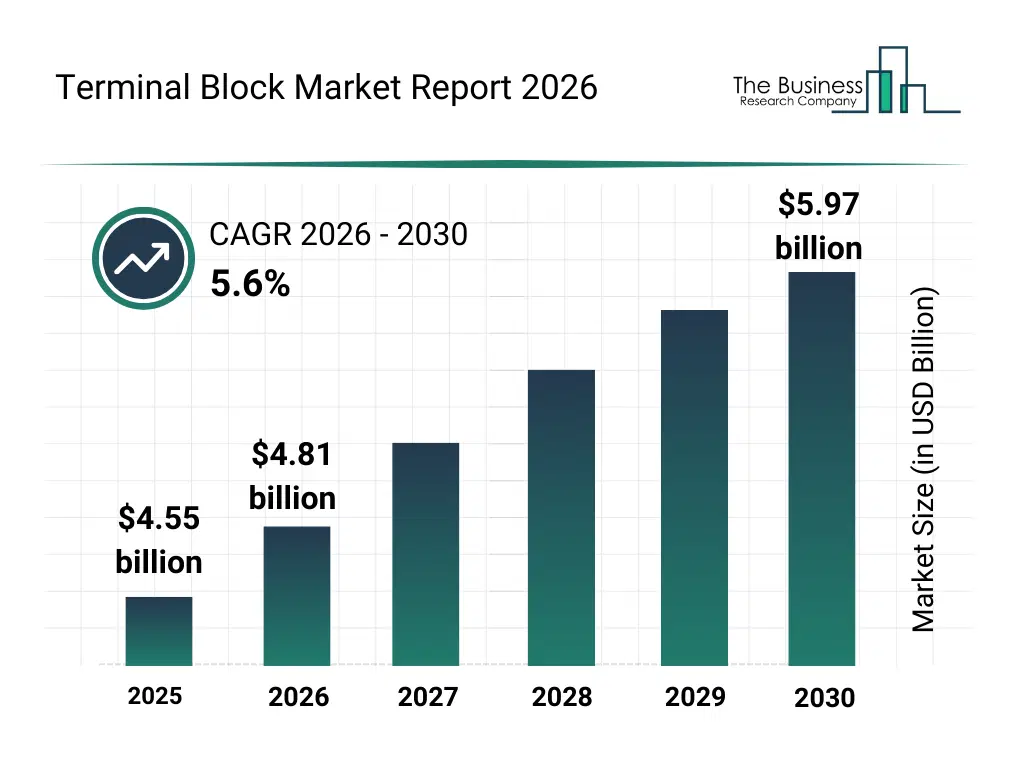
What Is The Terminal Block Market Size 2026 And Growth Rate?
The terminal block market size has grown strongly in recent years. It will grow from $4.55 billion in 2025 to $4.81 billion in 2026 at a compound annual growth rate (CAGR) of 5.6%. The growth in the historic period can be attributed to expansion of industrial control systems, adoption of electrical wiring safety standards, growing use in hvac and power supplies, early deployment in business equipment, increased reliance on modular wiring systems.What Is The Terminal Block Market Growth Forecast?
The terminal block market size is expected to see strong growth in the next few years. It will grow to $5.97 billion in 2030 at a compound annual growth rate (CAGR) of 5.6%. The growth in the forecast period can be attributed to rising automation in manufacturing, growth in renewable energy installations, adoption of smart connectivity components, increasing electrification across industries, rising need for secure and maintainable wiring infrastructures. Major trends in the forecast period include advancement of automated terminal block manufacturing, expansion of eco-friendly and sustainable materials, integration of IoT-enabled connection solutions, growth of digitalized electrical connectivity platforms, adoption of robotics-supported wiring and assembly systems.
Global Terminal Block Market Segmentation
1) By Type: Barriers Or Barrier Strips, Sectional Terminal Blocks, PCB Mount Terminal Blocks, Power Terminal Blocks, Other Types 2) By Function Type: Single-Level Feed-Through Terminal Blocks, Dual-Level Terminal Blocks, Three-Level Blocks, Ground Circuit Terminals, Fuse Terminal Blocks, Other Functions 3) By Industry: Business Equipment, HVAC Systems, Power Supplies, Industrial Controls, Process Control Instruments, Telecom Equipment, Transportation, Other Industries Subsegments: 1) By Barriers Or Barrier Strips: Single-Row Barrier Strips, Multi-Row Barrier Strips 2) By Sectional Terminal Blocks: Modular Terminal Blocks, Screw Terminal Blocks, Spring Terminal Blocks 3) By PCB Mount Terminal Blocks: Through-Hole PCB Terminal Blocks, Surface-Mount PCB Terminal Blocks 4) By Power Terminal Blocks: Heavy-Duty Power Terminal Blocks, Mini Power Terminal Blocks 5) By Other Types: Feed-Through Terminal Blocks, Fuse Terminal Blocks, Fuse Holder Terminal Blocks The top segments in the terminal block market will be: • Sectional Terminal Blocks will reach $2.81 Billion by 2030. • PCB Mount Terminal Blocks will reach $1.49 Billion by 2030. • Power Terminal Blocks will reach $0.83 Billion by 2030. • Barriers Or Barrier Strips will reach $0.51 Billion by 2030. • Other Types will reach $0.27 Billion by 2030.What Is The Driver Of The Terminal Block Market?
Rising demand for smart devices is expected to drive the terminal block market going forward. A smart device refers to a context-aware electronic device that can share data with other devices wirelessly or by connecting to them by cable. Terminal blocks are used wherever electrical systems need to stay safely connected, organized, and secure. For instance, in April 2024, according to ConsumerAffairs, a US-based consumer news and advocacy organization, it was reported that in 2023, approximately 57.55 million people in the United States used smart home products in 2022, with projections indicating that over 57% of US households will own at least one smart home device by 2025. The survey also revealed growing consumer concerns regarding data privacy and protection, as 62% of users expressed worries about the security of their connected devices in 2023. This represented a 10-percentage-point increase compared to 2022, highlighting heightened awareness of cybersecurity risks associated with smart technologies. Therefore, rising demand for smart devices drives the growth terminal block industry.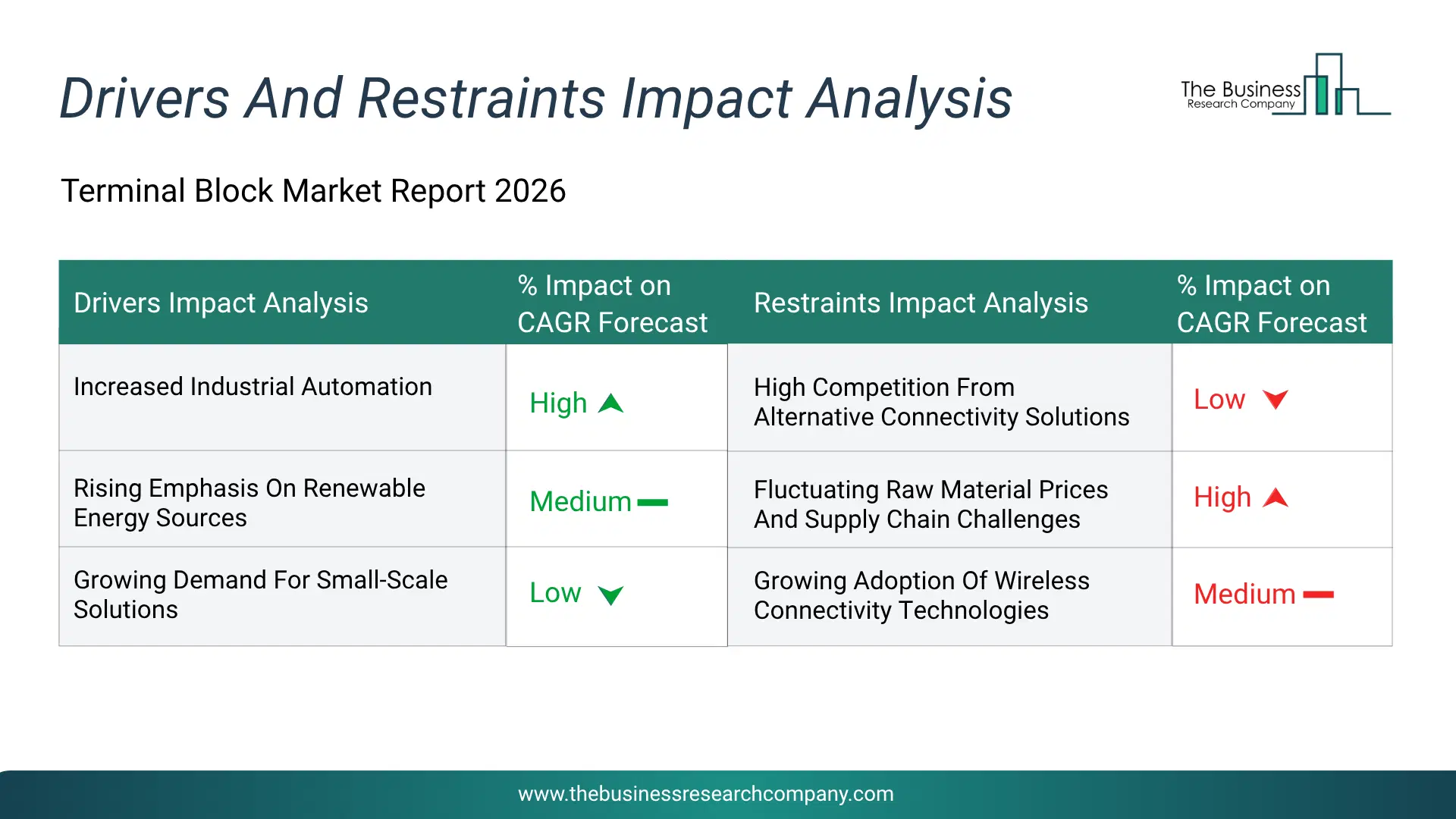
Infographic Chart Showing Key Market Drivers Analysis And Restraints For Terminal Block Market
The chart presents an impact analysis of key drivers and restraints, quantifying their relative influence on the market's growth rate and helping assess the balance between growth enablers and limiting factors. This chart offers a high-level perspective; the full report contains more detailed insights.
How Will The Drivers Impact Growth In The Global Terminal Block Market?
• Increased Industrial Automation (High) – During the forecast period, the increased industrial automation is expected to become a key growth driver for the terminal block market by 2030. Increased industrial automation is a significant driver of the Terminal Block Market because modern automated production facilities require reliable electrical connection systems for seamless machine operation. Terminal blocks provide secure wiring interfaces that support sensors, controllers, motors, and programmable logic controllers used in industrial automation. As manufacturers invest in smart factories and automated processes, the volume of electrical connections increases substantially. Terminal blocks help simplify installation, troubleshooting, and maintenance activities, reducing operational downtime. Their ability to ensure safe and organized wiring makes them essential in automated environments. Growing adoption of Industry 4.0 technologies further expands the need for advanced connectivity solutions. • Rising Emphasis On Renewable Energy Sources (Medium) – During the forecast period, the rising emphasis on renewable energy sources is expected to emerge as a major factor driving the expansion of the terminal block market by 2030. Rising emphasis on renewable energy sources is accelerating the growth of the Terminal Block Market as renewable energy installations require dependable electrical connection components. Solar farms, wind turbines, and energy storage systems rely on terminal blocks to ensure safe and efficient power transmission between various electrical devices. These components help manage complex wiring networks while maintaining system reliability under varying environmental conditions. Governments and private organizations are increasing investments in clean energy infrastructure, creating new opportunities for terminal block manufacturers. The expansion of renewable power generation projects increases the need for durable and high-performance connection technologies. Terminal blocks also support easier maintenance and system scalability in renewable installations. • Growing Demand For Small-Scale Solutions (Low) – During the forecast period, the growing demand for small-scale solutions is expected to act as a key growth catalyst for the terminal block market by 2030. Growing demand for small-scale solutions is driving the Terminal Block Market by increasing the need for compact and space-efficient electrical connection products. Industries such as consumer electronics, building automation, telecommunications, and medical equipment require smaller components without compromising performance. Terminal blocks enable efficient wiring within limited spaces while maintaining safety and reliability standards. The trend toward miniaturized devices and compact control panels has encouraged manufacturers to develop innovative terminal block designs. These solutions help optimize equipment layouts and reduce installation complexity. Rising adoption of modular and portable electrical systems further supports market growth. As compact electrical applications become more widespread, terminal block demand continues to increase.How Will The Restraints Impact Growth In The Global Terminal Block Market?
• High Competition From Alternative Connectivity Solutions (High) – During the forecast period, the high Competition From Alternative Connectivity Solutions acts as a restraint on the Terminal Block Market because manufacturers increasingly have access to substitute connection technologies such as plug-in connectors, insulation displacement connectors, and wireless communication systems. These alternatives often offer faster installation, reduced wiring complexity, and greater flexibility in certain applications. As industries seek to improve efficiency and reduce assembly time, some end users may prefer these competing solutions over traditional terminal blocks. The availability of multiple connection options can limit market penetration and reduce replacement demand. Additionally, technological advancements in alternative connectivity products continue to challenge the adoption of conventional terminal blocks. This competitive pressure can impact revenue growth and pricing strategies for terminal block manufacturers. As a result, the presence of alternative connection technologies restrains overall market expansion. • Fluctuating Raw Material Prices And Supply Chain Challenges (Medium) – During the forecast period, the fluctuating Raw Material Prices And Supply Chain Challenges represent a major restraint for the Terminal Block Market because the production of terminal blocks depends on materials such as copper, brass, steel, and engineering plastics. Variations in the prices of these materials can increase manufacturing costs and reduce profit margins for producers. Global supply chain disruptions, transportation delays, and shortages of essential components can further affect production schedules and product availability. These challenges may lead to increased product prices for end users, potentially reducing purchasing demand. Manufacturers also face difficulties in maintaining consistent inventory levels during periods of supply uncertainty. The need to manage rising procurement costs can limit investments in innovation and expansion activities. Consequently, raw material volatility and supply chain issues hinder the steady growth of the terminal block market. • Growing Adoption Of Wireless Connectivity Technologies (Low) – During the forecast period, the growing adoption of wireless connectivity technologies acts as a restraint on the Terminal Block market because industries are increasingly exploring wireless communication solutions to reduce wiring complexity and improve installation flexibility. Wireless technologies can eliminate the need for traditional wired connection components in certain automation, monitoring, and control applications. As manufacturers adopt smart industrial systems with wireless capabilities, demand for conventional terminal blocks may face pressure in specific segments. The shift toward cable-free solutions can reduce installation requirements and maintenance needs. Consequently, increasing preference for wireless connectivity alternatives can limit the growth opportunities for traditional terminal block products.Key Players In The Global Terminal Block Market
Major companies operating in the terminal block market are TE Connectivity Ltd., Omron Corporation, Eaton Corporation PLC, Rockwell Automation Inc., Molex LLC, Weidmüller Interface GmbH & Co. KG, WAGO Kontakttechnik GmbH & Co. KG, Phoenix Contact GmbH & Co. KG, Wieland Electric GmbH, ABB Ltd., Weco Electrical Connectors Inc., Ningbo Degson Electrical Co.Ltd., Metz Connect GmbH, Dinkle Group, K.A. Schmersal GmbH & Co. KG, Altech Corporation, Amphenol Corporation, Bourns Inc., Curtis Industries LLC, EBY Electro Inc., E-T-A Elektrotechnische Apparate GmbH, Keystone Electronics Corp., Lumberg Automation Components GmbH & Co., Regal Rexnord Corporation, Panduit Corp., RIA Connect Inc., Sprecher + Schuh Inc., Weiland Electric Inc., Würth Elektronik GmbH & Co. KG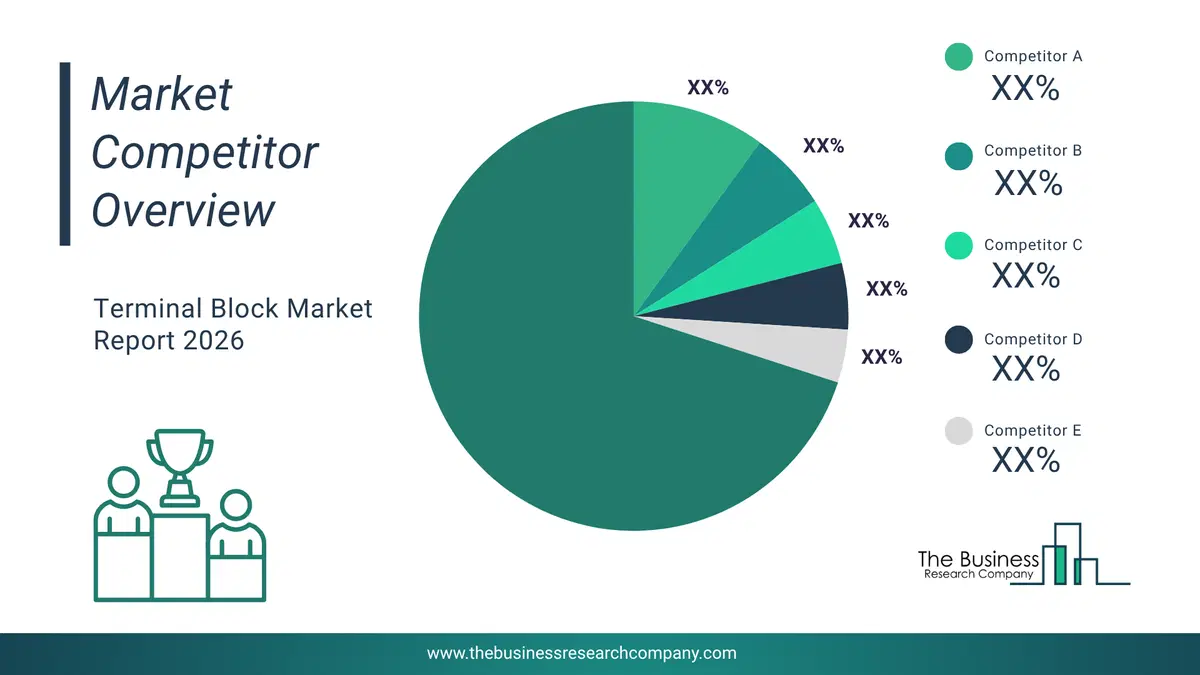
This chart is for illustrative purposes; the full report includes a detailed competitor analysis and comprehensive overview of the top 10 companies in the market.
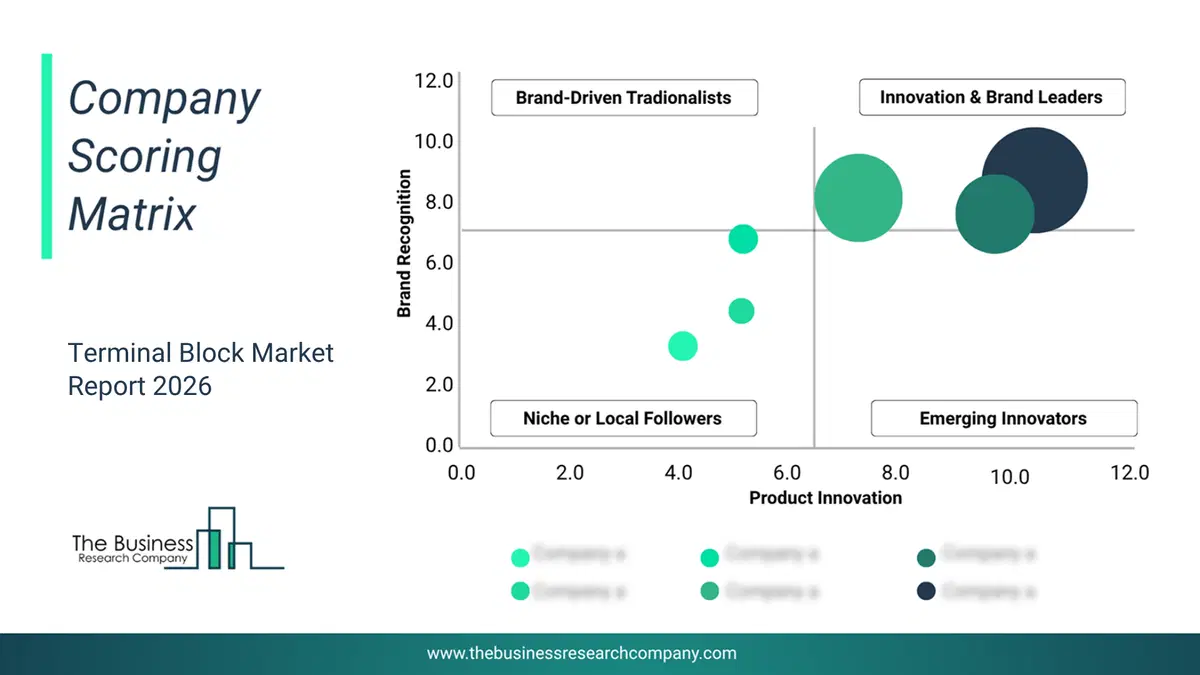
This chart maps companies by product innovation and brand strength, with bubble size indicating relative revenue, helping identify market leaders, challengers, and niche players. This is an illustrative chart; the full report provides a complete and accurate competitive analysis.
Global Terminal Block Market Trends and Insights
Major companies operating in the terminal block market are focusing on developing technologically advanced solutions, such as modular compact terminal blocks, to enhance connectivity and accommodate the growing demand for flexible and scalable electrical systems in various industries. Modular compact terminal blocks refer to small, space-efficient electrical connectors used for securely connecting multiple wires within electrical control panels and junction boxes. For instance, in May 2024, Weidmuller, a Germany-based company that specializes in electrical connectivity and industrial connectivity, introduced its new Klippon Connect W2C and W2T modular compact terminal blocks, designed to enhance flexibility and efficiency in managing complex signal wiring within compact panel installations. These terminal blocks feature a modular design that allows for easy customization, making them ideal for applications with limited space.What Are Latest Mergers And Acquisitions In The Terminal Block Market?
In July 2023, Amphenol Corporation, a US-based electronic connector manufacturing company, acquired Eby Electro Inc. for an undisclosed amount. Through this acquisition, Amphenol aims to enhance its portfolio of high-technology interconnect products in the diversified industrial market, integrate Eby's experienced management team, strengthen its competitive position in North America, and contribute approximately $15 million in annual sales to support its growth initiatives. Eby Electro Inc. is a US-based custom terminal block design and manufacturer.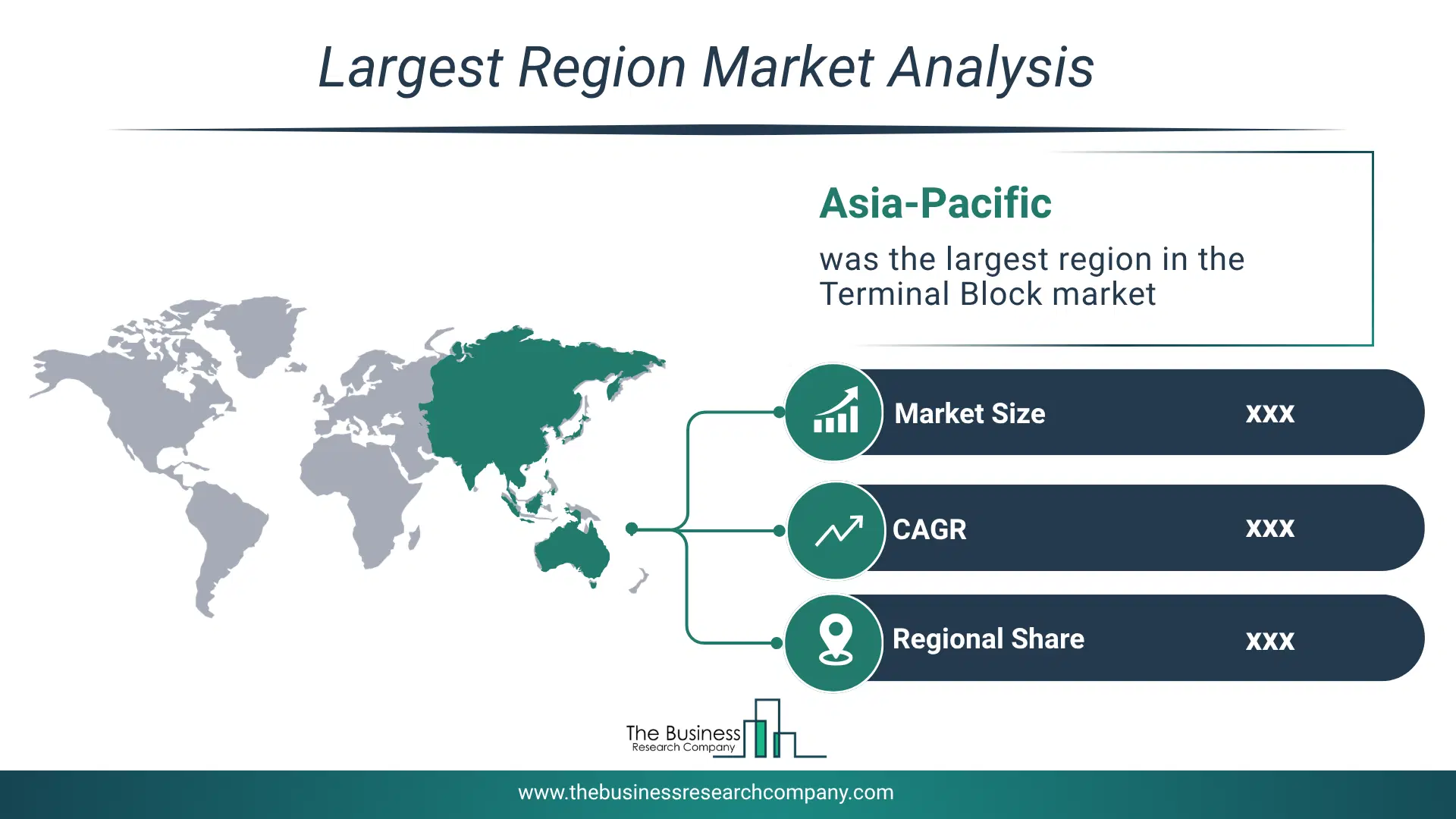
Regional Outlook
Asia-Pacific was the largest region in the terminal block market in 2025. The regions covered in this market report are Asia-Pacific, South East Asia, Western Europe, Eastern Europe, North America, South America, Middle East, Africa. The countries covered in this market report are Australia, Brazil, China, France, Germany, India, Indonesia, Japan, Taiwan, Russia, South Korea, UK, USA, Canada, Italy, Spain.What Defines the Terminal Block Market?
The terminal block market consists of sales of modular terminal blocks, strip accessories, tubular-type blocks, pluggable terminal blocks, and push-fit terminal blocks. Values in this market are ‘factory gate’ values, that is, the value of goods sold by the manufacturers or creators of the goods, whether to other entities (including downstream manufacturers, wholesalers, distributors, and retailers) or directly to end customers. The value of goods in this market includes related services sold by the creators of the goods.How is Market Value Defined and Measured?
The market value is defined as the revenues that enterprises gain from the sale of goods and/or services within the specified market and geography through sales, grants, or donations in terms of the currency (in USD unless otherwise specified). The revenues for a specified geography are consumption values that are revenues generated by organizations in the specified geography within the market, irrespective of where they are produced. It does not include revenues from resales along the supply chain, either further along the supply chain or as part of other products.
This chart presents market attractiveness based on a quantitative evaluation of growth, competition, strategic alignment, and risk, offering a clear view of opportunity areas for decision-making. This chart is for illustrative purposes; the full report contains the complete analysis.

This chart highlights the Total Addressable Market (TAM) by estimating the maximum revenue opportunity using an assumption-driven approach, supporting strategic planning and opportunity sizing across markets. The chart is illustrative; the full report provides a more comprehensive analysis.
What Key Data and Analysis Are Included in the Terminal Block Market Report 2026?
The terminal block market research report is one of a series of new reports from The Business Research Company that provides market statistics, including industry global market size, regional shares, competitors with the market share, detailed market segments, market trends and opportunities, and any further data you may need to thrive in the terminal block industry. The market research report delivers a complete perspective of everything you need, with an in-depth analysis of the current and future state of the industry.Terminal Block Market Report 2026 Market Report Forecast Analysis
| Report Attribute | Details |
|---|---|
| Market Size Value In 2026 | $4.81 billion |
| Revenue Forecast In 2030 | $5.97 billion |
| Growth Rate | CAGR of 5.6% from 2026 to 2030 |
| Base Year For Estimation | 2025 |
| Actual Estimates/Historical Data | 2020-2025 |
| Forecast Period | 2026 - 2030 |
| Market Representation | Revenue in USD Billion and CAGR from 2026 to 2030 |
| Segments Covered | Type, Function Type, Industry |
| Regional Scope | Asia-Pacific, Western Europe, Eastern Europe, North America, South America, Middle East, Africa |
| Country Scope | The countries covered in the report are Australia, Brazil, China, France, Germany, India, ... |
| Key Companies Profiled | TE Connectivity Ltd., Omron Corporation, Eaton Corporation PLC, Rockwell Automation Inc., Molex LLC, Weidmüller Interface GmbH & Co. KG, WAGO Kontakttechnik GmbH & Co. KG, Phoenix Contact GmbH & Co. KG, Wieland Electric GmbH, ABB Ltd., Weco Electrical Connectors Inc., Ningbo Degson Electrical Co.Ltd., Metz Connect GmbH, Dinkle Group, K.A. Schmersal GmbH & Co. KG, Altech Corporation, Amphenol Corporation, Bourns Inc., Curtis Industries LLC, EBY Electro Inc., E-T-A Elektrotechnische Apparate GmbH, Keystone Electronics Corp., Lumberg Automation Components GmbH & Co., Regal Rexnord Corporation, Panduit Corp., RIA Connect Inc., Sprecher + Schuh Inc., Weiland Electric Inc., Würth Elektronik GmbH & Co. KG |
| Customization Scope | Request for Customization |
| Pricing And Purchase Options | Explore Purchase Options |